Your mobile app idea is ready. Your in-house development team is booked for the next two quarters, and hiring senior engineers could take longer than the market is willing to wait. That gap is why so many companies choose to outsource mobile app development.
Mordor Intelligence values software development outsourcing at about $564 billion and expects it to approach $977 billion by 2031. A lot of that spend goes to waste. When nobody pins down what the app should do, a quote that looks cheap in month one can end in a rebuild by month six, and mobile app development outsourcing gets blamed for a scoping problem.
Below are the numbers on what it actually costs to outsource app development, and how to size up an outsourcing partner before signing a contract. We also point out where an app development project usually starts to slip.
Key Takeaways
-
Outsourcing mobile app development can save money and provide access to skilled developers worldwide. It can also speed up development and allow for easier team expansion.
-
In the US and the UK, hourly rates are significantly higher, while countries like India offer competitive rates for talented developers. This makes India a popular choice for affordable and quality app development.
-
The cost of outsourcing mobile app development depends on how complex the app is and which platforms it targets, such as iOS, Android, or both.
Why Outsource Mobile App Development
Most teams only start thinking about outsourcing app development after something stalls. A lead iOS engineer resigns in week three of a sprint, or the in-house team gets pulled onto a software development backlog and the app roadmap sits untouched for a month.
That’s usually when mobile development outsourcing starts to make sense. Hiring senior engineers can take a quarter, sometimes longer, and your launch date won’t move to match. A remote development team can often start within a couple of weeks, which buys you room to decide what your permanent setup should look like.
Access to Technical Expertise: Technical expertise is the other big driver. Say your in-house development team knows Java well but has never shipped a Flutter app. You can spend months training people, or you can bring in app developers who’ve built a dozen of them already.
Cost Savings: Cost savings matter a lot. Developers in India bill a fraction of North American rates. We’d still rank them below speed and skill, because a cheap outsourced team that misses the deadline saves you nothing.
Outsourcing Only the Build: You also don’t have to hand over everything. Plenty of companies keep product decisions with their existing team and give only the build to an outsourcing company. Internal teams stay on business goals, and nobody burns hours on unnecessary management overhead. The external team gets a clear brief and a weekly demo.
When to Hold Off: One caution. If nobody on your side can make product decisions, hold off. Outsourcing development without a decision-maker on your end tends to go badly.
How Much Does It Cost to Outsource App Development?
App development outsourcing costs run from about $15,000 to $400,000 or more. That spread looks silly until you see what sits at each end. A simple booking app and a fintech platform with live data share an App Store category and almost nothing else.
App Development Outsourcing Cost by App Complexity
Treat these as planning ranges. Two apps with the same number of screens can land in different tiers if one needs live sync and the other doesn’t.
Hourly Rates by Region
Where the team sits changes the bill more than most buyers expect. Regional market data puts North America at $100 to $200 an hour, Western Europe at $80 to $150, Eastern Europe at $30 to $70, and India at $20 to $50.
A low rate can still produce an expensive project. A senior engineer at $45 an hour who finishes in 300 hours costs less than a junior at $25 who needs 600. Our guide to software developer hourly rates by country breaks the numbers down further.
Platform Choices That Change the Price
Targeting multiple operating systems is where budgets split. Native work means one codebase for iOS and another for Android, and your app development costs roughly double on the shared features.
Outsourcing Android app development on its own typically costs $15,000 to $100,000, while cross-platform development runs about $25,000 to $130,000. Frameworks like Flutter and React Native share one codebase and often cut costs by 20 to 40 per cent on MVPs and mid-sized apps. Hybrid apps wrap web code in a native shell and suit simpler products.
Android developers spend extra time testing across devices, so leave room for that. If your app also needs an admin panel or a web app development component, it needs its own screens and backend, and the quote grows to match.
Hidden Costs to Budget For App Development
The quote usually covers the build and its testing. It rarely covers what keeps the app alive. Cloud infrastructure on AWS or Google Cloud bills monthly and grows with your user count. Third-party APIs for maps or payments often charge per call. Store fees are small: a one-time $25 for Google Play and $99 a year for Apple, but you’ll pay them.
Maintenance is the big one. Plan for roughly 15 to 20 per cent of the build cost every year. An app project budget that skips these lines tends to run short in year two, and total development costs end up well above the first quote. Our post on the hidden costs of offshore development has a longer checklist.
If you want a number for your own idea, the outsourcing calculator gives an instant estimate.
Choose the Right Engagement Model for Outsourcing App Development
Your engagement model settles who manages the daily work and how you get billed. It also decides who eats the cost when scope grows, which is where most arguments with an outsourcing partner begin.
The Four Engagement Models
Fixed Price
Fixed price suits a project scope that’s signed off and unlikely to move. That’s rare. Once real users get hold of a beta, the feature list changes, and every change request turns into a negotiation. Time and materials copes with that better, though someone has to go through the backlog each sprint or the bill creeps.
For anything with a roadmap past version one, we’d pick a dedicated development team. The same engineers stay on the product and learn the codebase. Nobody has to explain last quarter’s decisions to a newcomer. Staff augmentation fits a smaller need, say adding two Android engineers to a team that already ships on time.
Freelancer vs Agency vs Dedicated Team
A freelancer works for a prototype or one isolated feature. On a full app, you end up handling project management, QA, and releases yourself, and a freelancer who takes another gig mid-build leaves you with a half-finished codebase.
An agency or a dedicated team covers the entire project, so your own people can stay on the product. Whichever delivery model you land on, find out early who gets the call when a release slips.
Onshore, Nearshore or Offshore
Onshore keeps everyone in your country and costs the most. Moving the work abroad cuts the bill, and offshore cuts it furthest, with the widest time gap to match.
Offshore mobile app development does ask for tighter habits. Agree on three or four hours of overlap each day and hold a weekly demo. A shared tracker covers the rest. Our comparison of nearshore vs offshore outsourcing lays out the trade-offs.
How to Outsource App Development: Step-by-Step
The outsourced app development process runs through the same project phases as an in-house build. The difference is a contract in the middle and a team you can’t walk over and talk to. Here is the order we’d follow across the whole development lifecycle.
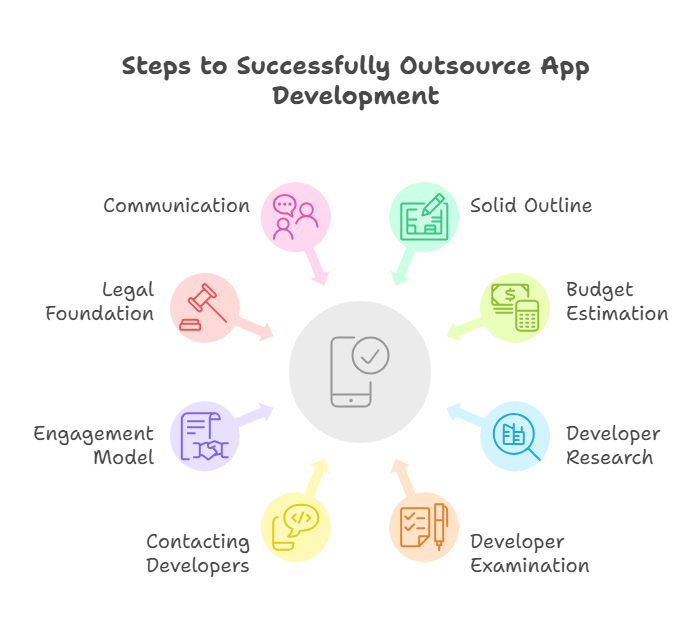
Step 1: Write Down Your Project Requirements
Start with the app, long before any vendor. List the user flows, sketch rough wireframes, and mark which features must ship in version one. Everything else goes on a “later” list. Vendors price what’s on the page, so vague project requirements get you vague quotes. A brief like “an Uber for dog walkers” produces five estimates that differ by 4x.
Step 2: Pick Your Platforms and Tech Approach
Decide on iOS, Android, or both, and whether to go native or cross-platform. If you’re still testing demand, a lean MVP on one platform is a safer first build than a full release on two. Your partner can advise, but you should arrive with a preference.
Step 3: Shortlist Partners and Choose a Model
Narrow the list using the engagement model you picked earlier, then check each firm’s past work. The section below on choosing an app development agency covers what to look for.
Step 4: Sign the Contract
Get the intellectual property clause right before anything else. Source code, designs, and cloud accounts should be yours from day one. Add an NDA, then write acceptance criteria for each milestone so everyone knows what “done” means. Tie payments to those milestones.
Step 5: Kick Off With a Project Manager
Assign one person on each side who owns the schedule. If you don’t have one, you can hire a project manager through your outsourcing partner. Set up your project management tools, a shared chat channel, and a weekly demo in the first week. Most communication gaps trace back to a missing routine, and the time zone gets the blame.
Step 6: Build in Sprints and Test as You Go
Work in two-week sprints and ask for a working build at the end of each one. Screenshots don’t count. Automated testing should run on every code push, with manual checks on real phones for the rest. Ask to see code quality reports, and have your own engineer review a sample. Delivery quality is easiest to judge in the second sprint, when the novelty has worn off.
Step 7: Launch and Plan for Support
Submit to the App Store and Google Play early, since reviews can take days. Confirm you hold the developer accounts and the cloud credentials. Agree on post-launch support before you sign off, including who fixes crashes, how fast, and at what rate.
How to Choose the Right App Development Agency
A portfolio page shows what an agency has shipped. It says very little about how the team behaves once a build gets hard, so you have to dig a bit.
What to Check Before You Shortlist
Start with live apps. Ask for ones in your category, download them, and look at the store ratings and the date of the last update. An app untouched for two years tells you how that team treats a product after launch.
Then ask who will work on your app development project. Sales calls feature the senior people, and the people who show up in week two are often different. Request names and CVs. Mobile engineering depth varies a lot, too. A mobile app development agency that does lovely UI can still be thin on backend and APIs, so ask where the server work gets done.
Reference calls help more than reviews. Ask for a client with a budget close to yours and speak to them directly. If you want a starting list, our roundup of mobile app development companies is a fair place to begin. Any app development outsourcing company worth your time will also hand over a short paid trial task, and the way they handle it tells you plenty.
Questions to Ask Before Signing
Put these to every outsourcing partner on your list and compare the answers side by side:
-
Who owns the source code and the cloud accounts?
-
Who holds admin access to the repository?
-
How do you estimate and approve a change in scope?
-
If the app crashes at 2 a.m. in my time zone, who picks up and how fast?
-
What documentation do we get at handover?
-
Could we move the project to another team later?
The last one makes people uncomfortable, which is useful. A development company that answers it plainly usually has nothing to hide.
Red Flags
A quote at half the price of every other bid usually means someone misread the scope or plans to trim QA. Be careful with a mobile development agency that never asks about your users, and with one that won’t name the engineers. A firm that promises a fixed launch date before any discovery work is guessing, and you’ll pay for the guess later.
Why Outsource Mobile App Development to India
India is where a lot of companies end up when they outsource mobile app development, and the reasons are fairly practical.
Developer Availability: The talent pool is huge. If you need Flutter engineers by next month, you can find them. Same for iOS, Android, and the backend people who sit behind them. Companies that outsource app development to India can often assemble a full team in a few weeks, whereas a local search for senior engineers might take a quarter. We wrote about the background in our piece on why India became a premier IT outsourcing destination.
Rates: Outsourced mobile developers in India usually bill $20 to $50 an hour. North American rates run $100 to $200. Put four engineers on a six-month build, and that difference adds up to a serious chunk of your budget. Compare quality first, though. A cheap team that rewrites half the app in month five costs you more than a pricier one that got it right.
Time Zones: India runs roughly 10 hours ahead of the US East Coast, so the team’s afternoon is your early morning. That gap sounds awkward, and some days it is. A bug you flag at 6 p.m. can be fixed and tested by the time you’re back at your desk, though. With the UK and Europe, the difference is only four or five hours, and the working days overlap well. US clients usually settle on a fixed call of two or three hours, early morning for you and late afternoon for the team. Outside that window, everything goes through a shared tracker, and offshore mobile app development stays smooth as long as nobody skips the daily update.
The Dedicated Team Model: When you outsource mobile app development to India, a dedicated team tends to give the best return. The same engineers stay on the app for months, so they learn how your codebase got where it is and don’t need the history repeated. At Your Team in India, we run dedicated development teams where senior developers and QA work side by side, and clients in the US, the UK, and South Africa have used the model.
After Launch: Support, Maintenance and Measuring Results
Post-Launch Maintenance: An app doesn’t stop needing work once it’s in the stores. Apple and Google release new OS versions every year, and an app that ran fine in September can start crashing by October. Agree on post-launch maintenance before you sign off on the build. A yearly budget of 15 to 20 percent of the build cost is a fair starting point. The team that built the app usually fixes things faster, since they already know where everything sits.
Ongoing Support: Put the support terms in writing. Decide what counts as critical (a broken checkout, say) and how fast someone has to respond. A misaligned button can wait for the next sprint. Also settle who gets the alert at night, and who holds the logins for the cloud infrastructure and the store accounts. Skip that last step, and you’ll regret it the first time the original team is unreachable.
Mistakes to Avoid When You Outsource Mobile Application Development
Most outsourcing projects that go wrong trace back to a handful of early decisions. Here are the ones we see over and over.
Choosing the Lowest Bid: When one quote comes in at half the others, something is missing from it. It’s often QA, or the senior engineer from the sales call who never joins the project. You end up paying for the fixes later. Line up what each quote includes before you look at the totals.
Starting With a Vague Brief: “An Uber for pet care” gives a team almost nothing to price. With no written project scope, features get added one small request at a time, and the budget follows them upward. A week spent on wireframes and a ranked feature list saves months.
Cutting QA and Security: Testing is the first line to go when money gets tight, and users notice it quickest. An app that crashes on older Android phones collects one-star reviews within days. A hole in a payment flow is worse. Keep the testing budget even when the schedule is squeezed.
Ignoring Hidden Costs: Hosting, third-party APIs, and updates keep billing after release. Some teams spend everything on the build and then can’t afford to run the app. Put those running costs into the plan on day one, so cost savings from outsourcing don’t vanish in year two.
Building Everything at Once: You don’t know yet which features people will use. A lean MVP puts the idea in front of real users within a few months and for a fraction of the spend. Add the rest once you’ve seen how they behave.
Leaving Communication to Chance: Most communication gaps come from having no routine at all, even though the time zone gets the blame. A weekly demo and a short daily status note fix a lot of it. Name one person on each side who owns decisions, and the small questions stop piling up.
Conclusion
Outsourcing mobile app development works when you settle a few things before the first sprint. Get the project scope on paper, choose an engagement model that suits how long the product will live, and budget for what comes after launch. Price matters, but the team behind the quote matters more.
If you plan to outsource app development to India, Your Team in India can put a dedicated team on your project within days. Talk to us about your app, and we’ll tell you honestly what it will take.
Frequently Asked Questions

It depends on what you hold. If you own the repository and have written documentation, a new team can pick the work up with a short code audit. If the old vendor controls the code and the cloud accounts, expect delays and a rebuild of some parts. Ask the new team for an audit first, then get a firm quote.
Plan on a weekly demo, a few short check-ins, and quick answers whenever the team asks about a feature or design choice. For most projects, that is a few hours a week from one person who can make decisions. Slow replies hurt a schedule more than a skipped meeting.
Yes. Start with a code audit, usually a small paid engagement, before the new team quotes the rest. It shows what can stay, what needs rewriting, and what finishing the app will take. Have the repository, store accounts, and any existing documentation ready to hand over.
Usually not. One team keeps design, the API, and release dates consistent across both apps, and a cross-platform framework like Flutter makes that easier. Separate native teams can work on a large product, but they need a shared API contract and a single product owner, or the two apps drift apart.

By Mangesh Gothankar


By Ashwani Sharma
By Achin Verma








 4.8 out of 5 by