It has always been hard for startups and enterprises to multitask. The load never gets lighter, from building a team of professional engineers to handling projects and ensuring their success.
But with the introduction of offshore development companies, things have changed drastically. The offshore outsourcing trend is booming worldwide. In fact, the demand to hire the best offshore developers is rising with each passing day.
As per the latest stats, over 70% of companies worldwide now outsource at least one business function, and nearly 52% of enterprises plan to increase their outsourcing investment in the coming years.
The major reasons for its craze are cost-effective solutions, access to top developers, and the opportunity to work with skilled talent from offshore countries such as India and Ukraine, along with zero headaches of managing in-house teams.
But the success of offshore hiring is not only about choosing the right destination, but it is also about following the right hiring process and evaluating the right frameworks. And, this is where the businesses actually struggle.
To deal with such scenarios, startups and even known brands hire developers from India. If you want to understand the offshore development fundamentals, you must be aware of the broader model first. Here is a complete guide, a more practical approach that helps you hire offshore developers more effectively with a clear understanding and step-by-step details.
How To Hire Offshore Developers
Whether you are a startup that is still building a team or an established brand, there will always be a need for offshore developers. With a bulk of projects every day, handling them all can get hectic unless you outsource them.
To address this, you can hire an offshore developer, which allows you to access offshore talent from a global pool, offering flexibility, cost-effectiveness, and scalability compared to traditional in-house hiring. But “How do you hire offshore software development companies?”
Below are the five steps that can be taken when hiring offshore developers.
1. Identify the Business Requirements
The first step is always to discover your business needs. It should include the development needs, how you visualize the product, specifying project requirements, the type of team you require, etc.
For example, as a startup, you might need projects that require work from scratch, but as an established business, there must be some projects that only need modifications from professional developers. Hence, clearly identify the needs to ensure that there is no miscommunication.
2. Know the Tech needed for the Project
When hiring offshore engineers, you would, of course, need to be clear about the technology part of the project. There is no need to go in-depth about it, but as a business looking to outsource the work, you must know the tools needed.
You should also identify the relevant technologies required for your project, including programming languages, integration requirements like APIs, libraries, frameworks, and third-party software that are essential for effective development. As several technologies are used, know which will work best for your project. It will help you be more concise about the project’s needs and highlight the requirements for its success.
3. Research, Compare, and Shortlist
Now that you have noted the requirements and goals, it is time to find developers who match your skills. One of the best ways is to ask for recommendations from your friends and business partners. Another way is to find it through search engines.
Check their reviews, past projects, and experience, and be sure to review their completed projects to assess their technical skills and practical work history. This will help you shortlist the best options that you believe can help your startup or your enterprise grow.
4. Conduct the Interview
The next step includes interviewing the best options that are listed. You can do that via video call or visit them for face-to-face conversations. Depending upon the project level, the members of your company should ask relevant questions to ensure that you pick the right team.
Do not forget to evaluate the soft skills of team members, especially communication skills, as they will play a crucial role in coordinating. In 2026, async communication and adaptability are as important as technical expertise.
5. Start with a Trial & Finalize the Engagement Model
Before finalizing the contract, consider offering a no-risk trial period (trial period) to evaluate the developers' skills and compatibility without any commitment. A trial phase also reduces risk and gives both sides clarity on expectations.
Once you’re confident in the collaboration, you can move forward by selecting the most suitable engagement model. The models include hourly, project-based, or a dedicated team, based on your scalability and long-term goals. Once you are satisfied, sign the contract and get the project started.

Pro Tip:
India is one of the favorite outsourcing destinations for companies in the USA, Europe, Australia, and New Zealand. So, if you are residing in any of these countries, look out for offshore development services in India.
Related Read: Checklist To Hire Offshore Development Team
When Should You Hire Offshore Developers?
While cost savings and scalability are important, the timing of hiring offshore developers is crucial to maximizing their value. Bringing them on board at the right stage—whether you're scaling your product, facing resource gaps, or accelerating time-to-market—can significantly improve efficiency and outcomes. The key is to align your offshore hiring decision with clear business needs and growth milestones to get the best results.
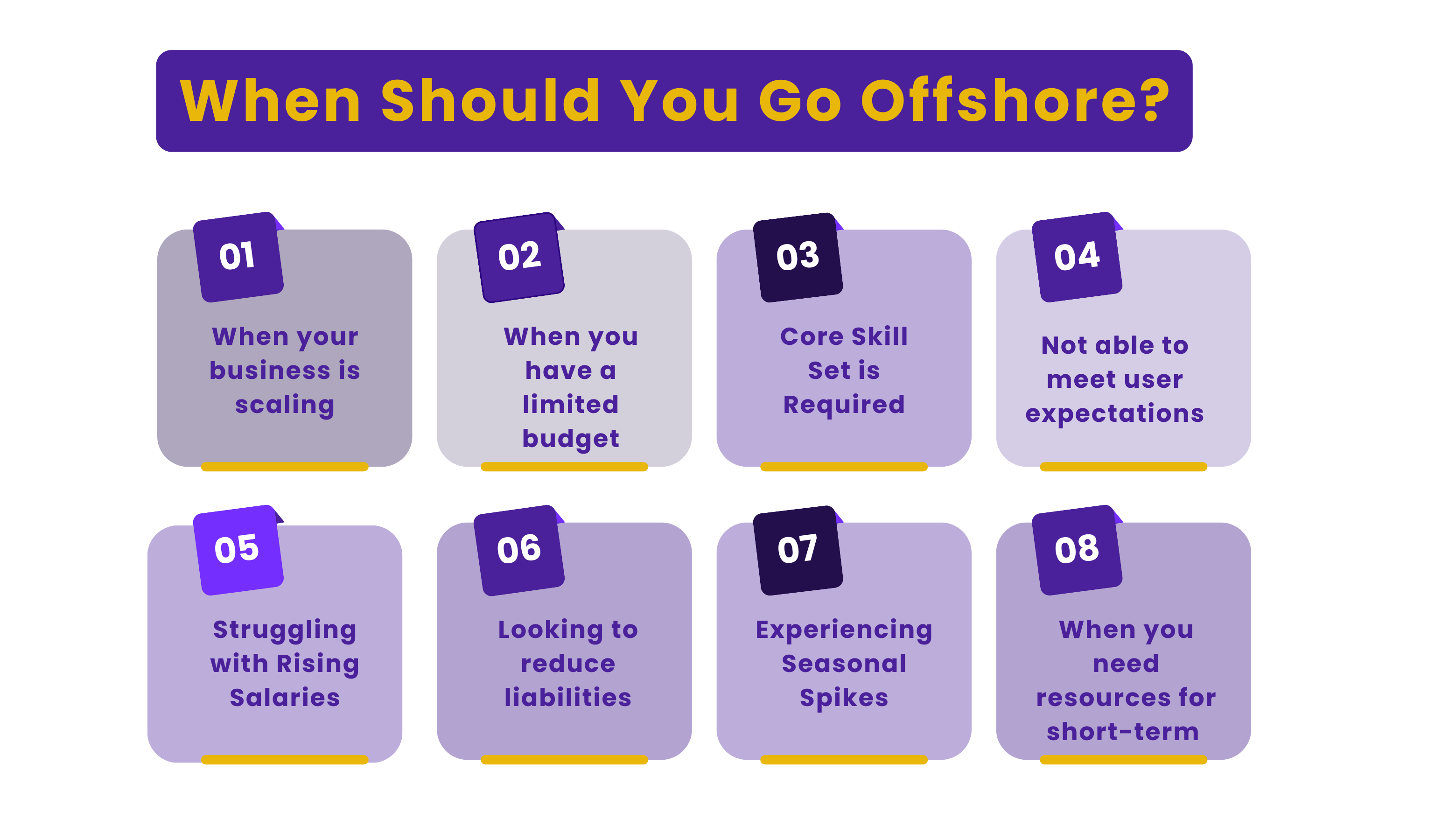
1. Business Scaling
Growth is a very crucial element of expansion. If your business is unable to incorporate various growth strategies, like cost reduction or technology needed to improve performance, you might be hindering the ability to thrive in the marketplace.
Setting up an offshore development center offers operational flexibility and gives a competitive edge by helping in streamlining your business process, maintaining consistency across various geographies, entering into international markets, or scaling up/down efficiently.
2. Cost Efficiency
Startups usually have a limited budget. And, it becomes very difficult for them to hire experienced professionals. Plus, providing systems, setting up infrastructure, and arranging other resources adds up to the cost.
If your business is facing this situation, it’s time to think out of the box, leading you to hire developers from an offshore location. This approach allows you to access experienced developers at a lower cost. By hiring offshore software developers, you can have a team of experts, and that too while saving up to 60% in comparison to working with an in-house team.
3. Core Skill Set is Required
When all the business functions are housed together, everything becomes complicated. Software development requires a good amount of time as well as attention.
Suppose that you operate a finance business and want to build a Flutter mobile app to digitize your business. The requirement is just to build a mobile app, and hiring a developer locally on a permanent basis would be costly. So, what’s the option?
Just share your requirements with an offshore software development company & hire Flutter app developers to fulfill your requirements. Make sure the offshore team possesses the technical abilities required for your project, including the necessary skills, technologies, and experience level.
4. Challenging to Meet Customer Expectations
Is your company struggling to invest and keep itself updated with the latest innovative technology? Do you have software that requires 24*7 developments or updates?
Hiring developers from an offshore location in collaboration with your existing local team can help you fulfill your requirements without increasing the operational costs.
5. Team Productivity is Dropping
Outsourcing is not about handing over the projects or tasks that your in-house team is not efficient at, but it is advisable sometimes to outsource your core competencies as well.
The simple solution would be to build your product engineering team in a foreign country like India to streamline the software development process or aid your team in completing a time-consuming task while not abandoning your daily tasks.
6. Experiencing Seasonal Spikes
Outsourcing companies specialize in anticipating and planning for peak call volumes, and they have the training abilities to ramp quickly when required. Supplementing staff when the customer base is growing allows your business to grow while staying focused on important tasks.
Recommended Read: Onshore vs Offshore Software Development
Offshore Development Team Structure: Roles You Need to Hire
It is vital to understand the team structure before hiring offshore developers. Here are some of the fundamental roles within an offshore team.
Understanding the team structure also helps you identify the ideal offshore developer for your project, ensuring you select candidates with the right skills and qualities for success.
1. Project Manager
Make sure you are well coordinated with them, and you both stay on the same target and within the specified timeframe. The PM works with your allotted offshore development team to allocate the required resources, set targets and processes, and provide you with timely feedback.
2. Frontend and Backend Developers
The frontend team is responsible for managing the implementation as well as the visual aspects of your project. Supported by the back-end developers, the front-end team brings your project to life. Proficiency in relevant programming languages is essential for both frontend and backend developers to ensure technical requirements are met and code quality is maintained. You need to make sure both of them are on the same page while implementing your requirements.
3. Quality Assurance (QA)
A quality assurance team will determine and supervise the in-house quality standards, evaluating your requirements and thus making sure that these continue in the same manner throughout the project.
4. UI/UX Designers
UI/UX designers focus on creating intuitive and user-friendly interfaces. If your product is customer-facing, investing in design can significantly improve user engagement and retention.
5. DevOps Engineers
DevOps engineers manage deployment pipelines, infrastructure, and system performance. They are crucial for projects that require continuous integration, faster releases, and scalable architecture.
This is just a general structure; you can modify it according to your requirements and budget.
Conclusion
In a nutshell, it has now become more important than ever to leapfrog the competition. So, a lot of companies are choosing the road to offshore outsourcing their development requirements.
However, before you shake hands with an offshore development center, clearly define your needs and required skill set, and plan the budget accordingly. Additionally, you should consider agile development with an offshore software development team that has a proven track record, access to specialized developers, is proactive, and follows quality standards.
In a nutshell, it has now become more important than ever to leapfrog the competition. So, a lot of companies are choosing the road to offshore outsourcing their development requirements. However, before you shake hands with an offshore development center, clearly define your needs and required skill set, and plan the budget accordingly. Additionally, you should consider agile development with an offshore software development team that has a proven track record, access to specialized developers, is proactive, and follows quality standards.
Hiring offshore developers becomes easier when you have the right partner guiding the process. Your Team in India helps businesses build reliable offshore teams that are aligned with their goals, timelines, and scalability needs. With a strong presence across India, the USA, New Zealand, and the Netherlands, the company enables businesses to hire pre-vetted developers across technologies like Java, Python, Node.js, and Flutter without the complexities of traditional hiring.
Our offshore developers bring deep expertise across these technologies to successfully deliver projects, while helping businesses save both time and cost. If you are looking for a free consultation on your product development, you can share your requirements or reach out via email, and the team will get in touch with you shortly.

By Mangesh Gothankar


By Ashwani Sharma
By Achin Verma
Frequently Asked Questions (FAQs)

Managing offshore developers requires effective communication, regular progress updates, and the use of collaboration and project management tools. It is also important to establish clear expectations and guidelines for the project.
The risks of hiring offshore developers include language and cultural barriers, time zone differences, and the potential for miscommunication. It is important to choose a reputable outsourcing company or platform and conduct thorough background checks on individual candidates.
There are several ways to find offshore developers, including online job boards, freelancing platforms, and outsourcing companies that specialize in offshore development.
The cost of hiring offshore developers varies based on factors such as location, experience level, technology stack, and engagement model. For example, developers in countries like India typically offer more cost-effective rates compared to the US or Europe. On average, businesses can save up to 40–60% on development costs by hiring offshore.




.png?width=352&name=platforms-to-hire-mobile-app-developers%20(1).png)



 4.8 out of 5 by