You're choosing between three options: hiring in-house, outsourcing a fixed-scope project, or building a dedicated development team. A senior developer in the US costs $130-200+ an hour. The same seniority level through a dedicated software development team in India costs $35-55 an hour, and the quality gap that price difference implies mostly doesn't exist.
This piece breaks down what a dedicated development team actually costs, how you'd structure and run one, and when it beats the alternative.
What is a Dedicated Development Team?
A dedicated development team is an outsourcing model where you hire a full dedicated software development team. Team composition includes experienced developers, project managers, business analysts, QA experts, and others. The dedicated structure is built around what your project needs, not a fixed package.
The difference from project-based outsourcing is exclusivity. A vendor running a fixed-price contract might split its developers across five clients in a given week. A dedicated engineering team doesn't. They're in your sprint planning, your standups, and your Slack or Teams channel daily, running the same development process an in-house team would, without you handling payroll, benefits, or recruitment for them.
This works well for two very different situations: a startup that can't yet justify five full-time software development salaries, and an enterprise that needs to scale a team fast without a six-month hiring cycle competing against internal budget approvals.
Key Roles In A Dedicated Software Development Team
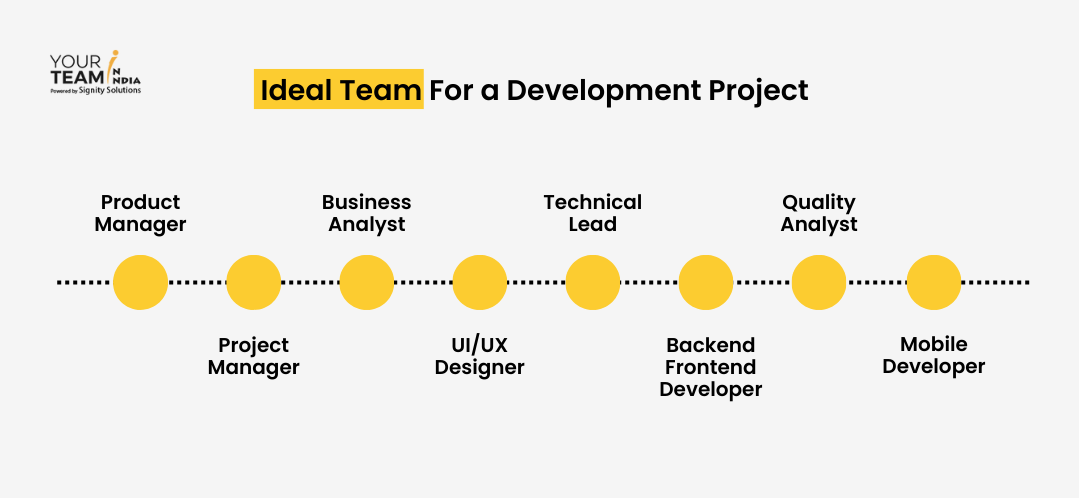
A dedicated development team is a team structure where you outsource project requirements to a group of remote professionals who work exclusively on your product. The exact team composition depends on the project's technical requirements and business goals, but most dedicated software development teams are built around the same core roles.
-
Product manager
-
Project manager
-
Business analyst
-
UI/UX designer
-
Technical lead
-
Backend and frontend developer
-
Quality analyst
If you are a mobile developer setting out in the technical business, the probability is high that you are not aware of the job roles discussed. Let us have a quick rundown of what each means. Quality assurance professionals play a crucial role in ensuring a complete and effective software development process by maintaining high standards and identifying issues early.
Now, you have an in-depth understanding of the team members you need to onboard for your startup. Let's uncover the advantages of this business model.
Recommended Read: How to Hire Developers for Startups
When Should You Hire a Dedicated Development Team?
A dedicated development team model is ideal for complex and long-term projects that can expand in the future. This option is also the best when you lack clarity on your product and need a discovery stage.
Outsourcing software development to a dedicated team makes sense in five specific situations. Here's when each one applies.
Reason 1: Fixed Development Budget
As a startup, the biggest challenge is a limited development budget. Thus, it’s best to go for a dedicated team that is friendly to your budget bracket. Often, you don’t require software developers under your arm’s stretch.
Compared to other software development teams, dedicated software development teams offer greater cost efficiency and scalability, making them ideal for long-term project management. They can act as an extension of your in-house unit, providing specialized support and flexibility as your project grows.
A senior developer in the UK costs $80-220/hr depending on seniority and specialization. A senior developer through a dedicated development team in India runs $35-55/hr for the same experience level. That gap holds even after accounting for management overhead and time-zone coordination costs, which is why the dedicated software development team model has become the default for cost-conscious scaling rather than a fallback option.
Recommended Read: Global Software Developer Hourly Rates: A Country-by-Country Comparison
Reason 2: The Expertise Gap
Imagine you are developing a project that needs skills or some expertise knowledge for a platform that your in-house developers lack. A dedicated engineering team closes that gap fast. Instead of running a 6-8 week hiring cycle for one specialist, you get senior engineers with the exact skill set already in place, and you build the dedicated software team around your actual project requirements rather than whoever happens to be available locally.
Reason 3: The Lack of Resources
Sometimes the budget isn't the problem. Your product has traction, retention is strong, and you still can't find enough dedicated developers to keep up with the roadmap. That's a resourcing gap, not a funding gap, and it usually means your internal team is stretched thin trying to cover both maintenance and new development at once. A dedicated development team fills that specific hole without pulling your existing team off what they're already doing.Reason 4: Projects with Evolving Requirements
If your idea doesn't fit the market and needs exploration, a dedicated team is a good option. The discovery stage is crucial for your project's development and may take months of tests and interviews to finalize. The dedicated team model helps you focus on this stage without worrying about overspending. In fact, a dedicated team can help you explore a discovery phase for vague requirements.
It helps clarify your vision, define user journeys, and set a realistic scope. During this stage, dedicated teams conduct workshops, market analysis, and prototyping to ensure alignment before coding begins. A discovery phase typically runs 4-8 weeks and directly reduces the odds of a mid-project scope rewrite, which is the single biggest driver of budget overruns on custom software projects.
Reason 5: Long-term Projects
A dedicated team works well for complex, long-term projects that may grow over time. Startups that have moved past the pre-seed stage and need to expand quickly can benefit from hiring a dedicated development team. This approach can save you money on hiring and firing, gives you access to skilled developers in a global talent pool, and helps you scale your product without the delay of a full internal hiring cycle.
Startups value flexibility and cost control. With a dedicated development team they can scale up or down without long-term commitments or overhead costs. For enterprises, dedicated teams enable faster time-to-market, 24/7 development cycles across time zones, and access to niche talent unavailable locally. In fact, according to research, 65% of technology firms outsource to improve focus on core business functions.
Advantages of Hiring a Dedicated Development Team
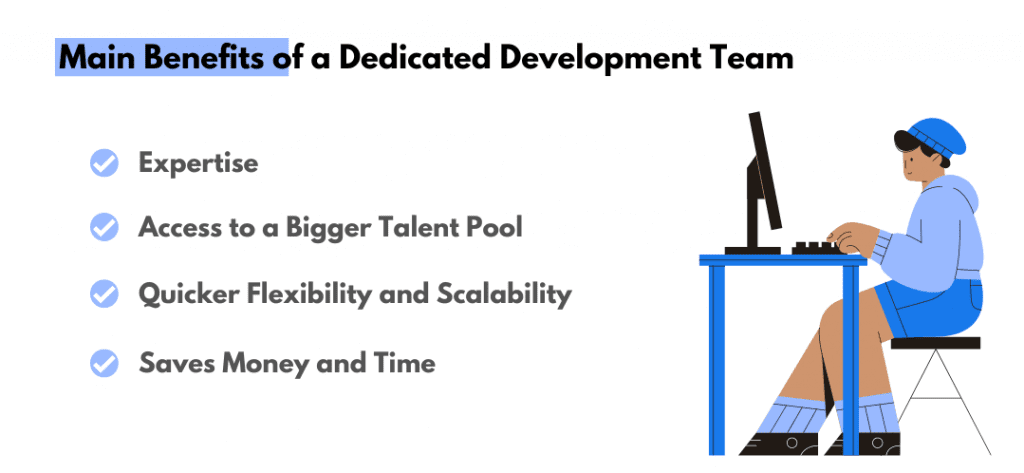
92% of G2000 enterprises use IT outsourcing, and 37% of small businesses outsource at least one business process, according to ISG research. The dedicated development team model is one of the most common structures behind those numbers. But why are they doing so? Well, below are some of the reasons why they are doing so and how it is beneficial for them to collaborate with a remote dedicated development team:
1. Expertise
By outsourcing software development to a dedicated team, startups and enterprises can collaborate with professionals who have the right skills and experience to deliver high-quality products. Dedicated development teams are composed of skilled professionals whose expertise is crucial for driving business growth and maintaining a competitive advantage.
Mostly, these experts dwell on the exclusive experience of working on similar projects, so they can better help you leverage the benefits of minor details.
Besides, through years of teamwork, the dedicated team already has a proven workflow and is comfortable with task delegation. The best part is you don't have to do all this from scratch and deal with challenges that may arise with dedicated team application development type setup.
2. Access to a Bigger Talent Pool
If there’s a paucity of talent pool in your in-house team, then a dedicated development team is unquestionably the way to step ahead. Finding local talent can be challenging due to skills gaps, high wages, or recruitment difficulties, which is why companies often consider offshoring options.
Hiring dedicated development teams open your startup to a pool of professionals worldwide, allowing you to pick the best hands at a cost-effective price. Skype's early backend development was outsourced to a team of developers in Estonia rather than built in-house from day one, and the company scaled globally before bringing that expertise in-house. That's the pattern a global talent pool makes possible: access the skill set first, formalize the structure later.
3. Quicker Flexibility and Scalability
"Outsourcing is synonymous with unparalleled flexibility and scalability."
Undoubtedly, outsourcing is an ideal choice to address your top-notch flexibility in defining the scope of your project. Also, it eases the entire development process of minimizing or maximizing your team size without breaching any employment laws.
In simple terms, this flexibility feature is intrinsic to catering to ever-evolving business requirements. A software development dedicated team also fosters continuous improvement through agile development and ongoing process enhancements.
On the contrary, growing your in-house team seems arduous, expensive, and time-consuming. Scaling down your in-house team without a staff-dignifying reason may have an impact on your employee's morale and significantly impact their productivity.
Besides, it can allay your company's reputation as an employer.
4. Saves Money and Time
A remote dedicated team is a key ingredient for numerous US-based startups' success.
Hiring a dedicated software development team for startups and established organizations is a win-win situation. Primarily this is because the cost of hiring developers varies from region to region.
As this blog sheds light on software development costs, US-based startups are likely to spend $99-$120/hour on a local software developer. At the same time, outsourcing to a dedicated team in India is cost-effective, at around $25-$49/hr.
This substantial difference helps you save $100 an hour.
Also, if you hire a dedicated development team, the complete scope of work is clearly defined, leaving no chance of budget overrun.
This is a rough estimation. Furthermore, when hiring a remote development team, there’s no need to invest in aspects like office space and upskilling. Compared to maintaining in house staff, the dedicated team model offers greater flexibility in scaling your team and significantly reduces the financial burden associated with in house personnel.
Real-World Examples of Dedicated Development Teams
Slack is the example people bring up most. What actually happened: the company hired MetaLab, a Canadian agency, to build its logo, marketing site, and the first version of its web and mobile apps. Slack's own engineers weren't doing that work. An outside team was, on a defined set of deliverables, while Slack kept running the company.
Skype is a messier example, and worth knowing why. Ahti Heinla, Priit Kasesalu, and Jaan Tallinn built Skype's backend as engineers based in Estonia. They didn't stay a vendor. They became core to the company. So is that a dedicated team or a founding team? Honestly, both, and that's usually how these arrangements go when they work. The distinction between "external dedicated team" and "in-house team" gets blurry fast once a working relationship holds up.
Neither company handed its whole product to an outside vendor and walked away. Slack kept product decisions in-house and outsourced design and build. Skype's outside engineers became the core team. A dedicated development team works when there's a clear line between what the external team owns and what stays with you, not when that line disappears entirely.

Different Outsourcing Models with a Dedicated Development Team
Let’s dive deeper into different outsourcing models of understanding with a dedicated development team. Dedicated development team isn't one single arrangement. It covers three distinct models, and picking the wrong one is a common reason these engagements underperform.

Model 1: Full Dedicated Development Team
A tech partner assembles a group of remote professionals, developers, a project manager, QA engineers, who work exclusively on your project, full time, for as long as the engagement runs.
No one on this team is juggling other client accounts. Use this model if you're locked into a long-term project, you don't have the runway to build an in-house team from zero, or your current developers just don't have the skills the project calls for. Any one of those is reason enough.
Model 2: Staff Augmentation
This one is different. Instead of bringing in a separate team, you add individual specialists, say, a front-end developer with React Native experience your in-house team doesn't have, directly into your existing team. They report into your structure, sit in your standups, and work under your management day to day. The tech partner just handles their payroll and employment logistics.
This is a staffing fix, not a team structure. You use it when the gap is narrow: one or two missing skill sets, not a whole project's worth of capacity. It costs less than a full dedicated team because you're paying for individual contributors, not a self-contained unit with its own project manager and QA layer.
Model 3: Dedicated Team on a Project Basis
Same setup as Model 1, minus the open timeline. You bring in a dedicated software team for one project or a fixed scope, and when that scope ships, the engagement ends. It works well when your in-house developers are already booked solid and a new project shows up that needs its own team, without you hiring permanent headcount to cover something temporary.
This suits teams that are already stretched: your in-house developers are booked on other work, and a new project needs its own dedicated capacity without permanently expanding headcount. A business analyst usually leads the initial requirements-gathering here, translating what you need into a scope the outside team can execute against, since the engagement won't run long enough to build that shared context organically the way an open-ended dedicated team would.
Difference Between Dedicated Development Team and Other Models
Outsourcing isn't one model, it's at least three: dedicated team, fixed price, and time and materials. Each handles budget, control, and flexibility differently, and picking the wrong one for your project type is a common reason engagements go over budget or stall out.
Dedicated Development Team vs Fixed Price Model
A fixed price model locks your budget before development starts. You know the cost upfront, which makes planning easier if you're a startup watching runway. The tradeoff: any change to scope after signing means a new estimate and often a new contract.
However, the primary requirement is to define the project scope and requirements. This can lead to the slow project launch, which is one of the most common cons of the fixed price model, according to ScienceSoft.
If you are working on short-term projects, then fixed-price models make a good choice. It is important to ensure that the chosen model aligns with your business objectives to maximize project success. But, if your project is highly sophisticated and liable to changing requirements, it’s recommended to select the dedicated team engagement model.
Dedicated Development Team vs In-House Model
An in-house team sits inside your own company, on your payroll, in your office or your internal systems. That proximity means fast, informal communication and full alignment with company culture, but it also means you're carrying the full cost and timeline of hiring.
Dedicated Development Team vs Time & Material Model
As the name suggests, this time and material model entails paying for the efforts and time invested in development.
As it's related to web and mobile app development, it includes paying the outsourcing development company on an hourly basis. This is a common outsourcing methodology, as it's deemed convenient, flexible and adaptable.
Let’s have a quick glimpse of the differences between both.
Here, time and material models come to your rescue if all you want is not to burn your pocket. Also, stepping on a long-time project should choose a dedicated team structure. After all, long-time projects have an evolving scope and scale-up potential. Dedicated development teams can handle the entire lifecycle of development projects, improving efficiency and scalability.
But with this, we don’t mean that hiring a dedicated development team structure can be an expensive choice for you. Check out how much choosing dedicated development team services would cost you.
How Much Does It Cost to Hire a Dedicated Development Team?
Cost varies more by seniority than by region alone, though region still drives most of the gap. Here's what a dedicated development team actually costs, broken down by role level and geography.
A senior developer through a dedicated software development team in India costs $35-55/hr, against $130-200+/hr for the same seniority level in the US. That's a 60-75% reduction in hourly cost, and the gap holds even after accounting for the project management overhead and communication structure a remote dedicated team needs to run well.
The wider a project's timeline and headcount, the more that hourly gap compounds. A five-person dedicated development team running for a year at Indian mid-level rates costs a fraction of the same team staffed at US rates, budget that most companies reinvest into a longer runway, a bigger scope, or hiring additional developers into the same team.
Region isn't the only cost driver. Team size, the mix of seniority levels you actually need (a project rarely needs five senior engineers when two senior and three mid-level will do the job), and the length of the engagement all move the total more than the headline hourly rate does.
Our Outsourcing Calculator
This calculator will help you determine if the cost savings and increased efficiency are worth the investment. See if you are getting the best value for your money.
Check Your Team in India Outsourcing Calculator to evaluate your cost savings with us.
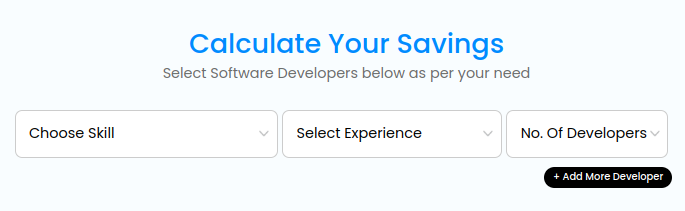
In countries like India, a skilled developers' prices vary from $18 - $39/hour. This is a rough estimation. Furthermore, when hiring a remote development team, there's no need to invest in aspects like office space and upskilling.
In a nutshell, this is a huge saving on time as well as money. But when it thinking of hiring one, how to hire a dedicated software development team for your project.
How to Hire a Dedicated Development Team?
If you have decided that a software development dedicated team is the right fit, the next step is finding the right partner to help you make it happen. Well, bringing a dedicated team of developers on board should be a seamless process, with your tech partner managing the selection and onboarding for you. Here are the straightforward steps:
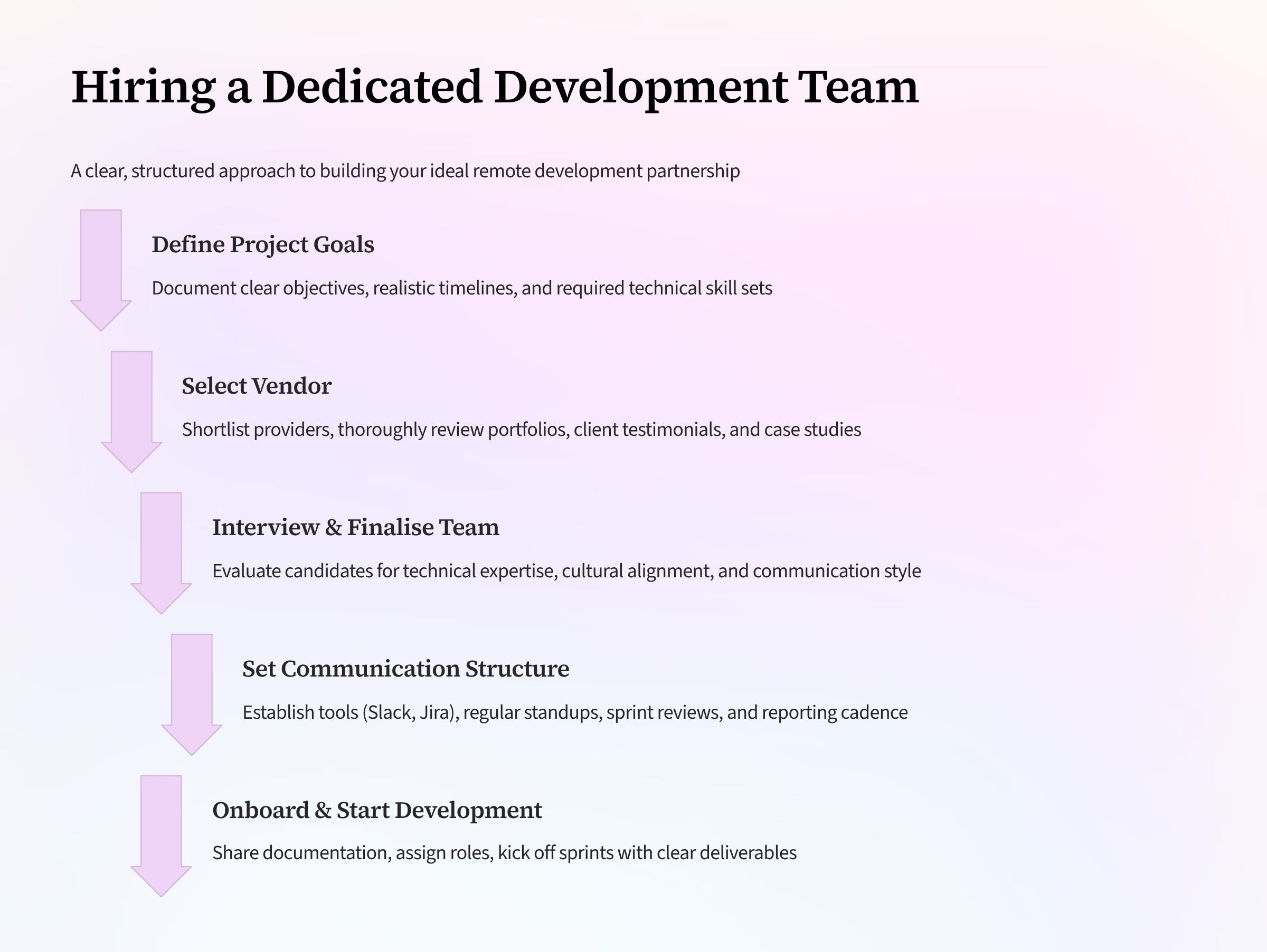
1. Define Your Needs Clearly
Before reaching out to dedicated development team service providers, take the time to identify your project requirements. This includes your objectives, scope, deliverables, timeline, and the type of expertise you’ll need. Also, consider cultural values so you know what kind of team dynamic will work best.
2. Shortlist Dedicated Development Team Service Providers
Instead of diving into candidate profiles, focus first on selecting the right company. Research dedicated development team service providers with strong track records, relevant domain expertise, and positive client reviews.
3. Evaluate Team Fit Through Interviews
Even when working with a partner, you should help choose dedicated development team members. Interview candidates to evaluate their technical skills and personal qualities. In addition to coding skills, look for good communication, problem-solving abilities, and cultural fit.
4. Establish Communication & Collaboration Practices
Clear communication is essential when working with a dedicated team of developers. Choose your tools early, such as Slack, Jira, and Trello, and decide on formats like daily stand-ups, weekly reviews, and sprint demos to stay connected. The goal is to make the offshore team feel like a part of your in-house team.
5. Streamline Onboarding
Once you have selected the developers outsourcing dedicated team, focus on onboarding them effectively. Share project documentation, explain workflows, and introduce them to your company culture. A smooth onboarding process ensures the team can begin working and start delivering value quickly.
6. Define Governance & Reporting Structures
Set clear expectations from the start by agreeing on KPIs, reporting frequency, and feedback loops. This helps maintain transparency and keeps projects aligned with business goals.
7. Invest in Relationship Building
Success depends not just on technical skills. It's important to create a culture of trust, openness, and teamwork between your staff and the dedicated team. Strong relationships lead to better communication, improved problem-solving, and increased productivity over time.
Dedicated Development Team Cooperation Process
Here’s the insight into what happens when clients hire us as their trusted, dedicated development team: A dedicated manager oversees daily workflows and ensures effective communication between you and the development team.
#Step 1: Scope Estimation
In this phase, we evaluate how much work needs to be done and how many resources need to be involved.
A deep understanding of industry knowledge and specific project requirements is crucial at this stage to ensure accurate scope estimation and alignment with the client's needs.
To do so, usually, a business analyst usually communicates with the client to identify the requirements related to dedicated software developers. Then, based on the information provided, the experts outline the project's requirements and determine the project's scope.
Here, two scenarios can arise:
-
The client has a predefined scope - In this, we discuss the budget with the client regarding their priorities and the estimated timeline.
-
The client has no idea about the scope - Here, we process a discovery stage where we make hypotheses and validate them with a prototype.
#Step 2: Team Selection
Here, we put together a team of skilled, experienced, and motivated experts to work exclusively on your project. Assembling a professional team of domain-specific experts ensures specialized expertise and successful project execution. Here are the criteria we carry for the selection process:
-
Quality and service
-
Skills and expertise
-
Profitability
-
Experience
-
Morale and motivation of resources
#Step 3: Scope Call
This call discusses the purpose, milestones, and priorities for the client’s initial sprint. Project managers play a key role during the scope call by aligning client priorities and facilitating clear communication between all stakeholders.
#Step 4: Proposition Call
We suggest a solution, expected team composition, timelines, and budget at this stage. The proposed team composition includes skilled software engineers to build and accelerate software products efficiently.
#Step 5: Kick-Off Call
Finally, this is the point where the team gets a kick-off, and the collaboration starts. The call aims to introduce the team, discuss job responsibilities, and assign project and business priorities. It is crucial during this call to clearly define the roles and responsibilities of each team member to ensure effective collaboration throughout the project.
Finally, getting the right expertise to create a unique product is essential. And to achieve this, startups like you are usually torn between hiring a full-time in-house team or hiring a remote dedicated development model.
Don't worry! We'll help you turn your project into a success story.
Conclusion
A dedicated development team works best when your project's scope keeps shifting and you need people embedded long enough to know the codebase, not when everything can be specified upfront. That's the real line between this model and fixed-price or time and materials outsourcing.
The cost gap alone makes the case: a senior developer through a dedicated software development team in India runs $35-55/hr, versus $130-200/hr or more in the US. That holds even after you account for coordination overhead. Which model actually fits depends on your situation. A full dedicated team, staff augmentation, or a project-scoped engagement each solve a different problem, and picking based on cost alone usually backfires if the team structure doesn't match what the project needs.
If you're weighing this against building in-house or running a fixed-scope project, talk to Your Team in India to figure out which model fits your requirements and timeline.
Frequently Asked Questions

A dedicated development team and project-based outsourcing are both outsourcing models, the difference is in structure and commitment. Project-based outsourcing hands off a defined piece of work to a vendor for a fixed scope and timeline. A dedicated development team is a long-term, exclusive team that works only on your project, becomes an extension of your in-house team, and adapts as your requirements change instead of operating against a locked scope.
To hire a dedicated development team, start by defining your project requirements and budget. Look for a tech partner with a proven track record and skilled developers, and confirm their communication process before you commit. If you want to hire dedicated developers individually rather than a full team, staff augmentation is usually the better fit, evaluate expertise, cultural fit, and time-zone compatibility either way before onboarding.
Building a dedicated development team starts with identifying your project goals and the roles you actually need, developers, a project manager, QA engineers, a business analyst, not a generic package. From there, you can hire dedicated development team members directly through a tech partner, build the equivalent in-house, or blend the two depending on cost, project duration, and how specialized the required expertise is.
When choosing a dedicated development team, look at technical expertise, communication skills, and past project outcomes over generic sales claims. Check cultural alignment, time-zone overlap with your working hours, and whether the provider can scale the team up or down as your project changes. A tech partner that can show real delivery history is a stronger signal than one that just lists dedicated development team services on their site.
Managing a dedicated development team works best when you treat it like managing an internal team, not a vendor relationship. Run the same sprint planning, standups, and priority-setting you'd use in-house, and give the team direct access to your product context rather than routing everything through an account manager. Most friction in these engagements comes from unclear ownership, so define upfront who owns which decisions, your project manager or theirs, before work starts.

By Mangesh Gothankar


By Ashwani Sharma
By Achin Verma








 4.8 out of 5 by