This guide helps startups understand developer hiring decisions based on their stage, not specific services.
Hiring the right developers can shape how fast your startup launches, iterates, and scales. For early-stage businesses, product execution often depends on a small number of technical decisions made under pressure. That includes not only what to build, but also who should build it, when to hire, and what type of team structure makes the most sense.
Many founders struggle with startup hiring because they are balancing limited runway, aggressive timelines, product uncertainty, and the pressure to move fast. Some do not yet have an in-house CTO. Others know what they want to build but are unsure whether they need a freelancer, a dedicated developer, or a full product team. As a result, hiring gets delayed, roles stay unclear, and product momentum slows down.
That is why learning how to build a development team for a startup is no longer just an operational task. It is a strategic decision. The wrong hire can consume precious budget and delay product delivery. The right hire can accelerate MVP development, improve release velocity, and help the startup move toward product-market fit with more confidence.
The good news is that startup hiring does not have to be complicated when you have the right framework. Founders who define their product stage, delivery priorities, required stack, and hiring model early usually make stronger technical hiring decisions. They also avoid the common trap of hiring too much, too late, or in the wrong direction.
In this guide, you will learn how to build your development team for startup growth, how to hire software developers for startup teams more effectively, and how to choose the right approach based on your stage, budget, and roadmap.
If you are already comparing commercial hiring options, you can also explore our main page to hire developers in India for vetted talent, engagement models, and onboarding options.
Why Startups Prefer Global Developer Talent Today
Startups today are no longer limited by geography when building product teams. Instead of relying only on local recruitment, many founders now explore global developer talent to improve hiring speed, widen access to skills, and make better use of limited budgets.
This shift is not only about cost. It is also about flexibility, speed, and access to experience that may not be readily available in local markets.
Access to a Wider Talent Pool
When founders expand beyond local hiring, they can access developers with broader exposure to modern product environments, fast-moving startups, and evolving technologies. This is particularly useful for startups building in areas such as SaaS, AI, cloud, mobile, automation, and marketplace platforms.
A wider talent pool also increases the chance of finding developers who match the exact stack and product needs of the startup. Instead of hiring the best available local candidate, founders can focus on hiring the right-fit candidate.
Faster Hiring Cycles
Traditional in-house hiring can take weeks or even months. That may be manageable for mature companies, but startups often do not have that kind of time. Delays in hiring can push back MVP launches, investor timelines, release milestones, and customer validation.
Startups that prefer distributed execution can also explore how to hire remote developers to improve hiring speed and access global talent more efficiently.
Better Use of Runway
Cash efficiency matters at every startup stage, especially in pre-seed, seed, and early growth phases. The more efficiently a startup can build its product team, the more space it has to invest in user acquisition, product discovery, operations, and retention.
Founders evaluating structured hiring approaches can also review how our hiring process works to understand evaluation, onboarding, and delivery alignment.
Flexibility for Product Uncertainty
Startups rarely need the same team shape for long. Some phases require a single full-stack developer. Others may need frontend specialists, QA support, cloud engineering, or mobile development. Global hiring models allow startups to adjust more easily as the roadmap evolves.
Experience in Startup-Style Delivery
Many remote developers and distributed teams have already worked with startup environments. They understand shorter iteration cycles, evolving requirements, MVP logic, and founder-led decision-making. That experience matters because startup delivery is very different from enterprise delivery.
Recommended Read: Why Indian Software Developers are the Best Choice?
Top Challenges You Face When Planning To Build your Development Team for a Startup
Hiring developers for a startup is very different from hiring for a stable, mature business. Startups usually operate with fewer resources, more urgency, and less room for hiring mistakes. That is why even strong founders often find startup hiring harder than expected.
Here are the biggest challenges.
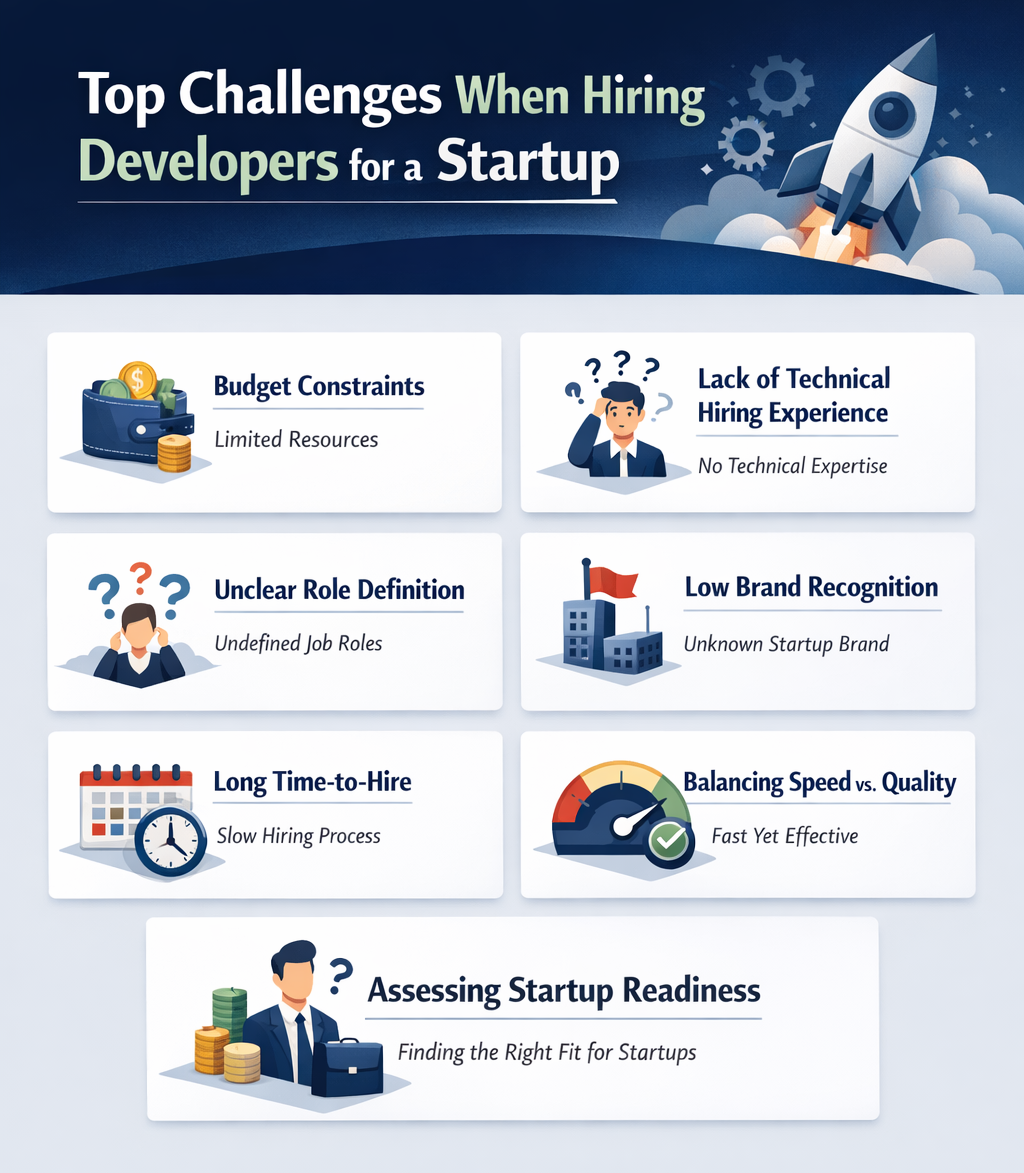
1. Budget Constraints
Most startups operate with tight budgets, especially in the early stages. Hiring full-time local developers often involves more than salary. It also includes recruitment costs, software access, devices, onboarding, benefits, office setup, and management time.
For many founders, the issue is not whether they need technical talent. It is whether they can afford the wrong hiring structure.
2. Lack of Technical Hiring Experience
Not every startup has an experienced engineering leader from day one. In many cases, the founder is leading product strategy but does not have the technical depth to assess code quality, architecture decisions, delivery maturity, or stack suitability.
Without a strong technical evaluation process, startups can easily build your development team who interview well but are not the right fit for the actual product environment.
3. Unclear Role Definition
This is one of the most common startup hiring mistakes. Founders know they need “a developer,” but they have not clearly defined whether they need:
- a full-stack engineer,
- a frontend specialist,
- a backend-heavy product developer,
- a DevOps resource,
- a mobile app developer,
- or a small team.
If the role is unclear, candidate selection becomes messy, and hiring outcomes weaken.
4. Low Brand Recognition
Large companies attract talent through brand power, compensation, and perceived stability. Startups often need to compete without those advantages. That means the opportunity itself has to be compelling. Developers need to see the mission, product direction, and growth opportunity clearly.
5. Long Time-to-Hire
A long hiring cycle can be very expensive for startups. It delays product execution and reduces momentum. The longer a key technical role remains open, the more pressure builds on the existing team, founders, or product roadmap.
6. Balancing Speed with Quality
Startups need to move fast, but they also need to avoid low-quality technical decisions that create future debt. Hiring quickly without a clear evaluation framework often results in short-term progress and long-term problems.
7. Difficulty Assessing Startup Readiness
Not every strong developer is a good startup developer. Startup environments require adaptability, communication, ownership, and comfort with ambiguity. Some developers thrive in structured enterprise settings but struggle in founder-led, fast-changing product teams.
These challenges are exactly why startups need a hiring process that is lighter than enterprise recruitment, but more structured than casual sourcing.
The Right Approach to Hiring Developers for a Startup
Before a startup begins sourcing candidates, it should first define what kind of support it actually needs. Hiring becomes much easier when the product scope, role expectation, and team structure are clear.
Here are the questions founders should answer first.
How many developers do you need right now?
Startups often overestimate their first technical hiring need. Instead of building the biggest team possible, it is usually better to start with the smallest practical team that can move the product forward. That may be:
- one full-stack developer,
- one frontend and one backend developer,
- one product engineer plus QA support,
- or a small dedicated pod.
The right answer depends on complexity, not ambition.
What level of expertise is required?
Some parts of startup delivery need senior expertise, especially around architecture, cloud setup, security, or product-critical workflows. Other tasks can be handled well by capable mid-level developers.
If the startup is building its first version and needs technical direction, seniority matters more. If the product direction is already stable, execution-oriented developers may be enough.
Which stack is essential?
Many founders speak in general hiring language, but developer hiring works best when tied directly to the product stack. A startup building a React and Node.js SaaS platform needs a different profile than a startup building a Flutter mobile app or an AI-enabled workflow system.
What hiring model fits your stage?
This is where many startups get stuck. A startup may need:
- a freelancer for a short feature sprint,
- a dedicated developer for stable roadmap execution,
- or a full team for an MVP or rebuild.
The model should fit the stage. Pre-seed startups often need flexibility. Growth-stage startups often need continuity.
If you want to compare structured engagement models, you can also explore options for a dedicated development team in India based on your product stage and roadmap.
What non-technical traits matter?
A good startup developer should not only write solid code. They should also communicate clearly, ask the right questions, adapt to changing priorities, and contribute in a collaborative way. Startups need builders, not only executors.
The clearer the startup becomes on these questions, the easier it is to hire with confidence.
Startup Hiring Checklist: How to Build your Development Team with Less Risk
If you want to build your development team for startup growth without wasting time and budget, use this checklist before you start outreach or interviews.
1. Define the project requirements clearly
Document what you are building, why it matters, what problem it solves, and what outcomes you expect from the development effort.
2. Clarify the scope of work
Break down the scope by features, milestones, platform requirements, integrations, and future scale expectations. This helps you define what type of developer or team you need.
3. Identify the right hiring source
Choose whether you want to hire through direct recruitment, freelancer platforms, referrals, startup-focused hiring partners, or dedicated developer providers. You can also explore guides on how to find remote developers to evaluate sourcing options more effectively.
4. Match the hiring model to the roadmap
If your startup needs continuous delivery support, a dedicated developer or ongoing engagement may work better than purely project-based freelance help.
5. Set a realistic budget
Budget planning should account for engineering effort, product complexity, testing, iteration cycles, and the possibility of future expansion.
6. Define your evaluation criteria
Create a shortlist framework based on technical skills, startup experience, communication ability, problem-solving, and collaboration style.
7. Plan onboarding in advance
Even the best developer can underperform without good onboarding. Make sure the new hire will understand your roadmap, tools, product priorities, and communication process from day one.
One of the biggest decisions startup founders make is whether to work with freelancers or dedicated developers. Both models can work, but each suits different stages and delivery goals.
Dedicated Developers vs Freelancers for Startups
One of the most important decisions a founder makes is whether to hire freelancers or dedicated developers. Both can work, but they are not equally useful across every startup stage.
When freelancers work well
Freelancers can be a good option when the work is:
- short-term,
- clearly scoped,
- specialist-led,
- or experimental.
For example, a startup may use a freelancer for:
- a landing page build,
- a small feature sprint,
- design implementation,
- bug fixing,
- or a one-off technical audit.
They can be fast to source and useful for narrow needs.
Where freelancers become risky
Freelancers can become difficult to manage when:
- the scope keeps changing,
- product knowledge needs to compound over time,
- startup priorities shift often,
- multiple stakeholders are involved,
- or continuity becomes important.
If the startup needs someone deeply embedded into the roadmap, product context, and day-to-day decision-making, freelancers often create fragmentation.
When dedicated developers work better
Dedicated developers are usually better for:
- ongoing product delivery,
- MVP-to-scale transitions,
- stable sprint execution,
- growing roadmaps,
- and startups that want consistent technical support.
They offer more continuity, easier collaboration, and stronger integration into product workflows.
Which model is better?
For most startups building a core product, dedicated developers are usually the stronger long-term choice. Freelancers work best when the work is temporary and tightly scoped.
If you want to explore different long-term hiring approaches, it is useful to compare how various engagement models align with your product roadmap and delivery needs.
Benefits of Hiring the Right Developers for Startup Growth
Hiring the right developers can accelerate your product roadmap and help your startup use resources more effectively, especially when supported by a well-aligned development team and clear delivery processes
1. Faster Product Execution
The right developers help startups launch MVPs, ship features faster, and reduce technical bottlenecks.
2. Better Use of Budget
Strong hiring decisions reduce wasted spend caused by mismatched candidates, project delays, and frequent replacement cycles.
3. More Flexibility
Startups often need to adjust priorities quickly. Hiring the right model gives you room to scale up, shift responsibilities, or extend support when needed.
4. Stronger Product Quality
Experienced developers improve code quality, delivery predictability, and technical decision-making, all of which matter when a startup is building under pressure.
5. Better Long-Term Scalability
When startups hire well early, they create a stronger technical foundation for future product growth.
Recommended Read: Benefits of Indian ODCs to Startups & SMEs
Why Developers Often Choose Startups
Startups are not only attractive to founders - they can also be attractive to developers for the right reasons.
1. Faster Learning and Growth
Developers in startup environments often get broader exposure to product decisions, user problems, and technical ownership.
2. Real Product Impact
In a startup, developers can directly influence product direction, technical choices, and delivery outcomes.
3. Autonomy and Ownership
Startups often give engineers more responsibility and more freedom to contribute beyond narrowly defined roles.
4. Exposure to Modern Technologies
Many startups experiment with modern stacks, cloud platforms, AI workflows, automation, and new product architectures.
5. Mission Alignment
Developers are often motivated by the opportunity to work on meaningful problems and contribute to something being built from the ground up.
This matters because startup hiring is not just about evaluating talent - it is also about creating a role and environment that top developers want to join.
How to Attract and Find the Right Developers for Your Startup
Finding the right startup developers requires more than posting a role and waiting for applications. Startups need to make themselves attractive to technical talent in a competitive market.
1. Show your product vision clearly
Developers are more likely to engage when they understand what you are building, who it serves, and why it matters.
2. Highlight growth opportunities
Top candidates want to know how they will grow with the product, expand their responsibilities, and contribute strategically.
3. Build visibility in relevant communities
Startups can also strengthen their hiring strategy by learning how to assess technical skills while hiring remote developers before making final decisions.
4. Be clear about your stack and hiring model
The more specific you are about the role, technology, and collaboration model, the more likely you are to attract aligned candidates.
5. Use structured technical evaluation
Whether you hire directly or through a partner, create a hiring process that tests practical problem-solving, communication, and delivery fit.
8 Effective Steps to Build your Development Team for Startups
Hiring developers for a startup works best when the process is structured. Here is a practical step-by-step approach founders can use.
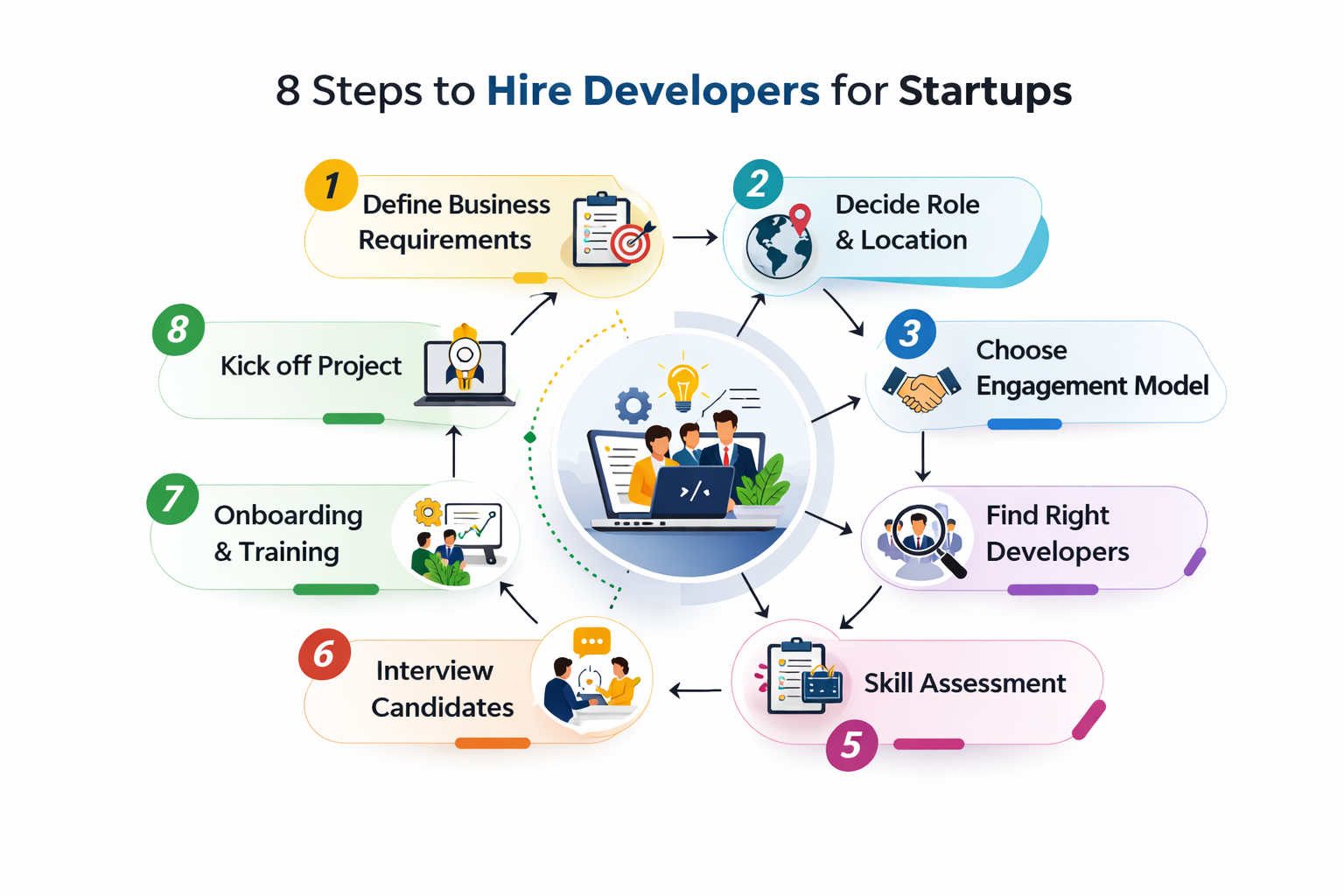
1. Define business requirements
Clarify what you are building, who it is for, what platforms it will support, and what success looks like.
2. Decide the role and location strategy
Choose whether you want local, remote, or offshore hiring based on budget, hiring speed, and access to talent.
3. Choose the engagement model
Decide whether your startup needs hourly support, monthly dedicated developers, or a fixed-scope team.
4. Source candidates from the right channels
Use referrals, startup communities, professional networks, hiring partners, and vetted talent pools.
5. Assess technical capability
Review actual project experience, relevant technologies, product thinking, and learning ability.
6. Interview for fit
Evaluate communication, collaboration style, ownership mindset, and comfort with startup ambiguity.
7. Plan onboarding
Align the developer on roadmap, tools, workflows, priorities, and decision-making processes.
8. Launch with clear delivery checkpoints
Set expectations around milestones, sprint planning, feedback loops, and reporting from the beginning.
Checklist of Skills to Look for While Hiring a Startup Developer
When hiring for a startup, look for the right mix of technical, product, and collaboration strengths.
Important skills to assess
-
relevant stack experience
-
product-building experience
-
ability to work in ambiguity
-
clean coding habits
-
communication skills
-
startup adaptability
-
ownership mindset
-
feedback openness
-
agile collaboration
-
distributed team readiness
A startup developer should be able to contribute beyond tasks. They should help the team move forward.
Common Mistakes Startups Make When Hiring Developers
Hiring mistakes can cost a startup time, money, and delivery momentum. Here are the most common ones to avoid:
Focusing only on cost
Low-cost hiring often leads to poor fit, weak delivery quality, and more rework. Startups should evaluate value, not just rate.
Hiring before defining the role
If the role is unclear, it becomes harder to identify the right skills, level, and hiring model.
Overvaluing credentials and undervaluing experience
Practical startup experience, product sense, and delivery maturity often matter more than academic labels alone.
Ignoring communication and soft skills
Startup teams need developers who can handle ambiguity, collaborate well, and adapt quickly.
Skipping onboarding structure
Even strong hires need proper onboarding to start contributing efficiently.
Not planning for future scaling
A startup hire should solve current needs without blocking future product growth.
Recommended Read: The Right Model To Hire Developers From India
When Should Startups Consider External Development Support?
Startups do not always need to build everything in-house from day one. In many cases, external development support becomes relevant when:
- the product needs to move faster than internal hiring allows
- the required technical expertise is not available internally
- the roadmap is growing but hiring capacity is limited
- founders want to reduce hiring risk while maintaining flexibility
External development support can take different forms depending on the need, including freelancers, dedicated developers, or structured development teams. The right choice depends on the startup’s stage, product complexity, and long-term goals.

By Mangesh Gothankar


By Ashwani Sharma
By Achin Verma
Frequently Asked Questions (FAQ's)

The best way to build your development team for a startup is to first define your product stage, scope, budget, and hiring model. Startups usually hire more effectively when they match the role to the roadmap instead of hiring too broadly too early.
Startups can reduce hiring delays by defining the role clearly, choosing the right engagement model, and using structured sourcing and evaluation methods. Many founders also speed up the process by working with vetted hiring partners instead of relying only on traditional recruitment.
If you do not have a technical co-founder, start with a clear product scope, use practical technical assessments, and consider working with a trusted hiring partner or technical advisor who can help you evaluate candidates more accurately.
Freelancers are often a good fit for short-term, clearly scoped tasks, while dedicated developers are usually better for ongoing product development, deeper collaboration, and roadmap continuity.
Most startups should begin with the smallest practical team needed to build or maintain delivery momentum. In many cases, one to three developers is a sensible starting point depending on product complexity and speed requirements.
Look for technical fit, communication skills, startup adaptability, product thinking, ownership mindset, and the ability to work well in fast-changing environments.
Founders usually hire startup developers through referrals, LinkedIn, developer communities, vetted talent partners, startup networks, and selected freelance platforms depending on the role, urgency, and level of vetting needed.
The best platforms depend on whether you need freelancers, long-term remote developers, or a vetted hiring partner. Startups typically evaluate remote hiring options based on speed, technical quality, communication, and ability to support ongoing product delivery.
Yes. Many startups build strong remote teams by using clear workflows, good onboarding, structured communication, and well-defined delivery expectations from the start.




![How To Hire A Full Stack Developer: A Complete Guide [2026]](https://www.yourteaminindia.com/hs-fs/hubfs/Imported_Blog_Media/How-To-Hire-Full-Stack-Developer-Sep-25-2023-10-23-51-7781-AM.png?width=352&name=How-To-Hire-Full-Stack-Developer-Sep-25-2023-10-23-51-7781-AM.png)


 4.8 out of 5 by