The IT outsourcing industry isn't slowing down. Statista's latest outlook puts the global market on a 6.20% CAGR between 2026 and 2030, with revenue expected to cross US$806 billion by the end of the decade.
One of the first decisions any business faces here: build a dedicated project team structure that works only on your product, or build an extended development team that plugs into the people you already have?
We work with founders and CTOs on both models every week, and the honest answer is that it depends on your project, not on which model sounds better on paper. This guide compares a dedicated team against a team extension model so you can see what each actually looks like day to day, and figure out which one fits what you're building.
Before moving directly to the differences, let’s understand each IT outsourcing model quickly.
1. What is a Dedicated Team Model?
A dedicated team is a group of developers, designers, and QA engineers hired to work only on your project, full-time. They're employed by an outsourcing partner, but for practical purposes they operate as your team. This setup is common in dedicated team project management, where a company needs a group that lives inside their workflow, follows their sprint cycles, and owns the project end to end, from the first line of code to deployment and beyond.
2. What is an Extended Team Model?
An extended team model adds outside specialists to a team you already have. Instead of building something new from scratch, you're topping up the skills or headcount your in-house group is missing. Extended teams typically join your existing tools, standups, and reporting lines rather than running separately, which is why businesses often reach for this model when they need extended team software expertise for a specific feature or sprint, without hiring full-time.
3. Exploring the Key Differences: Dedicated Team vs. Extended Team
Both dedicated team models and extended team models have their unique features and characteristics, which we will compare to help you understand their distinctions.
When it comes to making a decision on the suitability of your unique project requirements, the choice can be made only after having clarity over the models. Now, let’s take a look at both models.
3.1 Control and Management
In terms of control and management, having a dedicated team gives you direct control over their operations, methods, and workflow. It’s like having a remote development team working just for you.
This setup allows you to align closely with your internal processes and goals. For CTOs and business owners, this level of control is essential for projects that need to follow strict internal standards and manage complex tasks.
In contrast, an extended team offers a more collaborative approach. It’s like adding specific skills to your existing team.
The only thing that requires attention is integrating external talent into your existing workflow alongside the client's in-house team. However, having an extended team working on your project is a valuable option for business owners looking for agile scaling and rapid project adjustments.
3.2 Cost Efficiency
Dedicated teams typically run on a fixed monthly fee, which makes long-term budgeting simple and predictable. Extended teams charge for the specific skills or hours you use, so costs move with your actual needs. Neither is cheaper across the board; a dedicated team pays off over a long project, while a team extension model avoids the overhead of hiring in for something short-lived.
3.3 Expertise and Specialization
Where a dedicated team brings a full bench built around your project from day one, an extended development team is built to plug a specific hole — a missing skill, a short-term surge in workload, a specialist you don't need permanently.
3.4 Scalability and Flexibility
When choosing a team model, dedicated teams provide reliable growth for long-term projects. You can adjust the team size as needed, but this requires a structured approach. CTOs and business owners need to plan for the long-term growth and scalability of the development team while considering the balance between internal and external teams.
On the other hand, extended teams offer more flexibility to integrate seamlessly with the in-house development team. They allow businesses to add or reduce resources based on project needs quickly. This could be an ideal approach for projects with dynamic requirements and tight deadlines.
In a nutshell, if you need a stable, long-term team, choose the dedicated team model. If your project has uncertain or evolving needs, the extended team model is better.
3.5 Security and IP Protection
Dedicated teams generally offer tighter security by default, since the team works exclusively on one project under one set of contracts. Extending your team with outside specialists isn't inherently riskier, but it does mean you need clear data-access rules and NDAs in place before anyone joins your systems.
An extended team needs careful planning for security and intellectual property protection. Because this extended IT team works more flexibly, businesses must set clear security rules and make sure they follow data privacy laws.
If your project involves sensitive data, an extended team gives you better control. For long-term development with contracts that protect intellectual property, a dedicated team is a great option.
3.6 Process and Tools
Dedicated teams tend to run on set project management tools like Jira and Slack, matched to a defined workflow. Extended teams use the same categories of tools but adapt to whatever your in-house team already runs on.
In contrast, an extended team adds flexibility to the process. This allows them to adjust based on the changing needs of the organization. Extended teams also use project management tools and video conferencing to facilitate smooth collaboration despite physical distance.
In summary, extended teams vs. dedicated teams: both are equally dynamic and efficient.
Recommended Read: How to Effectively Manage Your Remote Development Team?
3.7 Global Talent Access
Businesses often face unprecedented competition for skilled professionals, particularly in technology fields. Since domestic talent pools are limited, the demand for specialized talents in areas like AI development, cloud architecture, and full-stack engineering is increasing.
Both dedicated and extended team models address these challenges by breaking down geographical barriers to talent access, but they do so through fundamentally different approaches.
A dedicated team model provides you with full-time professionals who work exclusively on your projects, typically employed by a service provider who handles recruitment, administration, and workspace provisioning.
The extended team model augments your existing team with external specialists who integrate into your workflows while remaining employed by their original companies. This approach creates different opportunities for global talent access, such as multi-specialized networks.
Both dedicated and extended teams allow companies to access top-rated talents from global markets.
3.8 Communication and Collaboration
A dedicated team makes communication and collaboration easier. Since the team is part of your workflow, it helps with clear communication and efficient project management. To work well together, businesses need to set up clear communication channels and tools for managing projects.
In contrast, the extended team model also requires communication and collaboration tools for efficient communication throughout. However, it's important to include strong communication and collaboration tools for all extended team members. This helps ensure that the new team joins smoothly with the existing team and keeps the project on track.
4. How To Choose the Right Hiring Model Based on Your Business Stage?
Business stage matters as much as the project when picking a model. Here's what tends to work at each one.
4.1 For Startups & Early-Stage Companies
If a founder or technical lead already knows the product inside out and just needs more hands on deck, an extended team model works well. It keeps management shared, adapts as funding rounds and priorities shift, and lets your internal team pick up good development habits as it grows.
An extended team model works well when a founder or technical lead already has the product vision and just needs more hands to execute it. It keeps management shared, adapts as funding and priorities shift, and lets your internal team pick up good development habits along the way as it grows.
A dedicated team model suits founders without a strong in-house technical team. Costs are predictable, workflows are set from day one, and results tend to land faster because there's no ramp-up on your side. Some startups later grow this dedicated development team into an acquisition target or spin it into an in-house department.
Related Read: How To Hire Developers For Startups - Ultimate Hiring Guide
4.2 For Growing Mid-Sized Businesses
As a company scales past the startup stage, the question shifts from whether you have a team to whether that team has the right skills.
An extended team model fills that gap directly. It adds specialized skills where your current stack or roadmap needs them, without a full hiring cycle. This engagement model also helps manage technical debt while your core team stays focused on what they already own.
A dedicated team model works best when you want a group running independently on a specific product line or new initiative. It's often the more cost-effective route at this stage, and it's easier to manage since the team isn't competing for your internal team's time.
4.3 For Enterprise Organizations
At enterprise scale, the choice usually comes down to how much you want a project to sit inside existing approval chains versus outside them.
An extended team model fits within your current workflows, compliance processes, and departmental structures. It's useful when you need to fill a skill gap without restructuring anything.
A dedicated team model gives you a self-contained unit that can innovate without being slowed by corporate process. Enterprises often use it to build an extended development team's counterpart: an independent group that owns a feature or product line outright, with its own budget and its own security and compliance standards.
5. Which Hiring Model to Choose for Your Project?
Although both hiring approaches bring different pros and cons for businesses, they are considered ideal choices in some specific scenarios. Let's get familiar with it.
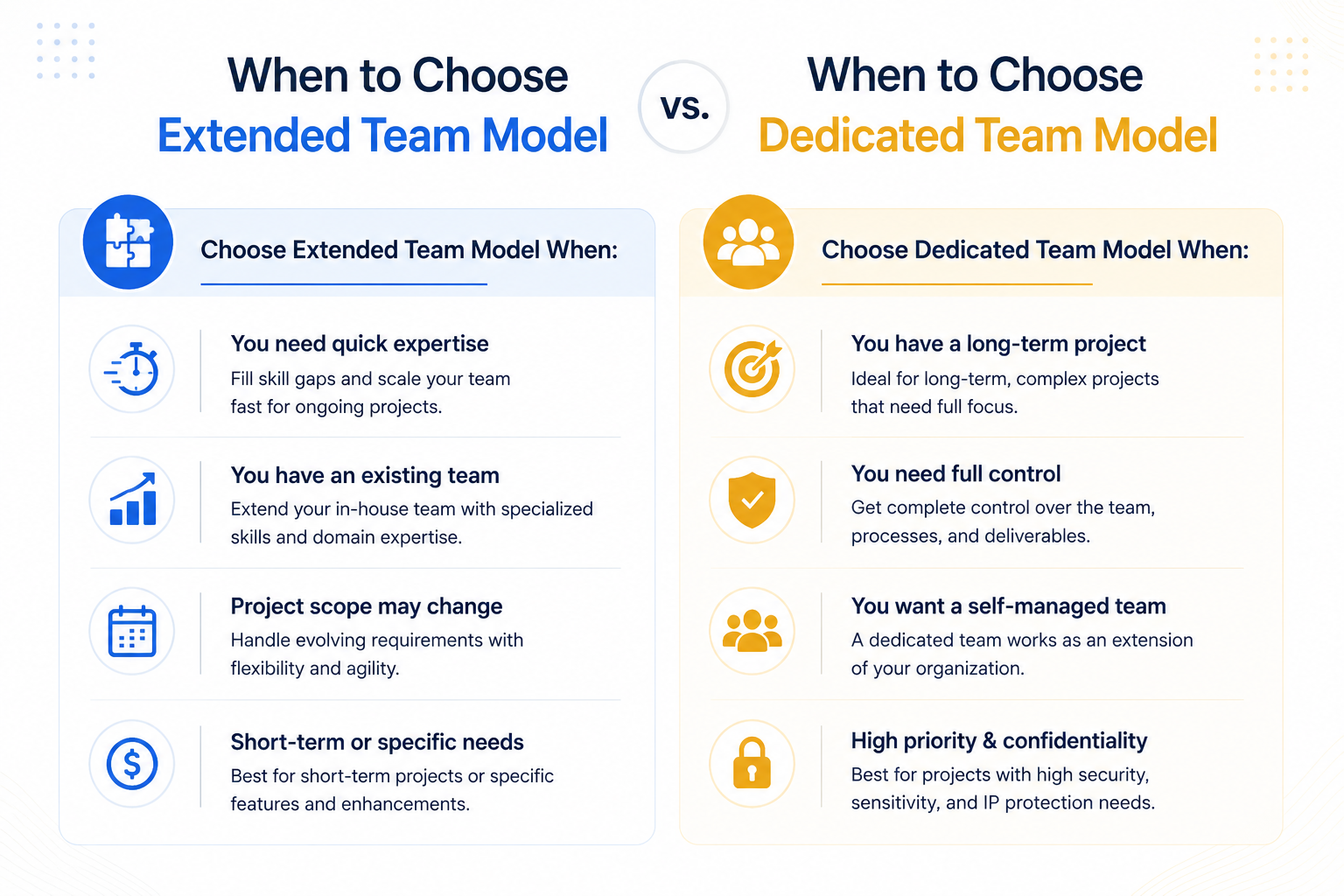
However, the goal is to move beyond general comparisons to a specific recommendation based on their unique business requirement.
6. Key Considerations for Deciding Between Extended Development Team and Dedicated Development Team Model
Business stage is only part of the picture. These factors matter just as much when you're picking between a dedicated team and a team extension model.
1. Project Goal & Scope: Both models can deliver, but only if the scope is clear going in. A vague brief causes more friction with a dedicated team, since the whole unit is built around your goals from the start. With an extended team, unclear scope tends to show up as duplicated work or gaps between what your in-house team assumed and what the extension actually built.
2. Technical Leadership: A dedicated team brings its own structure and leadership, so you don't need deep technical oversight on your side to keep it moving. An extended team is the opposite: it works best when you already have a strong internal lead who can direct the extra hands. If that leadership doesn't exist yet, a dedicated model is usually the safer bet.
3. Knowledge Gaps: If you're missing one or two specific skills, an extended team is the faster fix. If you're missing an entire capability, say, you have no mobile developers at all, a dedicated team is built to bring that in from scratch rather than patch around it.
4. Budget & Financial Planning: The accounting differs too. Extended teams are usually treated as an operational expense, with costs that flex month to month based on what you use. Dedicated teams tend to run as a fixed, project-based cost, which makes budgeting more predictable but less adjustable. Which one is better depends on whether your finance team wants flexibility or predictability more.
5. Parallel Development Process: A dedicated team can run as a separate, self-contained unit, which some companies use to keep work moving around the clock as one team hands off to another across time zones. An extended team is better suited to work with tight interdependencies, since it's already embedded in your existing processes and doesn't need a handoff layer.
6. Technology Stack Evolution: An extended team is a good fit for gradually upgrading a stack your in-house team already owns. A dedicated team is better suited to a full rebuild or a new technology adoption, since it isn't tied to legacy decisions your current team has already made.
Conclusion
Both models work. The one that's right for you depends on where your project stands, how much technical leadership you already have, and how your budget is structured, not on which one sounds better in a comparison blog.
Whichever way you go, the real work is in getting the hires right. A dedicated development team or an extended team is only as good as the people staffing it.
That's where we come in. At Your Team in India, we build both. Whether you need a full dedicated team from day one or want to extend the team you already have, we can match you with developers for hire from India who actually fit the role.
Frequently Asked Questions (FAQs)

A dedicated team is a group of professionals who work solely on your project. They are usually outside your company and focus full-time on your project for a long time. This approach gives you more control, focus, and commitment.
An extended team supplements your existing in-house team. This approach is flexible and allows you to bring in specific skills as needed. It focuses on filling skill gaps where the in-house team lacks and providing additional resources to your current team.
A key advantage of a dedicated core team is that it gives you better control and focused expertise. Since the entire team is only working on your project, you can directly oversee their work and methods. This helps the team develop strong knowledge of your project and leads to high-quality outcomes.
Yes! You can have both extended and dedicated teams working on your project simultaneously. And when you hire a hybrid remote team from a reliable service provider, you have an advantage of gaining a competitive edge. However, this choice can vary based on your unique project requirements.
When choosing an outsourcing team for your business, it's important to look at a few key factors. Consider these points when selecting the right group for your project:
-
Project goals
-
Skills and qualifications
-
Budget and commitment
-
Integration and control
A dedicated team can be more expensive than an extended team, especially in the short to medium term. On the contrary, an extended team is usually more cost-effective for short-term needs. This gives you more flexibility and allows you to control costs.
However, for long-term and complex projects that need a consistent external team, a dedicated team can be more cost-effective over time.

By Mangesh Gothankar


By Ashwani Sharma
By Achin Verma



-1.png?width=352&name=Why%20Businesses%20Choose%20Offshore%20Development%20%20(1)-1.png)




 4.8 out of 5 by