Remote work changed how software teams operate, and the data holds up. WorkTime's 2026 survey puts it plainly: 77% of remote employees say they get more done at home, and 70% find it easier to focus without an office humming around them.
So companies stopped forcing everyone into one building. Hiring across regions gets you a deeper talent pool, and it usually runs cheaper than filling those roles locally. That trade is what keeps pulling businesses toward remote teams over in-house hires.
Running one well is the harder part. Miss a few threads across time zones, and a project drifts off schedule before anyone notices. This guide covers the mechanics of keeping a distributed team structured and productive once you've committed to going remote. Budget comes later, with real numbers.
Key Takeaways
- Remote development teams offer access to global talent and cost savings but face communication and collaboration challenges.
- Structures for remote development teams include generalist, specialist, and hybrid teams.
- Effective management involves using project management tools, encouraging a positive team culture, providing resources, sharing knowledge, and recognizing achievements.
- The cost of hiring remote teams varies based on location, skills, project complexity, and employment type.
What is a Remote Development Team?
A remote development team consists of professionals in different geographical locations collaborating virtually to develop software and applications. Unlike traditional in-house teams, remote teams use communication and collaboration tools to work together remotely. When you hire remote developers, they leverage technology to bridge the distance gap and achieve project goals.
Recommended Read: How To Find Remote Developers In India From Anywhere Around the World
Pros and Cons of a Remote Development Team
Every hiring model has trade-offs, and a remote development team is no different. Here's what you actually gain, and what you have to stay on top of before hiring a remote team of developers.
Pros
1. Access to global talent: You're not stuck with whoever lives within driving distance. Hire from anywhere and the pool of skills and experience you can reach gets a lot bigger.
2. Lower cost: Remote developers usually come in cheaper than an equivalent in-house team. No desks, no utilities, no office perks to pay for, and in many regions the salaries themselves run lower.
3. Flexibility: People work where they focus best and set hours that fit their lives. That flexibility tends to show up later as better retention.
4. No commute: Those lost hours go somewhere useful instead. Part back into the workday, part into rest.
5. Access to niche skills: Need a Rust engineer or someone who's shipped a specific kind of ML system? Locally that person might not exist. Remotely, they're findable.
6. Faster scaling: Ramping up or trimming down is quicker when you're not tied to office space and local hiring cycles. Handy when project scope shifts mid-flight.
7. Round-the-clock progress: Spread your team across time zones and work carries on after your day ends. A handoff at the right hour keeps things moving overnight.
Recommended Read: Benefits of Hiring Remote Developers for a Business
Cons
Hiring a remote development team has real downsides too. None are dealbreakers, but ignore them, and they compound.
1. Communication gap: Time zone lag, language differences, everything routed through chat. Messages sit for hours and nuance gets lost when nobody shares a room.
2. Harder collaboration: Teamwork takes more deliberate effort without face-to-face contact. Trust builds slower between people who've never met, so you have to build the conditions for it on purpose.
3. Drift and misalignment: Remote teams fall out of sync easily. Goals and priorities need restating more often than they would if everyone could catch problems in passing.
4. Time zone coordination: The same spread that keeps work moving overnight also makes live meetings a headache. Someone's usually dialing in at an awkward hour.
5. Onboarding friction: New hires ramp up slower with no one at the next desk to ask. Weak documentation makes it worse.
6. Security exposure: People logging in from personal devices and home networks widen your attack surface. Data protection needs more thought than it does behind one office firewall.
7. Culture and isolation: Company culture is harder to hold together when people never meet. Some remote workers feel cut off, and that wears on motivation over time.
What are the Common Remote Development Team Structures?
Remote development teams can be structured differently based on a project or organization's needs and goals. It can be classified into two categories:
1. Common Remote Development Structures
2. Software Development Team Structure by Role
Common Remote Development Structures
This is about how the team is composed, meaning the mix of skills people bring and how they divide the work. There are three common setups.
1. Generalist Structure
Generalists wear a lot of hats. Each person carries a broad skill set and can shift between tasks across the development process as the work demands, which keeps a small team nimble without hiring a specialist for every job.
|
Pros |
Cons |
|
Handle many tasks and adapt as project requirements change. |
Depth suffers. Complex or specialized work can expose the limits of a broad skill set. |
|
Fewer hires needed, since one person covers several roles, which keeps costs down. |
Specialized tasks take them longer, which can stretch timelines. |
2. Specialist Structure
Specialists go deep in one area and deliver strong results inside it. This structure fits larger projects, or any build that needs real depth in specific domains rather than general coverage.
|
Pros |
Cons |
|
Deep expertise means higher-quality output in their domain. |
Narrow focus. Work outside their specialty is a stretch. |
|
Tasks in their area get done faster and cleaner. |
Specialists cost more than generalists. |
3. Hybrid Structure
A hybrid team pulls from both. You keep a core of generalists who can cover broad ground, then add specialists with deep expertise in areas like front-end, back-end, or QA where it counts.
|
Pros |
Cons |
|
Flexible enough to handle varied work and shifting priorities. |
Generalists and specialists don't always communicate cleanly. |
|
Adapts to changing requirements and reallocates people quickly. |
More moving parts to coordinate and manage. |
Software Development Team Structure by Role
Structure by role is just this: who owns what. Every job on a software development team, mapped to the work that's actually theirs. Skip it, and parts of the software development process end up with nobody accountable. Here's the usual lineup.
1. Developers
They write the code. That's the short version. The longer one is that they're involved from the moment requirements get picked apart through design, coding, and the push to production, and they spend a fair chunk of their week not writing new code at all but reviewing each other's and hunting down bugs. Frameworks shift under them constantly, so the good ones stay curious out of necessity, not virtue.
2. Testers / QA Engineers
"It compiles" and "it works" are different claims. QA proves the second one. They write the test cases, run functional, regression, and load tests, and when something breaks, they file it, track it, and check the fix actually stuck. Tools like Selenium, Cypress, or Playwright do the heavy lifting. They work close to developers, because catching a bug in week two is cheap and catching it in production is not.
3. Project Managers
The PM holds the timeline. They break the work into milestones, assign it, shuffle people when something jams, and keep an eye on whether any of it is actually on track. Half the job is really translation, making sure the developer in one timezone and the client in another are talking about the same thing. Jira or Linear is where most of that lives.
4. UI/UX Designers
Someone decides what the product feels like before a developer builds it. Designers map the flows, wireframe the screens in Figma, and hand over a spec clear enough to build from. On a distributed team this quietly saves you: a tight design kills a dozen "wait, what did you mean" messages that are miserable to untangle across an eight-hour gap.
5. DevOps Engineers
Code has to get from a laptop to production without a fire drill every release. That's DevOps. Pipelines, deployment automation, monitoring, the infrastructure it all sits on, usually some mix of Docker, Kubernetes, and a CI tool like GitHub Actions. The measure of a good one is boring deployments and a 2am alert that resolves itself before a customer ever sees it.
6. Business Analysts
The BA stands between the client and the build. They dig out what the business actually needs, not what it first asked for, and turn it into requirements a developer can work from. On offshore projects, that translation layer is often the whole reason the delivered product matches what the client pictured.
7. Tech Leads
Someone senior makes the calls that shape the codebase. Which architecture, which patterns everyone sticks to, how quality holds up when five people are committing at once. The tech lead does that while still writing code themselves, mentoring the juniors, and being the person the PM or client goes to for a straight technical answer.
What are the Challenges of Remote Development Teams?
Managing a remote development team brings its own set of challenges that need to be addressed to ensure successful collaboration and project delivery. Here are a few common challenges faced by remote development teams:
1. Balancing Work and Personal Life
Around 27% of remote team members often find it challenging to create a clear separation between their work responsibilities and personal life. Without a physical separation between the two, it becomes easy for work to spill into personal time and vice versa.
The absence of clear boundaries can lead to a blurred line between work hours and personal time. This can cause team members to overwork or struggle to switch off from work-related tasks. The constant accessibility and the expectation of being available at all times can contribute to an unhealthy work culture, leading to increased stress, fatigue, and burnout.
2. Managing Time Zones
Nearly 98% of companies hire dedicated remote development team from multiple time zones. Working across different time zones presents a significant challenge for remote development teams. With team members located in various regions, coordinating schedules and ensuring timely collaboration can be demanding.
The time zone differences can lead to prolonged response times and difficulties in organizing meetings or synchronous work sessions. Furthermore, it can affect the speed of problem-solving and decision-making processes.
3. Maintaining Company Culture
Company culture contains shared values, beliefs, and practices that define an organization's identity and working environment. In a remote setting, where team members are physically separated, it can be challenging to maintain a cohesive company culture.
Moreover, 16% of remote members reported struggling with loneliness due to remote work. This feeling can impact their connection with the company while demotivating them toward their work.
4. Security and Data Protection
The risk of cybersecurity threats increases with team members working from various locations and potentially accessing company resources from different devices and networks. In fact, 19.8% of businesses experienced a data breach after transitioning to remote work arrangements.
Thus, maintaining the confidentiality and integrity of sensitive information becomes a critical concern for remote teams.
How to Manage a Remote Development Team?
Managing a remote development team comes down to communication and coordination, and the right stack makes both easier. You don't need a dozen apps. You need one solid tool for each job the team actually has to do. Here's a practical 2026 setup, grouped by purpose.
1. Everyday communication: Slack
Slack is where the day-to-day conversation lives. Real-time messages, channels so discussions don't collapse into one endless thread, file sharing, and hundreds of integrations that pull alerts from the rest of your tools into one place. For a distributed team, it's the closest thing to a hallway you can bump into someone in. Most teams now lean on its huddles and AI channel recaps to catch up on what moved overnight.
2. Meetings and calls: Microsoft Teams or Zoom
When chat isn't enough, and you need faces on screen, Teams covers video calls, screen sharing, and live document editing through Microsoft 365. If your team lives in Google's world or just wants the simplest call experience, Zoom or Google Meet does the same job. What matters is having one dependable place for the conversations that have to happen live.
3. Project and sprint management: Jira or Linear
This is where a personal task app falls short for a dev team. You want something built for engineering work. Jira is the long-standing pick for agile teams running sprints, backlogs, and issue tracking at scale. Linear is the faster, cleaner favorite a lot of teams have moved to in the last couple of years. Either gives everyone a shared view of what's moving and what's stuck.
4. Code collaboration: GitHub or GitLab
For a development team specifically, this is the real center of gravity. Pull requests, code reviews, CI/CD pipelines, and issue tracking all live here. Async code review is also what lets engineers in different time zones build on each other's work without anyone waiting around. If your project tool tracks the "what," this tracks the "how."
5. Documentation and knowledge: Notion or Confluence
This is the fix for the onboarding problem from earlier. A shared knowledge base keeps processes and decisions, plus the project context that usually lives in one person's head, somewhere the whole team can actually find it. Notion is flexible and quick to stand up. Confluence pairs tightly with Jira if you're already there. Either way, good docs are what stop the same question getting asked ten times.
6. Time zones: Every Time Zone
With a team scattered across regions, a shared view of who's awake when saves a lot of cruel 2 am invites. Every Time Zone (or World Time Buddy) lays everyone's local time side by side so you can find a slot that works for most of the team, and it adjusts for daylight saving on its own.
Cost of Hiring Remote Teams
The cost to hire a remote development team can be around $6000 to $12,000 per month.
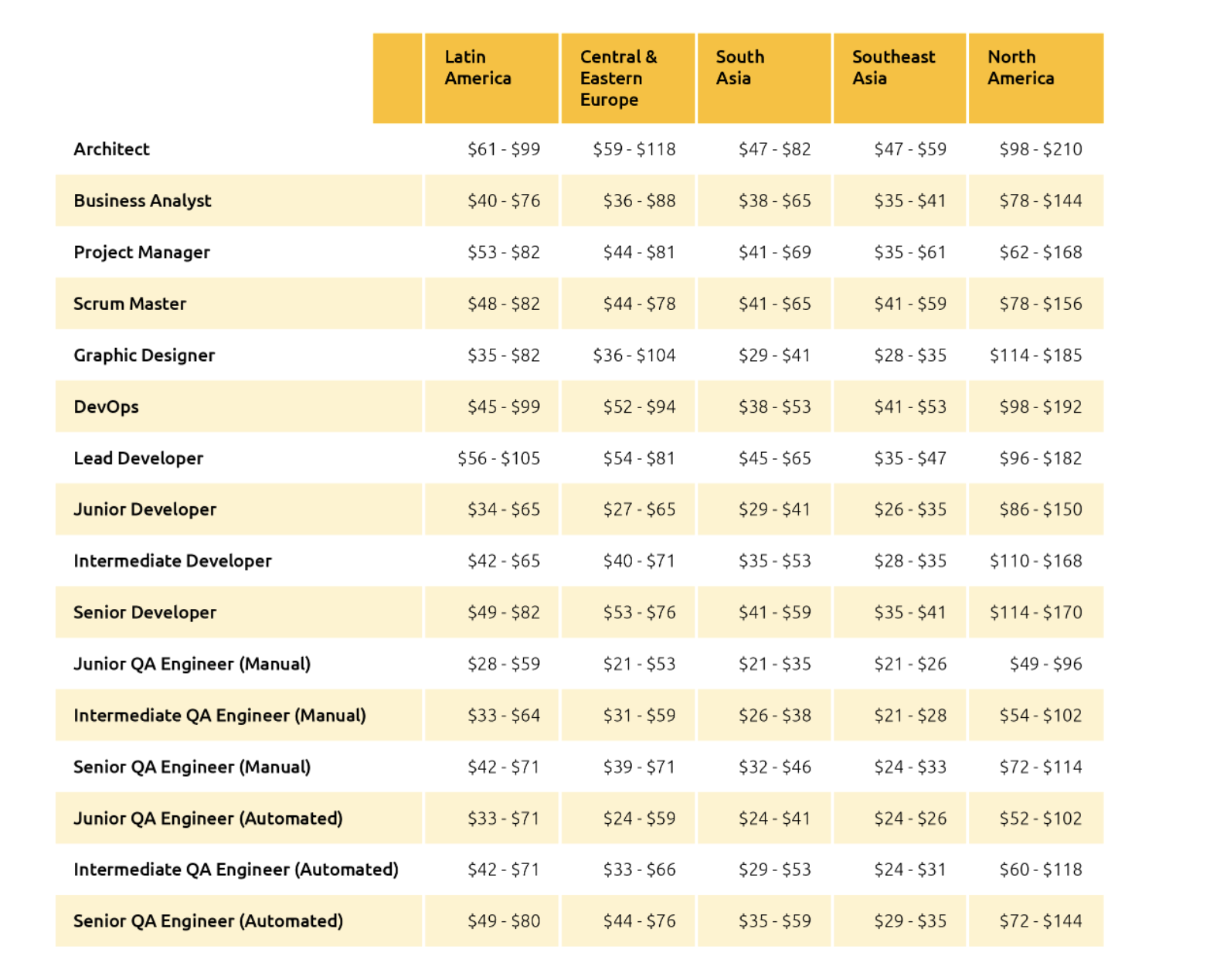
However, the cost may be influenced by several factors, such as:
1. Geographic Location and Cost of Living
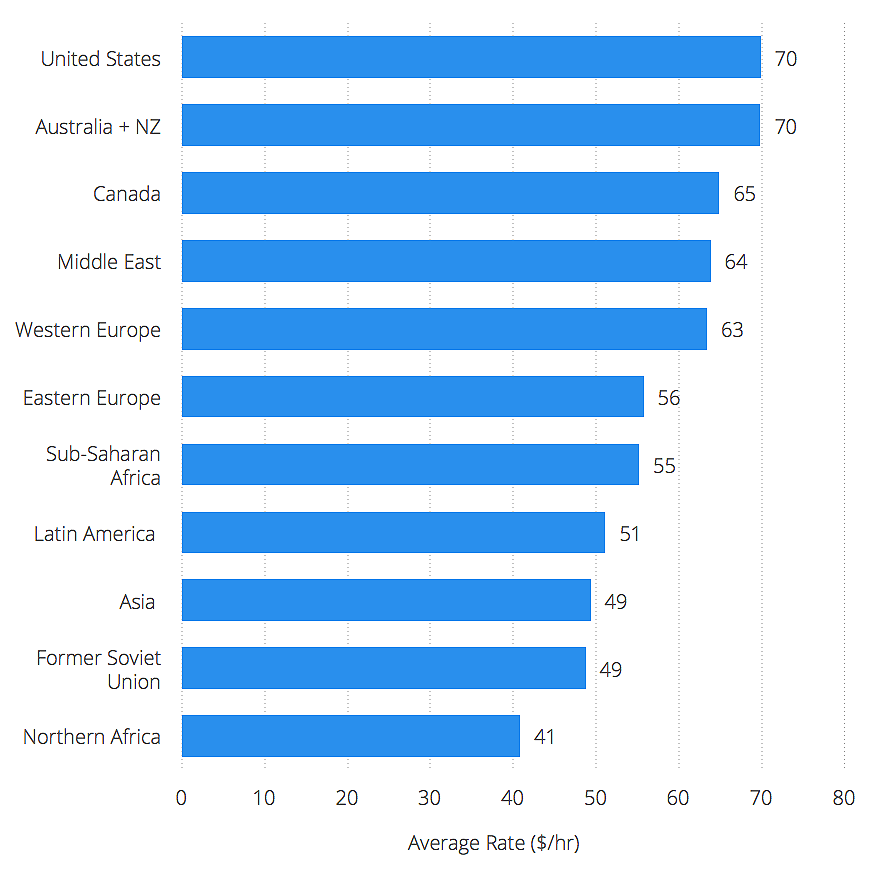
The salary expectations of remote developers can differ depending on the country or region they are from. Developers from countries with a lower cost of living may offer more affordable rates than those from high-cost regions.
2. Skills and Experience Level
The expertise and experience required for a particular project will also impact the cost of hiring remote developers. Senior-level developers with specialized skills and in-depth knowledge may have higher rates than junior-level developers.
3. Project Complexity and Duration
More complex projects requiring advanced technical skills and longer time commitments may result in higher rates than simpler, shorter-term projects.
4. Employment Type
The choice between hiring full-time remote developers or freelancers can affect the cost. Full-time developers may require a fixed salary, while freelancers are generally paid on an hourly or project basis. Furthermore, additional expenses such as onboarding and overhead costs should also be considered.
Average hourly rate of freelancers around the globe:
How to Build a Remote Team With Your Team In India?
To build a remote team with Your Team in India, you can follow these steps:
1. Define Your Requirements
Determine the specific skills and expertise you need for your remote team. This can include developers proficient in Angular or any other technology you require.
2. Contact Your Team in India
Reach out to Your Team in India through our website to express your interest in building a remote team. You can mention your project requirements and the number of developers you need.
3. Hiring Models
Your Team in India offers different hiring models based on your preferences. You can select a retainer model or hourly model according to your flexibility in terms of spending.
4. Engagement Models
Your Team in India also provides engagement models to manage your remote team effectively. The monthly-based model allows you to hire a remote team of developers for up to 160 hours a month. You can manage the team using your methodologies and receive real-time updates on project development.
5. Benefit From Your Team in India Services
When you choose Your Team in India as your outsourcing partner, you can hire developers from India and access our industry experience, a pool of pre-vetted Indian programmers, tech expert mentoring, and more.
Final Thought
Hiring remote developers enables you to assemble a high-performing team capable of delivering innovative solutions while reducing elevated costs associated with maintaining a physical office space. Although, unlike any other thing, managing remote development teams also comes with certain challenges, you can effectively overcome them with the proper practices and tools.

Frequently Asked Questions

Effective communication is of utmost importance to effectively manage a remote development team. Furthermore, it would help if you established clear goals and promoted a positive team culture in the company.
A remote development team can be structured as generalists, specialists, or a hybrid, depending on project requirements and team dynamics.
Choosing the right team structure is essential for remote development because it ensures the efficient allocation of resources and maximizes productivity.
Popular tools to ensure remote development team productivity include Jira for project management, Slack for communication, Microsoft Teams for collaboration, and Every Time Zone for managing time differences.

By Mangesh Gothankar


By Ashwani Sharma
By Achin Verma








 4.8 out of 5 by