Fintech is booming, and that's driving serious demand for developers who can actually build secure, compliant financial software, not generic fintech app developers who've never touched a regulated system. The World Economic Forum's Future of Jobs Report ranks fintech engineers as the second-fastest-growing profession worldwide, projecting 95% growth between 2025 and 2030, trailing only big data specialists.
Here's the problem: most companies can't find fintech software developers who check every box. You need someone who can write solid algorithms, wire up third-party APIs, and build backend systems that hold up under financial-grade security standards. However, this combination is hard to come by.
This guide covers how to hire fintech software developers for your project, whether you're building in-house or outsourcing to fintech development companies, without getting buried in technical jargon along the way.
Understanding Your Requirements To Hire Fintech Developers
Before you start the process of hiring fintech software developers, it is crucial to understand what challenges it can address. What is the tech stack associated with your FinTech project? How can you plan for your fintech software development? What exactly are your project requirements?
It is also important to understand what type of financial solution you want to launch.
-
A digital payment app like Google Pay, Paytm, etc
-
Robo advisor for funding management
-
Lending platforms for quick and cost-effective banking solutions.
-
A blockchain-based solution like Bitcoin
-
An application offering a blend of financial solutions
Or do you want to launch a custom software for your fintech company?
Some other considerations include,
-
Is your idea really workable?
-
What is the plan of action for your idea's execution?
-
What problem is being solved with this execution?
-
Who is your target audience?
-
Do you need a mobile application or custom software? Or both?
-
What essential functionalities do you want to highlight?
-
What would be the purpose of launching this in the digital world?
It is critical to get answers to all these questions before considering moving forward with hiring a developer for your fintech software development project.
Pro-Tip: Before going through the entire development process, develop a Minimum Viable Product. It's a bare minimum version of the software with all the essential features that let you analyze real user inputs and validate your concept. This way, you can improve your app version based on real user inputs.
If you don't have experience building an MVP, you can reach out to a professional MVP App Development Company to get the required assistance.
How to Hire Fintech Software Developers: Step-By-Step Guide
By now, you must have understood your unique project requirements and planned to execute the development of your Fintech project. Here is a step-by-step guide on how to hire fintech software developers.
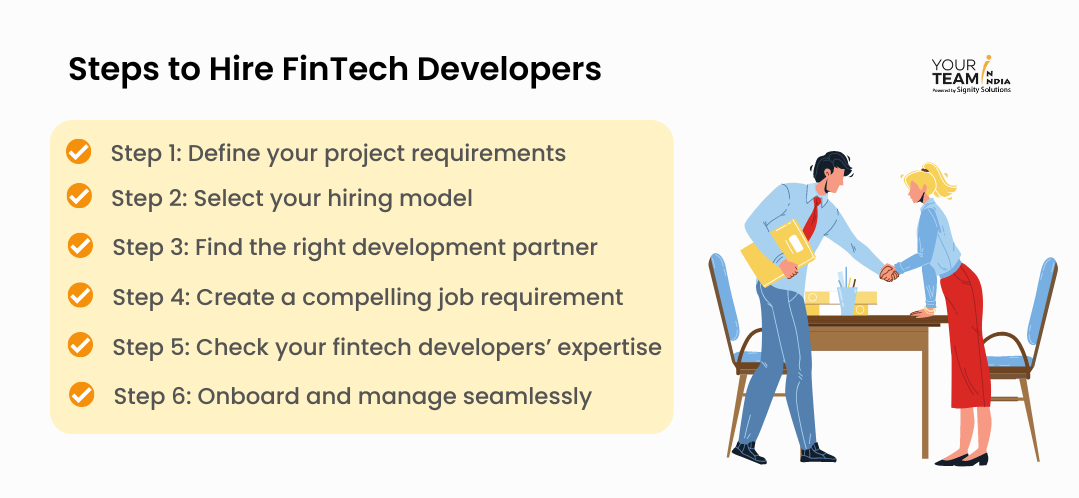
Step 1: Define your project requirements
Begin the process of hiring a fintech developer by defining your project requirements and budget appropriately. At this step, you must:
-
Identify your fintech applications' main functionalities and targeted audience.
-
Set a realistic budget depending on the developer rates and project complexity.
-
Outline the desired skills and development timeline.
-
Clearly identify the programming languages, areas, and technical competencies that are important for the successful execution of your project.
Pro-Tip: Conduct competitor research and share your ideation and perspective for creating a FinTech application while addressing the project requirements.
Step 2: Select your hiring model
Will a remote developer cover your needs, or do you need an offshore team or a full in-house setup?
Well, this may sound very basic, but this question could be the foundation of your project's success. To move your project forward, you must consider which model works best for you. Below are some of the hiring engagement models:
IT Outsourcing
IT Outsourcing means partnering with another company to handle the entire software development. Outsourcing your fintech project allows you to focus on your core business goals while your hired fintech development experts take care of your software's tech requirements.
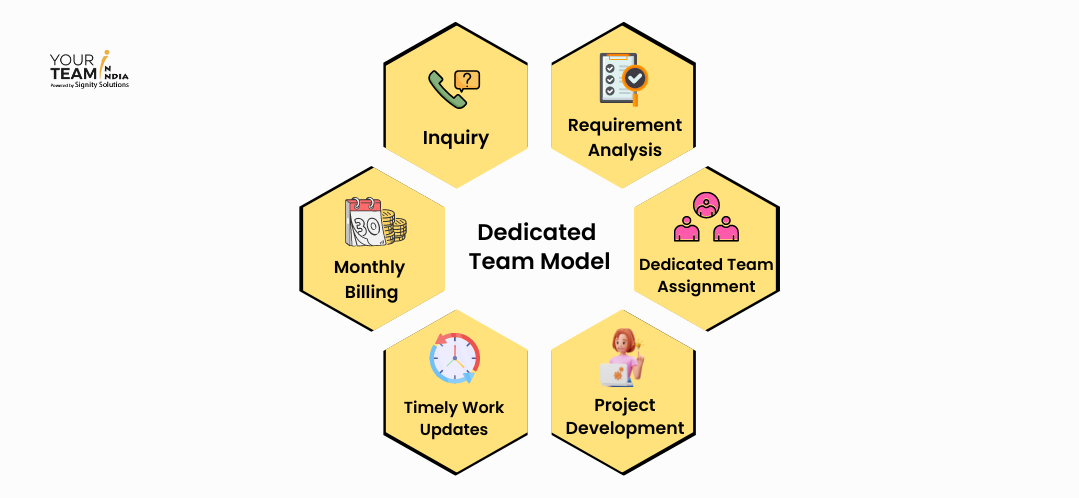
Dedicated Development Team
A dedicated development team is a collaboration model involving an outsourced team of developers who work with a client on a long-term basis. When you hire a dedicated team, you work with a group of outsourced professionals aligned with your business objectives. It's similar to having an in-house team.
With this option, instead of beginning from scratch, you will get a team of talented fintech developers. If required, you can also hire an entire team of QA engineers, designers, and project managers to take care of your project. This ensures high-quality outcomes.
Offshore Development Center
An offshore development center (ODC) is a team of software developers and IT professionals located in another country, working in a different time zone.
According to Wikipedia, offshore custom software development involves moving the software development process to a country where development costs are lower, thereby reducing budget spending. The appeal of accessing a global talent pool while optimizing operational costs has made the Offshore Development Services model particularly attractive to businesses, from startups to multinational corporations.
Staff Augmentation
Staff augmentation is often selected when an in-house team is already working on your project but lacks expertise in the domain. This helps bridge the gap between the lack of expertise and the in-house team.
Step 3: Find the right fintech development partner
Finding a reliable fintech software development company can be a daunting task. Especially when a huge number of options are available. However, to help you make an informed decision, here are some of the factors to be considered:
Expertise
When selecting a software development company, businesses should consider the company's experience and the following parameters:
-
Client testimonials
-
Word of mouth
-
Portfolio showcasing relevant fintech experience
-
Compliance with set standards and procedures
Regulatory compliance
Partner with a software development company that ensures that your development project complies with the regulatory requirements. There are several factors that you must consider:
-
The type of regulatory authority your business falls under
-
How long have they been operating with particular regulations associated with your industry?
-
Do they have specific regulations adherence related to your particular industry?
Development methodology
When choosing a software development partner, it's important to understand the development methodology they employ. The methodology can significantly impact the project's timeline, cost, and quality. Agile is quite a popular methodology. Check if the software development company aligns with any of these.
Step 4: Create a compelling job requirement
Once you find a reliable partner, share a compelling job description with them. Clearly state your project requirements and the skillset required to match you with the ideal fintech programmer.
Step 5: Check your fintech developers' expertise
Once you share your unique project requirements, they will provide a list of top pre-vetted talents who best match your needs. Evaluate the candidates and select the best match for your project.
Ensure to check out the following:
-
Proficiency in FinTech programming libraries, frameworks, and languages like JavaScript, React, Python, AngularJS, HTML, and jQuery.
-
Expertise in using databases, including relational (SQL) and non-relational databases (NoSQL).
-
Strong understanding of economic and financial concepts.
-
In-depth know-how of investments, risk control, and monetary standards.
-
Familiarity with fintech technologies like artificial intelligence, machine learning, and statistical analytics.
-
Data mining and handling skills
-
Understanding of cybersecurity practices and protocols to ensure regulatory compliance.
-
Proficiency in DevOps tools and skills
-
Effective team collaboration and communication.
-
Expertise in designing, developing, and maintaining secure and scalable back-end systems.
You can conduct technical assessments online by coding tests to gauge their skill sets. Also, you can connect over the initial on-call interviews or prepare a technical and cultural fit interview to evaluate their capabilities.
You can communicate directly with the developers to find out how you can bring your imagination to execution.
Pro Tip: It is a plus to keep a note of the top programming languages for Fintech software development and decide which one would best suit specific project requirements.
Step 6: Onboard and manage seamlessly
Done with the assessment part and selected the best fit for your project? If so, then you can start onboarding them seamlessly and managing them even from a remote location. Here's what you need to do:
-
Establish a clear communication channel
-
Use effective project management tools
-
Foster a collaborative environment
-
Offer them opportunities for professional growth
-
Schedule regular meetings
-
Provide constructive feedback throughout
Even if you lack technical knowledge about fintech development, a reliable fintech development partner can handle everything for you.
Challenges Businesses Face While Hiring FinTech Developers
In the continuously evolving Fintech sector, businesses are increasingly facing the challenge of finding reliable Fintech developers, those who can create secure and innovative solutions.
However, hiring fintech developers comes with a unique set of challenges, including finding the right fit for your project requirements.
Below are some of the key obstacles and their solutions that businesses often face:
|
Challenge |
Why It Happens |
The Solution |
|
1. Finding qualified talent |
High demand for developers who blend financial knowledge with technical skills |
Outsource to talent-rich, cost-effective regions like India |
|
2. Security & compliance requirements |
Developers often know fintech but lack depth in regulatory and security practices |
Work with legal/compliance experts; hire developers current on GDPR, PCI DSS, and more |
|
3. Cultural & organizational fit |
Offshore/remote teams can struggle to integrate with in-house culture and workflows |
Use shared collaboration tools (Jira), regular check-ins, and clear KPIs |
|
4. Regulatory compliance |
Stringent, evolving regulations make full compliance hard to verify |
Vet experience with relevant frameworks and check past project compliance, |
|
5. Talent shortage and retention |
Global skills gap: developers want flexibility, pay, and growth |
Outsource to skilled, cost-effective offshore teams, to retain top talent |
|
6. Skill gaps |
Shortage of developers in both foundational languages and advanced tech |
Hire globally from regions with strong foundational and advanced tech |
1. Finding the qualified talent
Fintech companies often require professionals with skills in data analysis, UX/UI design, software development, and artificial intelligence. These skills are highly sought after, and there is strong competition to attract top talent. However, the challenge of recruiting qualified fintech talent to work remotely remains at the top.
The search for a fintech programmer can be narrowed down to one who has a complete blend of
-
Financial knowledge
An in-depth knowledge of the complexities and regulations of the financial industry. Whether the business requires a robust payment solution, a secure banking application, or an advanced trading platform, the developer must have a thorough understanding of all of these.
-
Technical expertise
Expertise in delivering high-performing applications that meet the complex demands of the financial industry. The development expert should be proficient at working with programming languages (Python, JavaScript, C++, SQL, CSS, Angular, React.js).
The Solution
According to Indeed, fintech development typically requires skills in Python, Scala, Java, C++, JavaScript, and Ruby. Additionally, the modern fintech industry heavily relies on cloud computing, artificial intelligence, and blockchain technology.
You must consider outsourcing your developers to countries like India, where you find a vast talent pool of developers with the required skills and cost-effective prices.
If you need help finding the right programmers for your fintech project, consult our tech team and find the right talent for your fintech project today!
2. Security and compliance requirements
Since fintech app development involves handling sensitive financial data, it's crucial to adhere to stringent security standards and regulatory compliance. However, even if developers have knowledge of fintech and technical aspects, they often struggle with implementing such security compliance and industry-standard practices.
This complexity underscores the need for developers with specialized knowledge in fintech security and compliance.
The Solution
You can work with legal and compliance experts to implement and interpret the regulatory requirements accurately. Also, choose a fintech developer who is updated with current regulations, like GDPR and PCI, and implements robust security measures like data encryption, vulnerability assessment, and other security coding practices.
3. Cultural and organizational fit
Finding the right cultural and organizational fit is not just a concern; it's a necessity. A skilled developer from a favorable location cannot only provide the best cultural fit but also stay lighter on the pocket.
This emphasis on cultural and organizational fit highlights the requirement of having developers on board who can seamlessly integrate into your team and work environment.
The Solution
Use unified collaboration tools that both onshore and offshore teams are comfortable with. Schedule regular meetings to ensure alignment and integration with your offshore developers. Consider using project management tools (Jira, Trello, Asana) to track tasks, progress, and deadlines. Establish clear key performance indicators (KPIs) and deliverables for them.
4. Regulatory compliance
The regulatory compliance in the Fintech software development market is growing as governments impose stringent regulations. This is because of cybersecurity threats and misuse of financial data. Therefore, finding a fintech developer who complies with the regulations introduced is a greater challenge.
The Solution
Make sure the candidate has the right experience with compliance regulations such as GDPR, PCI DSS, or HIPAA, check their past projects for compliance, look for certifications in compliance-related areas, and clearly outline compliance responsibilities in the job description.
5. Talent shortage and retention
Fintech companies consistently struggle to attract and retain experienced fintech talent. The global talent shortage is real. Also, simply attracting the best talent is not enough.
Retaining them is important to ensure they can take the best out of them for your fintech project. However, with the increasing demand for fintech software developers, the engineers often seek
-
Flexible working schedules
-
Higher payments
-
Flexible locations
-
Career advancement opportunities
The Solution
According to Computer Weekly, there is an increasing interest in offshore capability solutions. This includes outsourcing software development to highly skilled yet cost-effective teams in overseas locations or delegating time-consuming, predominantly manual tasks to an outsourcing company.
6. Skill gaps
Every business wants an experienced fintech programmer, but they often struggle to find a qualified and skilled developer.
Highly capable programmers who specialize in Java, Python, SQL, Blockchain, C#, and C++ are in high demand. The tech industry struggles to hire developers in advanced technology fields like AI, machine learning, and cybersecurity due to a lack of expertise in these areas among developers.
The Solution
Hire global talents from geographical locations where the developers are a perfect blend of expertise in foundational languages, advanced technologies, and even financial knowledge.
From finding the right fintech developer to hiring and retaining one, everything calls for a huge contribution from the company's end. However, to mitigate the challenges, you must partner with a reliable Fintech development partner to get talented programmers, increase focus on retention, introduce reskilling and upskilling programs, and offer better benefits to retain them.
Must Read: How can Fintech Businesses Leverage Outsourcing Software Development?
How Much Does It Cost to Hire FinTech Programmers?
The cost to hire fintech software developers majorly depends on two primary factors:
1. The location
The cost can vary based on the region. For instance, hiring a developer from a developed country may cost more due to the high cost of living. Conversely, hiring a developer from a developing country may cost less due to lower living costs and labor expenses.
However, it's essential to note that even though the labor costs are lower, it doesn't necessarily mean that the quality of the project will suffer. In fact, you can expect a high-quality outcome for your project.
2. The experience
The experience of the Fintech developer is a significant factor in determining the cost of hiring. This can range from junior to mid-level to senior developers, each with its own cost range.
Although the factors affect the cost of hiring a Fintech developer, the basic range of hiring a Fintech developer can be figured out from the table below:
|
Region |
Hourly Cost |
|
North America (USA, Canada, etc) |
$40-150 |
|
Europe (UK, France, Italy, etc) |
$45-100 |
|
Asia (India, Japan, Russia, etc) |
$15-50 |
|
Gulf Countries (UAE, Saudi Arabia, etc) |
$30-120 |
|
Australia and New Zealand |
$35-150 |
However, to get an estimate of the fintech app development costs, you can get in touch with the fintech development experts.
3. The hiring engagement model
A dedicated development team and an outsourcing partner have different cost structures, even for the same skill level. Suppose you hire a freelancer; it costs less per hour, but offers less stability. On the other hand, dedicated teams and an outsourcing partner may cost more, but the stability and trust is a lot more.
4. Project complexity and scope
A simple payment integration costs less to staff than a multi-module trading platform with custom compliance logic. The more moving parts your fintech product has, the more specialized and costly the team you'll need.
5. Specialization
Developers with blockchain, AI/ML, or deep regulatory compliance experience typically command a premium over general-purpose fintech developers, since these skills are scarcer and harder to find.
Conclusion
Navigating the dynamic landscape of fintech requires strategic planning to hire developers. We hope this blog has provided you with all the information you need to hire a developer.
With more companies choosing fintech development services, developers who keep up with the latest trends and possess the necessary skills are more likely to bring innovation to projects while adhering to industry best practices.
Your Team in India has a team of pre-vetted developers with experience in creating custom fintech solutions to meet specific business needs. If you are looking for one, YTII could be the ideal one-stop solution for you!
Frequently Asked Questions

The best way to hire a fintech software developer is to partner with a reliable software development company. FinTech software development companies have access to a global pool of programmers, allowing organizations to select the one that best fits their specific project requirements.
To find the right fintech software development company, you need to research and evaluate your options carefully. Make sure they meet your business needs and provide secure, high-quality, and compliant solutions. Look for expertise, reliability, and a good track record. Here's what you must do to find the right one!
Expertise in financial software development: Ensure the company has significant experience in building fintech products, apps and stays current with the latest technologies.
Fintech Developers: Look for certified and experienced fintech developers capable of creating robust, secured and bug-free software and apps.
Regulatory Knowledge: Verify that the company understands regulatory standards like GDPR and HIPAA in the FinTech sector and can ensure compliance.
Track Record: Review the company's history of delivering successful FinTech solutions. Check out their portfolio and client testimonials.
Maintenance Services: Check if the company offers after-sales service and ongoing maintenance.
The most commonly used programming languages by fintech companies are Python, Java, C++, Ruby, and JavaScript. Since fintech software and apps are involved in the online trading of stocks and other financial assets, these languages help in creating fast programs. Want a detailed overview? Check out these top 10 programming languages in the fintech industry.
For FinTech backend development, programmers commonly use languages like Python, Java, and JavaScript. These languages are popularly opted for their strong security features, reliability, and extensive support for financial libraries and frameworks, making them well-suited for creating robust FinTech software.
To build top-tier financial solutions, it's essential to hire Python developers and hire Java developers who possess the expertise to leverage these languages effectively.








 4.8 out of 5 by