Every founder we talk to has the same starting point: a phone full of apps they never think twice about, and one idea for an app of their own that they can't stop turning over in their head.
That's usually where it goes wrong.
Not because the idea is bad. There's just no plan for turning it into something that survives contact with real users. Google Play alone had 2,378,163 apps live as of June 2026. Apple's store had 2,398,713. Somewhere in that pile is every competitor you'll ever have, along with a graveyard of half-built projects that never made it past a demo.
A mobile app development roadmap is what separates the two outcomes. It's not a document you write once and file away. It's the sequence of decisions: what problem you're actually solving, who is building it, whether you need to hire mobile app developers, what gets tested before it ships, and what changes once people start using it. Those are the decisions that most teams either skip or do out of order. Skipping the mobile app development process doesn't save time. It just moves the pain to month six instead of month one, and fixing a bad call at that point costs a lot more than it would have at the start.
We've watched the same mistake play out enough times to name it: treating the first release like the finished product. It never is. Every app worth using today got there by shipping something smaller first, watching what people did with it, and rebuilding around that.
Top Mobile App Development Challenges
Five things trip up most teams before they get an app to market: a weak idea, market research nobody bothered to finish, a shortage of the right people, a budget that runs out before the app is ready, and a market so crowded that even a good app struggles to get found.
1. Idea
Copying a feature set from a popular app because it worked for someone else rarely works twice. Users can tell when there's no real reason to switch, and they don't. The fix isn't a better logo or a longer feature list. It's talking to the people you think will use the app, finding out what they're doing right now instead, and building only the piece that actually closes that gap. That's the real starting point of a mobile app development strategy, long before anyone opens Figma.
2. Market Research
This is the step teams cut corners on most, mostly because it feels slower than building. Skip it, and you're guessing at every decision downstream. A few questions worth answering with actual data, not intuition:
-
Who's realistically going to download this?
-
Does a market for it even exist, or is that an assumption?
-
How easily will people find and install it?
-
What's the actual plan for reaching your target audience?
-
How does this compare to what people already use?
-
Where does it get sold or distributed?
-
Who's the target audience, in specific terms?
-
Who are the competitors, and where are they winning?
Answer these honestly, and the mobile app development roadmap that follows gets a lot easier to plan.
Related read: Mobile App Development Trends - What the Future Holds
3. Resources
Non-tech founders usually underestimate how hard it is to find good developers. Tech companies can pull from an existing bench. Everyone else starts at zero, and a bad hire here costs more in rework than it ever saved on rate. A few things worth checking on anyone you're considering:
-
Do their technical fundamentals hold up beyond the resume?
-
How much hands-on time do they have with the platform you need?
-
Can they explain blockers clearly, or does everything sound fine until it isn't?
-
Do they suggest ideas, or just execute what's handed to them?
-
Which platform are they strongest on, iOS, Android, or cross-platform?
-
Will they flag a missing feature before it becomes a problem post-launch?
A lot of teams solve this by outsourcing instead of hiring in-house. A dedicated offshore development team comes pre-vetted on most of the above, working under your direction rather than as a black box.
4. Restricted Budget
Startup budgets rarely match startup ambition, and the mobile app development lifecycle spends money at every stage, not just during the build. Research, design, development, launch, and everything after launch all draw from the same account. A few calls worth making early:
-
Hourly or fixed-rate pricing for the development team?
-
Native build or hybrid?
-
What does maintenance run once the app is live?
-
Is a co-branding or partnership arrangement worth exploring?
Recommended read: Factors Affecting Mobile App Development Cost
Offshore development teams tend to be the more direct fix here. Hire dedicated offshore developers, and overhead drops by up to 60% compared to building the same team in-house.
5. Market Saturation and Rising Acquisition Costs
With well over 2.3 million apps live on Google Play and roughly the same on the Apple App Store, getting downloaded is no longer the hard part. Getting downloaded by the right person, at a cost that doesn't wipe out your margins, is. User acquisition costs have climbed steadily as paid channels get more competitive, which means an app's launch plan now needs a distribution strategy built in from day one, not bolted on after the fact. That includes App Store Optimization, a realistic organic-versus-paid mix, and a retention plan, since acquiring a user twice because the first one churned in week one costs more than getting it right the first time.
Roadmap to Build a Successful Mobile App
There's a rough order to how this usually plays out. You start by testing whether the idea actually holds up, then dig into who'd use it and why. Design comes next, followed by the actual build and testing. Somewhere in there you have to work out how the thing makes money, and only once that's settled does it make sense to launch. Miss a step early on, and it doesn't disappear; it just shows up later, usually once the app's already live and a lot more expensive to fix. That's the app development roadmap in practice, and it holds whether you're two people in a garage or a funded team with twenty engineers.
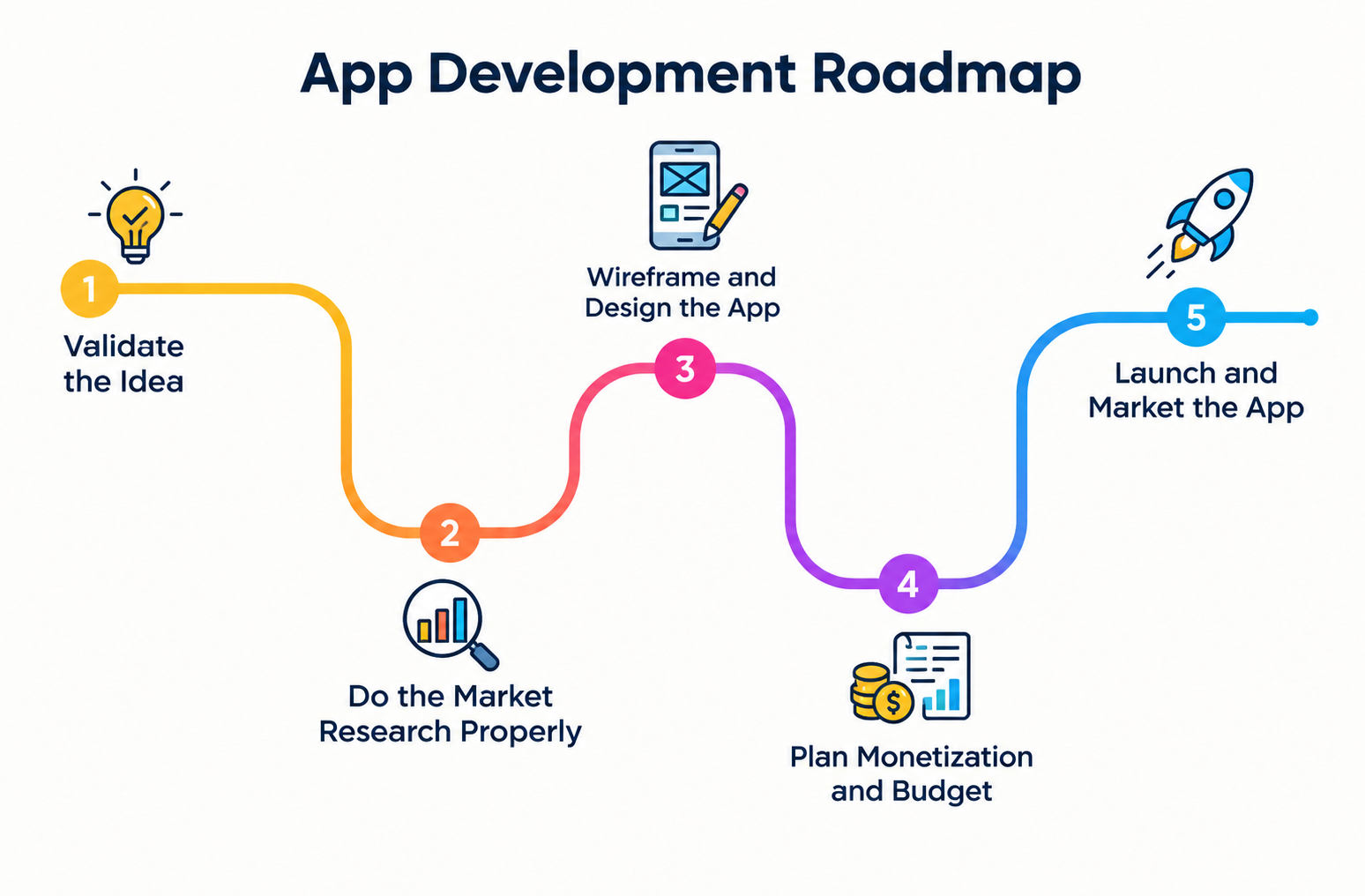
Phase 1. Validate the Idea
An idea that sounds good in a pitch meeting isn't automatically an idea people will pay for or download. Before spending anything on it, look at what already exists in that space and figure out why those apps didn't stick around. Usually the answer points to a gap you can build into, rather than a feature you should just copy.
The apps that do well tend to solve something nobody's handled cleanly yet. If the market's already crowded with decent solutions, look for where they fall short instead of trying to out-feature them. Google Trends is a reasonable first check on whether people are actually searching for what you're building. Keyword Planner adds real numbers to that, so you're not guessing at demand.
Phase 2. Do the Market Research Properly
Most early teams are small, often under fifteen people, and nobody on staff owns market research as a job. That's usually why it gets rushed. Before moving into design, you need honest answers on a handful of things: what the app is actually for in one sentence, who's going to use it, what makes it different from what's already out there, who the competitors are and where they're weak, what the whole thing will cost to build and keep running, and how you plan to reach the first wave of users.
Talking about the idea openly usually produces better feedback than protecting it does. Most ideas don't fail because someone stole them. They fail because nobody executed well. Understanding what a customer is actually struggling with, in their own words rather than your assumptions about it, feeds directly into the mobile application development roadmap you build from here.
Phase 3. Wireframe and Design the App
Before anyone opens Figma or Photoshop and starts making it pretty, sketch out what's on each screen and how someone gets from one to the next. Yes, actual sketching, even on paper, works. A lot of teams skip this because it feels like busywork, then spend three weeks in month two rebuilding a screen flow that made no sense, which a five-minute drawing would've flagged on day one.
Once that's done, you'll know roughly what the app looks like, whether tapping around it actually makes sense, and honestly whether the whole idea solves the problem you started with. Sometimes it doesn't, and that's a much cheaper thing to learn now than after development's underway.
Design work comes after, and it pulls straight from whatever you learned during market research earlier. This is where someone decides how the interface and backend architecture fit together, puts together a style guide so the app doesn't feel like five different apps stitched into one, and builds out the actual mockups. Figma's the default tool for most teams now; Photoshop and Sketch have mostly fallen out of use for this. Last step before development is a clickable prototype, something that behaves enough like the real app that you can test the flow without writing a single line of production code yet.
Phase 4. Plan Monetization and Budget
Monetization isn't a decision you make after the app is built; it has to get settled before development starts because it actually changes what gets built. Freemium works well if you want downloads fast, since there's nothing stopping someone from trying it. In-app purchases turn the app into a repeat revenue source instead of a one-off, and this is where e-commerce and gaming apps tend to make most of their money. Subscription only really makes sense for apps people come back to often, usually content-heavy ones.
On the budget itself: Sensor Tower's numbers put in-app purchase and paid-app revenue across iOS and Google Play at $167 billion for 2025, up over 10% from the year before, and early 2026 numbers are running ahead of that pace. None of that money is guaranteed to land in your pocket, though. What your actual budget ends up looking like comes down to how disciplined the feature list stays (scope creep is still the number one way budgets blow up), whether you go native on both platforms or cross-platform with one codebase, and what maintenance costs once the thing is actually live, which almost everyone underbudgets for.
Phase 5. Launch and Market the App
Pick an actual launch date and treat it like a deadline. The moment the app goes live, feedback starts coming in, and the next release should get shaped by that feedback, not by whatever the original spec assumed.
Marketing deserves just as much planning as the build did. Most launches run on some mix of social media, paid ads, email marketing, SMS marketing, and App Store Optimization to get that first wave of downloads moving, and that mix is really the mobile app development strategy for the weeks right after launch. Look closely at apps in your category that failed too. They tend to show the exact mistake worth avoiding, which is often more useful than trying to reverse-engineer whatever worked for a competitor.
Do's and Don'ts to Consider for Successful App Development Process
A well-planned app development process starts with knowing what to prioritize and what to avoid. The following do’s and don’ts cover key areas such as planning, design, development, testing, security, and scalability to help you build an app that is reliable, user-friendly, and easier to maintain.
What to Do
People don't give a new app much time. If the download is slow or the first screen leaves them guessing what to do next, they close it and move on, often without giving the app a second try. Good flow mapping earlier on is why this doesn't happen as often. It's not just a step you finish before development starts; it's the reason screens connect the way they should once actual code replaces the sketches.
Platform strategy is also worth rethinking from how it used to work. Choosing between iOS and Android used to mean picking one to launch first and dealing with the other months later. Flutter and React Native have changed that math for a lot of teams, since a single codebase can now target both platforms without maintaining two separate builds. It's not free of tradeoffs. Apps that depend heavily on specific hardware, tight camera control, or precise background location tracking are common examples that still tend to perform better built natively. But for a large share of apps, cross-platform is now the sensible starting point rather than a fallback.
Recommended Read: How to Hire App Developers – A Comprehensive Guide
What Not to Do
Adding a feature because it seems like a good idea, rather than because someone actually asked for it, is one of the fastest ways to make an app harder to use and easier to break. It's tempting to keep adding once development is already underway. Resisting that is often harder than the build itself. The apps that hold up well tend to do fewer things, and do them without friction.
Copying a successful app rarely reproduces its success. Whatever made the original work- the timing, the audience it launched into, the trust it built early- doesn't come along with the feature list. A clone usually arrives late and without any of that context.
Rushing to hit an internal deadline almost always costs more than the delay would have. Users have no idea the team was under pressure; they just see an app that breaks the first time they open it, and most won't come back to give it a second chance. A smaller app that actually works will earn more trust than a full one that doesn't. Deadlines have a way of testing whether a mobile app development strategy was real or just something written down for a slide.
Conclusion
None of the five steps here work well in isolation. Validating the idea without real market research just moves the guesswork downstream. A solid design without a monetization plan behind it means rebuilding the business model after launch instead of before it. Rushing past QA to hit a launch date tends to cost more in user trust than the time saved was ever worth.
What ties it together is treating the roadmap as a sequence rather than a checklist to get through. Idea validation shapes what market research actually needs to answer. That research shapes the design and feature set. The feature set shapes the budget and the monetization model. And how well all of that holds together is what gets tested the moment real users start using the app.
If you're mapping this out for your own app, it's worth getting a second set of eyes on the plan before committing budget to development, whether that's a technical co-founder, an advisor who's shipped an app before, or a development team that can walk through the tradeoffs with you.
Frequently Asked Questions
 There are numerous advantages to developing a mobile app. Having mobile apps can help businesses reach a wider audience, improve customer engagement, and maximize sales. In some scenarios, it is used to collect data and insights about customers, which eventually help to improve products and services.
The steps involved in developing a mobile app depend on the app type and the business requirements. However, some steps are
1. Ideation: The first step is to come up with an idea for the app. This should be relevant to the business and its customers.
2. Market Research: Once you have an idea, you need to do some market research to see if there is a demand for your app. You can do this by surveying potential customers, analyzing your competitors, and looking at industry trends.
3. Designing: Once you have validated your idea, you need to design the app. This includes creating wireframes, mockups, and prototypes.
4. Development: Once the design is complete, you need to develop the app. This involves coding the app and testing it on different devices.
5. Testing: After the app is completed, you need to test it thoroughly to ensure it is error-free and works as expected.
7. Marketing: Finally, don’t skip this part for your app’s undefeatable success. Marketing can be done through online advertising, social media marketing, and also public relations.
The cost of developing a mobile app depends on the app’s complexity, the features and functionalities to include, and the experience of the development team. However, the ballpark estimate for developing a mobile app varies from a few thousand dollars to hundreds of thousands of dollars.
Here are some proven tips for developing a successful mobile app:
-
Ensure the app is relevant to your target audience.
-
Do market research to assess app demand
-
Keep your app design user-friendly and intuitive- Keep your app design user-friendly and intuitive
-
Test the app before launching
Market your app to the right target audience Test the app before launching








 4.8 out of 5 by