Companies are outsourcing programming work more than ever, and the reasons are pretty practical: it's cheaper, it's faster, and it opens up access to developers you might not find locally.
92% of G2000 companies already use IT outsourcing in some form. Deloitte's Global Outsourcing survey puts the number even higher for development specifically, with 54% of companies hiring developers this way instead of building everything in-house.
Small teams outsource because building an engineering department from scratch takes time and money most startups don't have yet. Bigger companies do it too, just for different reasons. Sometimes the internal team is already maxed out on other work. Sometimes nobody on staff has touched machine learning or a specific cloud platform before, and hiring for that one skill full time doesn't make sense.
Picking the right outsourcing company matters more than most people expect going in. There's a real difference between a software outsourcing company that just staffs bodies against a project and a development partner that actually understands your tech stack and business goals. This guide walks through the different outsourcing models, what separates a good outsourcing partner from a risky one, and what should be in the contract before you sign anything.
What Is Programming Outsourcing?
Programming outsourcing means bringing in developers from outside your company to handle software work, either through an outsourcing agency or by hiring individual contractors directly. Outsourcing programming can involve having the entire project completed by the outsourced software developers or just a few lines of code, with expertise in working on various digital solutions.
It also goes by other names. Some people call it programmer outsourcing; others just say outsource programming or software development outsourcing. The terms overlap enough that they're mostly interchangeable in practice.
According to a Global Outsourcing Survey by Deloitte, over three-quarters of the surveyed executives said they outsource their IT functions.
8 Key Benefits Of Outsourcing Programming
Outsourcing has become a default move for startups and larger businesses alike, not just as a stopgap but as a real strategy for building software. The global IT outsourcing market reached $638 billion in 2026, according to Mordor Intelligence, with 92% of Global 2000 companies outsourcing at least one IT function. Roughly 44% of outsourcing contracts now include AI and automation components, and just under half of organizations, about 49.6%, plan to increase outsourcing spend this year, with fewer than 10% planning cuts
Cost savings and specialized skills are usually what gets a company to consider it in the first place. Here's a closer look at why outsourcing programming keeps growing.
1. Lower Development Costs
Full-time in-house developers come with more than just salary. Benefits, office space, equipment, and hiring costs all add up. Outsourcing sidesteps a lot of that. Around 59% of companies outsource mainly for cost efficiency, often by working with skilled developers in countries like India where development costs are lower.
2. Access to a Wider Talent Pool
Talent acquisition is a real bottleneck. Roughly half of corporate executives point to it as one of their biggest internal challenges. Outsourcing opens up a global pool of engineering talent, including niche skills and domain expertise that might not exist locally. Need a full-stack team or someone with a specific tech stack background? The odds of finding that person go up considerably once you're not limited to one city or one country.
3. Scalability and Flexibility
Business needs shift, sometimes seasonally, sometimes overnight. A retail company might need extra developers during a product launch and far fewer once things stabilize. A dedicated team or staff augmentation model lets you scale up or down without the cost of hiring and then laying off an in-house team. Deloitte's research found 59% of businesses cite this flexibility as a major reason they outsource.
4. Faster Time-to-Market
Distributed teams working across time zones can keep a project moving almost around the clock. That overlap helps compress development timelines without cutting corners on quality assurance, which matters when a delivery model depends on hitting deadlines.
5. More Room to Focus on Core Business
Every hour spent managing an internal software team is an hour not spent on strategy, sales, or product direction. Handing programming work to an outsourcing partner frees up internal teams to focus on what actually grows the business.
6. Access to Modern Tech Stacks
Keeping up with tools like Angular, Flutter, or newer cloud platforms takes ongoing investment that not every company can justify for a small in-house team. Outsourcing firms typically stay current on emerging technologies since it's core to what they sell, which means you get access to a modern tech stack without maintaining it yourself.
7. Stronger Security Practices
Data security is one of the more common concerns companies raise about outsourcing. A PwC study found 69% of organizations see it as a real challenge. That risk is manageable with the right vendor. Around 94% of businesses say outsourcing has actually helped improve their security posture, largely because established outsourcing companies build data protection and industry best practices into how they work. The key is vetting the outsourcing partner carefully and getting data security standards written into the contract upfront.
8. Support for AI, Machine Learning, and Emerging Tech
Building an in-house team around AI, machine learning, or large language models is expensive, especially if the work is project-based rather than ongoing. Outsourcing this kind of specialized work lets a company access that technical expertise on a defined budget instead of committing to a full-time hire for something short-term.
4 Main Steps To Outsource Programming
Although outsourcing programming services brings a myriad of advantages to businesses, there are a few essential factors that need to be considered to ensure that you have chosen the right development partner for you. Below, we have compiled a list of essential things that you must consider.
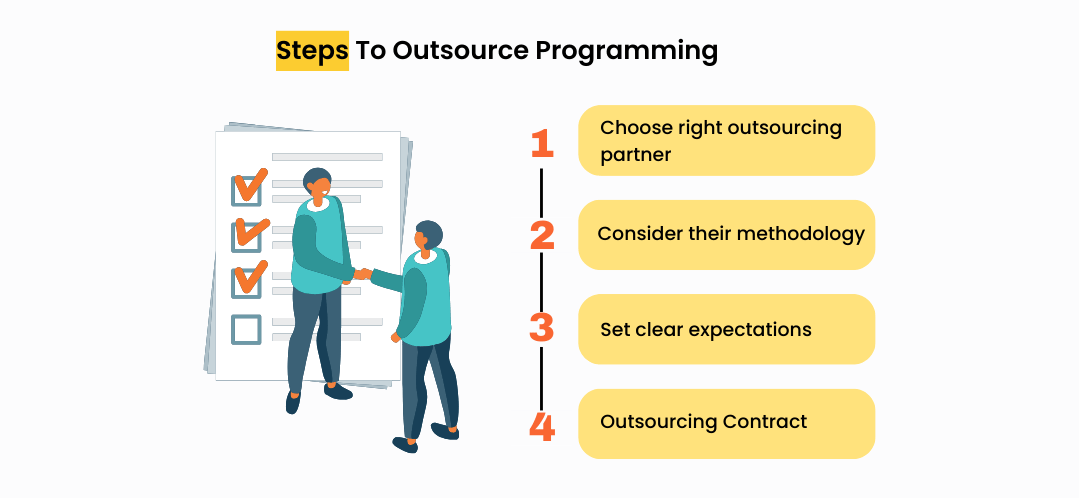
1. Choose the right outsourcing company
When searching for an IT outsourcing company, it's essential to verify that they possess the necessary skills and technical expertise for your project. Choosing the right IT outsourcing partner involves following a systematic process. However, when making your selection, be sure to consider the following:
-
Check if they have relevant experience in delivering similar development projects.
-
Looking at their previously successfully delivered projects.
-
Consider word of mouth for a brand's programming services.
-
Verifying their testimonials and proven track record.
-
Checking the quality of their work for their past programming outsourcing solutions.
Would you like to learn more about how to select one? You can find comprehensive information about IT outsourcing partners in this blog post.
2. Consider their methodology
Every outsourcing partner works with different methodologies to pursue the necessary tech tasks vital to executing the project.
Agile methodology is one of the most common and efficient approaches to development, as it enables iterative feedback for each phase of the process. Be it coding or the UI UX design of the application developed through code, it runs thorough checks and ensures quality assurance. This way, the client and the developer can be assured that the project is ongoing and has the same goal and intention.
And if any improvement is required, it can be made beforehand. You can choose outsourcing vendors by following the right methodology for project management, ensuring predictable delivery and that the project doesn't cost you more.
3. Set clear expectations
Ensure that you state your expected outcomes precisely when collaborating with programming outsourcing companies. Clearly communicate to project managers what you want from the project, the tech tasks, and their necessary deadlines. Include all details in the outsourcing contract to avoid any misunderstandings.
These may involve a focus on core technology selection or integration of advanced machine learning techniques, with a check on quality assurance benchmarks. Therefore, everything you need, from UI UX design to software testing to other IT-related services, must be clearly described by your company representative to the offshore development company.
4. Outsourcing Contract
Once you have found a reputable outsourcing partner, the next step is to sign the programmer outsourcing contract.
Just like any other agreement, the software outsourcing contract needs to include some essentials, such as general terms, conditions, risk management, dispute resolution, and more; below are some of the essential pointers that are must-haves for a contract.
-
The services: The services section must describe the services in detail. For instance, web development, app development, frontend or backend development, quality control, etc. must be separately specified. This also includes the project scope that you expect your IT outsourcing company to deliver.
-
Project cost and time: This section clearly states hourly rates, milestones, development phases, and deadlines. It also includes who will be responsible for delays, the payment schedule, and more.
-
Intellectual Property Rights: The IP rights clearly state that the code and project will be handed over to the client upon completion. It may require signing NDAs and defining infrastructure management guidelines while clearly stating that the product belongs to the customer and not the programming outsourcing vendors.
-
Acceptance Testing: This includes the tests to be conducted to determine whether the contract requirements are met. It also states which party is responsible for testing, how the results are communicated by project managers, and if the in-house team and outsourced developers work together.
-
Confidentiality: This section includes information about the non-disclosure agreement, and the information needs to remain confidential throughout.
Must Read: Best Practices for Software Development Outsourcing
How to Measure Success After You Outsource Development
A signed contract doesn't tell you much. You find out if outsourcing actually worked a few weeks or months into the project, once code starts shipping and problems start showing up, or don't.
Track a few basics from day one. How far off is delivery from what was promised. How many bugs show up after something ships. How long it takes to get a fix when something breaks. None of this is complicated, but a lot of companies skip tracking it and end up going on gut feeling instead.
1. Track Client Feedback Early
Pay attention to how communication feels in the first couple weeks. If it's already slow or confusing, that's usually not a phase; it's how things are going to be. Check in often, not just when a milestone is due. Catching a problem in week two is a lot easier than catching it in month three.
2. Define Expected Outcomes Upfront
Decide what "this worked" actually means before the project starts. A launch date. A performance number. A defect count you're willing to accept and one you're not. Without something concrete, you're just guessing at the end whether it went well.
3. Watch for Continuous Improvement Over Time
A good outsourcing partner should get better at working with you as time goes on, not just better at the code. They start picking up on how your team communicates, what actually matters to you versus what's just noise, and where the shortcuts are. That kind of knowledge transfer is easy to overlook, but it's usually what separates a partner you keep working with from one you drop after the first project.
Most Common Models of Outsourcing Programming
There are three main outsourcing models you can use to outsource programming.
1. Fixed-Price Outsourcing Programming
If you have a small or medium project and need short-term help from experienced developers, like some basic mobile app development, this model could work for you to gain speed. Professionals have a specific set of tasks and processes, and the cost is fixed for the project.
Advantages
-
Budget certainty
-
Clearly defined expectations
-
Focus on meeting deadlines
Cons
-
Inflexibility
-
Potential for overestimation
2. Time & Material Model
This model is more flexible than the fixed-price model. It allows for adjustments in cooperation, team composition, tech stack, and project requirements.
It's best suited for small and medium-sized projects that need a skilled programming workforce.
Advantages
-
Flexibility
-
Transparency
-
A focus on quality
Cons
-
Budget uncertainty
-
Need for involvement
3. Dedicated Team Model
This model works well when you're outsourcing to a development company for the long haul. It offers full flexibility, letting you hire a team of skilled engineers and manage them directly for your web or app development goals, similar to how staff augmentation extends an in house team.
It's ideal for large, complex projects where the team needs to adapt quickly to changes. Costs are determined monthly per professional, which actually makes budgeting more predictable over time even though the upfront rate runs higher than the other two models.
Advantages
-
Full control and integration
-
Consistency and long-term commitment
-
High flexibility
Cons
-
Higher monthly cost, though this often pays off through consistency and reduced hiring overhead
-
Requires some ongoing resource management on your end
When it comes to embracing the capabilities of outsourcing programming services, many well-known brands have also been seen taking advantage. Let's take a look at some of them:
1. Google
Even though Google is the biggest search engine in the world, did you know that it still uses outsourced programming services? That's right. Google takes advantage of third-party services and still outsources some of its development tasks to reduce costs.
2. Alibaba
Alibaba has also benefited from using outsourced talent. The rapid growth of China's e-commerce giant demonstrates how it has taken advantage of outsourcing to fuel its business growth, rather than sticking to a tedious hiring process.
In-House Team vs. Outsourced Programming: Which Fits Your Project
Not every project needs the same answer. Some work is better handled by people who already know your codebase inside out. Other work is better handed to someone outside the building entirely.
An in-house team makes more sense when the work touches core product decisions on an ongoing basis, or when there's a lot of technical debt tied up in legacy systems that only your own engineers fully understand. Deep, long-term system integration work across enterprise systems often falls into this category too, since it usually requires institutional knowledge that's hard to hand off cleanly.
Outsourcing tends to make more sense for defined projects with a clear scope: a cloud migration, standing up new infrastructure on a specific cloud platform, building out a new product from scratch, or any project where digital transformation initiatives need specialized skills your current team doesn't have and won't need permanently.
A lot of companies land somewhere in between. Core product work stays in-house, while a defined project, like migrating to new cloud platforms or modernizing part of a legacy system, goes to an outsourced team. This hybrid approach tends to improve operational efficiency without requiring a company to staff up for a project that has a clear end date.
Wrapping Up
Outsourcing programmers is a convenient way for businesses seeking access to specialized expertise in mobile or web development without deploying an in-house setup.
However, finding the right outsourced programmer can be complicated as the one you partner with must be reliable. That is where Your Team in India comes into the picture!
We bridge the gap by making it easy for you to access the top talents and hire Indian developers for everything from project development to project management. We leverage cutting-edge technologies to deliver outstanding software solutions.
Get in touch to discuss your programming outsourcing requirements today.
Frequently Asked Questions

Yes. A lot of companies treat programming outsourcing as an ongoing part of how they build software, not just a short-term fix. Working with a reliable outsourcing partner gives you access to specialized skills, lowers development costs, and keeps things flexible as the business grows. It also frees up your internal teams to focus on core work instead of getting pulled into every technical task.
Projects with clear requirements tend to work best. That includes web development, app development, custom software development, and UI/UX design. It also works well for anything that needs niche skills your team doesn't have in-house, or work that's project-based rather than ongoing.
The main ones are cost savings, access to skilled developers from around the world, more flexibility in how you staff a project, and more time for your team to focus on core business functions instead of managing every technical detail themselves.
Software development outsourcing does come with real risks. Communication can get harder across time zones or language differences, quality control needs more attention when work happens remotely, and data security is a valid concern with any external team. Managing an outsourced team usually means more oversight than managing people down the hall. None of this is a deal breaker, but it's worth planning for with clear risk management practices and the right vendor from the start.
A few things worth checking before you commit:
- Their technical expertise and domain expertise in your specific tech stack
- A proven track record on similar projects
- How well they communicate, and how responsive they are early on
- Transparent pricing, with no hidden fees buried in the contract
- Whether they can scale the team up or down as the project changes
- Case studies and client feedback from past work
- Time zone overlap with your team
Yes. Outsourcing gives small businesses and startups access to experienced developers without the cost of building a full in-house team from day one. It also makes it easier to scale up or down as things change, without the overhead of hiring and letting people go.
Costs vary a lot depending on project complexity, team size, the specific tech stack involved, and where the developers are located.

By Mangesh Gothankar


By Ashwani Sharma
By Achin Verma







 4.8 out of 5 by