Cutting costs is only part of why businesses look at IT outsourcing. Plenty of companies do it because they can't find the right skills locally. Try finding five senior engineers who specialize in a niche stack in a mid-sized US city on a normal budget. Good luck.
People quote that 40% to 70% savings number constantly, and it's basically true on average. But average numbers are useless when you're the one signing a contract and trying to reduce costs on a real project. A junior developer in Poland runs $35 to $50 an hour. A senior machine learning engineer in India can run $60 to $90. Both count as outsourcing, both fall inside that 40-70% range somebody quoted you, and they're not remotely the same decision once you factor in project scope.
Hiring in-house is slow and expensive too. A single senior hire can take three or four months from job posting to start date. Add benefits, office space, and equipment, and the meter's running before anyone writes a line of code. Understanding IT outsourcing costs upfront is what separates a good decision from an expensive one.
Is IT Outsourcing really cost-effective?
Is IT outsourcing actually worth it, or is that just something outsourcing companies say to close deals?
It depends on the provider, but the numbers usually work out. IT outsourcing means paying an outside provider to handle IT services you'd otherwise build with an in-house team, from writing code to keeping servers running.
The savings aren't really the interesting part, though. You're also buying access to people you couldn't hire locally even with a bigger budget. A compliance-heavy fintech project might need someone who's worked with specific banking regulations in three countries. Good luck finding that person through a local job posting. Outsourcing puts you in front of a talent pool that's actually large enough to have that person in it.
None of this happens by accident. Pick a bad provider, and you'll spend more fixing their work than you would have paid an in-house team from day one. The savings are real, but only after you've done the vetting.
Recommended Read: The All-In-One Guide to Software Development Outsourcing
What Are the Costs of IT Outsourcing?
IT outsourcing comes with direct costs and indirect costs, and most companies only budget for the first kind. Here's what actually shows up on the bill.
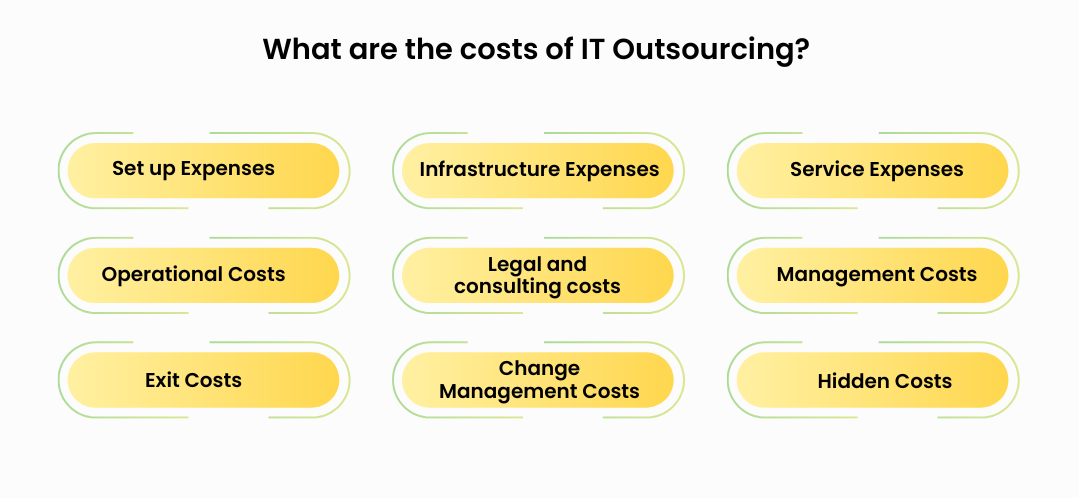
1. Set-Up Expenses
Set-up costs hit before any actual work begins. Signing the outsourcing agreement is the easy part. Moving your data over, transitioning services, and getting infrastructure in place with the outsourcing provider is where the real time goes.
2. Infrastructure Expenses
Hardware, software licenses, cloud services, backup systems, disaster recovery. These add up fast if nobody's tracking them against the original outsourcing pricing quote. Businesses that manage infrastructure costs closely tend to catch scope creep before it becomes a real problem.
3. Service Expenses
This is the core spend: software development, application maintenance, system administration, managed IT services, and similar work. Providers bill it differently depending on the deal. Some charge fixed-cost, some per-user, some per-device, some per-service. Know which model you're signing up for before you compare rates.
4. Operational Costs
The outsourced IT service needs upkeep once it's live, and this is the part most pitches gloss over. System upgrades and software licensing renewals keep coming. So does technical support. None of it shows up as a line item until the second or third invoice.
5. Legal and Consulting Costs
Somebody has to sit down and actually negotiate the outsourcing contract, not just sign whatever the provider sends over. Drafting takes time, review takes longer, and neither ends when the ink dries. Regulated industries have it worse. Laws shift, and legal review has to keep pace with them.
6. Management Costs
Somebody on your side has to manage the relationship. That means staff time for communication with the outsourcing vendor, oversight, and coordinating their work with your internal teams. It's easy to underestimate how many hours this eats.
7. Exit Costs
Ending an outsourcing relationship costs money too. Transitioning the service back in-house or to a new provider takes time and resources, and contract termination fees can be steep depending on how the agreement was written.
8. Change Management Costs
Scaling the engagement, adding new services, switching providers. Any of these can trigger extra charges under the outsourcing agreement. If your team needs training on new systems as a result, add that cost too.
Hidden Costs
This is the category that catches people off guard. Marketing expenses for the delivered product are one example. A few others worth watching for:
-
Sticking with an outdated outsourcing strategy long after it stops making sense
-
The overhead of managing multiple service providers at once
-
A sales and operations strategy that doesn't match how the provider actually works
-
Warranties and other contractual allowances
-
Risks nobody planned for
-
Work that comes back below the quality bar
-
Logistics problems that force expensive last-minute fixes
Working with an experienced outsourcing provider cuts down on most of these. It doesn't eliminate them.
Factors Impacting the Cost of IT Outsourcing
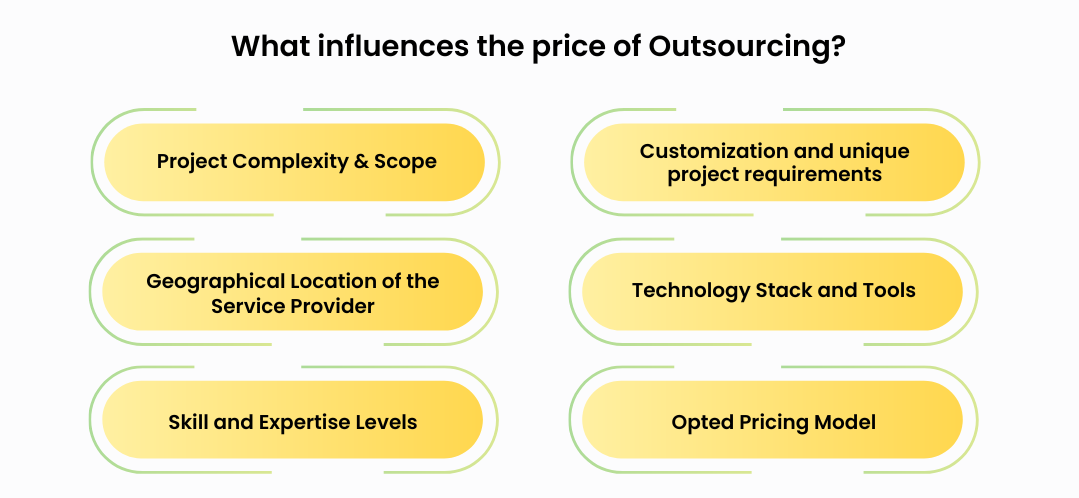
Not every outsourced project costs the same, and the gap can be huge. A basic MVP might run six weeks on a modest budget. A custom enterprise platform can hit six figures before launch. What decides where your project lands comes down to a handful of factors. Before evaluating the costs of IT outsourcing services and considering potential savings, it is important to understand the various factors that impact them
1. Project Complexity and Scope
A simple app with standard features is cheap to build. Add custom integrations, advanced functionality, or a newer tech stack, and the hours pile up fast. Complexity is the single biggest lever on price, more than almost anything else on this list.
2. Geographical Location of the Service Provider
Location changes the math more than people expect. A developer in San Francisco and a developer in Bangalore might write equally good code, but their hourly rates aren't close. As of 2026, senior developer rates look roughly like this:
India holds its position as one of the best value outsourcing destinations. The skill level hasn't dropped. The price has just stayed low relative to everywhere else.
3. Skill and Expertise Levels
Generalists cost less. Specialists cost more, and niche expertise; someone who's worked deeply with a specific AI framework or a rare compliance standard- commands a real premium no matter which region you're hiring from.
4. Customization and Unique Requirements
Buying something off the shelf is always cheaper than building it custom. Every feature that deviates from a standard build adds development hours, and those hours are the actual bill.
5. Technology Stack and Tools
Certain frameworks need specialized expertise. Some need paid licenses. Either one adds cost before a single feature ships.
6. Project Timeline and Deadlines
Need it faster than the provider's normal pace? That's a rush job, and rush jobs get charged accordingly.
7. Quality Assurance and Testing
Skip QA, and you'll pay less now, more later. A missed bug in production costs far more to fix than catching it during testing, even though testing itself takes real time and real money.
8. Scalability and Flexibility
A fixed-scope build has a predictable price. A project that needs to scale up or down as demand shifts doesn't, and that flexibility carries its own cost structure.
9. Legal and Compliance Considerations
Data protection laws, industry regulations, IP rights. None of this is optional, and regulated industries in particular end up paying for legal review on top of development.
10. Post-Implementation Support and Maintenance
The invoice doesn't stop at launch. Factor in ongoing support and maintenance from the start, because it's coming whether you planned for it or not.
11. Communication and Collaboration Requirements
Time zone gaps and language barriers slow things down and cost money to bridge. Providers with strong cultural alignment to your team tend to move faster simply because less gets lost in translation.
12. Service Provider's Reputation
A well-known, experienced outsourcing provider charges a premium. Most of the time it's justified. Fewer costly mistakes mean less rework down the line, and rework is where budgets actually get blown.
Line these factors up against any quote you get, and you'll know pretty quickly whether an outsourcing vendor's price makes sense or not.
Deciding between an in-house team and outsourcing usually comes down to one question: where does the money actually go?
An internal IT team costs more than the salary line suggests. Recruitment eats weeks. Onboarding eats more. Then there's office space, equipment, software licenses, training, and the cost of backfilling anyone who leaves.
-
Salaries and benefits
-
Recruitment and Onboarding
-
Office space and equipment
-
Software licenses and tools
-
Ongoing training
-
Turnover and backfill costs
A slow month doesn't shrink any of that. You're still paying full salaries whether the team is buried in work or waiting on the next project to start.
Outsourcing works differently. You're mostly paying for the work itself.
-
Hourly rate or fixed project fee
-
Setup and onboarding with the outsourcing partner
-
Project management and communication tools
-
Ongoing support after launch
An outsourcing cost calculator can rough out an estimate based on team size, skill level, and project length. But the number that actually matters is everything missing from that list. No office lease. No benefits package. No idle payroll between projects.
Planning something longer than a single project? Running an offshore development center has its own cost profile worth checking separately.
For the full comparison, see our guide on in-house vs. outsourcing.
Can IT Outsourcing Cost Less Than Hiring An In-House Team?
Outsourcing IT services is a cost-effective solution for businesses that require specialized skills, need to manage short-term projects, want to reduce overheads, and desire flexibility in resource allocation. Although both options have advantages, there are situations where IT outsourcing can provide significant cost benefits compared to hiring an in-house team. Here are some key scenarios where outsourcing proves to be the more economical choice:
-
Choosing the correct service provider
-
Establishing clear and open communication
-
Securing the necessary skills and expertise
-
Emphasizing superior quality over cost considerations
-
Having greater control and flexibility
-
Avoiding hidden expenses
How to Evaluate IT Outsourcing Costs?
Start by subtracting the outsourcing cost from the in-house cost. That gap is the whole point of differential cost analysis.
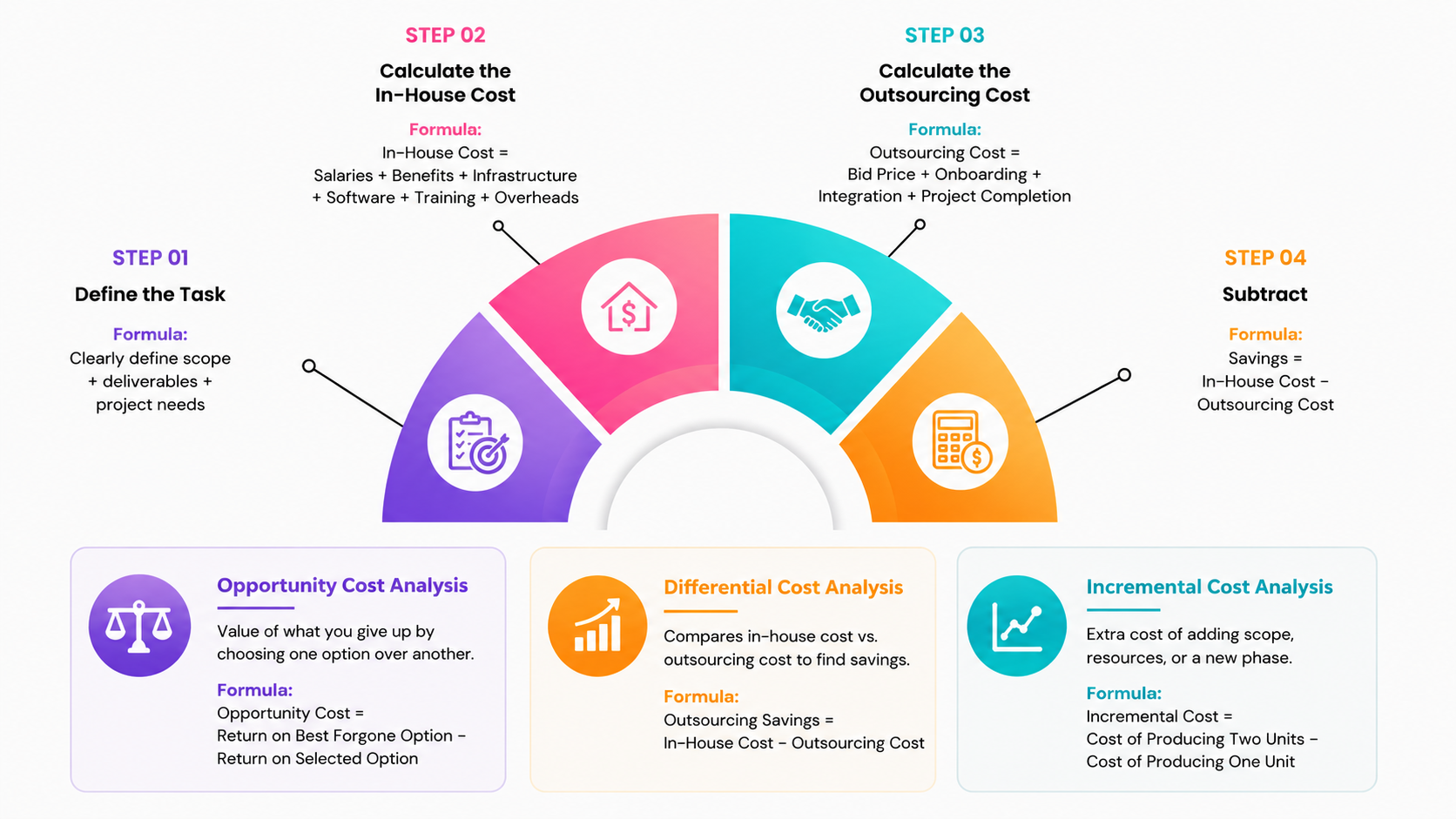
Step 1: Define the Task
Vague scope gives you a vague number. Nail down what you're actually outsourcing first: platform, UI/UX, core functionality, backend infrastructure, how much customization you need, and whether this is an MVP or the full build. Skip this step and the comparison you run later won't mean much.
Step 2: Calculate the In-House Cost
Salaries, benefits, supplies, IT infrastructure, hardware, software, training. All of it counts. For a mid-size software product development project staffed in-house, that total tends to land somewhere around $190,520.
Step 3: Calculate the Outsourcing Cost
Now total the outsourcing side: bid price, integration work, onboarding, everything through project completion. That same project outsourced might run around $80,000.
Step 4: Subtract
$190,520 minus $80,000 equals $60,480 in savings.
That's differential cost analysis in action.
Differential Cost Formula:
Outsourcing Savings = In-House Cost − Outsourcing Cost
Opportunity Cost Analysis
Opportunity cost is what you give up by picking one option over another. Say you build in-house instead of outsourcing software development. You didn't just spend more money. You also lost the faster delivery timeline, the lower total cost, and the specialized talent your local market couldn't offer. That loss is the opportunity cost, even though it never shows up on an invoice.
Opportunity Cost Formula:
Opportunity Cost = Return on Best Forgone Option − Return on Selected Option
Incremental Cost Analysis
Incremental cost, also called marginal cost, is easy to underestimate. It's the added expense of producing one more unit, or in outsourcing terms, the extra cost of adding scope, headcount, or a new phase to an existing engagement with your outsourcing vendor.
Incremental Cost Formula:
Incremental Cost = Cost of Producing Two Units − Cost of Producing One Unit
Run all three methods side by side, and comparing in-house cost against IT outsourcing cost stops being a guess. Once you know the real numbers, calculating IT outsourcing cost for your next hire gets a lot faster.
What to Expect From IT Outsourcing In 2026?
Rates shift year to year based on inflation, currency swings, and demand. Here's where things stand across major outsourcing destinations in 2026.
Latin America
Rates edged up 6% to 10% from 2025, mostly tracking inflation and currency movement.
Eastern Europe
Rates stayed close to flat, up just 1% to 10%, largely a result of the region's ongoing geopolitical situation holding growth back.
South Asia
Still the most affordable major outsourcing region, even after a 6% to 15% rate increase this year.
South East Asia
Rates held mostly steady, with a modest 3% to 10% bump.
How to Calculate IT Outsourcing Cost?
A simplified response to this question can be provided through either a fixed fee, representing the cost for a specific project and timeline, or by employing the following outsourcing cost formula:
Total Number of Hours X Hourly Rate = Cost
However, to get an accurate estimation around this, checking out the real-time costing of IT outsourcing and the skill set required could be an optimal solution. Check out the Outsourcing Cost Calculator based on the skill set required for a specific project.
How Can "Your Team in India" Help?
Tight budget, and your in-house team is missing skills you can't hire for fast enough? That's usually when IT outsourcing starts making sense.
Your Team in India puts together a dedicated team that actually stays on your project. The same developers who scope the work in week one are still there at launch, so nobody's re-explaining the codebase to a new outsourcing vendor every quarter. That's the difference between outsourcing services from a vendor that treats you like a ticket number and one that treats your product like it matters.
Take the 7-day trial first. See how the team handles real work before committing to anything longer.
Frequently Asked Questions

In 2026, IT outsourcing costs typically range from $20 to $60 per hour in regions like India and Southeast Asia, $30 to $70 per hour in Eastern Europe, and $100 to $150+ per hour in the US and Western Europe. The final rate depends on expertise level, technology stack, and engagement model.
Businesses can minimize hidden outsourcing costs by clearly defining project scope, choosing transparent pricing models, setting measurable KPIs, conducting regular performance reviews, and partnering with vendors that follow strong governance, documentation, and security practices.
Yes. Despite inflationary pressures, IT outsourcing remains cost-effective in 2026 due to access to global talent, optimized delivery models, cloud-based infrastructure, and flexible hiring. Outsourcing continues to reduce long-term costs compared to maintaining full in-house teams.
The fixed-price model works best for well-defined projects, while time-and-material is ideal for evolving requirements. For long-term engagements in 2026, many businesses prefer dedicated team models as they offer predictable costs, scalability, and better cost control.

By Mangesh Gothankar


By Ashwani Sharma
By Achin Verma




.png?width=352&name=IT%20Outsourcing%20Companies%20(1).png)


 4.8 out of 5 by