Fintech has accelerated globally over the past few years. The global fintech market was worth USD 394.88 billion in 2025 and is projected to hit USD 460.76 billion in 2026, reaching USD 1.76 trillion by 2034 at a CAGR of 18.20%.
The company count has grown with it. North America alone hosts more than 12,500 fintech companies, Europe close to 10,000. They compete for the same narrow group of developers who understand card network rules, KYC pipelines, ledger design, and the audit trails that come with holding other people's money. Filling one senior fintech role in the US or Western Europe takes four to six months at a salary most early-stage companies can't sustain across a team.
That gap is the reason financial services outsourcing has shifted from a cost decision to a staffing one, and why choosing the right fintech software development company now matters more than the hourly rate you negotiate.

Source: Allied Market Research
What is Fintech Software Development Outsourcing?
Fintech software development outsourcing is an arrangement where a financial technology company contracts an external engineering firm to build, maintain, or extend its software. The vendor employs the developers, handles payroll and infrastructure, and assigns them to the client's product. The client keeps ownership of the code, the roadmap, and the customer relationship.
Three arrangements dominate the market:
Dedicated team: The vendor assembles a group of developers who work only on your product, usually for a year or longer. You run the standups and set priorities. The vendor handles hiring, replacement, and retention. Most companies building a full product choose this model.
Staff augmentation: You bring in individual developers to fill specific gaps on an existing team, such as a payments integration specialist for a six-month card processing build. Your engineering manager runs them the same way they run internal staff.
Project-based delivery: You define a scope and deadline, the vendor delivers against it, and the engagement ends. This works for contained pieces of work like a compliance reporting module. It works badly for products where requirements shift, which describes most fintech builds.
The distinction matters for compliance. Under a dedicated team arrangement, developers work inside your security perimeter and follow your controls, which auditors treat differently from a vendor building externally and shipping you a finished artifact.
Why Do Fintech Companies Outsource Software Development?
Speed is the usual answer, though it is worth being precise about where the time savings come from.
Hiring a senior payments engineer in the US or UK takes months of sourcing, interviewing, and notice periods before a single line of code gets written. An established outsourcing partner has those developers on staff already, often placing a working team within two to four weeks. On a product where a competitor's launch date determines your market position, that difference decides the outcome.
Compliance experience is the second reason, and the one companies tend to discover late. A developer who has already shipped software through a PCI DSS assessment writes different code than one who has not. They know that logging a full card number for debugging will fail an audit. They know why tokenization has to happen before data touches your application layer. Teams that lack this context build something functional, then spend the next quarter rebuilding it after the first assessment comes back.
Cost sits third, not first, despite how the model is usually sold. Rate arbitrage is real and substantial. It stops mattering the moment a rebuild wipes out a year of savings.
Who Needs Fintech Software Development Outsourcing?
Early stage fintech startups make up the largest group. A seed-funded company with eighteen months of runway cannot spend six of those months recruiting. Bringing in an external team lets founders reach a working product while the money lasts.
Established financial institutions use it differently. Banks and insurers with functioning internal engineering teams bring in outside developers for modernization work their staff has no bandwidth for, such as migrating a core banking system off legacy infrastructure or building an API layer over systems written decades ago. The internal team keeps running the business while the external team handles the rebuild.
Regulated non-fintech companies form a third group that gets overlooked. Payroll providers, healthcare billing platforms, and marketplaces moving money between users all end up needing payment infrastructure and the compliance work attached to it, without any in-house financial engineering experience to draw on.
Benefits of Outsourcing Fintech Software Development
1. Shorter Path to a Working Product
The time savings come from hiring, not from coding. A senior payments engineer in the US or UK takes somewhere between four and six months to source, interview, offer, and onboard through a notice period. An established outsourcing partner has those developers on staff and can typically place a working team inside three weeks.
For a seed-funded company burning $150,000 a month, five months of recruitment is $750,000 spent before the product exists. That is the actual number behind speed-to-market.
2. Compliance experience you would otherwise pay to acquire the hard way
A developer who has already shipped software through a PCI DSS assessment writes different code than one who has not. They know that a full card number in a debug log fails an audit. They know tokenization belongs upstream of the application layer. They know why your reconciliation job needs an immutable trail rather than an updatable table.
Teams without that background build something that works, pass it to an assessor, and find out in month seven that the data model has to change. Remediation on a failed assessment usually runs six to twelve weeks of engineering time. Hiring people who have been through it already is the cheapest form of compliance insurance available.
3. Lower total cost, though not for the reason it is usually sold
Rate differences are real. A senior developer costs $120 to $180 an hour in the US, against $30 to $55 in India for comparable experience.
The savings that get overlooked sit elsewhere. You skip recruiter fees, which run 20 to 25 percent of first-year salary. You skip equipment, office space, benefits, and payroll tax. You skip the cost of a bad hire, which for a senior engineer lands somewhere near 30 percent of annual salary once you count the wasted months. A vendor replacing an underperformer absorbs that cost rather than passing it to you.
4. Capacity that moves in both directions
Adding three developers to an internal team means starting a hiring cycle. Adding three to an external team usually means a conversation and a two-week lead time.
Scaling down matters more than most companies expect. Fintech products go through periods of heavy build followed by long stretches of maintenance. An internal team sized for the build is overstaffed for the maintenance phase, and layoffs are expensive and damaging. Contracted capacity can shrink at a contract boundary without any of that.
5. Specialists you would never hire full time
Some fintech work needs deep expertise for a short period. A card scheme certification, a Plaid or Open Banking integration, a fraud scoring model, a migration off a legacy core banking platform.
None of these justify a permanent salary. All of them go badly when handled by a generalist. Vendors running multiple fintech accounts keep these specialists on the bench and rotate them across projects, which is how a fifteen-person engagement gets access to a cryptography specialist for the three weeks it actually needs one.
Recommended Read: Top 10 Fintech Software Development Companies
6. Coverage outside your working hours
Payment infrastructure fails at inconvenient times. A settlement job that breaks at 2am local time either waits until morning or wakes someone up.
An offshore team eight to twelve hours ahead is already at their desks when your night falls. Companies running production financial systems treat this as a reliability benefit rather than a cost one, and it changes what an on-call rotation looks like.
7. Internal engineers returned to the work only they can do
Your in-house team knows your customers, your risk appetite, and the reasoning behind decisions made two years ago. That knowledge is wasted on building an admin dashboard or a KYC document upload flow.
Moving that work to an external team puts your senior people back on pricing logic, underwriting rules, and the parts of the product where being wrong costs money.
Factors To Consider When Outsourcing Fintech Software Development
Undoubtedly, fintech software development outsourcing has many advantages, provided you choose the right outsourcing company to power your digital transformation.
But how does one decide if an outsourcing service provider fits your fintech project needs?
Well, this is exactly what we will be discussing in this section. Factors one must consider while hiring an outsourcing partner to build a fintech solution.
1. Expertise & Experience in Finance Technology
To build efficient fintech apps, it is imperative that your outsourcing partner has expertise in the right programming languages and relevant fintech technologies like cloud computing, artificial intelligence, blockchain, robotic process automation (RPA), and big data.
Choosing a software development company with expertise in fintech development is important. Please be sure to look for companies with experience in developing fintech solutions, especially those similar to your requirements.
2. Ensuring Compliance
The financial industry operates under constant regulatory scrutiny, making compliance a continuous process. In 2026, fintech development demands a security-first approach, where compliance is built into every stage of the development lifecycle. A reliable outsourcing partner must monitor regulatory changes and perform security checks to stay compliant and risk-free.
3. Security
Data security is a big concern in today's digitally connected world, especially in fintech, as a small lapse can create heavy repercussions. So information security is of utmost importance. You must ensure your outsourcing partner has appropriate security measures and protocols to ensure sensitive data security while creating a fintech software solution.
4. Communication
Whether you choose offshore or onshore outsourcing, effective communication is crucial to the success of your product development. So, choosing a partner with a clear communication strategy and a proper plan of scrums, feedback, and regular updates is necessary.
5. Scalability
Quick scaling is an attribute required for all fintech software. So, choosing a development partner that can provide scalable solutions to meet future needs is essential.
6. Cost
Cost is an important consideration, especially when most software development projects are outsourced to work with experts at economical rates. But the price cannot be the only consideration when choosing an outsourcing partner. One must consider a good track record of delivering quality work as a deciding factor.
7. Company Size
A ten-person vendor will give your project real attention and will struggle if you need to double the team. A three-thousand-person firm has the depth and may assign junior developers to a small account while the senior people sit on enterprise work.
Ask where your project would sit in their client list by revenue. Being someone's largest client is risky. Being their smallest is worse.
8. Development Methodology
Your solution must match customer needs to operate in the dynamically changing financial industry. So, one should select an outsourcing provider that works on the agile development methodology to build your project.
9. Cultural Fit
Cultural fit is an underrated but essential aspect when collaborating with a third-party vendor. Working with an outsourcing company with a similar work culture can ensure successful project development.
IT Operations a Fintech Company Can Outsource
Not everything in a fintech stack needs to be built by people on your payroll. Below are the functions companies most commonly hand off, along with a note at the end on what should stay internal.
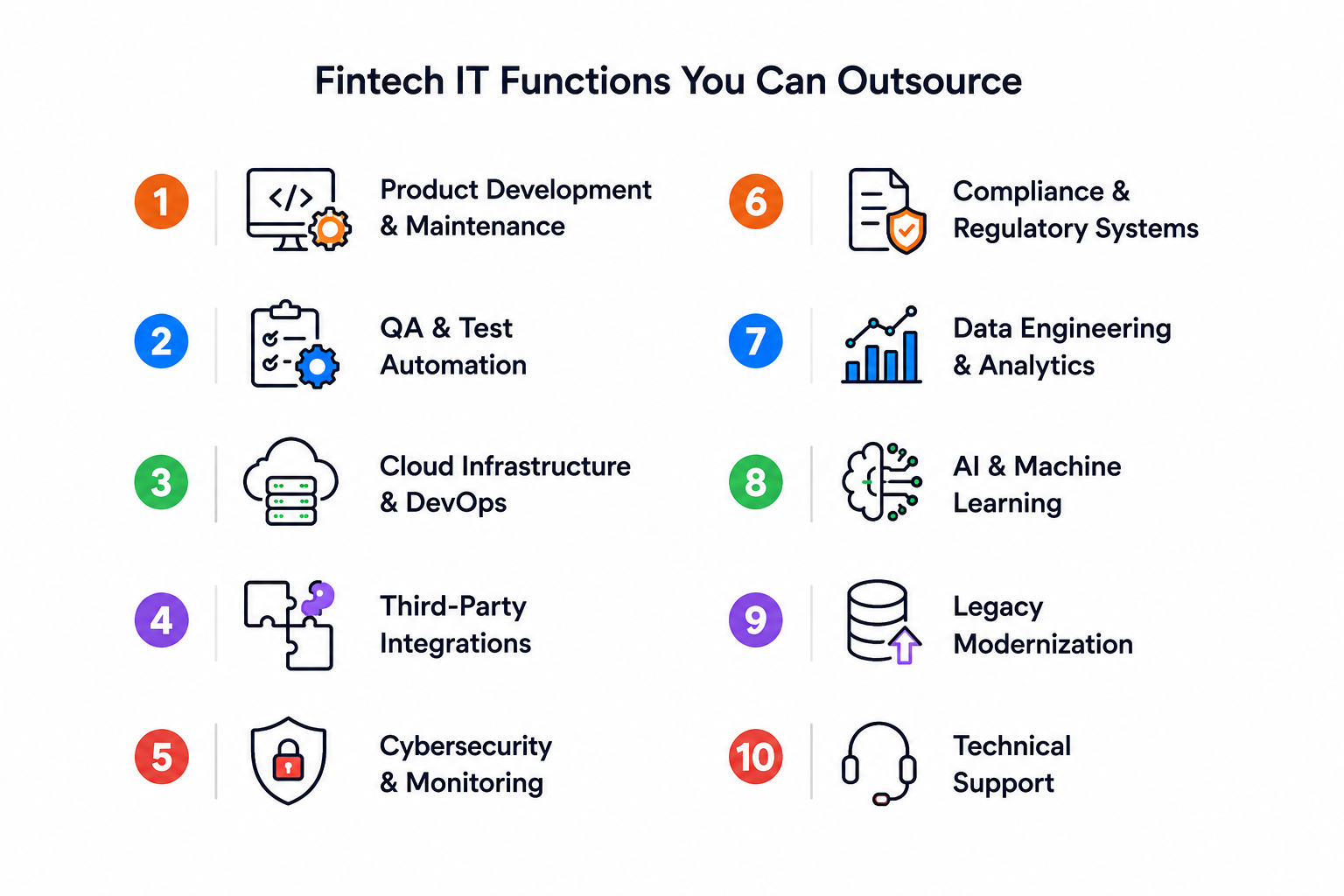
1. Product development and maintenance
The core build. Mobile wallets, trading platforms, lending systems, insurance products, digital banking front ends. An established partner handles this end to end, from architecture through release and the ongoing maintenance that follows.
Maintenance is the part companies forget to plan for. A fintech product in production needs dependency updates, security patches, and API version migrations when a payment processor deprecates an endpoint. That work never stops, and it rarely justifies senior in-house salaries.
2. QA and test automation
Testing financial software involves scenarios that generic QA teams have never encountered. Declined transactions, partial refunds, duplicate settlements, currency rounding across conversion, chargebacks arriving weeks after the original payment.
Building a regression suite that covers this takes months and a tester who has worked in payments before. Most companies outsource QA earlier than they outsource development, because the specialization is narrower and the cost of getting it wrong is visible immediately.
3. Cloud infrastructure, DevOps, and on-call
Cloud environments running regulated workloads carry requirements that standard setups do not. Data residency rules on where customer records physically sit. Encryption at rest and in transit with documented key rotation. Audit logging that an assessor can read.
Beyond the initial setup, someone has to run deployment pipelines, watch monitoring dashboards, and answer the page when a settlement job fails at 3am. An offshore team working opposite hours covers that window without putting your own engineers on a night rotation.
4. Third-party integrations
Fintech products are largely assembled from other companies' APIs. Card processors, KYC and AML providers, open banking aggregators, core banking systems, accounting platforms.
Each integration is contained work with a defined finish line, which suits an external team well. It also benefits from repetition. A developer who has integrated Plaid four times will do it faster than your best engineer doing it once.
5. Cybersecurity and monitoring
Financial platforms are attacked continuously, and the requirement is round-the-clock coverage rather than business-hours attention. Outsourced security work covers endpoint protection, penetration testing, vulnerability scanning, and SIEM monitoring.
Penetration testing in particular should sit with an external party. An assessor will ask whether your testers were independent of the team that wrote the code, and the answer needs to be yes.
6. Compliance and regulatory reporting systems
Someone has to build the software that produces audit evidence. Transaction monitoring that flags suspicious activity, immutable audit trails, automated regulatory filings, and the reporting that a QSA reviews during assessment.
This is engineering work rather than legal work. Your compliance officer defines what needs reporting. A development team builds the system that produces it, and vendors who have shipped through assessments before know what assessors expect to see.
7. Data engineering and analytics
Pipelines, warehousing, and the reporting layer on top. Fintech companies generate large volumes of transaction data with immediate uses in fraud detection, credit decisions, and product decisions.
The compliance dimension matters here too. Analytics environments frequently end up holding copies of production customer data, which becomes an audit problem unless masking or synthetic data is used from the start.
8. AI and machine learning models
Fraud scoring, credit decisioning, transaction categorization, document processing during onboarding. These need people who have built models against financial data specifically, since the class imbalance in fraud detection breaks approaches that work elsewhere.
Regulation caught up with this in 2026. The EU AI Act classifies creditworthiness assessment as high risk, which brings documentation, human oversight, and bias testing requirements. A vendor building scoring models for European customers needs to know that before writing code.
9. Legacy modernization
Banks and insurers carry systems written decades ago that still process live transactions. Modernization covers API layers over existing cores, gradual migration off mainframe infrastructure, and replatforming without interrupting service.
Internal teams rarely have the bandwidth, since they are occupied keeping the current system running. This is among the most common reasons established financial institutions bring in fintech development services rather than hiring.
10. Technical support
Ticket triage, first and second line response, escalation to engineering. A product that runs continuously needs someone answering when a customer cannot complete a transfer at midnight.
Fintech Software Development Outsourcing Best Practices
Like any software development project, one must follow best practices to ensure the successful development of a fintech project. Here is the list:
1. Establishing Project Scope
Before you even start to look for a fintech software development company, establishing clear expectations and goals is a must. The project scope includes defining features and functionality, regulatory compliance requirements, resources & technology requirements, delivery time, and project budget.
2. Finding the Right Outsourcing Partner
Your solution's success depends on your outsourcing partner's ability. So you'll need to find a company that fits your project requirements. Choose a partner with a proven track record of delivering high-quality fintech software development services. Check their portfolio, references, and customer reviews to evaluate their capabilities.
3. Ensuring open and transparent communication
Communication is key when working with a remote team. So, communication tools, establishing channels, and creating regular team scrums are crucial to ensure seamless team interaction and collaboration.
4. Creating a solid project management plan
Establish a clear plan that splits development into smaller milestones with delivery timelines. Create frameworks, an escalation matrix, and SOPs to ensure on-time delivery of work. Deploy tools like Jira, Asana, or Trello to track the progress and seamlessly communicate with your outsourcing partner.
5. Maintaining regular check-ins and progress updates
Carry out regular testing to ensure the software meets your standards and requirements. Create regular testing cycles and review sessions to discover and fix bugs early, before they reach production and cost far more to resolve.
Set a fixed weekly review where the team demonstrates working software rather than reporting status. A demo shows you what exists. A status update shows you what someone believes exists.
Have your own engineers review external code, at least through the first few months. It catches problems early and tells you whether the standards you agreed on are actually holding.
6. Mitigating potential risks and challenges
Failing to meet regulatory compliance can become a threat to your business. Hence, one must ensure that the outsourcing partner meets security and compliance standards at all stages of development.
7. Keep a Collaborative Approach
Foster a culture of collaboration, trust, and openness to feedback to build stronger ties. When you work with an outsourcing partner, you must acknowledge them as the expert in fintech development and treat them like one. Their suggestions on improving the product can help you build a robust solution.
By following the practices mentioned above, you, too, can create a high-performing and robust fintech app & deliver a unique experience to your users.
How To Find The Right Fintech Development Outsourcing Partner
We have already established the criticality of finding the right outsourcing partner to build a powerful fintech software solution. But who is the right partner, and how to find one?
That is precisely what we will discuss in this section: finding the right outsourcing partner for fintech software development.
1. Researching Potential Partners
This goes without saying that finding the right outsourcing company starts with research. Find the markets where the financial services industry is rising and traditional financial institutions are rapidly digitizing their operations. You can find software developers with the right expertise here.
Once you decide on the location, find development companies providing outsourcing services in the fintech industry. Shortlist the companies with the most relevant experience.
2. Evaluate Work
Review the previous work of the shortlisted companies to evaluate their experience in handling complex processes while creating solutions for the financial industry.
Explore their client base in finance and request case studies and testimonials of these clients to understand the scope of work and their delivery capabilities. This will help you narrow your list further.
3. Interviewing potential partners
Interviewing the top management and project manager can help you assess the work culture and communication skills. These are two major aspects to consider while checking the compatibility of an outsourcing partner with your organization.
Working with a remote outsourcing team that shares your work ethic and values creates a healthy, respectful, and collaborative environment, enabling smooth operations.
4. Consider Talent Pool
Enquire about the outsourcing company's different services, resources, and team size. This will help you gauge whether the company has enough resources to ramp up development or experienced experts to resolve complex development challenges in the project.
5. Evaluate Security Measures and Compliance Knowledge
Data security and regulatory compliance are critical to building a successful fintech app. Thus one must closely evaluate the security measures and safety protocols set by outsourcing companies to see their seriousness regarding data security.
Interviewing them about their knowledge of regulatory policies and compliance and assessing the previously built product can help evaluate if they fit your business correctly.
6. Evaluating proposals and agreements
Once you have decided on the final list of outsourcing companies, it's time to request a business proposal. Compare the shared proposals with your initial requirements. Evaluate their service level agreement and the project budget to see if it satisfies your needs.
Following these processes, you can find an outsourcing service provider that fits your project development.
Software Developer Hourly Rate Comparison Across the Globe
Case Studies of Successful Fintech Software Development Outsourcing
Here are two use cases where outsourcing fintech software development has helped businesses build agile and high-performing solutions.
A. How a payment processing solution provider reduces its time-to-market by 20%
GETTRX is a US-based payment processing service provider that provides payment gateway and terminal POS solutions to thousands of American merchants. Being in the Fintech industry, GETTRX must ensure its solution is regularly upgraded to meet security and regulatory compliance.
They sought a strong and experienced development team of senior software developers who could constantly upgrade their systems and software to ensure an infallible fraud control system was always in place.
They reached out to "Your Team in India" with the requirement for an offshore development team of experienced programmers to outsource their solution's complete enhancement and maintenance. After understanding the requirements, a team of software developers with 6+ years of experience was deployed on the project.
The team created process automation at various stages of testing to eliminate human errors. It helped in reducing 99% of man-hours in QA. A process that took days to complete now was being done within hours.
They also helped enhance product performance by reducing the fraud detection time from seconds to milliseconds, creating a seamless and delay-free payment processing experience for the users.
Read More: Case study of a payment processing solution provider
B. How plena data eliminate repetitive ERP tasks and accounts reconciliation work
Plena Data is a fintech automation company in the USA helping businesses create custom-built RPA (robotic process automation) solutions for their accounting department.
They create customized RPA workflows that eliminate repetitive ERP tasks and accounts reconciliation work of accounting teams, empowering them to focus on ROI-driven tasks.
They have created solutions for automating accounts payable, accounts receivable, and reconciliation functions on Quickbooks, NetSuite, Yardi, Microsoft Great Plains, and many other ERPs.
They contacted "Your Team in India" to hire a team of experienced RPA developers for RPA software development for their customers. They sought a team of experienced RPA developers who could help them ramp up their solution development to meet the increasing market demands.
"Your Team in India" assisted Plena Data in selecting two tech architects with 8+ years of experience to scale their operations. This team of highly skilled developers delivered 12+ robust RPA bots within 6 months.
Besides delivering solutions quickly, they also managed and assisted fellow developers hired by clients on the project. The team integrated best development practices and delivered high-quality, error-free code to ensure customer data was never at risk.
Read More: Case Study of Customized RPA Solutions for Plena Data
How Much Does it Cost to Outsource Fintech Software Development?
The cost to outsource fintech software development depends on two variables: how many engineering hours your product needs, and the rate you pay per hour. Everything else is a function of those two.
Developer rates by region, 2026
Senior developer rates in 2026 run roughly $120 to $250 an hour in the US, $90 to $180 in the UK and Western Europe, $45 to $90 in Eastern Europe, $50 to $95 in Latin America, and $30 to $65 in India.
|
Region |
Senior developer, hourly |
Notes |
|
United States |
$120 to $250 |
Highest cost, no time zone friction |
|
UK & Western Europe |
$90 to $180 |
Similar profile to US, slightly lower |
|
Latin America |
$50 to $95 |
Nearshore for US buyers, strong overlap |
|
Eastern Europe |
$45 to $90 |
Poland at the top of the band, EU data residency |
|
India |
$30 to $65 |
Deepest talent pool, largest overnight coverage gap |
Fintech work carries a premium of roughly 15 to 25 percent over these figures. A developer who has shipped through a PCI DSS assessment or built a KYC pipeline bills above a generalist in the same market, and reasonably so.
One number that rarely appears in vendor proposals: your loaded cost typically lands at 1.4 to 1.8 times the headline rate once management overhead, onboarding, communication time, and attrition are included. Budget against the loaded figure rather than the quoted one.
What fintech products cost to build
The figures below are modelled from typical engineering effort multiplied by blended regional rates. They cover a first production release, meaning something you can put in front of real customers under real regulation. They exclude ongoing maintenance, third-party licence fees, and compliance audit costs.
|
Product type |
Effort (hours) |
India |
Eastern Europe |
United States |
|
Fintech MVP, single core feature |
1,200 to 2,000 |
$48K to $90K |
$72K to $150K |
$180K to $400K |
|
Personal finance / budgeting app |
2,000 to 3,500 |
$80K to $158K |
$120K to $263K |
$300K to $700K |
|
Lending or BNPL platform |
3,500 to 5,500 |
$140K to $248K |
$210K to $413K |
$525K to $1.1M |
|
Investment or trading platform |
4,000 to 6,500 |
$160K to $293K |
$240K to $488K |
$600K to $1.3M |
|
Insurance platform |
4,500 to 7,000 |
$180K to $315K |
$270K to $525K |
$675K to $1.4M |
|
Digital banking platform |
8,000 to 15,000 |
$320K to $675K |
$480K to $1.1M |
$1.2M to $3M |
Outsourcing to a development team in India or Eastern Europe is less expensive than outsourcing to a team in North America or Western Europe due to the lower cost of living.
The hourly rates for fintech software development outsourcing can range from around $30-$150 per hour, with an average of around $75 per hour.
The right way to get an accurate estimation is to request business proposals from different outsourcing firms operating in a country and evaluate them to find the best fit for your project.
How Your team in India can help you in fintech outsourcing?
Your team in India can help you with the end-to-end development and maintenance of your fintech product. Our fintech experts are well-versed with the regulatory compliance requirements of fintech apps and have experience in delivering complex projects quickly and accurately, helping you reduce a product’s time to market.
By hiring "Your Team in India" as your offshore outsourcing partner for developing your fintech solution, you will get
-
Extensive NDAs to ensure complete data protection
-
Experienced developers with knowledge of regulatory policies and compliance
-
A large pool of talented developers to scale quickly
-
Flexible hiring models to meet your project needs
-
Project manager to ensure seamless communication
-
Enterprise-grade security
-
Zero infrastructure cost
Whether you are a financial services provider like the banking industry wanting to digitize their offerings or a startup looking to build a new fintech software solution, we can help create robust and scalable solutions.
In today’s tech-savvy world, customers seek convenience in all aspects of their daily life. Besides offering comfort to carry out financial transactions with ease, Fintech solutions are helping create financial inclusion by removing the constraints of traditional financial services.
Outsourcing is a great way to build robust and high-performing fintech software, provided you do your homework in finding the right outsourcing partner for your business.`

Frequently Asked Questions

Depends heavily on what you're building. An MVP with one core feature starts near $48,000 offshore. A full digital banking platform is a different category of spend, running past $320,000 in India and well over a million in the US. Hourly rates sit at $30 to $65 in India and $120 to $250 in the US, though the rate matters less than the total hours your compliance scope forces you into
Architecture decisions are the expensive one. A team that doesn't know PCI DSS applies will build a data model that fails assessment, and you find out in month seven. Time zone gaps cause slower damage, where a question that should take ten minutes takes a day. And check who owns your repository before you sign anything, because vendors who host your code on their infrastructure have leverage you won't notice until you try to leave.
Compliance got heavier. PCI DSS 4.0 requirements are fully mandatory now, and the EU AI Act put credit scoring models in its high-risk category, which brings documentation and bias testing obligations most teams weren't planning for. Meanwhile, AI tooling made routine build work considerably faster without touching any of that. So the thing you're paying an outsourcing partner for has quietly changed from writing code quickly to knowing which code survives review.
Three to five months for an MVP. Lending platforms and trading products usually land somewhere between six and ten months before a first real release, and digital banking stretches past a year. Getting the team in place is the fast part, typically two to four weeks with an established vendor.

By Mangesh Gothankar


By Ashwani Sharma
By Achin Verma








 4.8 out of 5 by