Offshore development is a strategic choice for businesses, helping them innovate and scale globally. Businesses are already opting for offshoring, and the market is expected to reach approximately USD 1.06 trillion by 2030. It is not going away anytime soon, as businesses are leveraging it to reduce development costs, hire talent from anywhere, and ultimately improve the product.
To make it look much simpler,
Suppose you hire a developer at $20-$40 per hour rather than hiring locally at $100 per hour. It helps you reduce costs by 50%. But what companies discover too late is that the hourly rate is just one part of the equation.
Experienced organizations recognize that the hourly rate is only part of the overall investment. A successful offshore strategy is not simply about lower costs; it is about planning a complete cost strategy and structure. When you factor in team communication, infrastructure, compliance, and more, you actually get a clear picture of offshore development costs.
Well, the good news is that with the right budget approach, offshore development becomes the most effective choice and scalable practice to grow your business. Here is a guide that breaks down offshore software development costs so that you can maximize the value and avoid unexpected surprises.
What is Offshore Development?
Offshore development is a practice that allows businesses to hire dedicated software development teams based in another country or nearby. They help businesses build, maintain, and scale their digital products. So, rather than building an in-house development team, which can be costly, companies collaborate with skilled developers overseas to access specialized talent.
This model can include:
- Dedicated developers
- Full offshore development teams
- Project-based outsourcing
- Offshore development centers (ODCs)
Nearshore outsourcing only allows you to hire talent from nearby countries; however, offshoring covers a greater geographical distance and offers a stronger talent pool with a larger talent pool.
Why Companies Outsource Software Development?
Outsourcing software development is not only a cost-cutting measure; it is a strategic growth decision. Whether you are a startup or an enterprise, companies outsource to build a faster, smarter, and more competitive business in the evolving market. Here are some of the top benefits of offshore development.
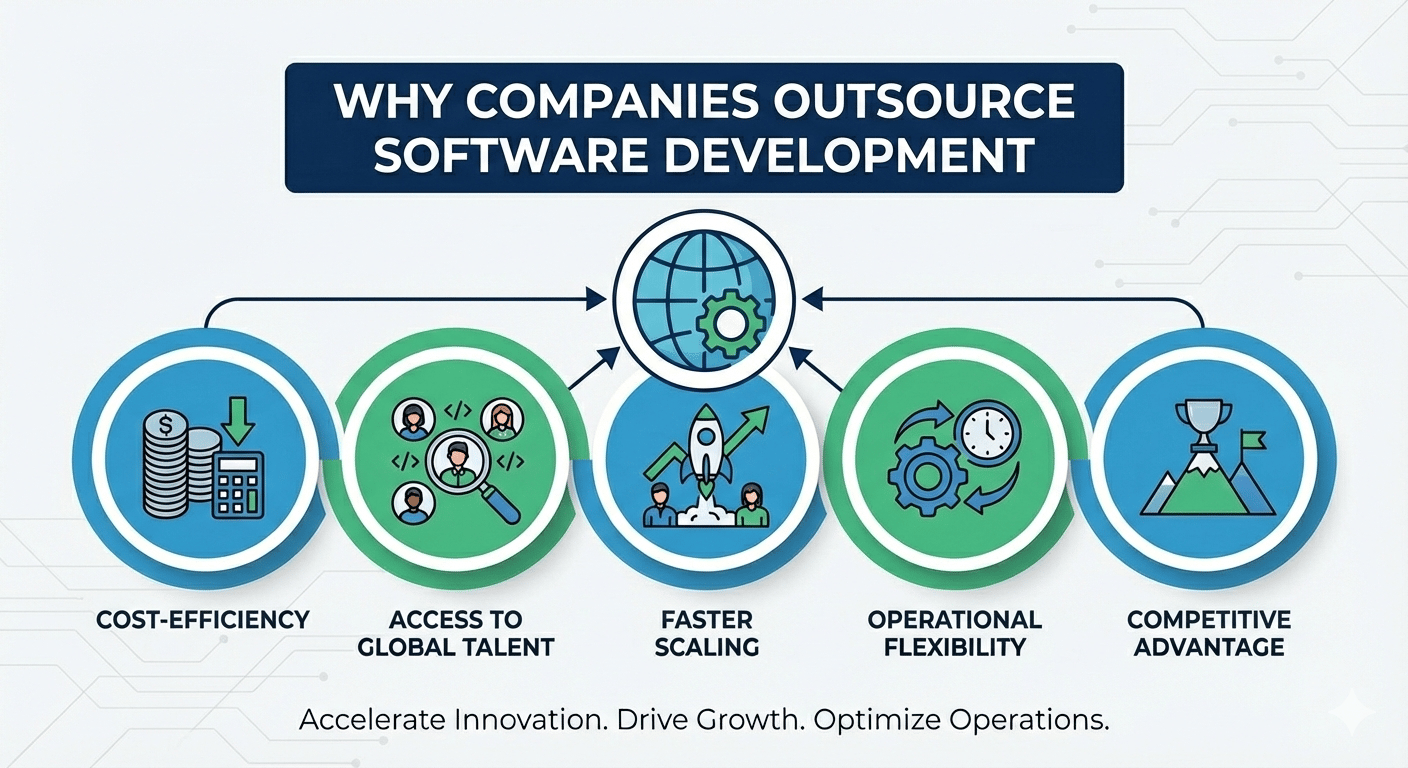
1. Cost-Efficiency
Cost savings are among the most critical benefits of offshoring. Hiring an offshore developer, especially in India, can help reduce the expenses by 40-70% as compared to hiring locally or in countries like the US or Europe. With lower operational and infrastructure costs, overall ROI improves. This helps companies allocate budget towards production innovation and business expansion instead of a fixed payroll cost.
2. Access to Global Talent
Another major challenge most Western countries face is the shortage of talent. Offshoring allows access to a vast pool of talent and expertise across the latest technologies like AI, machine learning, cloud computing, and more. It also allows you to hire expertise in SaaS platforms, healthcare, fintech solutions, and other domains. You don't have to compete in the local hiring markets anymore, because with a single tap, you can hire specialized skillsets and build more capable teams.
3. Faster Scaling
In this highly competitive landscape, speed is vital no matter what. With offshoring, companies can scale their teams up or down without having to worry about anything. Based on the project requirements, you can hire the candidates. This flexible approach helps boost the process of product development and reduces time-to-market. It also helps in-house teams to respond quickly during the product launch or dynamic market shifts.
4. Operational Flexibility
From hourly to monthly and dedicated teams, offshore outsourcing allows for flexible engagement models. It allows companies to adjust the team size and project scope without having to make long-term commitments. The operational flexibility allows businesses to experiment and optimize operations without having to make structural changes.
5. Competitive Advantage
When the development cost is low, the deliveries are accelerated, and companies gain a measurable competitive edge. Whether it is about a faster product launch or iterating frequently, they can help enter new markets without any financial risks. Hiring offshore developers is a strategic option that drives growth; it is not just a support function.
The Obvious Cost: Hourly Rates
The first comparison typically focuses on hourly rates across different countries. It is the most visible expense and is the critical reason businesses choose outsourcing in the first place.
|
Region |
Average Hourly Rate |
Key Notes |
| India | $15–$60 per hour | Wide talent pool; cost varies by experience and tech stack |
| Eastern Europe | $40–$80 per hour | Strong technical expertise; higher average cost |
| Latin America | $30–$70 per hour | Time zone alignment with the US |
| United States | $100–$150+ per hour | High labor and operational costs |
However, while hourly pricing provides an initial benchmark, it represents only one component of the overall outsourcing budget. A comprehensive cost evaluation requires looking beyond rates to understand the complete financial picture.
Want a clearer idea of what offshore development might cost for your specific business and requirements?
Use our outsourcing cost calculator to estimate your project budget in minutes, including developer rates, team size, engagement models, and more.
The Hidden Costs Most Teams Usually Ignore
Even when businesses calculate developer salaries accurately, hidden outsourcing costs can impact the final budget if they are not planned in advance. Here are a few of the hidden costs that teams overlook:
1. Communication and Cultural Gaps
Working across different time zones and cultures needs structured communication. So if there are any differences in the expectations, decision-making, or documentation, it can directly hamper productivity and create a clarification cycle. Robust communication, a clear and well-defined documentation process, and help reduce inefficiencies.
2. Management Overhead
To ensure successful offshoring, there should be consistent coordination and oversight to ensure quality benchmarks and scheduled timelines. This covers project managers, scrum masters, sprint planning, and more. If the management roles are not aligned with the engagement model, it adds to the overall budget.
3. Quality Assurance & Rework
Insufficient planning or changing requirements increases the testing cycles. When the documents are not clear, it adds additional development hours to fix the issues. Though rework is a natural part of iterations, failing to account for buffer impacts both the budget and timelines.
4. Infrastructure & Tools
Though offshore development reduces the development rates, there are infrastructure and tools costs added. Cloud hosting, DevOps pipelines, a license for software development, and other collaboration tools are an investment for the companies. In some scenarios, vendors may include it in the pricing; in others, they may be billed separately, leading to additional costs.
5. Security & Compliance Costs
Some of the organizations, like healthcare and finance, operate under strict security regulations. Measures such as data protection, industry standards, certifications, audit processes, and secure infrastructure may also be required. These safeguards ensure long-term security and must be incorporated into the outsourcing budget from the beginning.
Understanding Offshore Software Development Costs
Before we dig into how much it costs to offshore developers, let us first understand what all expenses actually affect the offshore engagement. For most businesses, it is about developer rates; there are other factors that include:
1. Developer Hourly or Monthly Rates
The cost of Indian developers typically ranges between:
- $15–$25 per hour for junior developers
- $25–$40 per hour for mid-level developers
- $40–$60+ per hour for senior developers and specialists
Dedicated developer costs may range between $2,500 to $8,000, depending on the experience and technology stack. Compared to the US and other Western countries, the cost varies from $100 to $150 per hour, which is very high. However, here are some of the other factors to keep in mind.
2. Engagement Model Costs
Another factor that affects the cost is the engagement model you choose. There are different engagement models designed as per different project needs, timelines, and budgets.
- A dedicated engagement model is ideal for long-term projects and involves paying a fixed monthly fee.
- You can choose a project-based model when the requirements are defined and follow milestone-based pricing.
- The time and material model is ideal for evolving projects, and you only have to pay for the actual hours the team has worked.
- Whereas an ODC is a long-term strategic partner that offers a full team and infrastructure support.
3. Infrastructure and Tooling
Even when you plan to choose offshore teams, there may be certain infrastructure costs, including cloud hosting, project management tools, collaboration platforms, version control systems, and other security tools. These tools are often shared in the contracts, but they are still a huge part of the offshore development cost.
4. Project Management & Oversight
Offshore development needs a clear structure and communication for seamless execution. This involves roles including project management, scrum masters, and technical leads who take care of the entire project. These can either be included in the contract or may be separately billed.
Therefore, it is vital to understand what is included in the contract to ensure that your offshore software development costs remain transparent.
How to Avoid Hidden Costs in Offshore Development
Instead of focusing only on hourly pricing, businesses should develop a detailed outsourcing budget template that includes:
1. Define Clear Scope and Objectives
Clearly outline the project goals, technical needs, timelines, and milestones. With a detailed scope, cost estimates remain accurate. Uncertainty in early planning leads to the expansion of scope that impacts the timelines and budget.
2. Choose the Right Engagement Model
Whether it's dedicated teams, time-and-materials, or project-based, ensure you choose the right engagement model, as it directly impacts cost predictability. For long-term benefits, you can choose a dedicated team model; for short-term, you can go with a fixed-pricing model.
3. Account for All Cost Categories
Apart from the developer rates, the outsourcing budget also accounts for project management and coordination, quality assurance, infrastructure, tools, compliance and security, and more.
4. Use Data-Driven Cost Estimation Tools
Instead of relying on assumptions, use structured estimation tools to calculate offshore software development costs based on team size, project duration, and engagement model.
5. Choose an Outsourcing Partner Wisely
Carefully choose a partner you are willing to hire. Evaluate their case studies, testimonials, portfolio, expertise, and more.
How "Your Team in India" Helps You Avoid Hidden Costs
Understanding offshore software development costs is not simply about comparing the hourly rates; it is all about planning the complete project. Whether it is communication, tools management, or compliance, every component impacts the total budget of outsourcing.
Your Team in India helps businesses gain complete visibility into hidden outsourcing costs and eliminates them via transparent pricing and quality management. We help ensure your offshore development costs remain as discussed and align with the project goals.
When you hire indian developers, offshore development becomes a strategic advantage, not a budgeting challenge.
Frequently Asked Questions

To accurately estimate offshore software development costs, businesses should go beyond hourly rates and evaluate the full scope of work, project duration, team structure, technology stack, and compliance requirements.
Offshore software development costs may increase due to scope changes, evolving requirements, additional integrations, or overlooked hidden outsourcing costs. Clear documentation, defined milestones, and proper budgeting help maintain financial predictability.
The cost of Indian developers depends on several factors, including experience level, technical specialization, project complexity, communication overlap requirements, and engagement model. Senior developers with expertise in AI, cloud architecture, or enterprise systems may command higher rates, but they can also reduce long-term costs through better code quality and efficiency.
An outsourcing budget template provides a structured framework to account for developer salaries, project management, infrastructure, QA, security, and contingency reserves. By identifying these components early, businesses can proactively manage hidden outsourcing costs rather than react to unexpected expenses later in the project lifecycle.








 4.8 out of 5 by