As the business paradigm continues to shift towards more digitalization, businesses face dual challenges. One is the rising demand for skilled developers, and the other is the increasing development cost in-house.
And this is where offshore development centers (ODCs) step in. It not only allows businesses to hire talent globally but also acts as a strategic growth driver for development companies.
And some numbers tell these stories.The offshore software development market hit $204.32 billion in 2026 and is projected to reach $347.99 billion by 2030, growing at a 14.2% CAGR. Also, it allows development companies to save on costs, along with faster hiring cycles.
Well, it is not only about the financial shift that offshore is helping with, but there is also an operational shift.
More small-scale businesses and startups are now relying on offshore setups to boost their development cycle, tap into the global pool of talent, and scale as per the need in the highly competitive market.
What was once seen as a simple outsourcing model has now evolved into a powerful offshore development center setup, where dedicated teams work as an extension of in-house teams.
Want to know more about offshore development- what exactly it is, how it works, and how it helps you successfully build and scale your business?
What is an Offshore Development Center (ODC)?
An offshore development center is a team based in a different country: developers, engineers, QA specialists, DevOps, whoever the project needs. They work exclusively on your product and operate as an extension of your in-house team. Businesses get real control over process and team composition, plus access to global talent at a lower cost than hiring locally. Setting up an ODC has become one of the more effective offshore development models for building tech teams that perform.
Setting up an ODC has become one of the most effective offshore development models for building high-performing tech teams.
1.1 Key Components of an Offshore Development Center
Setting up an offshore development center is far beyond hiring remote developers. There should be a well-defined structure, infrastructure, and more that align with the business goals. Here are the components that separate a high-performing ODC from a loosely managed remote team.
1. Infrastructure
There should be a robust infrastructure setup that ensures smooth operations. From ensuring the infrastructure has secure networks to cloud environments and deployment-ready systems, everything must be taken care of. Modern infrastructure now relies on cloud infrastructure that allows for real-time access and quick deployment cycles. With proper and secure infrastructure, productivity rises, and there is reduced downtime.
2. Talent & Team Structure
The success of an ODC depends on how well the team is structured, how experienced they are, and how well they can align with your business goals. If the team structure is defined appropriately, it ensures that everyone can understand their roles and responsibilities. This reduces the chaos and confusion and improves the overall project efficiency. Ensure the structure is flexible enough so that it can scale as per the project's needs.
3. Communication Framework
Effective communication is necessary to ensure the success of an offshore development center. Ensure integration of clear and effective communication channels, there are regular meetings, and transparency across the teams. When businesses establish a consistent communication practice, there are no misunderstandings, and time zone gaps are also bridged.
4. Security & Compliance
Security and compliance are two of the most critical roles that ensure offshore development centers can function effectively. It becomes even more important when dealing with sensitive business information and intellectual property. Robust frameworks include strict access control and data protection policies.
5. Tools & Technologies
The right stack, from project management platforms to version control, is what makes ODC software development actually work day to day. With modern tools, productivity rises, and the teams remain aligned with the best practices in the industry.
1.2 Key Usage Examples of an Offshore Development Center
An offshore development center isn't a one-size-fits-all setup. Where it fits depends on the offshore development model a business needs at that stage, and what problem it's actually trying to solve.
Startup Scaling Teams
Startups care about two things mostly: speed and staying lean. Hiring a full in-house team takes months most founders don't have, and it means competing for local talent on a fraction of an enterprise budget. An ODC skips a lot of that friction. Teams get built fast, budgets stretch further, and the product ships sooner instead of sitting in a hiring pipeline.
Enterprise Digital Transformation
Cloud migrations, AI integration, big infrastructure overhauls, these projects need people who aren't already stretched across five other priorities. An ODC gives enterprises that extra bandwidth without pulling focus from the core team busy keeping everything else running.
Product Development
Some companies bring an ODC in from the very first line of code. Ideation, design, build, deployment, one team stays involved through the whole thing instead of handing work off between different vendors at each stage. That continuity tends to show up in the finished product.
Legacy System Modernization
Plenty of businesses are still running on systems built a decade ago, and those systems quietly cap what the business can do. Modernizing them is unglamorous work. Nobody wants to spend a quarter refactoring old code instead of shipping something new, which is exactly why an ODC handling it separately works well: operations keep running while the upgrade happens in parallel.
1.3 How an Offshore Development Center Works
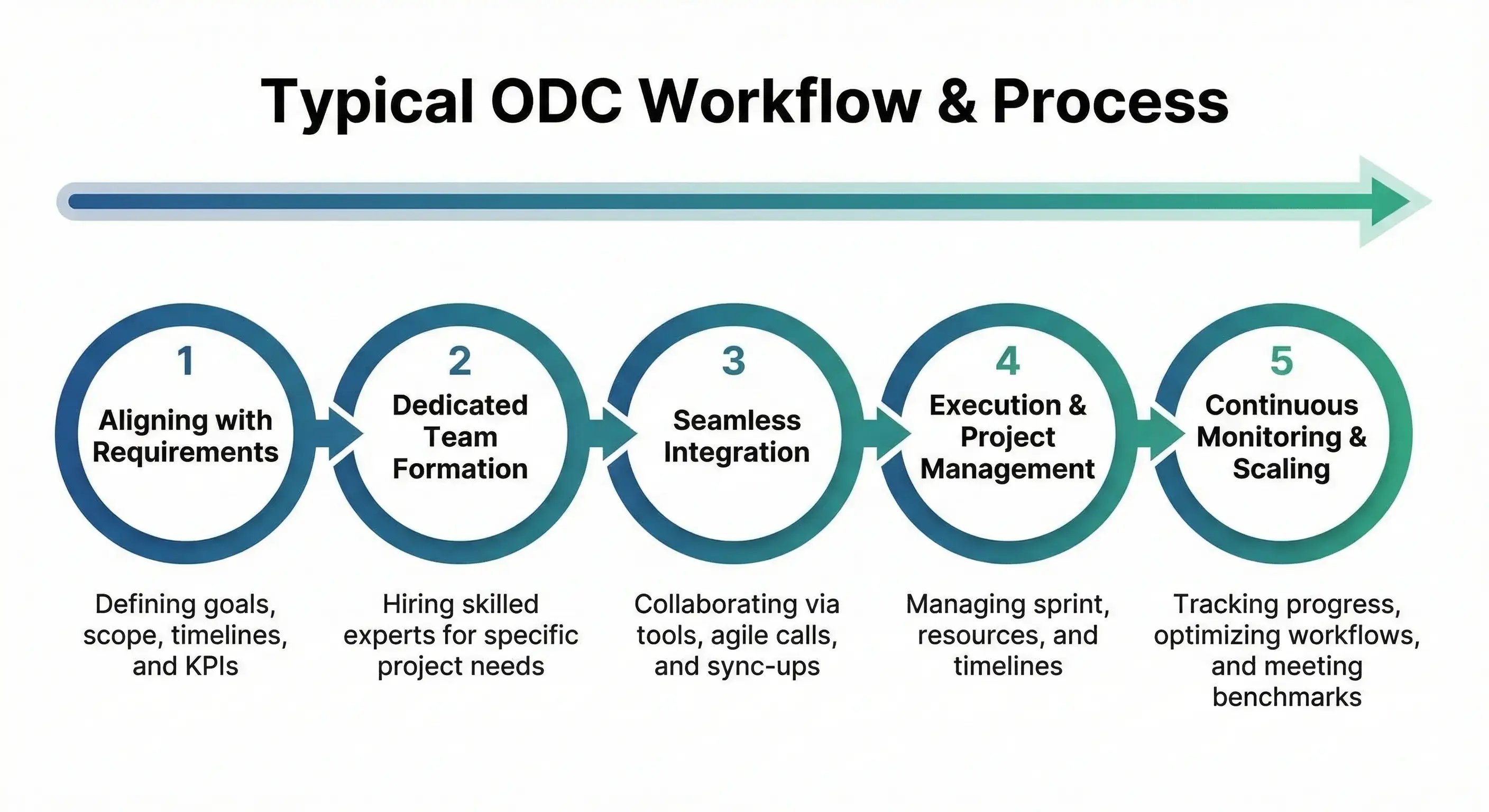
Five-step workflow flowchart showing how an offshore development center works from requirement alignment to continuous scaling.
Onshore and offshore teams work as one unit, just split across two locations. The parent company owns the product vision and stays the main point of contact for stakeholders. The offshore side carries most of the day-to-day execution and keeps improving the build as it goes.
An ODC is a full-time team, developers, QA engineers, designers, and others, embedded directly into your software development lifecycle. They stay on the project long term, sprint after sprint.
Getting ODC software development right comes down to how well people, process, and technology actually connect on a daily basis. Here's what that looks like step by step:
1. Aligning with Requirements: The parent company lays out business goals, project scope, timelines, and KPIs upfront, so the offshore team knows what's expected before work even starts.
2. Dedicated Team Formation: A dedicated development team gets built around what the project actually needs. An AI project pulls in developers with AI and ML backgrounds specifically. The goal is a stable team that grows with the project.
3. Integration with the Core Team: The offshore team plugs into your existing workflow through shared collaboration tools and agile practices. Daily scrum calls and regular sync-ups keep both sides working from the same page.
4. Execution & Project Management: Project managers handle the day-to-day link between the two teams, managing resource distribution and timelines while flagging risks before they turn into delays.
5. Continuous Monitoring & Scaling: The ODC tracks performance against real KPIs and dashboards, catching issues early enough to adjust the offshore development model before small problems compound.
For companies running an ODC in India, this structure keeps coordination working across the time zone gap.
1.4 Key Roles in an Offshore Development Center Team
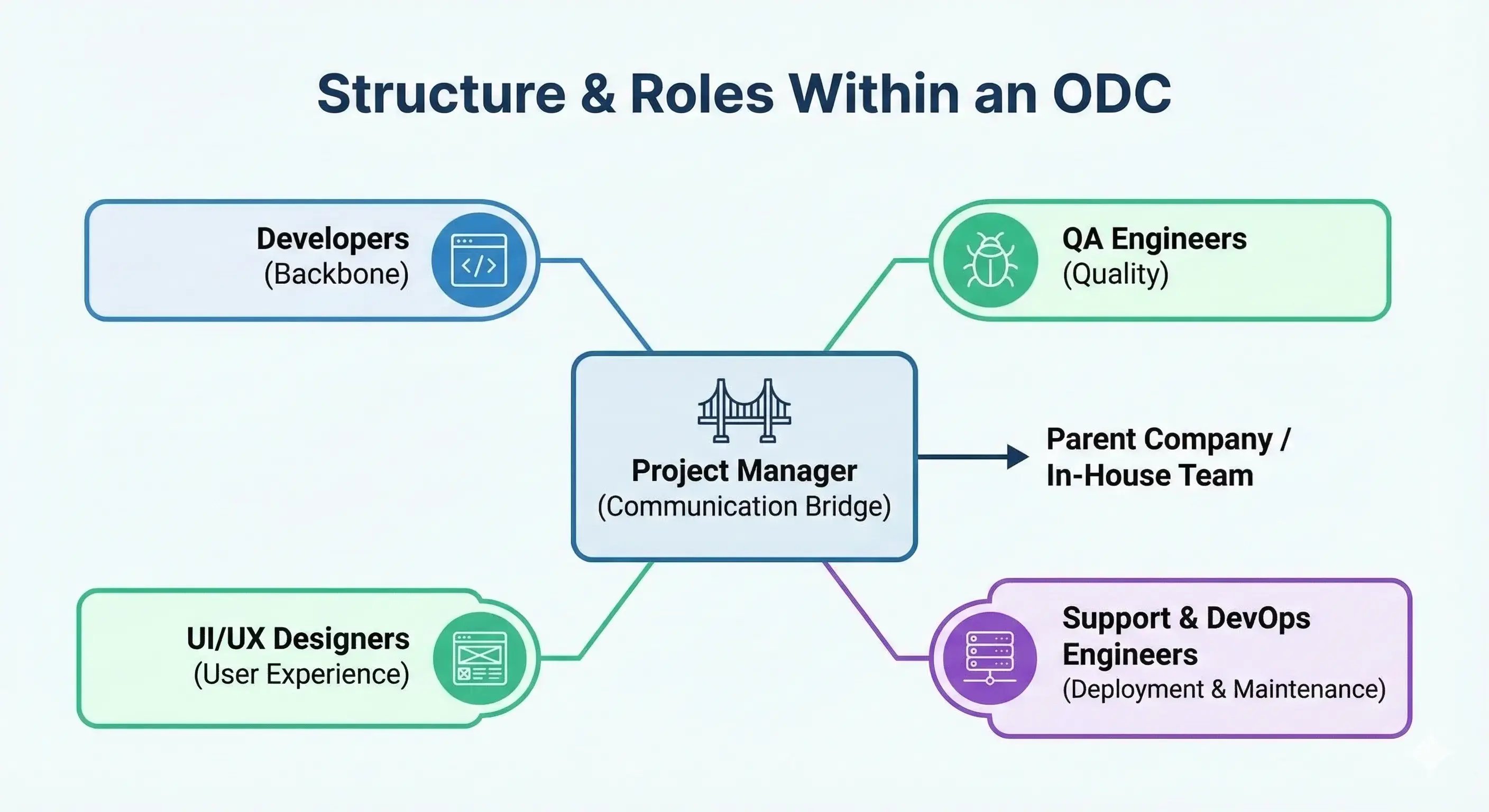
An ODC acts as an extension of the in-house team that brings together experts from all over the world. Everyone in the setup has their own contribution that leads to faster delivery, seamless collaboration, and quality outcomes ultimately.
1. Developers
Developers are the backbone of the offshore development center and are responsible for developing and maintaining apps with modern tools and frameworks. They work closely as part of in-house teams and follow required coding practices to ensure the product aligns with business goals. They possess expertise in web development, mobile app development, cloud technologies, Artificial Intelligence, and more.
2. Project Managers
Project managers act as a communication bridge between the in-house teams and the offshore teams. From securing a smooth allocation of resources to proper task distribution and communication management, they help ensure the process remains transparent without chaos. They can also track the progress of the project, ensure the deliverables are met, and that quality standards are met.
3. QA Engineers
QA experts maintain product quality via continuous testing and validation. Structured testing strategies, like automation, help identify challenges at the early stages of the development cycle. They ensure that the final product is reliable, secure, and compatible across different platforms.
4. UI/UX Designers
UI/UX designers' main focus remains on creating an intuitive and visually appealing experience for the users, because first impressions matter . They can conduct research, design wireframes, and seamlessly collaborate with developers to work on the design part and satisfy the users.
5. Support & DevOps Engineers
DevOps and support teams ensure the deployment is smooth and provide ongoing maintenance for the app. They ensure smooth integration and continuous delivery via automation and monitoring tools. This investment keeps performance high and supports long-term scalability.
1.4 What ODC Means for Businesses
An ODC is not an operational model; it offers a strategic benefit for businesses that wish to scale their capabilities in the competitive ecosystem. The most critical benefit being it is not limited to local hiring, and allows companies to hire from anywhere in the world and set up their dedicated team.
At the core, ODC allows businesses to quickly move, operate, and innovate without any limitations.
Why Companies Are Shifting to ODC Models
The shift towards offshore development is driven by market competition and the ambition for growth. As the pressure due to competition continues to rise and technological advancements are happening, businesses need models that are agile and offer scalability.
Traditional hiring approaches could not meet the demand, as there is a limited availability of talent and resources. An ODC helps address all these challenges as it offers immediate access to skilled talent experts and a ready-to-deploy team structure.
The Benefits of Setting up an Offshore Development Center
Setting up an ODC allows businesses to move from a traditional approach to a scalable and high-performing ecosystem. Whether it is reducing operational costs or enhancing technical assistance, it has plenty of benefits.
Here are the critical benefits of setting up an ODC you should know.
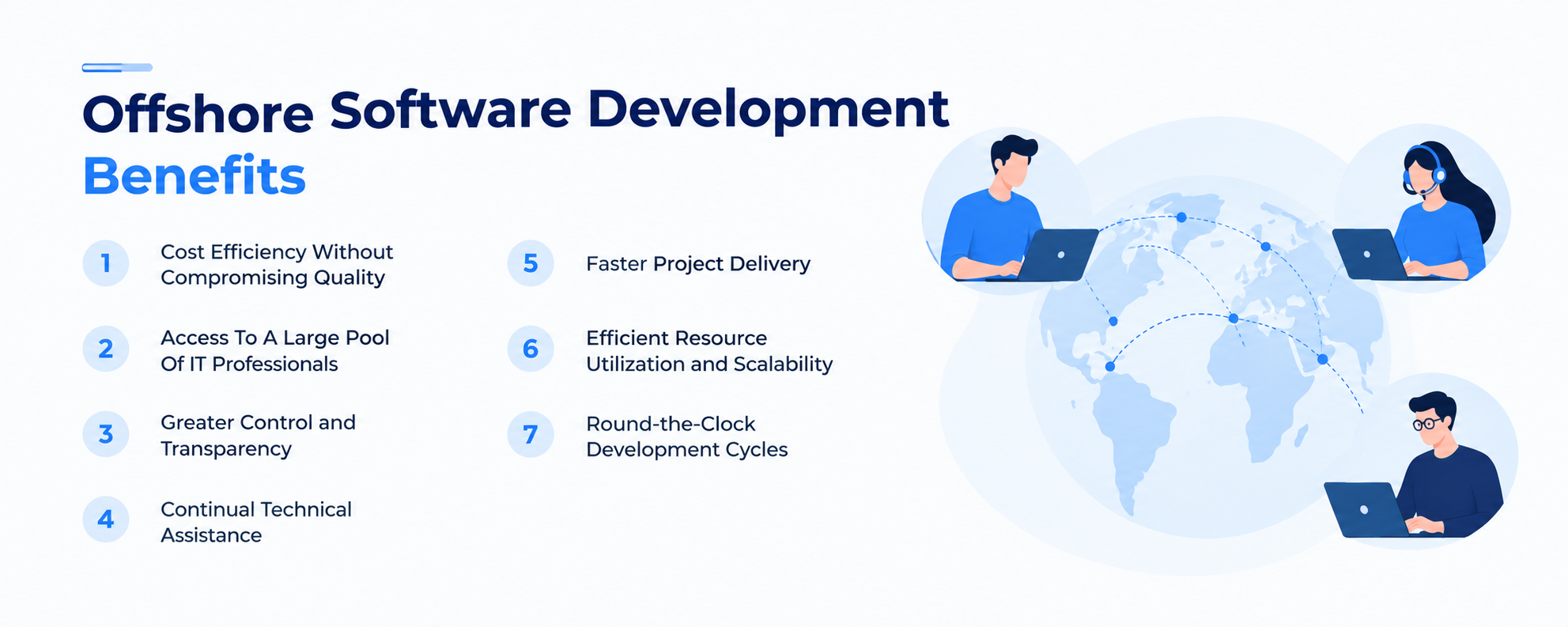
1. Cost Efficiency Without Compromising Quality
The Offshore Development Center has its equipment, infrastructure, and a team of highly qualified experts. As a result, your business will not have to worry about the costs of putting in place the necessary infrastructure. The ODC project may get started considerably sooner and at a lower price than if you started from scratch.
2. Access To A Large Pool Of IT Professionals
ODC gives you access to highly skilled IT teams with demonstrated IT expertise, abilities, and experience. It removes geographical limitations, allowing businesses to hire developers in India and other global talent markets to build strong and efficient teams. In addition, leading ODCs place a strong emphasis on developing their staff’s capabilities so that they can provide the greatest solutions to your target clients.
3. Greater Control and Transparency
As previously stated, the ODC carefully follows instructions given to them. You'll be able to assess and follow the present state of the project. You might wish to talk to the ODC company about contract conditions. If the outcomes do not meet your expectations, you have the option of requesting that the ODC rectify the project at an additional expense.
4. Continual Technical Assistance
Throughout the project's life cycle, ODC provides ongoing technical support. Offshore enterprises employ their skills to fulfill duties during the project. For your highly technical projects, there would be no scarcity of the right talent when you have the support of your ODC team.
5. Faster Project Delivery
ODC teams can deliver projects much faster because they work in ideal settings. The team adheres to the project timelines and guidelines established by the main office from start to finish. Additionally, they effectively collaborate with the in-house team, allowing the project to be completed in less time overall.
6. Efficient Resource Utilization and Scalability
The number of resources required varies depending on the project. An offshore development center functions as an extended arm that can handle the activities of in-house staff, allowing you to scale your IT department more effectively. Allocating resources without an ODC would be challenging.
7. Round-the-Clock Development Cycles
Time zone differences usually get treated as a downside, but they cut the other way too. When your in-house team logs off, the offshore team is just getting started. That overlap means code gets written, tested, and reviewed almost around the clock instead of stalling until the next business day. For projects on a tight deadline, that alone can shave weeks off a timeline that would otherwise move only during a single working day.
Common Offshore Development Center Locations
The right location matters for the offshore development center to be a success and offer cost-efficiency. Different regions have their own set of pros and cons in terms of cost, talent, expertise, and more. Let us talk about some of the most preferred offshore development center locations that businesses usually prefer.
India
India is one of the most preferred destinations for setting up an ODC. Whether it is about a vast pool of talent, robust knowledge on technologies, or cost benefits, India is a hub that offers an ideal ecosystem for building scalable teams or setting up an ODC. The country’s infrastructure is mature, and it has experience working with clients globally.
Eastern Europe
Ukraine and Poland are strong ODC destinations that are especially ideal for companies in Europe. It offers high-quality experts and engineering capabilities, and has a strong alignment with the Western markets. Compared to India, the cost is higher, but still companies choose Eastern Europe as it offers proximity and time zone advantages.
Southeast Asia
Southeast Asian countries like Vietnam and the Philippines are quite popular and emerging destinations for setting up an ODC. These places offer a competitive advantage in pricing models and have a strong tech workforce. Though these are still developing regions, it offers a strong potential for businesses that want cost-effective growth.
India: The #1 Offshore Development Center Destination
With a combination of the right set of talent, cost-effectiveness, and scalability, India turns out to be a global leader for establishing an ODC. With around 5.8 million software professionals in the country, finding the right expertise, whether that's cloud, AI, or something more niche, usually isn't the hard part.
Whether it is about finding expertise across technologies or dominating in AI, cloud computing, and other advanced technologies, you can find the right talent in India.
In addition to talent, cost efficiency remains a major advantage. Companies can reduce development costs significantly compared to Western markets while maintaining high-quality standards. This allows businesses to reinvest in innovation and scale faster.
How Much Does an Offshore Development Center Cost?
Cost is usually the question that ends the debate one way or the other. India runs cheap by comparison, junior developers around $20 to $30 an hour, senior talent topping out near $50, against $100 to $200 for the same seniority in the US. Do that math across a five-person team for a year and the savings aren't subtle.
Team Size and Specialization
Team composition matters more than most people expect going in. A two-person project pod and a five-person dedicated team scale cost very differently, and specialized skills like AI or cloud work push rates up regardless of country.
Engagement Model
Committing to a dedicated team costs more upfront than a project-based arrangement, mostly because you're paying for ongoing capacity instead of a fixed scope. Figuring out which offshore development model actually fits usually comes down to how long the work is expected to run, not just what looks cheapest on paper.
What the Rate Card Doesn't Show
Infrastructure, tooling, and local admin support, HR, compliance, payroll, typically add another 10 to 20 percent on top of straight developer salaries. It's not hidden exactly, it's just easy to forget until the first invoice shows up.
Getting an Accurate Number
None of this replaces an actual quote for your specific project. Going into that conversation with realistic numbers already in hand means negotiating from an informed position instead of anchoring to whatever headline rate a provider leads with. For ODC software development at real scale, the number that matters is the fully loaded one, not the one on the homepage.
Steps to Establish an Offshore Development Center
Setting up an Offshore Development Center takes more planning than hiring a few freelancers and hoping it works out. Skip a step here and it tends to surface as a problem three months in, not immediately.
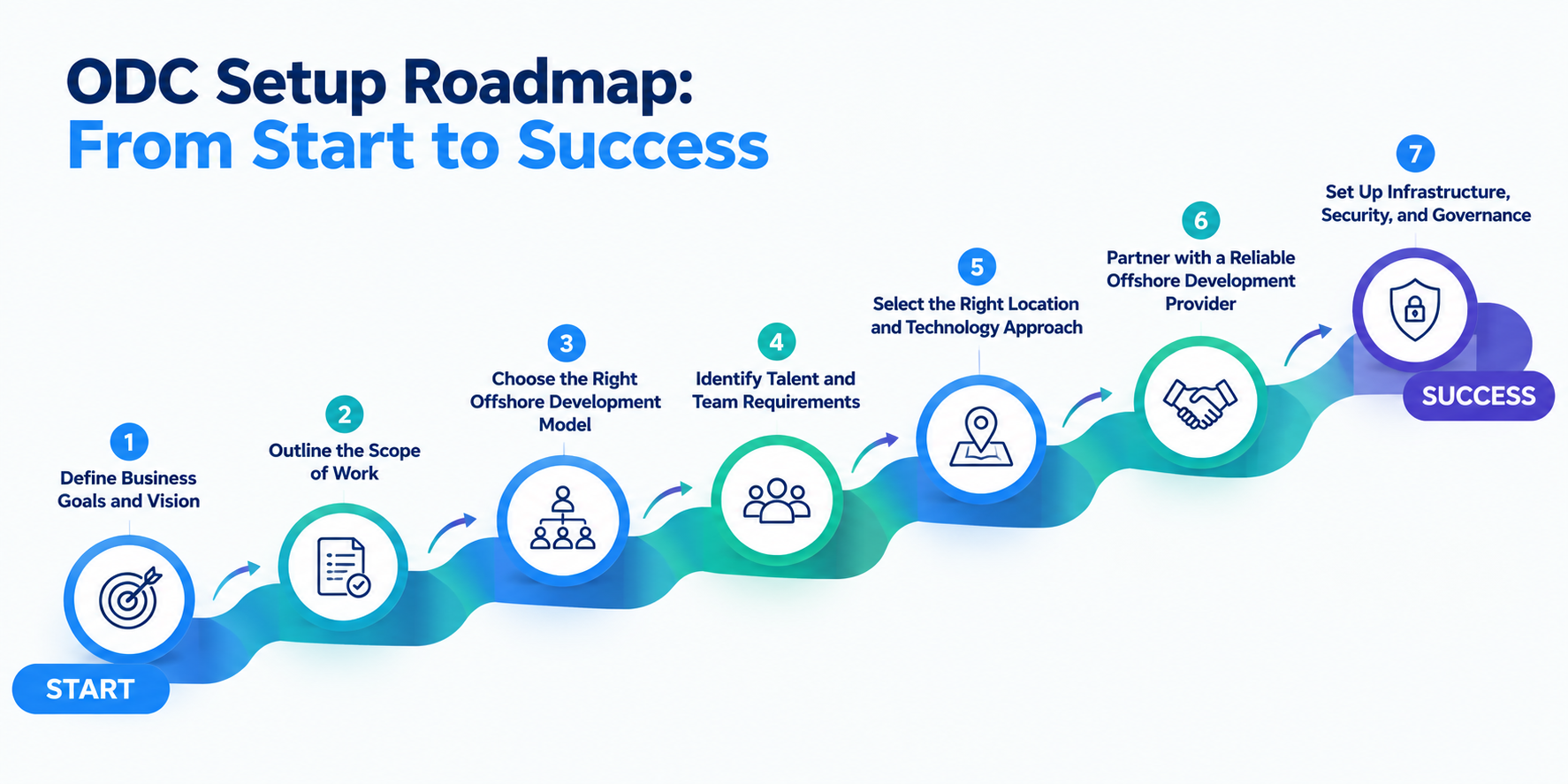
Step 1. Define Business Goals and Vision
Start by getting specific about why you're doing this. A new product build and scaling an existing team aren't the same project, and treating them the same is where a lot of ODCs go sideways early.
Step 2. Outline the Scope of Work
Write down the actual features and technologies involved before you start hiring. Vague scope means vague staffing, and that shows up fast once the team's already onboarded.
Step 3. Choose the Right Offshore Development Model
Dedicated team, project-based, hourly, ongoing support, these aren't interchangeable. Pick based on how long you'll need the team and how much the scope is likely to shift.
Step 4. Identify Talent and Team Requirements
Figure out who you actually need: developers, testers, PMs, specialists, whatever the project calls for. Overstaff and you're burning budget. Understaff and deadlines slip.
Step 5. Select the Right Location and Technology Approach
Location shapes cost, talent access, and the regulatory rules you're working under. Pairing that with an approach like Agile matters too, since a rigid process paired with a distributed team rarely survives the first scope change.
Step 6. Partner with a Reliable Offshore Development Provider
This is the decision most of the others depend on. A provider's sales deck will always look good. What matters more is talking to their existing clients and asking what actually went wrong on past projects, not just what went right.
Step 7. Set Up Infrastructure, Security, and Governance
Lock down the operational basics: infrastructure, security protocols, legal agreements. Skip this step or rush it, and it's usually the first thing that breaks once the team is actually working at full speed.
Legal & Compliance Considerations for ODC Setup
Setting up an ODC that ensures legal frameworks and data protection is vital. Offshore operations mean collaboration around the world, and therefore, it becomes vital for businesses to address compliance and security so that risks are reduced and there is long-term stability.
1. Contracts and Legal Agreements
Ensure businesses are able to define the contracts very clearly, with all the information covered. From the scope of work to their roles and responsibilities, engagement terms, and dispute resolutions, the agreement should define everything. With a clear contract, there is more transparency and accountability, while creating a stable relationship.
2. Intellectual Property (IP) Protection
Protecting intellectual property matters more with an offshore team than most businesses expect going in. Code, product ideas, and any other assets need contractual clauses that lock down ownership explicitly, so there's no ambiguity later about who owns what.
3. Data Security Regulations and Compliance
An offshore setup can be anywhere around the world, and when different geographies are involved, adherence to regulations becomes even more important. These regulations depend on your target market and the niche you are working on. There are different protection frameworks like HIPAA, GDPR, and more across different countries. Ensuring compliance can help get rid of the legal risks and build more trust with the client.
4. Access Control and Security Governance
This is vital to prevent unauthorized data access. Implementing two-factor authentication and role-based access ensures that teams can only access the necessary information that is actually needed by them. When combined with audits and monitoring, the risk of data breach is reduced.
5. Non-Disclosure Agreements (NDAs)
NDAs are quite critical for data protection in an offshore development setup. NDAs have all the stakeholders, like offshore panthers, in-house team members, and others, so that the sensitive and confidential information is maintained. This is vital to ensure that the business data and intellectual assets are protected.
Common Challenges of an Offshore Development Center
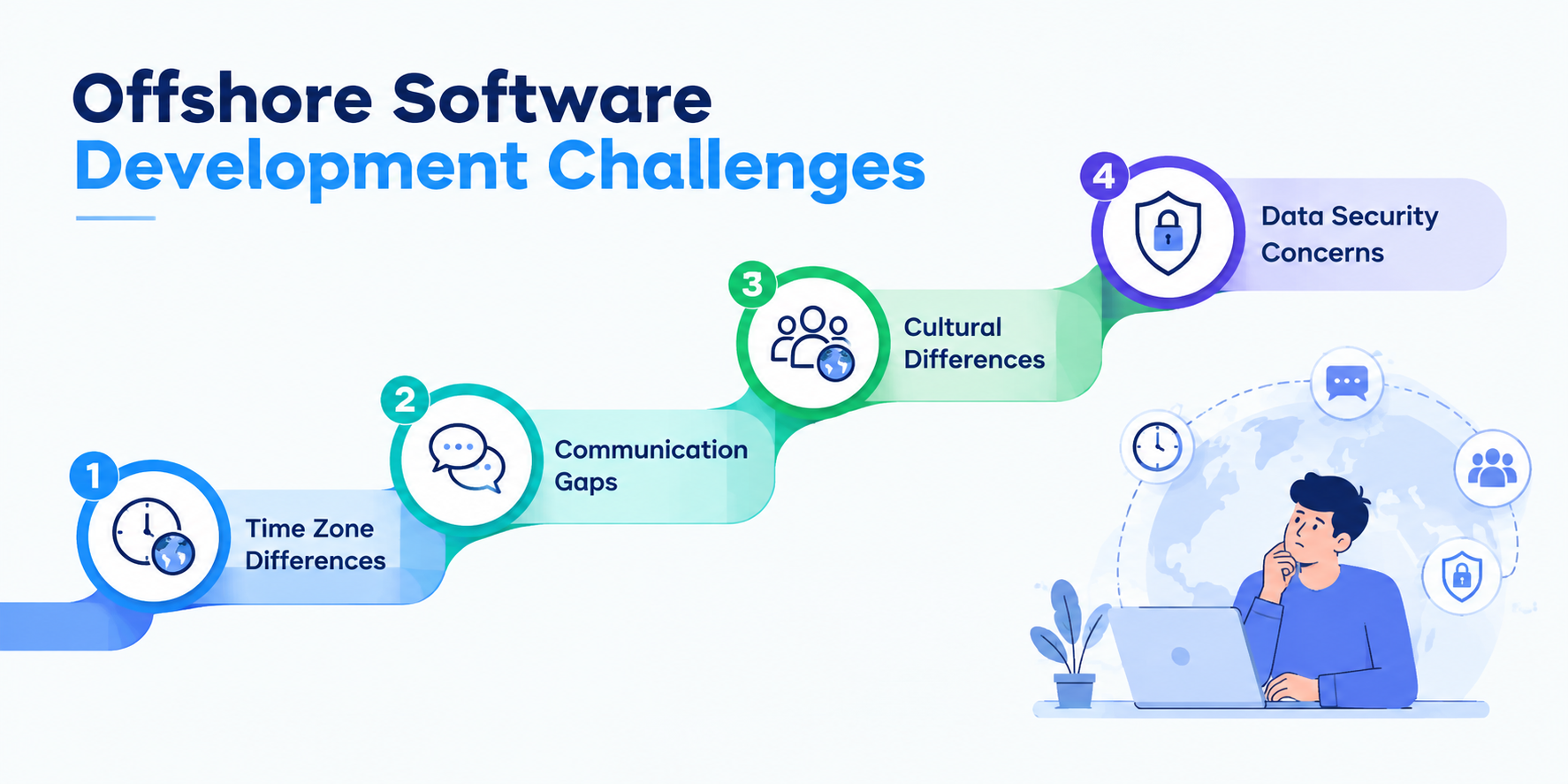
While there are significant benefits of an ODC, there may be certain challenges businesses may face. So here are a few of the challenges and how businesses can overcome them.
How to Structure an Offshore Development Center Team
The right offshore development model comes down to control: how much you want to keep in-house, and how much you're fine handing off. Three structures cover most of what businesses actually use.
Dedicated Team Model
The offshore team works exclusively on your project and follows your workflows like they're part of your own staff, because functionally, they are. Good fit when the work is ongoing rather than a single deliverable with an end date.
Hybrid Model
The in-house team keeps the core operations, offshore handles development, testing, and the rest of the execution. Where exactly that line sits is up to you. Some companies keep architecture decisions in-house and offload everything else. Others draw it somewhere completely different.
Project-Based Model
No standing team here. The ODC comes in for a specific project, defined timeline, defined deliverables, and wraps up once it's done. Shipping an MVP or building out a single feature both fit this pattern well.
How AI & Automation Are Shaping the Future of ODCs
AI and automation are helping evolve ODC centers in how they operate, perform functions, and more. What was earlier focused on cost optimization has now transformed into a high-performing and faster ecosystem. Here is how AI and automation help shape the ODC's future.
AI-Powered Development and Faster Delivery: AI is helping streamline the development process and lifecycle as it automates the repetitive and monotonous tasks. The complex work, like code generation, testing, and more, is automated with AI. This reduces the development time and also ensures more accuracy. Teams that leverage AI tools are able to deliver faster and error-free solutions.
Automation Driving Operational Efficiency: Manual work is eliminated in the development and operations. Whether it is carrying out testing, deployment, or workflow automation, AI in the ODCs can ensure a smooth execution and reduce turnaround time. This ensures that teams can een handle a higher volume of workload if needed.
Enhanced Decision-Making with Data and AI: AI-driven analytics allow businesses to make smarter decisions with real-time insights into performance, productivity of teams, and any risks that may arise. The ODC centers can leverage all these analytics to predict any challenge and boost operational efficiency.
Improved Collaboration and Communication: AI-powered tools are enhancing communication within distributed teams by enabling real-time collaboration, intelligent documentation, and automated updates. Features like smart assistants, automated meeting summaries, and language processing tools help bridge communication gaps and ensure better alignment between offshore and in-house teams.
Wrapping Up
Picking the right partner matters more than almost anything else in this process. Your Team in India works across the identifying-talent-and-setting-up-infrastructure end of it, project after project, which is a fairly unglamorous way of saying we've made most of the mistakes already so you don't have to.
If you're weighing your first offshore hire or trying to scale a team that's already running, get in touch. We'll walk through what your setup actually needs instead of selling you a template.
Frequently Asked Questions
We have answered some common queries about offshore development centers. For more information, you can contact us.
 There isn't a fixed number. A project-based engagement might only need two or three developers, while a dedicated team model built around a full product roadmap could involve ten or more across development, QA, and design.
It depends heavily on location, team size, and engagement model. India-based teams typically run 40 to 70 percent cheaper than equivalent US hiring, with junior developers starting around $20 an hour and senior talent topping out near $50. The cost section above breaks this down role by role.
No. Startups use ODCs just as often, mainly to scale a development team fast without the overhead of building one locally from scratch. The scale of the team is flexible, some ODCs run two or three people, others run fifty.
That comes down to how long you need the team and how much the scope is likely to shift. Ongoing, long-term work fits a dedicated team model. A single feature or an MVP is usually better suited to a project-based arrangement, since you're not committing to headcount past the delivery date.
There isn't a fixed number. A project-based engagement might only need two or three developers, while a dedicated team model built around a full product roadmap could involve ten or more across development, QA, and design.
It depends heavily on location, team size, and engagement model. India-based teams typically run 40 to 70 percent cheaper than equivalent US hiring, with junior developers starting around $20 an hour and senior talent topping out near $50. The cost section above breaks this down role by role.
No. Startups use ODCs just as often, mainly to scale a development team fast without the overhead of building one locally from scratch. The scale of the team is flexible, some ODCs run two or three people, others run fifty.
That comes down to how long you need the team and how much the scope is likely to shift. Ongoing, long-term work fits a dedicated team model. A single feature or an MVP is usually better suited to a project-based arrangement, since you're not committing to headcount past the delivery date.
An offshore development center model allows seamless collaboration between your onshore and offshore teams. Core team members, including project managers and developers, work in sync with your internal staff using collaboration tools, ensuring smooth workflows and consistent output.
India offers a large pool of skilled developers, cost efficiency, strong IT infrastructure, and extensive experience in serving global clients, making it a leading ODC destination.
An in-house team operates within your organization with full control but higher costs, whereas an ODC provides similar control and collaboration benefits at a significantly lower cost with easier scalability.
A dedicated offshore development center implements robust security measures, including access controls, secure development environments, and strict intellectual property protection policies. This ensures sensitive business data is safe while maintaining quality standards and operational efficiency.
AI and automation enhance ODC efficiency by accelerating development, improving decision-making, and enabling smarter collaboration across distributed teams.

By Mangesh Gothankar


By Ashwani Sharma
By Achin Verma








 4.8 out of 5 by