The vendor you hired said the app would be delivered by March, but it's September now, and the deadline keeps stretching. Though the demo looked fine, when the engineers are asked for repository access, the answers are slow and vague.
A failed software project rarely announces itself. You get a string of small delays, each with a reasonable excuse, until the budget is mostly gone. It happens more than people admit, too. PMI's 2026 Pulse of the Profession found that 31% of complex projects fail to deliver the full scope of their intended benefits.
You don't have to scrap everything, though. In most cases, a team can recover a failed outsourced software project by working with what's already there. The first step is a code audit that shows you what's solid and what's held together with workarounds. Critical bugs come next, and new features can wait. Many companies that rescue outsourced development work end up keeping much of the original build. Taking over failed vendor code feels slow in the first few weeks because nobody knows the system yet. Still, it usually costs less than paying for the same product twice.
Below, we go through the warning signs, how to audit the project, what a recovery plan looks like, and how to pick your next development partner.
Looking back, most failed projects were visible from about month three. People just don't want to see it, especially after signing a big contract.
Signs Your Outsourced Software Project Is Failing
Most failed software projects looked fine for the first two months. Trouble starts after that, and it comes in small pieces. Each one has an excuse attached, which is why people miss it.
1. Dates that keep moving: Everyone misses a deadline once. Then you hear "end of next week," and it passes, and you hear it again. By the third time, nobody is running the delivery process. Missed deadlines with no change to the plan or the team mean the vendor is guessing.
2. Demos you can't try yourself: A screen share tells you little. The vendor controls what you see, so a half-built app can look finished. Ask for your own login and run a few things. Sign up, reset a password, place an order. If it breaks or the vendor stalls, you have your answer. Working software holds up when a stranger touches it.
3. The same critical bugs coming back: A bug gets closed on Monday and reopens in two sprints. That's a team treating symptoms. Nobody found the root cause, and there are probably few tests behind the fix. Poor code quality shows up exactly here.
4. Different people, same invoice: Your pitch call had a senior architect on it. Now you're emailing juniors who haven't read your business requirements. Replies take days. Calls get shorter. Language barriers and time zones add friction, but they don't explain it alone. Your project has slid down their list. That's a communication breakdown, and it rarely fixes itself.
5. Bills that don't match the contract: You agreed on a scope and a price. The invoices say otherwise. Check what the extra hours bought. Often it's something from the original brief, renamed as a change request.
6. Your code sits in their accounts: Where do your source code repositories live? Who owns the cloud account, the domain, the app store listing? If it's all under the vendor's logins, ask for admin access this week. Pay attention to the reply. "We'll set that up after the release" is worth saving, since you may need it later.
7. Silence when you ask how it works: Ask where the data lives and how a release goes out. The team that built the thing answers in a minute. If you get quiet, or three different stories from three people, assume there's no real documentation and maybe no real design. Your own engineers will tell you the rest. When they refuse to open the vendor's code, it's often because of security risks or a performance problem somebody once got burned by.
8. How many is too many: Two of these are rough patches. Four or more means you're in a stalled project and should plan a software project rescue. Try one thing before you decide anything. Ask the previous development team, or the current one, for a staging build and read access to the repository by Friday. A healthy team sends both the same day. If the answer is a meeting about the meeting, you've learned what you needed to. From there, the first step to regain control is getting that access in writing.
Common Reasons Outsourced Projects Go Off Track
Founders usually blame the vendor first. Sometimes that's fair. More often, the project went wrong from several directions at once, and the vendor was only one of them. Here are the causes we see most.
1. The Brief was Thin: A slide deck and two calls are not business requirements. When the brief is vague, each side fills the gaps with its own assumptions, and nobody finds out until the demo. By then there are six months of code built on the wrong guess. Without written success criteria, nobody can say whether the build is on track, and every late change turns into an argument.
2. The Vendor was Picked on Price: The lowest quote usually has a reason. Fewer senior developers, junior staff doing the real work, and no budget for testing. The savings show up in the proposal. The cost shows up later as rework, and it tends to be bigger.
3. Nobody on Your Side Owned It: Outsourcing your project doesn't remove the need for a product owner. Someone has to answer questions the same day, say no to extra scope, and sign off on what counts as done. When that person is missing, priorities change weekly, and the vendor starts guessing at your business priorities.
4. Complexity Got Underestimated: Integrations with old systems, data migration, and compliance rules are where estimates fall apart. PMI's 2026 Pulse of the Profession found that 81% of project professionals say their projects have become more complex in recent years. A fixed price quoted without a discovery phase is a guess, and complex software punishes guesses.
5. Engineering Habits Were Weak: No code review, no automated tests, no staging environment. Poor code quality can hide for months because the features still appear to work. It shows up when you add the next feature and three others break. Security vulnerabilities tend to hide in the same places.
6. The Team Kept Changing: The people who won the contract move to the next account. New developers join, learn your system from scratch, and leave their own mess behind. Nobody writes anything down, so there is no comprehensive documentation to learn from. Each handover loses some of what the last team understood.
7. Distance Turned into Silence: Time zones and language barriers are easy to blame. The real issue is usually a team that hides bad news until it can't be hidden. A communication breakdown like that starts small. A question goes unanswered for a day, then three, and then it stops being asked.
8. You Couldn't See the Work: If you only see the product at the end of each milestone, you can't correct the course. Weekly demos on a real environment and read access to the tracker keep problems small. Without them, a project can drift for a quarter before anyone notices.
Look at this list against your own project. You'll probably recognize three or four. That's useful, because the causes decide the fix. A thin brief needs better requirements before any new code is written. A weak previous vendor needs replacing. A missing product owner is your problem, and no new development partner will solve it for you. We cover each of these in the recovery steps later in this guide, including how to rescue outsourced development work and take over failed vendor code without starting from zero.
How to Audit the Project and Development Team
Most audits go wrong in the first hour. Someone opens the code. Don't. Code is the last place to start.
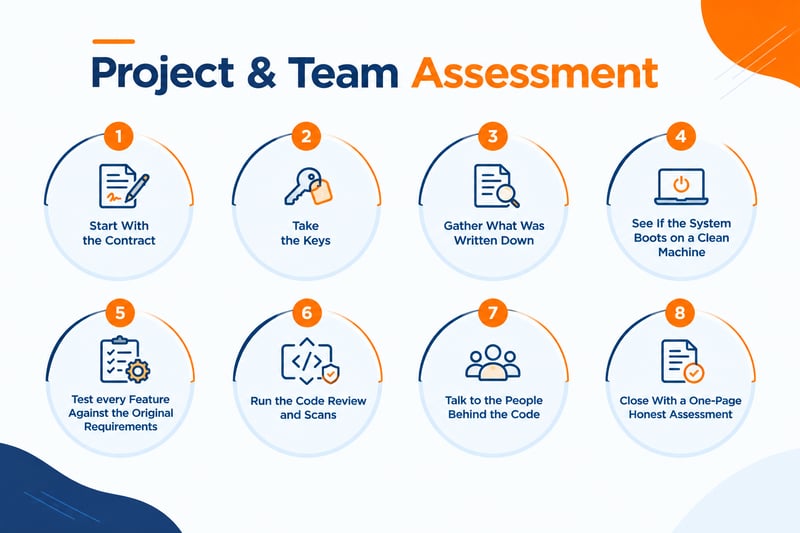
1. Start With the Contract
Who owns the IP, how termination works, how much notice each side owes? Get a lawyer to read anything fuzzy. The wrong email at this stage hands the vendor a breach claim, and now you're fighting about paperwork while the product sits half built.
2. Take the Keys
Admin rights to the source code repositories, the cloud accounts, the domain, the databases, the deploy pipeline, and every third-party login. Move ownership to accounts your company controls and rotate the passwords. A decent vendor does this in a day. A vendor who says "after the release" has told you plenty.
3. Gather What Was Written Down
Now gather what was written down. Requirements, designs, backlog, test reports, old status updates, invoices. Gaps in that pile are useful. Wherever documentation stops, the previous development team stopped caring, and you can often date it to the week.
4. See If the System Boots on a Clean Machine
Only then do you touch the code. Hand a senior developer the repository and the setup notes and see if the system boots on a clean machine. Often it doesn't. A setting lives on someone's laptop, or a key was never written down. That single test says more about the delivery process than any status report.
5. Test every Feature Against the Original Requirements
Then the part founders find uncomfortable: a feature-by-feature test against the original business requirements. Working, half working, broken, missing. Do it yourself, not through the vendor. Some projects hold much less working software than promised. A few are nearer the finish line than anyone admitted.
6. Run the Code Review and Scans
While that runs, your senior developers read the critical code and run static analysis plus a dependency scan. They're after security vulnerabilities, secrets saved in the repo, performance issues, and fragile integrations.
7. Talk to the People Behind the Code
Last, people. Talk to your own product owner and engineers. Talk to the vendor's developers too if the contract lets you, and ask what they'd change. How many people have touched the project in six months, and how many were senior? Is there a code review on every change? Do tests run automatically? Who can explain the architecture without opening a file? Evasive answers don't prove bad faith. They tell you the vendor's process can't be trusted to finish.
8. Close With a One-Page Honest Assessment
Close with one page for your CEO. Findings ranked by business risk, a recommendation (fix, refactor, or partly rebuild), and the root cause of the delay in plain words. If the root cause won't fit in a paragraph, you're not done. A mid-sized project usually takes one to three weeks to get here.
Assessing Code Quality, Architecture, Documentation, and Technical Debt
You've got access to the code and a list of what works. Now grade it, and grade it in separate pieces. Neat code on a shaky design is common, and so is a solid design with zero notes. One overall score hides that.
Read the code like you didn't write it
Pick two or three critical components and just read. Names that make no sense are a bad sign. So is the same block of logic pasted into five files. Run the tests, if there are any. If there aren't, that's already your answer. Poor code quality tends to look the same everywhere: 600-line functions, commented-out chunks, and errors caught and silently dropped. Then open the commit history and look for code review comments. Nothing there? Nobody checked this work.
Ask what happens when traffic doubles
Architecture is the grade that matters most. A messy file takes a few days to tidy. A weak design can take months. So ask the team where the data flows, which outside services it calls, and what dies when one server goes down. Common answers are "one big module handles most of it" and "settings are hard-coded for one environment." Neither is fatal, but both cost money to fix.
Hand the notes to someone new
Give whatever documentation exists to a developer who's never touched the project. See how long it takes before they ask a question. Look for a setup guide, API docs, a data model and deployment steps. Most failed projects have maybe a README and a stale diagram. Undocumented code can still be rescued. It's slower because the real knowledge sits with a few people, and some of them have probably left the vendor by now.
Scan for security and speed
Run a dependency scan. You'll almost always find libraries with known security vulnerabilities. Look at how login and permissions work, and check config files for passwords and API keys. For speed, open the slowest page with real-looking data and time it. Ask if anyone ever ran a load test. Fixing security risks and performance issues before launch is cheap. After launch it hurts.
Decide which technical debt to pay
Don't try to clear all of it. Fix first whatever causes critical bugs, opens a security hole or blocks a release. The rest can wait. Slow-but-working code is a scheduling problem, not an emergency, and old ugly code that nobody touches can sit where it is. Developers love rewriting it anyway. Say no.
Turn the grades into a plan
Mark each area sound, workable, weak or unusable, and write a one-line reason beside it. Then look at the whole page. Code and architecture both fine? Keep the existing codebase, fix critical technical issues, and add tests and documentation as you go. Architecture fine but code weak? Refactor in stages, starting with the files people change most. Architecture weak? Rebuild those components, but keep the data model and any feature that works. Both weak? Rebuilding is probably cheaper, though you should still reuse the requirements, designs and test cases.
How to Recover the Project Without Starting from Scratch
Don't burn it all down yet. A failed project usually still has a decent data model and some features that work, and a software project rescue keeps those and replaces only what's beyond repair.
a) Stabilize, then plan
Freeze new features first. Fix the critical bugs and security vulnerabilities, move the code into a repository your company owns, and add automated checks so changes stop breaking each other. That's how you regain control, and it often takes a few weeks.
After that, sit down with your product owner and rank what's left by business value. Write down what "done" means, set a date range for the finish line, and ship a couple of quick wins early. Users notice a fix long before they read a status report.
b) Deliver in short cycles
Run two-week sprints and end each one with a demo on a real environment. Misses show up in two weeks, not two months. Add tests around what you touch and write documentation as you go.
c) Keep what runs
If a module is too tangled to fix, replace it one piece at a time while the rest keeps running. Legacy code that works and has tests can stay, however ugly. A full rebuild only makes sense when the architecture can't carry your roadmap, and even then the old requirements and test cases save you time.
When to Replace the Outsourcing Vendor
Firing a vendor is a business decision, so let the audit make it for you. Your gut will say leave. The audit might say otherwise.
How to Transition to New Development Team
Handover is where plenty of rescues stall. The new team arrives keen and knowing nothing, and the old team has little reason to help. Sort out the knowledge transfer before anyone starts, not in week three when everyone's confused.
Before day one
Pick one person on your side who can answer questions the same day. Give your new development partner the audit report, the recovery plan and accounts for everything. A takeover failed vendor code goes badly when the new engineers have to rediscover what you already found.
Get the old team talking, if you can
If the previous development team is still reachable, ask for a walkthrough of the architecture, the database, deployment and known issues. Record it, because nobody remembers a two-hour call. Then give the new team one small real job, like a single bug fix, and watch where it snags. Missing access, a broken build or a gap in the documentation shows up fast. Even a week of overlap helps. If the old team is gone, lean on the audit and your own engineers.
When the old vendor won't help
It happens more than you'd think. Budget extra discovery time and work from what you can check yourself: repository history, logs, the database and the test suite. The first sprints will feel like reverse engineering, because they are. Write down every answer you dig up. After a few weeks, you'll hold the comprehensive documentation the first vendor never wrote.
Why a dedicated team fits a rescue
Keep the same engineers on your project from takeover through launch and into ongoing support, and what they learn in the first weeks stays with them. Project recovery gets steadier, and later software development moves faster. Check that working hours overlap with yours, and test how well the team communicates early, so language barriers show up before they cost you a sprint.
Also Read: Dedicated Development Team: What Is It and When To Use?
How to Prevent Another Outsourcing Failure
A recovered project needs tighter habits than the first attempt had. Most of this costs almost nothing at the start and a lot once trouble begins.
a) Write it down and own it
Put the business requirements on paper, with a clear definition of done for each milestone, and have both sides sign it. If you can't test it, it isn't a requirement yet. Create the repositories, cloud accounts, and domains under your company's name from day one, then give the vendor access. Not the other way round.
b) Pay for working software
Tie payments to accepted milestones, not hours alone, so the vendor wants a result you can use. Ask for a demo at the end of every sprint, shown to the people who'll actually use the product, and keep one person on your side with the authority to decide things the same day.
c) Make the engineering habits part of the contract
Code review, automated tests, and a staging environment belong in the agreement, along with access to the dashboards that show them running. Have someone outside the vendor review the code after the first milestone and again before launch. Ask for named senior developers on your project, and a notice period before any of them move off it.
d) Start small
A short paid pilot or discovery phase shows how a team really works before you commit the full budget. Check the warning signs from the start of this guide every month. If two show up together, call a meeting that week, not at the next review.
Checklist for Selecting a Recovery or Outsourcing Partner
If you are hiring engineering experts again, the process has to be sharper than the one that failed. Use this table on your vendor calls and score each project rescue services provider against it.
Conclusion
A failed software project feels final from the inside, but it usually isn't. Most founders who recover failed outsourced software projects start the same way: they get their source code repositories back, run a code audit and write down the root cause.
From there, build a recovery plan around business value. Stabilize first, ship a few quick wins and demo working software every sprint. If the audit says to change teams, plan the knowledge transfer and pick a development partner who stays for ongoing support.
If you're weighing a software project rescue, Your Team in India can review where your project stands and tell you whether to fix, refactor or rebuild. Share your project details, and we'll take it from there.
Frequently Asked Questions

It depends on what the code audit finds. If the architecture holds up and the data model is sound, a rescue usually costs less because you keep what you already paid for. If fixing the code would cost more than rewriting it, a partial rebuild is the better call. Any firm already quoting a full rebuild before seeing your code is guessing.
Yes, but the first few weeks run slower. A good team adds automated tests around the existing behavior before changing anything, then writes down what it learns as it goes. Undocumented code makes handover harder. It rarely stops a software project rescue.
Start with your contract and its IP and termination clauses, then talk to a lawyer about a formal written request. In the meantime, secure everything you can reach yourself, such as the live application, database backups and any accounts in your company's name. Do this before you confront the vendor, because your options narrow once the relationship turns sour.
Less than you'd think. Read-only access to the source code repositories, the original requirements, your latest status reports and a copy of the contract are enough to start. With those, Your Team in India can give you an honest assessment of whether to fix, refactor or rebuild, and what a recovery plan would look like.

By Mangesh Gothankar


By Ashwani Sharma
By Achin Verma





 4.8 out of 5 by