Manufacturing IT consulting used to mean patching software. Now it means finding where money actually leaks out of plant operations, and a lot of it hides in old infrastructure nobody's gotten around to fixing. A 2026 analysis of German manufacturing IT environments found that 15 to 25 percent of total IT operating costs trace back to structural inefficiencies in legacy, patched-together systems. Most of it comes down to two things: data that doesn't move cleanly between the plant floor and the ERP, and on-premises infrastructure that internal teams keep alive on top of their actual workload.
This piece breaks down how manufacturing IT outsourcing and the right technology stack fix both problems, and what changes when a manufacturing consultant takes this on instead of handling it in-house.
What Does Manufacturing IT Consulting Actually Cover?
Manufacturing IT consulting deals with systems tied to physical production: ERP and MES integration, plant-floor network infrastructure, machine data collection, and compliance work like ISO 27001 or industry-specific safety audits. A generic IT vendor can migrate email or patch a server. What it usually can't do is trace how a scheduling change in the ERP affects the actual production line, or explain why one unpatched PLC took down a shift.
That's the gap manufacturing consulting firms are built to close. Downtime, machine uptime, and supply chain visibility are the numbers that matter on a factory floor, and a manufacturing consultant scopes IT work around those specifically instead of applying the same playbook used for a retail point-of-sale network. This is what separates IT consulting for manufacturing from a generic IT retainer.
How Does IT Outsourcing Cut Manufacturing Costs?
Talent, servers, and downtime. That's where the money actually moves when a plant replaces an in-house IT team with manufacturing IT services from an outsourced partner. This is the core mechanics of manufacturing IT outsourcing: fewer fixed costs, more flexibility, and coverage that scales with the work instead of sitting idle.
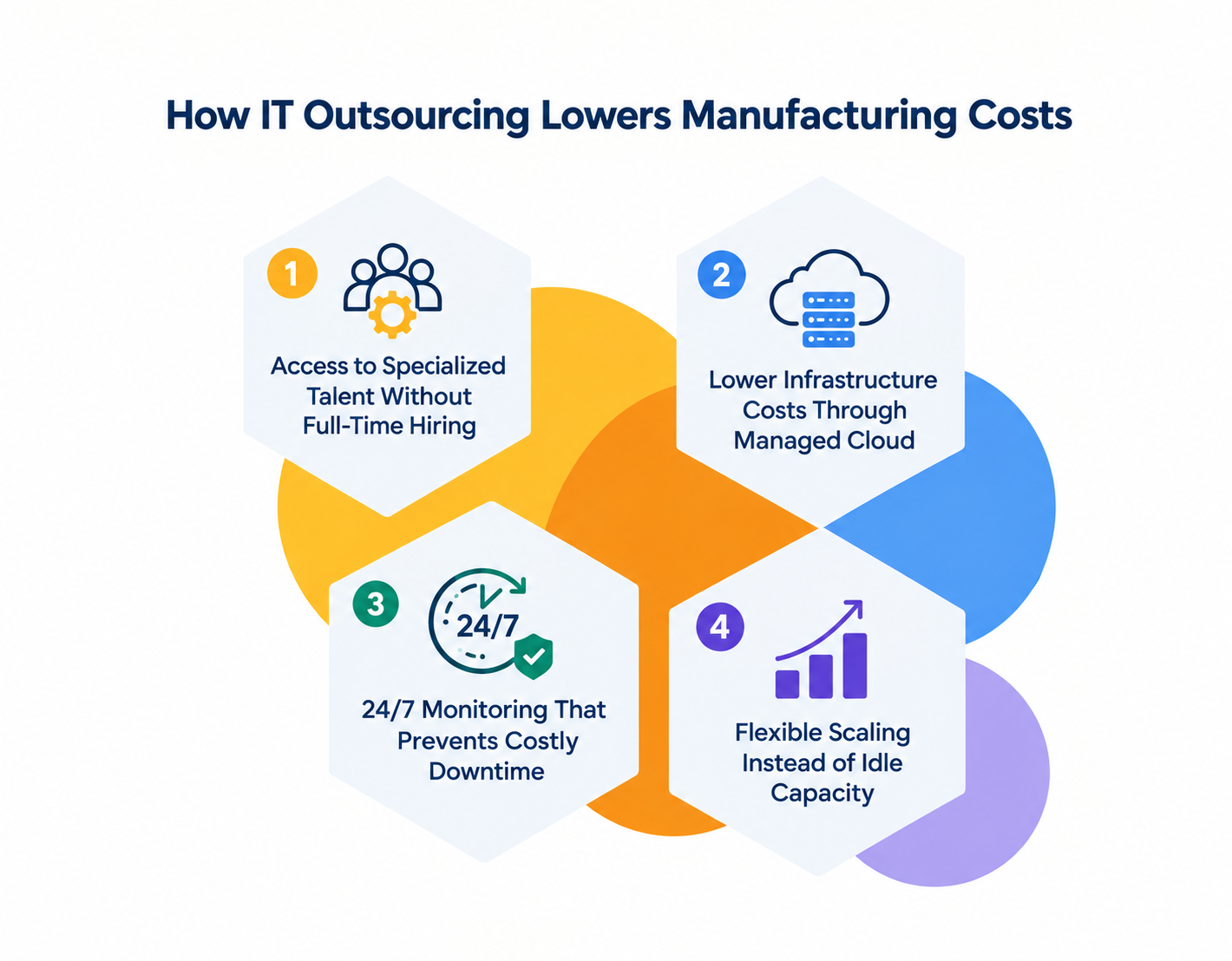
1. Access to Specialized Talent Without Full-Time Hiring
An automation engineer or data analyst doesn't have enough work to stay busy every week of the year on most plant floors. Paying that person a full-time salary and benefits regardless makes the role expensive relative to how much it's actually used. Outsourcing it instead runs 30 to 70 percent cheaper, with the gap coming down to which skill is being outsourced and which country the team sits in.
2. Lower Infrastructure Costs Through Managed Cloud
An on-site server room needs power, cooling, and someone on staff to patch and replace hardware when it fails. A managed cloud provider takes that cost off the books entirely and bills for what the plant actually uses each month instead of a fixed setup a company owns, whether it's running at capacity or not.
3. 24/7 Monitoring That Prevents Costly Downtime
Siemens and ABB's 2024 benchmarking across thousands of plants puts unplanned downtime at $125,000 to $260,000 an hour for general manufacturing. Few internal IT teams staff a night shift just to watch for a server issue before it takes down a line. An outsourced partner running around-the-clock monitoring often does, because that coverage is the job.
4. Flexible Scaling Instead of Idle Capacity
A six-month ERP migration needs more hands than a plant running in steady state. When you hire an outsourced team can add people for the migration and pull them back off once it's done, instead of a full-time hire sitting underused for the rest of the year.
Where Does Legacy IT Actually Cost Manufacturers Money?
Nobody budgets a line item called "legacy IT." It's buried inside maintenance costs that quietly climb every year until someone finally asks why.
Old Systems Eat Most of the IT Budget: Shoplogix's 2026 research found manufacturers spend 60 to 80 percent of their IT budget keeping systems they already own running, not building anything new. One aging ERP or MES platform can run a plant $30 million a year once specialized staff, patchwork integrations, and workarounds get added up. Whatever's left over is what's available for actual improvements.
The Person Who Understood the System Left Five Years Ago: A plant's custom scheduling logic or an old MES integration usually lives in one engineer's head, not in a document anyone can pull up. That person retires or takes another job, and the next fix takes three times as long because whoever's left is guessing at choices made years earlier for reasons nobody recorded. Manufacturing technology consulting engagements almost always start with a system audit for exactly this reason. Skip it, and you risk changing something that quietly held two other processes together.
Also Read: Does Offshore IT Outsourcing Save Money?
Fixing the Bottleneck Beats Rebuilding Everything: A full ERP replacement can take a year and shuts down operations nobody can afford to lose. Most of the cost, though, traces back to a handful of specific integration points, often the handoff between the plant floor and the ERP. A manufacturing technology consulting partner can usually fix that connection directly instead of rebuilding a system that mostly works.
How Does Technology Reduce Operational Costs on the Floor?
Versa Cloud ERP's research puts the cost of poor material planning and scheduling at up to 35 percent of a manufacturer's total spend. A lot of that comes down to three specific technology gaps on the floor.
Centralizing Data With ERP Cuts Material Waste
Setsu Precision Technology, a machine shop in Malaysia, ran purchasing, production, and inventory on separate systems until it consolidated everything into one ERP. Within six months, raw materials inventory dropped 50 percent. The shop had been ordering the same part under multiple part numbers and buying in small batches. Once one system showed actual usage, they consolidated the duplicates and started ordering in bulk.
Automating Manual Workflows Reduces Rework
A transcribed part number or a missed shift handoff is a common way defects enter a production run, and both usually trace back to someone re-typing data that already exists somewhere else. Pulling that data straight from machines and sensors into the ERP or MES removes the re-typing step. Fewer manual touchpoints means fewer chances for a number to get entered wrong.
IoT- Based Predictive Maintenance Catches Failures Early
McKinsey and Deloitte's industrial research found AI-driven predictive maintenance cuts downtime 30 to 50 percent compared to reactive repair. Sensors track vibration and temperature on equipment and flag a developing fault days or weeks out. A plant relying on reactive repair only finds out once the machine has already stopped.
In-House IT Team vs. Dedicated Outsourced Team: What Actually Changes?
The debate usually skips straight to cost, but continuity is what actually determines whether an outsourcing arrangement helps or creates new problems down the line.
Project-Based and Rotating Vendors Reset Knowledge Constantly
Standard offshore engagements often rotate staff onto whatever project needs coverage that month. Industry research on offshore IT turnover puts key personnel churn at 15 to 20 percent a year, and replacing a departed engineer typically costs 30 to 50 percent of their annual salary in recruiting and retraining. Every time that happens on a manufacturing account, someone new has to relearn the plant's specific ERP configuration, its integration quirks, and the reasons past decisions were made, none of which live in a document.
A Dedicated Team Model Keeps the Same People on the Same Systems
A dedicated or offshore development center model assigns a fixed team to one client for the length of the engagement instead of pulling from a shared bench. The team that mapped the plant's MES integration in month one is still the team maintaining it in month eighteen. That continuity matters more in manufacturing than most industries, since plant systems tend to carry undocumented logic that only the people who built it actually understand.
What This Means When Choosing a Manufacturing Consultant
A manufacturing consultant working through a dedicated development team structure builds institutional knowledge of a plant's specific setup over time, the same way an in-house hire would, without the manufacturer carrying the full-time headcount cost. That's a different value proposition than a vendor optimized for fast turnaround on isolated tickets.
Conclusion
The costs discussed throughout this piece, legacy system maintenance eating 60 to 80 percent of IT budgets, unplanned downtime running into six figures an hour, and material waste tied to disconnected data- are calculable, which means manufacturers with different priorities will value each fix differently. A plant with aging infrastructure and no in-house automation expertise gets the most out of outsourcing the skills gap first. A plant that already has solid staffing but runs on fragmented systems will see more from ERP centralization and predictive maintenance before touching its team structure at all.
Manufacturing IT consulting should start with that diagnosis, not a default answer. Map where the cost is actually coming from before picking between an in-house hire, a project-based vendor, or a dedicated outsourced team.
Your Team in India builds dedicated engineering teams for manufacturers looking to add exactly this kind of specialized IT capability without the overhead of a full in-house hire.
Frequently Asked Questions

Yes. Providers usually run outsourced support in parallel with the existing setup first, then shift things over once the new system's proven out. Nobody worth hiring starts by pulling the plug on production.
Usually, the cost isn't spread evenly across an old system. It's concentrated in a few integration points, often the one between the plant floor and the ERP. Fix that connection, and you've dealt with most of the actual problem without touching the parts that still work fine.
Because plant systems are full of decisions nobody wrote down. A retail POS system is fairly standard from company to company. A decade-old MES integration built around one plant's specific equipment is not, and someone has to actually learn it before they can safely change anything.
They replace guessing with data. Vibration and temperature sensors on equipment can flag a failing part weeks before it actually fails. Combine that with 24/7 monitoring, and most of the six-figure-per-hour downtime scenarios become preventable instead of something you find out about after the line's already stopped.

By Mangesh Gothankar


By Ashwani Sharma
By Achin Verma








 4.8 out of 5 by