People treat BOT vs traditional outsourcing like a vendor question. It isn't. It's a cost and capability question, and most companies don't sit with that distinction long enough.
Statista sizes the global IT outsourcing market at US$634.18 billion for 2026, which is a big enough number that I'd stop trusting anyone who calls this decision a footnote. What it actually comes down to is patience versus speed. BOT means you are building toward owning something, on a timeline measured in years, not quarters. Traditional outsourcing means you want speed now and you're fine handing the vendor the wheel on delivery.
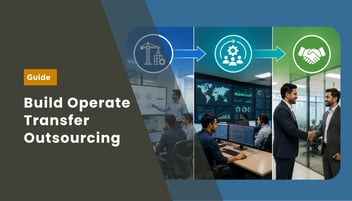
The World Bank describes BOT as a public-private partnership structure where a private company builds, operates, and later transfers an asset or capability back to the owner. In software delivery, the logic is similar. The partner sets up the team, the process, the operating layer, and the compliance structure. Then ownership shifts to you.
That difference matters because cost is not only about salary. It also includes hiring, tooling, legal setup, security controls, management overhead, service quality, transfer risk, and exit cost. If you are comparing BOT vs traditional IT outsourcing, you need the full lifecycle view.
This guide gives you that view and adds location-based cost signals from 2026 so the business case is practical, not theoretical.
What Does BOT vs Traditional Outsourcing Mean?
BOT is a phased delivery model that ends in transfer of ownership. Traditional outsourcing is vendor-led execution for a defined scope.
BOT works best when the goal is to build a capability you want to own later. It is often used in infrastructure projects, public-private partnerships, and large-scale operating models. In IT, the same structure applies when a private entity or outsourcing provider builds the team, stabilizes service delivery, and transfers full ownership to the client.
Traditional outsourcing is different. The vendor owns the operating model. You buy a service, a project, or a dedicated team. The relationship may be project-based, time and materials, or a dedicated team model, but the vendor remains the operating owner.
BOT phases
-
Build phase: team setup, legal structure, tooling, hiring, security, and process design.
-
Operate phase: the partner runs delivery, project management, QA, and support.
-
Transfer phase: ownership moves to your company, including IP, documentation, and people where contractually allowed.
The ownership difference is the central cost lever. BOT creates more work up front. Traditional outsourcing reduces initial setup work. BOT can look more expensive in year one. It often becomes more efficient over a longer horizon because the business stops paying vendor margin on an ongoing basis.
Traditional outsourcing is usually the better fit when the project scope is clearly defined, the timeline is short, and the business wants to stay light on internal overhead.
In its simplest form, BOT is a capability-building strategy while traditional outsourcing is a service-delivery strategy.
What Drives the Real Cost Difference?
The real cost is total cost of ownership, not just salary or invoice rate.
This is where many articles stay too shallow. A Build Operate Transfer model cost comparison should include setup, operating cost, governance, transfer, and exit.
1. Setup cost
BOT usually starts with higher upfront spend. The partner may handle hiring, tooling, office space or remote infrastructure, legal setup, onboarding, compliance, and management routines. You are effectively funding the creation of an owned capability.
Traditional outsourcing lowers that burden. The IT outsourcing provider already has the entity, process, and operational base. That reduces launch cost and speeds up delivery.
2. Run-rate cost
BOT model offers more efficiency once the team stabilizes and the transfer phase is complete. The business owns the team and the operating model, so recurring vendor margin becomes smaller over time.
Traditional outsourcing keeps recurring fees alive as long as the contract continues. That is acceptable for short-term or clearly scoped work. For long-duration engagements, the cumulative cost can exceed the early savings.
3. Governance cost
BOT projects need stronger governance in the early months. You need tightly written BOT contracts with checks on change control and clearly defined transition milestones. Besides, governance involves service quality metrics, knowledge transfer rules, and transfer readiness criteria. If those are weak, the cost shows up later as rework and delay.
Traditional outsourcing also needs governance, just in a different form. You still need SLAs, reporting, escalation paths, security checks, and acceptance criteria. If the scope is not tightly defined, change requests and rework can quickly erase the savings.
4. Exit and transfer cost
BOT includes a planned handover. That means transfer planning should be budgeted from day one. A clean transfer is not free, but it is controlled.
Traditional outsourcing often has lower formal exit costs. The hidden cost is knowledge loss. If the vendor exits, your internal team may need to rebuild documentation, architectural memory, and operational logic from scratch.
Cost Table
|
Cost Factor |
BOT Model |
Traditional Outsourcing |
|
Upfront spend |
Higher due to setup and enablement |
Lower because the vendor is already operational |
|
Monthly burn |
More predictable after stabilization |
Recurring vendor fees continue throughout the term |
|
Control |
High after transfer |
Moderate to low, depending on the model |
|
IP ownership |
Moves to the client after transfer |
Usually stays with the client for deliverables, not the team |
|
Scalability |
Strong for long-term growth |
Strong for short-term flexibility |
|
Exit planning |
Planned and contract-led |
Simpler on paper, riskier in knowledge retention |
Location-based Cost Signals for 2026
These numbers are useful because they show how location changes the economics of BOT and outsourcing.
|
Location |
2026 benchmark |
Source |
|
United States |
Software engineer range: $109,250 to $175,500; mid-point $142,000 |
|
|
United Kingdom |
Fullstack developer range: £43k to £75k; mid-point £58k |
|
|
Germany |
Average software engineer salary: €52,800 |
|
|
India |
Tier 1 mid-level software developer: ₹8-18 LPA; senior: ₹18-35 LPA |
|
|
Bangalore |
Average software engineer salary: ₹9.7 LPA |
For employer cost, one 2026 Bangalore benchmark guide calculates about ₹3,82,812 per year above a ₹15L salary when PF and a representative EOR fee are included. That matters because BOT and outsourcing decisions are rarely pure salary decisions. Employer burden changes the real total.
Where does the model choice change cost?
-
BOT is stronger when you want to avoid long-term vendor dependency.
-
Traditional outsourcing is stronger when the scope is stable and finite.
-
Direct hire vs BOT model cost often favors BOT when you want control without building everything yourself.
-
BOT can also reduce future transition risk because the transfer is designed into the engagement.
Related Read: Types of IT Outsourcing Models: How to Pick the Best One?
How Technical Architecture Changes the Equation?
Architecture determines how easy it is to scale, secure, govern, and eventually own the delivery stack.
Cost changes when architecture changes. This is why BOT and traditional outsourcing are not identical operating choices.
If your stack includes product engineering, DevOps, QA, cybersecurity operations, data engineering, machine learning, and support, then the delivery model must support traceability and transfer. A weak architecture creates technical debt. Technical debt becomes financial debt later.
Architecture layers that affect cost:
-
Application architecture: modularity, maintainability, and testability.
-
Data architecture: access control, retention, lineage, and residency.
-
Security architecture: identity, least privilege, secrets, and incident response.
-
Delivery architecture: CI/CD, observability, release gates, rollback paths.
-
Operating model: decision rights, escalation paths, and change approval.
BOT usually suits teams that must become part of your business operations later. That is because the build phase lets you shape standards early. Traditional outsourcing works well when the architecture is already stable and the project scope is clearly defined.
Compliance and control
For regulated workloads, cost must include compliance. That includes intellectual property, audit trails, access controls, data protection, and regulatory compliance.
BOT tends to offer stronger long-term control because the client can define the architecture, documentation depth, and transfer rules from the start. Traditional outsourcing can still be compliant, but only if the outsourcing provider has disciplined governance and the contract is precise.
Why do these matter?
The bot model addresses more than cost reduction. It can help in improving service quality, infrastructure management, and operational control. That is especially important in software development, where a cheaper team without disciplined engineering often creates expensive rework later.
If you are buying a long-lived platform, a BOT model can drive ROI by aligning engineering decisions with ownership from day one.
Your Team in India Proficiency
Hiring developers from India brings proficiency with a mix of talent depth, delivery maturity, and operational discipline that makes a team scalable.
India remains central to BOT and traditional outsourcing because it combines deep technical expertise, strong offshore teams, and a large delivery ecosystem. But the cost story is no longer just “India is cheaper.” It is more precise than that.
EY’s Future of Pay 2026 report says India Inc. expects a 9.1% salary increase in 2026, with premiums of 30-40% for AI, ML, cybersecurity, and cloud skills. That means strong teams cost more than generic teams. Good BOT or outsourcing partners know that and plan accordingly.
What proficiency should mean?
-
Strong technical expertise across backend, frontend, cloud, and data
-
Reliable quality assurance discipline
-
Clean documentation for complete ownership transfer
-
Security awareness and cybersecurity operations maturity
-
Clear communication in distributed project management
-
Cultural integration with your internal team
-
Readiness for regulatory and audit requirements
India-based Cost Signals that Matter
A 2026 India salary guide shows Tier 1 city ranges of ₹8-18 LPA for mid-level developers and ₹18-35 LPA for senior developers. In Bangalore, another 2026 guide places the average software engineer salary at ₹9.7 LPA.
That makes India a strong choice when you need cost efficiency without losing technical depth. It is also why many companies use BOT to build a high-quality India hub before transferring ownership.
What Should Buyers Carefully Evaluate?
-
Can the team support a remote team model and still maintain service quality?
-
Does the partner understand local regulations and IP controls?
-
Can they support secure onboarding, release governance, and documentation?
-
Can they operate with enough structure to make transfer smooth later?
-
Do they have a track record in successful projects, not just staffing?
The best India teams do not just reduce cost. They enable better architecture decisions, better delivery rhythms, and stronger long-term capability.
Which Model Should You Choose?
Be it the build-operate-transfer approach or traditional IT outsourcing, always choose based on control, longevity, and ownership, while taking budget into consideration.
Use BOT when:
-
the work supports core business operations,
-
you want full ownership later,
-
the roadmap is strategic,
-
the team must mature into an internal capability,
-
compliance and intellectual property matter,
-
the project has a long runway.
Use traditional outsourcing when:
-
the project scope is tight,
-
you need speed,
-
the work is tactical,
-
you want low upfront commitment,
-
you do not need to own the team later.
Decision matrix
|
Business need |
Better fit |
|
Lowest upfront spend |
Traditional outsourcing |
|
Long-term ownership |
BOT |
|
Strong IP control |
BOT |
|
Short, defined project scope |
Traditional outsourcing |
|
New delivery center |
BOT |
|
MVP or feature test |
Traditional outsourcing |
The most effective buyers do not ask, “Which model is cheaper?” They ask, “Which model creates the best operating economics over the full lifecycle?”
That question leads to better partner selection, cleaner architecture decisions, and stronger financial planning.
Conclusion
BOT vs traditional outsourcing is not a simple price comparison. It is a decision about how your business wants to build capability.
Traditional outsourcing reduces upfront cost and works well when the scope is clearly defined. BOT creates a path to ownership, stronger control, and better long-term economics when the team becomes strategically important. If the work affects core business operations, intellectual property, compliance, or future scale, BOT deserves serious consideration. If the work is bounded, fast-moving, and tactical, traditional outsourcing remains a strong option.
The best choice is the one that aligns cost with strategy, architecture, and transfer readiness. That is where ROI becomes real.
Frequently Asked Questions

Not upfront. BOT setup costs more initially; traditional outsourcing is cheaper early on. BOT usually wins on lifetime cost once vendor margin disappears post-transfer.
Most engagements break even between two and three years after transfer, once vendor margin stops accruing and the client owns the team outright.
Contracts commonly set it at 20–30% of one year's contract value, paid once at transfer. Always negotiate this figure before signing, not after.
Yes, for short, well-scoped projects or unpredictable workloads. It is the wrong choice for core, IP-sensitive functions you plan to run for years.
BOT transfers ownership later. Traditional outsourcing keeps delivery with the vendor.
Usually when vendor fees and retention costs outweigh the initial setup investment.
Often yes, because it improves control over IP, access, and documentation.
Yes, if contracts, access controls, and transfer terms are defined correctly.
Yes. Many companies start with outsourcing, then shift once the scope stabilizes.

By Mangesh Gothankar


By Ashwani Sharma
By Achin Verma






 4.8 out of 5 by