A build-operate-transfer contract isn't an outsourcing structure with extra paperwork. It's a legal and operational framework: a provider builds a capability, runs it for a set period, then hands it over to the client.
Get the terms right, and the arrangement lowers upfront costs while letting the business scale without paying the full cost of building in-house. Get them wrong, and the client ends up dependent on the provider, with compliance gaps nobody is responsible for closing and a handover that costs more to untangle than the original build would have cost in the first place.
What decides the outcome is the contract, not the "BOT" label. Most decision-makers stop at comparing it to direct hiring or in-house builds on cost and speed. That comparison says nothing about whether the agreement protects the client once the deal is actually running.
That scrutiny matters even more in 2026. 93% of U.S. companies expect to deploy or scale AI in finance within 18 months, and 74% say it has already met or beaten ROI expectations. Still, 53% name regulatory compliance as a major concern, and 60% of financial services CEOs think AI will hold or grow headcount this year rather than cut it. So the pressure isn't just to adopt AI. It's to pick an operating model that can handle the compliance side too.
For buyers, that makes a Build Operate Transfer contract a strategic decision. A vague scope or a weak transfer process can turn it into a long-term liability, and so can service level agreements that ignore real business risk. Get the structure right, and costs stay down. The team builds real capability along the way, and the handover goes smoothly when it finally happens. This guide covers what to check before you sign.
What A Build-Operate-Transfer Contract Really Means?
A build-operate-transfer contract is an agreement where a service provider builds an asset, a team, or a capability. The provider then runs it for a set period and hands ownership to the client. Public entities and local governments with limited budgets needed private partners. These partners could finance and execute complex projects that the local governments couldn't fund directly on their own.
In the modern tech context, the same model is used for bot projects, offshore development centers, and build operate transfer services. The private entity gets access to specialized knowledge and technical capability. It also gets an operating model that it can absorb into its own organization later.
BOT works well when funding is limited or internal hiring is slow. It also helps when market demand is forcing faster execution than the business could manage on its own.
The important part is that BOT is not simply outsourcing with a fancy name. It is a staged delivery model with distinct phases, distinct responsibilities, and clear ownership progression. The contract should define:
-
who builds what,
-
who manages operations
-
how long the operate phase lasts
-
what triggers the transfer process,
-
and what support remains after transfer.
Why does this matter for CEOs?
A CEO usually cares less about the term BOT itself and more about whether the structure reduces risk, protects cost efficiency, and supports strategic objectives. If the agreement is vague, the company may gain speed but lose control. If it is precise, it can deliver both.
What to Look for Before You Sign BOT Contract?
The most important part of a build operate transfer agreement is not the headline commercial rate. It is the quality of the clauses that determines how risk, ownership, and accountability move over time. Before signing, leaders should review the contract through five lenses: scope, governance, operations, transfer, and exit.
1) Scope and deliverables
The contract should define exactly what the service provider builds. In software and AI programs, that means architecture and environments. It also means integrations, testing, and documentation, plus operational support. In infrastructure settings, it means the asset and the operating process. It also means service obligations and handover criteria.
If the scope is vague, the private firm can claim compliance while the client still lacks the capability it expected. A precise scope section helps avoid disputes later.
2) Governance and ownership
The agreement should clearly state who owns the code, data, infrastructure, documentation, and operational decisions at each stage. During the build phase and operational phase, the provider may control delivery, but the client should retain governance rights over critical decisions.
This is especially important in finance because regulatory compliance, data access, and approval workflows cannot be left ambiguous.
3) Service levels and performance monitoring
A BOT engagement model must include measurable service level agreements and key performance indicators. These should cover uptime, response times, defect rates, documentation quality, incident handling, and transfer readiness. If the contract does not define performance clearly, the operation phase can drift without accountability.
4) Transfer conditions
The transfer clause is one of the most critical factors in the entire agreement. It should define when transfer begins, what evidence must be delivered, what training is required, and how ownership transitions.
A strong, structured transfer process protects the client from knowledge loss and operational disruption.
5) Exit and post-transfer support
The contract should clarify what support remains after transfer. Some post-transfer support is useful, especially for stabilization. But it should not create permanent dependence. The final agreement should support ownership transition, not prolonged ambiguity.
The Contract Risks Buyers Often Miss
Many BOT contracts look strong at first glance, but fail in practice because the client underestimates how much detail is required. The most common problems are not technical. They are contractual.
Hidden dependency
If the service provider keeps core knowledge inside a small offshore team, the client may get delivery, but not real internal capabilities. That makes eventual transfer harder and more expensive.
Weak legal structure
The legal entity setup can create problems if the agreement does not align with local labor laws, intellectual property rights, tax treatment, or cross-border operating rules. This is not just an admin issue. It can affect financial arrangements and transfer timing.
Poor compliance design
In regulated sectors, the contract should anticipate audit needs, documentation standards, and evidence retention. Without that, regulatory risks become operational risks.
Incomplete transition design
A BOT model should not assume the transfer process will “just happen.” It needs milestones, shadowing, documentation, training, and acceptance criteria. Without a structured transfer process, the client can inherit instability instead of capability.
Cost surprises
Some agreements promise cost savings but hide operational expenses, transition fees, or support costs. Leaders should review the full financial model, not only the headline service rate.
What A Strong BOT Contract Should Include?
A strong build operate transfer contract gives both sides confidence. It protects the service provider’s role during the early stages and protects the client’s ownership rights at the end.
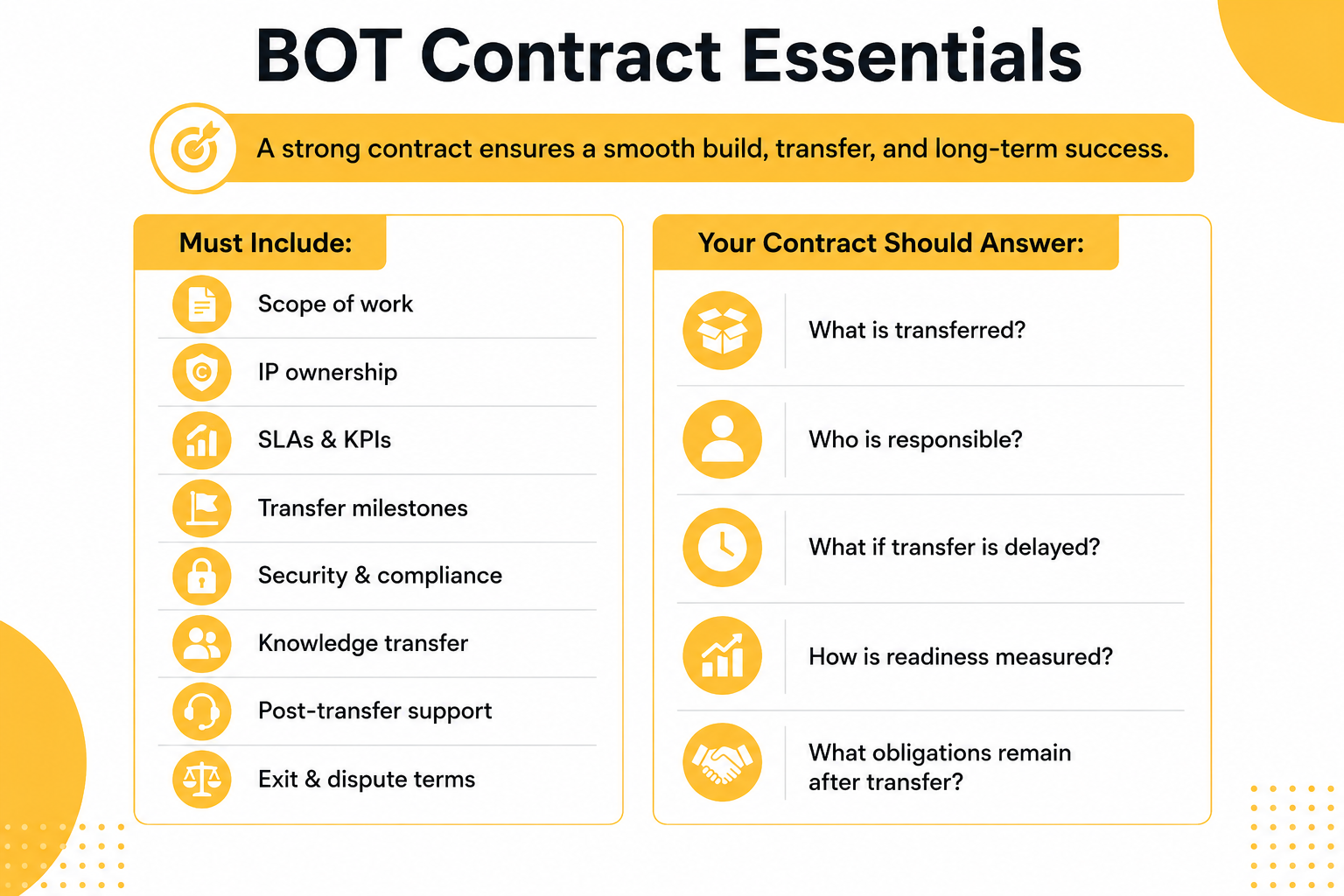
Core sections to insist on
-
detailed scope of work
-
ownership of deliverables and intellectual property
-
service level agreements and KPI reporting
-
transfer milestones and acceptance criteria
-
security, privacy, and regulatory compliance obligations
-
knowledge transfer and documentation requirements
-
post-transfer support terms
-
dispute resolution and exit rights
In infrastructure projects, BOT contracts often succeed because the parties accept that the build and operate phases must be governed carefully before transfer. Finance and AI programs should follow the same principle. If the contract is too thin, the company may face financial risks later. If it is too detailed in the right places, it enables speed with control.
Good contract language should answer
-
What exactly is being transferred?
-
Who is responsible during each phase?
-
What happens if transfer readiness is delayed?
-
What evidence proves operational maturity?
-
What obligations survive the transfer?
How BOT Aligns with Finance AI and Digital Transformation?
BOT is increasingly relevant for finance AI because the business needs both technical capability and governance discipline. Finance organizations cannot treat AI development as a simple staffing exercise. They need architecture, security, monitoring, and auditability built into the operating model.
That is where BOT software development and build operate transfer services become valuable. They allow a private company to work with a private sector entity or offshore team that can build the solution, manage it, and then transition it back into the organization once it is stable. This creates a controlled path toward digital transformation without forcing the business to absorb all the upfront costs and hiring risk at once.
For CEOs, this supports cost efficiency and financial stability. For CTOs, it creates a stronger operating model. For finance leaders, it improves compliance, performance monitoring, and ownership clarity. In other words, the build operate transfer approach is not only about delivery. It is about reducing friction while preserving control.
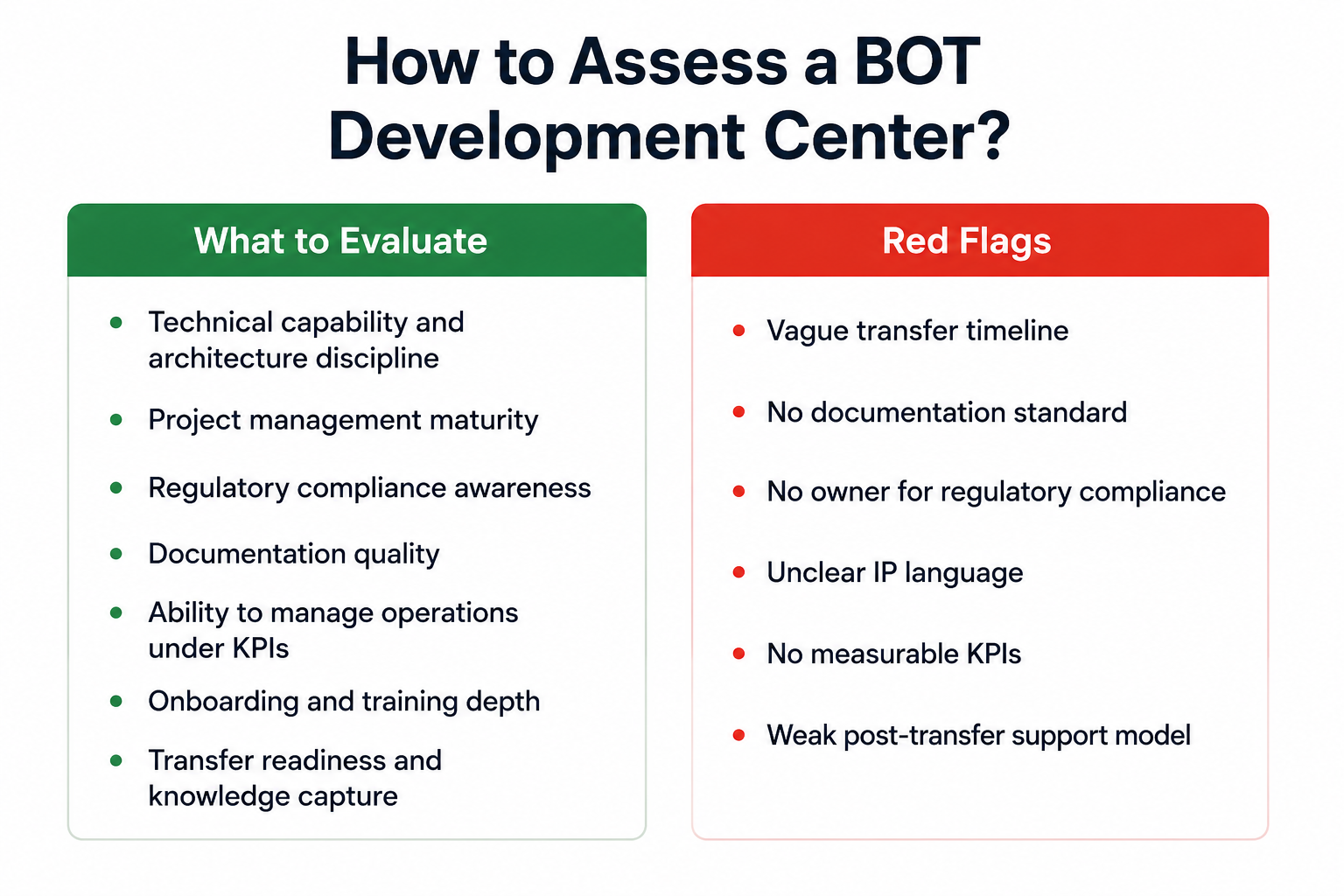
What To Evaluate in a BOT Development Center?
If the contract involves a BOT development center or offshore development centers, buyers should look beyond resumes and pricing. The real question is whether the provider can build an operation that transfers cleanly.
Evaluate these capabilities
-
technical capability and architecture discipline
-
project management maturity
-
regulatory compliance awareness
-
documentation quality
-
ability to manage operations under KPIs
-
onboarding and training depth
-
transfer readiness and knowledge capture
A strong provider will be able to explain how the build phase, operate phase, and transfer process connect to business outcomes. It should also be able to show how risk mitigation is built into delivery. If the provider cannot clearly describe how the handover will work, the contract is not ready.
Red flags
-
vague transfer timeline
-
no documentation standard
-
no owner for regulatory compliance
-
unclear IP language
-
no measurable KPIs
-
weak post-transfer support model
The India Advantage, When Done Properly
Many BOT contracts use India-based delivery because it offers technical talent, cost efficiency, and scale. But India is an advantage only if the team is structured properly. The offshore team must have real domain understanding, not just coding capacity.
For finance use cases, the team should understand business workflows, audit needs, documentation discipline, and secure engineering practices. It should also be able to support the transfer process without losing momentum. If the team lacks maturity, cost savings may disappear in the form of delays, rework, and operational expenses.
That is why team proficiency matters as much as geography. A good partner in India can help the client build internal capabilities faster. A weak one can leave the business with dependency and little ownership.
When Is BOT May Not Be The Right Fit?
Not every use case should use a build operate transfer agreement. If the scope is highly unstable, the business is not ready for ownership, or the transfer timeline is unclear, BOT may be the wrong model. It also may not fit if the company wants a permanent external operation rather than eventual transfer.
BOT works best when the client wants internal control, cost savings, and transferability. If those are not the goals, another operating model may be more suitable.
Conclusion
A build-operate-transfer contract is a business control document. It is not a procurement form. Before signing, finance leaders should examine the scope and ownership. They should also examine compliance and service levels. They should look closely at transfer mechanics and exit terms, too. Treat this with the same discipline you would apply to a major infrastructure project or a financial arrangement.
The best BOT contracts reduce capital expenditure. They also improve cost efficiency and support internal capability building. The weakest ones do the opposite. They create dependency, hidden risks, and a difficult transfer process. Get the contract structure right, and digital transformation comes with long-term ownership instead of long-term dependency.
Sign only when the contract proves it can move work, knowledge, and control from the provider to your organization without disruption.
Frequently Asked Questions

Look for scope clarity, ownership rules, service level agreements, transfer milestones, compliance obligations, and exit terms.
BOT is designed for eventual transfer and internal ownership. Standard outsourcing usually ends with the provider continuing the work.
They help reduce upfront costs, support regulatory compliance, and create a controlled path to internal capability.
The biggest risk is unclear transfer terms, because they can leave the client dependent on the provider after the operate phase.

By Mangesh Gothankar


By Ashwani Sharma
By Achin Verma






 4.8 out of 5 by