Businesses face constant pressure to build and scale their applications and other digital products at a faster pace, few resources, while ensuring cost effectiveness. And this motivates businesses to rely on external talent and sources to meet the evolving technological needs, without having to hire candidates in-house.
Two widely adopted approaches include IT staff augmentation and IT outsourcing. While both these approaches are popular and help businesses access specialized skills and boost the speed of delivery, the difference lies in the process execution, control, and ownership.
Staff augmentation is ideal for companies that wish to extend their in-house teams by simply integrating external professionals who can work as a part of their in-house team. On the other hand, IT outsourcing is the transfer of the complete project and its responsibility to the external vendor. From planning to executing and deployment, everything is taken care of by the outsourcing team.
Choosing between staff augmentation vs it outsourcing directly impacts the product control, scalability options and time-to-market.
Here is a complete guide that helps you understand the key differences between IT staff augmentation and outsourcing. It also helps you understand the use cases and which model ideally aligns with your business goals.
Difference between IT Staff Augmentation and Outsourcing
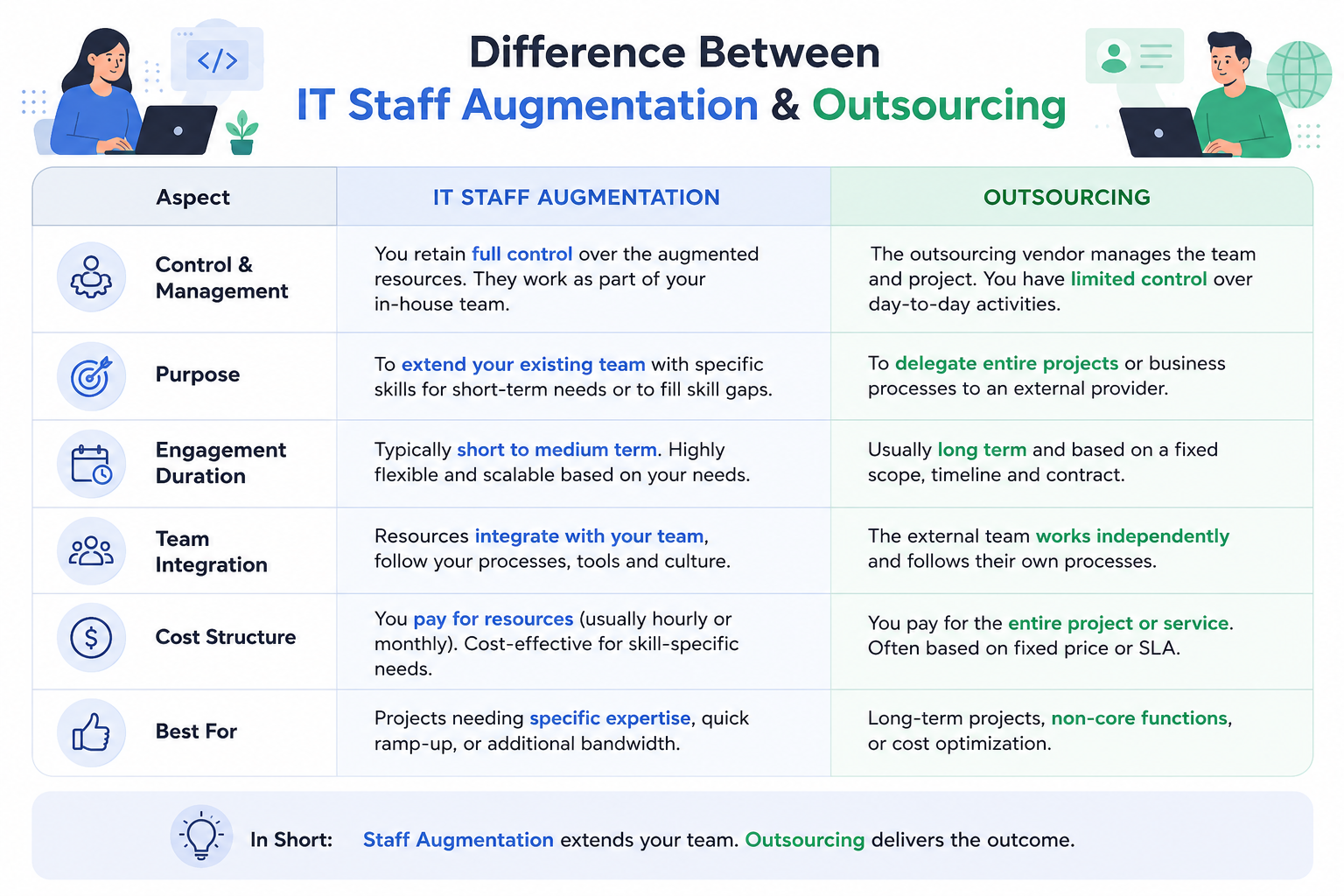
IT staff augmentation vs outsourcing is all about two different approaches that help scale the technological teams. Staff augmentation helps integrate skilled professionals in the in-house team for more control and flexibility. It basically fills the specific skill gaps. Outsourcing involves handing over the entire project to an external vendor. Here is a table that outlines the key differences between outsourcing and staff augmentation.
| Aspect | IT Staff Augmentation | Outsourcing |
|---|---|---|
|
Definition |
Temporarily adding skilled professionals to your in-house team. | Contracting an external vendor to handle entire projects or specific functions. |
|
Control |
High level of control over augmented staff and project management. | Limited control, as the external vendor manages the project or function. |
|
Flexibility |
Allows quick scaling up or down based on project needs. | Fixed contracts may limit flexibility during the project lifecycle. |
|
Cost |
Typically involves hourly rates or short-term contracts. | Often involves long-term contracts, potentially with higher overall costs. |
|
Integration |
Augmented staff work as part of the existing team, integrating with company culture and processes. | The external team operates independently, possibly with different practices and culture. |
|
Expertise |
Access to specific skills needed for a project. | The vendor provides a full team with expertise, but it may not be as specialized as needed. |
|
Commitment |
Short-term engagement with the option to extend as needed. | Long-term commitment with a defined scope and duration. |
|
Responsibility |
The company retains responsibility for project outcomes. | The vendor is responsible for delivering the project as per the agreement. |
|
Scalability |
Easily scalable based on project demands. | Scalability depends on the vendor’s capacity and contract terms. |
|
Risk |
Lower risk, as the company retains control. | Higher risk if the vendor fails to meet expectations. |
1. What is IT Staff Augmentation?
IT staff augmentation is one of the flexible models that allow companies to extend their in-house teams with the help of hiring external professionals. It is commonly used in discussions like staff augmentation vs IT outsourcing, where businesses need to compare control, scalability, and cost efficiency.
There is no need to hire full-time employees; organizations can simply bring in the expertise of skilled professionals for their specific project. Once the project is completed, the contract can be terminated. The model allows companies to close skill gaps and maintain complete control over project execution.

1.1 How Does Staff Augmentation Work?
Staff augmentation is hiring trained and qualified workers with the required skill sets. It is like using temporary workers or contractors to work on short-term positions within the company.
The hiring of a skilled workforce is done through Staff Augmentation Companies that keep a database of such employees.
In the IT staff augmentation process, these agencies maintain data of the workforce with different credentials and skill sets. They help businesses to evaluate existing skill sets and determine which additional skills are required. Thus, making the process turnkey for the client organization.
Depending on the evaluation, it is determined whether an organization should increase or decrease its staff. Also, depending on the agency providing resources, an organization needs to meet particular project requirements.
Recommended Read: How IT Staff Augmentation Model can Enhance your Business Growth?
1.2 When to use Staff Augmentation?
IT staff augmentation is quite important and effective when businesses wish to boost speed, flexibility and leverage specialized talent without having to fully outsource their operations. Here are the common scenarios that indicates the need of staff augmentation in your organization.
- Permanent staff are working overtime, but a new project has landed.
- A new project requires specialized skills that current business employees do not possess.
- An employee with the required knowledge/ skill-set is on an extended period of absence, and a new project has landed. So, you need temporary employees to cover the skills gap.
- The company lacks financial resources to recruit the right talent.
- The company needs to meet a strict deadline.
- The organization demands the flexibility to scale.
1.3 Benefits of Staff Augmentation Services
IT staff augmentation is one of the preferred models for hiring as it allows businesses to scale quickly and access specialized talent without having to burn the pockets. When comparing IT staff augmentation vs outsourcing, augmentation stands out for its flexibility, control, and faster team expansion. Here are some of the critical advantages it offers:
a) Faster Hiring and Lower Recruitment Costs
One of the biggest advantages of staff augmentation outsourcing is the speed. Organizations can onboard pre-vetted professionals, and guess what, they don’t have to go through lengthy hiring cycles. There is no onboarding needed, no background checks, and there is ultimately cost savings. This helps reduce time-to-hire and associated hiring costs.
b) Reduced Workload for In-House Teams
When you hire developers, businesses can ease the pressure on internal teams as the core development work goes to the augmentation team. This helps reduce employee burnout, boosts productivity and ultimately allow team members to focus on strategic business priorities.
c) On-Demand Scalability
When it is about staff augmentation, businesses can scale their teams up or down as per the project requirement and seasonal demand. This flexibility allows companies to manage the fluctuations in the workload and ensures the growth of both companies and employees.
d) Cost Efficiency Without Long-Term Commitment
When it is about traditional hiring, businesses need to pay even if the expert is not required. However, staff augmentation follows a flexible pay-per-use model. Here, the businesses only need to pay for the expertise and hours they actually need the expert. This avoids the long-term payroll obligations and infrastructure setup costs.
e) Access to Specialized Global Talent
Companies can tap into a wider talent pool with niche technical expertise that may not be available locally. This is one of the key reasons why staff augmentation vs software outsourcing remains a common evaluation for growing businesses.
2. What is Outsourcing?

Outsourcing is a more autonomous process as it involves offloading a task to third-party experts. In simple terms, hiring a team through an outside business for a particular time or project (or delegating a company's business process to a third party).
When comparing staff augmentation vs software outsourcing, outsourcing offers a more hands-off approach. While staff augmentation extends your internal team, outsourcing transfers project ownership to an external vendor.
While Offshore Outsourcing is hiring a third party to do the work offshore, usually to reduce the cost of the project. Also, taking advantage of their expertise, economies of scale, and scalable labor pool.
2.1 How Does IT Outsourcing Work?
The steps here include identifying the business functions, projects to be worked on, and capabilities to be assigned to the external partner. Once you define the scope, the outsourcing provider assigns a dedicated team with the expertise and resources.
From project execution to team management, and execution, the outsourcing partner takes care of everything and offers the best outputs.
A typical IT outsourcing process includes:
- Defining project scope, goals, and technical requirements
- Selecting the right outsourcing partner
- Establishing engagement models, timelines, and SLAs
- Building and onboarding the external team
2.2 When to use Outsourcing?
Outsourcing lets businesses hire remote developers or remote development teams with the required skill set. Reasons that demand the need for Outsourcing:
1. To Lower Operational and Labor Costs: If your business is located outside the country, then you can hire an offshore development team. Thus, passing on tasks to an experienced firm will save money and time both.
2. Focus on Core Business Functions: Freeing up the internal workforce so that they can efficiently work on internal business processes.
3. Mitigating Risk Factors: Outsourcing, especially hiring offshore developers, helps companies reduce risk and is also among the primary reasons.
4. Gaining Access to World-Class Capabilities: Companies outsource to gain access to new market areas and also to increase knowledge transfer.
IT outsourcing is one of the best and cost-saving tactics that helps businesses gain business advantages. Companies in 2026 consider outsourcing as one of the most viable options, which helps boost their digital transformation journey. When comparing outsourcing vs staff augmentation, outsourcing is the ideal option and allows businesses to seek end-to-end ownership of the project and reduce management overhead.
2.3 Benefits of Outsourcing
IT outsourcing is one of the best and cost-saving tactics that helps businesses gain business advantages. Companies in 2026 consider outsourcing as one of the most viable options, which helps boost their digital transformation journey. When comparing outsourcing vs staff augmentation, outsourcing is an ideal option and allows businesses to seek end-to-end ownership of the project and reduce management overhead.
a) Better Risk Management and Business Continuity
Outsourcing allows businesses to share technical, operational, and delivery-related risks with an experienced technology partner. Established outsourcing providers typically have mature processes, compliance frameworks, and contingency plans in place. This reduces project risk, improves reliability, and ensures greater business continuity.
b) Increased Focus on Core Business Functions
By delegating software development or non-core IT operations to an external partner, internal teams can concentrate on strategic priorities such as innovation, customer experience, and business growth. This leads to better resource utilization and stronger organizational focus.
c) 24/7 Productivity and Faster Time-to-Market
Working with offshore outsourcing teams across multiple time zones enables continuous development cycles. While your in-house team is offline, your outsourcing partner can continue building, testing, and optimizing. This around-the-clock workflow helps accelerate product development and reduce time-to-market.
d) Access to Specialized Global Talent
IT outsourcing gives businesses immediate access to a vast pool of highly skilled professionals across technologies, industries, and domains. This is especially valuable when local talent is scarce or when projects require niche expertise.
e) Significant Cost Savings
Outsourcing can substantially reduce expenses related to hiring, onboarding, infrastructure, employee benefits, and ongoing training. Businesses can convert fixed operational costs into variable costs while maintaining access to top-tier technical capabilities.
f) Improved Scalability and Flexibility
Outsourcing partners can quickly scale teams up or down based on changing project requirements, market demands, or business priorities. This flexibility enables organizations to respond faster to opportunities without the delays of traditional hiring.
Recommended Read: Why Should You Elect India for Mobile App Technology?
3. Hybrid Approach - IT Staff Augmentation & Outsourcing
There is no one-size-fits-all approach for most of the companies. Many times it is not possible for an enterprise to follow a staff augmentation model or a project outsourcing model individually.
There can be an overlap of needs to complete the work on time. So during that time, a hybrid approach might be your best option. The hybrid approach is a blend of project outsourcing and the IT staff augmentation model to fulfill the requirements of a project. This approach can be implemented at different stages during the development cycle, but with careful planning.
In the Hybrid Approach, companies collaborate with an outsourcing provider to set up a dedicated offshore development center.
3.1 How Hybrid Approach Work?
This approach lets businesses set up a development team remotely by using an outsourcing provider's resources. An outsourcing partner takes care of candidate selection and screening, IT hiring, project management, and deliverables.
For example:
- Your in-house team manages product strategy and critical decision-making
- Augmented staff fills specialized skill gaps within internal teams
- An outsourcing partner handles specific projects, modules, testing, or support functions
However, this approach requires a business to dedicate certain resources and to get involved in all project development stages.
3.2 When to use the Hybrid Approach?
A hybrid model is ideal when:
- You need to scale quickly without overextending internal resources
- Specialized skills are unavailable in your local talent market
- You want to reduce costs without compromising product quality
- Your project requires both strategic oversight and external execution
- You are building a long-term offshore development capability
This is why the staff augmentation software outsourcing hybrid model is becoming increasingly popular in 2026.
3.3 Benefits of the Hybrid Approach
a) Maximum Flexibility
Scale teams, capabilities, and delivery resources based on changing project needs.
b) Access to Broader Talent Pools
Combine in-house expertise with global technical talent and specialized external resources.
c) Lower Operational Overhead
Reduce recruitment, infrastructure, HR, and administrative costs by leveraging an outsourcing partner.
d) Greater Control with Shared Responsibility
Retain ownership of critical business functions while delegating execution-intensive tasks.
e) Faster Time-to-Market
Accelerate development cycles by distributing work across internal and external teams.
Conclusion
All three approaches are a great way to cut down your business costs and increase revenue. But, figuring out which model suits your business project needs is a bit of a complicated task. Therefore, a detailed cost-benefit analysis is the best way to make a decision. It will help you to understand which model will work best for your project.
IT Staff Augmentation and Outsourcing - Choose your model and take your business to new success heights. Your Team in India has been delivering world-class IT outsourcing services for more than twelve years, bringing together the right mix of knowledge and innovation.
Frequently Asked Questions

Businesses choose a hybrid model when the company needs both strategic control and execution externally. It works well for large-scale enterprises, digital transformation initiatives, and for long-term product development.
Staff augmentation is generally more cost-effective for short-term projects or specialized skill gaps. Outsourcing often delivers better value for long-term projects requiring full-team support and end-to-end delivery.
Yes, outsourcing typically involves less day-to-day control because the external vendor manages the project. In contrast, staff augmentation gives you direct oversight of resources, workflows, and deliverables.
The primary risks include reduced visibility, potential communication challenges, and dependency on the vendor. These risks can be minimized by selecting an experienced outsourcing partner with proven delivery processes.




%20(2)%20(1).webp?width=352&name=Programming%20Outsourcing%20(2240%20x%201260%20px)%20(2)%20(1).webp)



 4.8 out of 5 by