Most teams managing offshore teams across time zones fall into one of two traps: either there are too many live calls or too little communication. However, neither works, and both create chaos for the seamless project execution.
What does work is building a deliberate async-first operating model. This model ensures that communication is structured, documentation becomes a habit, and time-zone differences offer advantages rather than being a liability.
Also, research suggests that 83% of knowledge workers say async communication increases their productivity, while 52.8% want more of it.
When done right, async communication transforms the offshore dedicated team into a 24-hour execution engine. That means, even when you are sleeping, the work continues to move, and decisions don't wait for overlap windows. Offshore engineers stay focused, leverage uninterrupted work time, and the real productivity begins.
This async-first offshore team management playbook covers exactly how to build that system. It covers the communication stack, the time zone architecture, and the daily rituals that high-performing offshore teams actually use.
What "Async-First" Actually Means for Offshore Development Teams
Async-first doesn't mean async-only. It means replacing real-time updates with written documentation, and structured updates come before live calls, and improve team performance.
The goal is to help offshore development teams work efficiently without depending on overlapping working hours, unnecessary video conferencing, or constant remote communication interruptions.
Basically, it is a core shift from asking questions like “ are you available” to “here is everything you need to proceed forward.”
This means:
-
Decisions are documented, not just discussed on voice and video calls.
-
Context lives in tickets and docs, not in someone's head.
-
Questions are batched, not fired off as they arise.
-
Meetings have a clear trigger, a genuine blocker, not a status check
Project management tools like Slack and Jira form the backbone of most async communication stacks for offshore development teams. But tools alone don't create async culture; the norms and rituals have an impact too. Get that right, and your offshore team stops feeling "offshore" entirely.
The Communication Stack That Actually Works
Not all communication needs a meeting. The key is matching the right tool to the right type of message. Tools like Microsoft Teams help remote workers maintain visibility, reduce communication challenges, and keep the entire team on the same page. Here's the stack that high-performing dedicated development teams rely on:
|
Layer |
Tool Type |
Use Case |
|
Permanent record |
Docs / Wikis (Notion, Confluence) |
Decisions, specs, SOPs |
|
Threaded async |
Slack / Microsoft Teams |
Questions, updates, reviews |
|
Structured sync |
Loom / Vidyard |
Walkthroughs, feedback, demos |
|
Scheduled sync |
Zoom / Google Meet |
Weekly planning, blockers only |
If something can be documented in Notion, threaded in Slack, or recorded in Loom, it shouldn't be a meeting. Reserve your scheduled sync time for decisions that genuinely need live discussion, not status updates that belong in a ticket. This helps everyone to remain on the same page.
This single discipline cuts unnecessary calls by half and keeps your offshore development team moving without waiting on you.
How to Efficiently Handle Time Zone Differences
Time zone differences don't have to slow your team down. The teams that struggle are the ones that treat the offset as a problem to overcome. The ones that thrive design their workflows around it. Here's how:
1. Find the hours that work for both sides
Most offshore dedicated teams share 1–2 hours of workday overlap with their clients. Protect that window and use that time to make important decisions. Focus on resolving blockers rather than taking status updates.
2. End your day with a written update
Every engineer wraps up with a short written update, including what was completed, what's in progress, and any blockers. No overlap needed. Work continues on your end while they're offline.
3. Structure Your Async Sprint Ceremonies
-
Standups: written or recorded via Loom, not live
-
Sprint planning: tickets written with enough context to start without a call
-
Retrospectives: shared doc with comments before the live session
4. Let the Time Zone Work For You
With a clear handoff process, your offshore development team can work smoothly across time zones. Work moves while you sleep. By morning, progress is already documented and waiting.
Recommended Post: Time Zone Advantages: Turning the India-US Gap into an Edge
The Async-First Playbook: 8 Non-Negotiable Practices
Following practices like written standup, decision logging, pre-meeting briefs, and more helps separate the high-performing dedicated teams from the ones who struggle. These 8 practices form the core of remote environment communication best practices used by high-performing offshore teams in India.
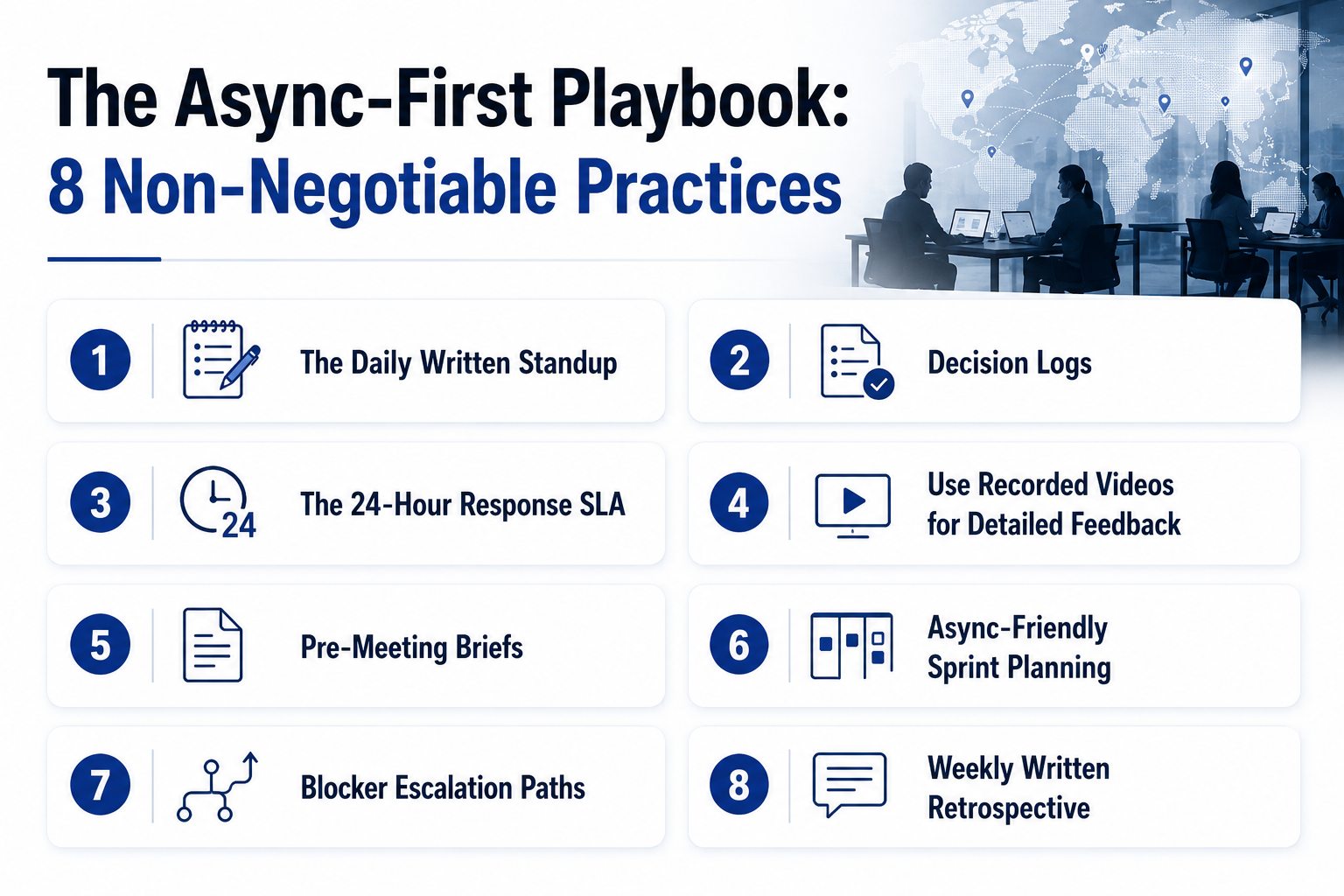
1. The Daily Written Standup
Replace the long and live standup meetings with quick and short written updates at the beginning of every working day. It follows a simple format here: add what was completed in the past, what are your plans for today, and indicate if there are any blockers. This practice eliminates the need for offshore development teams to get rid of scheduling unnecessary calls.
2. Decision Logs
When the meeting and call end, there are generally three bullet points you can find in the Confluence. These include what the decision was, why it was taken, and who actually owns the next step. New team members can find context without asking, and nothing gets lost between time zones.
3. The 24-Hour Response SLA
Every asynchronous and synchronous communication, whether in Slack, Jira, or a shared doc, gets a response within 24 hours. Critically, this works both ways. Client-side teams are just as accountable as the offshore team. When both sides respect the SLA, trust builds fast, and work rarely stalls waiting for an answer.
4. Use Recorded Videos for Detailed Feedback
When you are explaining bugs, changes in design, and code updates, the text messages create chaos. In that scenario, rather than scheduling long video calls, it becomes better to record video and prefer screen sharing. With a quick recording walkthrough, it becomes easier for the offshore development teams to understand things with ease. It also helps save time and has become a preferred choice.
5. Pre-Meeting Briefs
No agenda, no meeting. Every scheduled sync comes with a short written brief shared at least 2 hours in advance, the purpose, the decision needed, and any relevant context. This keeps your overlap window focused on outcomes, not catching people up on background they could have read.
6. Async-Friendly Sprint Planning
There must be enough context to be written on tickets so that the developer or engineer can start their work. That means the acceptance criteria are clear, there are documented edge cases and more. When the tickets are written that way, the sprint velocity rises.
7. Blocker Escalation Paths
Every engineer on the offshore team knows exactly who to contact, through which channel, and how urgently when they hit a blocker. Without a defined escalation path, engineers either wait hours for the overlap window or interrupt the wrong person. A simple escalation matrix properly documented solves this entirely.
8. Weekly Written Retrospective
Prefer using a shared doc rather than a live retro. Team members add their observations, wins, and friction points async throughout the week. Only the items that genuinely need discussion make it to a short live session. This approach produces richer retrospectives because people have time to think.
Where Async-First Goes Wrong
Async-first only works when it's actively maintained. Here are the most common failure points and how to fix them:
|
Problem |
What It Looks Like |
Fix |
|
Over-documenting, under-deciding |
Docs pile up, but no clear decisions get made. Async becomes avoidance. |
Set a decision deadline on every open thread |
|
Context collapse |
New joiners can't find anything. Everything lives everywhere and nowhere. |
Maintain a single source of truth, one wiki, clear structure |
|
Client-team silos |
The offshore team and the client operate in separate bubbles. Alignment slowly breaks down. |
Weekly shared update visible to both sides |
|
Broken async culture |
Response lag, repeated questions, and poor doc quality become the norm. |
Run a quarterly async audit, review your stack, rituals, and norms. |
Sync Moments That Still Matter
No, as we have clear details on async-first, that does not clearly mean you never get on a call. There are moments when you genuinely need a live conversation, so that things can be sorted more efficiently and you can make decisions with more clarity. Knowing when to go live is one of the most overlooked remote team communication best practices for offshore teams in India. Here's when to go synchronous:
Weekly Alignment Video Calls
Try keeping it short and precise. Already have an agenda in mind so that you can directly come to the point. This is preferable for decisions and directions only.
Monthly 1:1s with Tech Leads
When you check in monthly with the offshore development team, it helps build more trust, helps surface issues at an early stage, and keeps their relationship stronger. These don't have to be too long; a conversation of around 15-20 mins with a clear focus is more than enough.
Quarterly Team Retrospectives
Once a quarter, bring the full team together live. Review what's working, what isn't, and what needs to change. This is one meeting worth protecting on the calendar.
New Joiner Onboarding
The one exception to every async rule. New team members need live interaction upfront — to understand context, ask questions freely, and feel part of the team. Invest synchronous time early, and you'll need far less of it later.
Concluding Thoughts
Building an async-first operating model is not a one-time setup; it is an ongoing process. The teams that get it right don't just communicate better across time zones; they execute faster and build stronger working relationships with their offshore development teams.
The practices in this playbook work. But only if both sides commit to them. Ready to work with an offshore development team that's already built for async communication? Reach out to Your Team in India and build a remote team that works efficiently across time zones without slowing down execution.

By Mangesh Gothankar


By Ashwani Sharma
By Achin Verma
Frequently Asked Questions

An async-first playbook is a set of communication rules, tools, and daily rituals that allow offshore dedicated teams to collaborate effectively without relying on live calls. It replaces reactive communication with structured, documented workflows.
Start with the right stack: Slack for threaded updates, Notion for documentation, and Loom for complex feedback. Then build rituals around it: daily written standups, decision logs, and a clear response SLA. Tools without habits don't work.
The biggest challenge is keeping work moving during non-overlap hours. The fix is a strong end-of-day handoff ritual, async sprint ceremonies, and a clear blocker escalation path so engineers are never stuck waiting.
For the best remote setup, define your communication layers clearly, protect your overlap window for decisions only, document everything in a central wiki, and run quarterly async audits to keep your system healthy.
The right mix includes Slack for threaded messaging, Notion or Confluence for documentation, Loom for screen sharing and async video walkthroughs, and Zoom for scheduled video conferencing. But tools alone aren't enough; daily written standups, decision logs, and clear escalation paths are what turn tools into a real team collaboration system to streamline communication across different countries.




-1.png?width=352&name=Why%20Businesses%20Choose%20Offshore%20Development%20%20(1)-1.png)


 4.8 out of 5 by