Distributed software development is defining the grounds for modern engineering organizations that need to instantly scale their products and services.
Yet many leaders still consider the India-US time difference as a scheduling inconvenience.
Academic research in global software engineering shows a clear pattern. It says, “Distributed teams without planned overlap experience struggles with lower productivity and coordination.”
Even though limited, shared working hours significantly improve outcomes compared to teams that work under zero overlap. Such a relationship can be understood statistically and is well documented in peer-reviewed research on global software teams published via PhilArchive.
At the same time, workflow models where work moves sequentially across time zones allow progress to continue beyond a single workday. The follow-the-sun model demonstrates how development time per day increases when teams are intentionally organized across regions.
In short, the constraint is not geography. It is more of a problem with leadership design. When teams define delivery ownership at the initial stage, accountability is defined upfront.
In this blog, we will understand how the India-US time gap can become the pathway to speed and continuity. Besides, we will understand all the possible scenarios that can help overcome the friction.
The Real Cost of Poor Time Zone Management
Poor time zone management rarely fails in obvious ways. It fails through small repeated inefficiencies that quietly slow delivery:
What Breaks Without a Defined Time Zone Strategy?
Delayed feedback loops: A common pattern appears when a US team hands off work at the end of the day. Questions surface offshore, but decision makers are offline. Without considering the work pauses or assumptions made. By the time feedback arrives, an entire day is lost. When it comes to a sprint, such delays compound into missed commitments.
Idle engineering hours: Without clear handoffs, offshore teams spend time waiting rather than building. Effort shifts toward preparing updates and seeking clarity instead of advancing the product. Activity remains high, but momentum drops.
Leadership burnout from late coordination: To compensate, managers usually step into late-night calls and early morning syncs. Such gap shifts decisions from planned forums to reactive conversations. Over time, leadership focus erodes, and fatigue sets in.
Offshore teams are reduced to execution: Lack of structure strips ownership. Offshore teams wait for direction instead of driving outcomes, which causes offshore teams to struggle with initiative declines and slower deliveries.
Why does the problem become expensive?
With growing offshore teams, coordination debt accumulates with increased dependencies. It leads to a decline in velocity also. In such cases, fixing the structure later means changing contracts and trust models. Thus, designing a time zone strategy early is far less costly than repairing it under pressure.
Understanding the India–US Time Zone Gap in Practical Terms
The time difference between India and the United States ranges from roughly 9.5 to 12.5 hours (depending on the US region and daylight changes). The gap is often discussed as a limitation. But in practice, it creates scope for clearly defined execution time and review time.
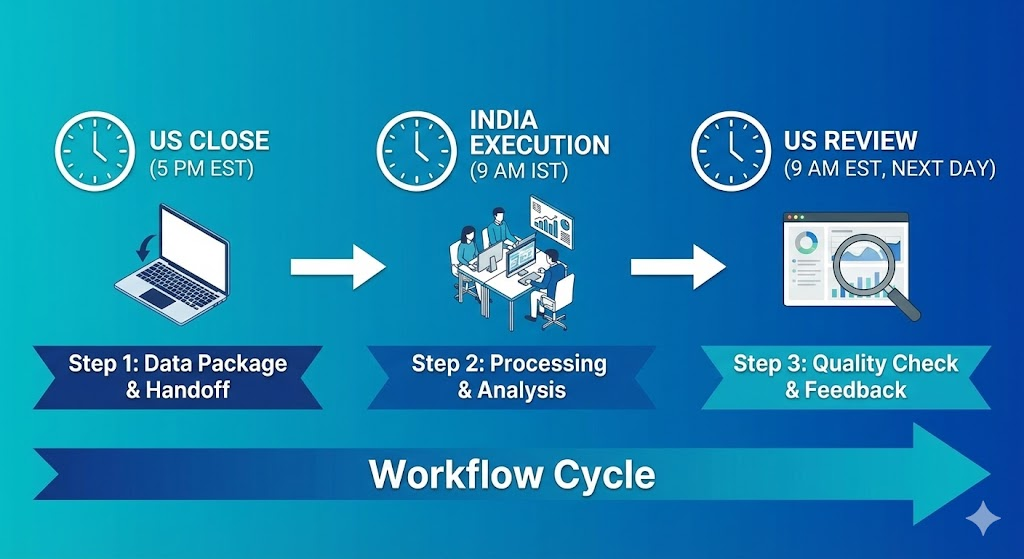
When US teams end their workday, Indian teams are starting theirs. This creates a natural shift in responsibility rather than a collision of schedules. Execution happens when focus is highest. Reviews and decisions happen when stakeholders are fully available. The problem is not the gap itself. It is that most organizations do not plan around it.
Overlap windows do exist. They are predictable and consistent. But they only add value when they are designed intentionally. Without planning, overlap turns into scattered meetings.
Why Is This Gap Actually Valuable?
A well-designed gap creates clear handoff points. Organizations that are established in the US and have an offshore development center in India know when work moves.
Progress continues without waiting for the next shared hour. In such a setting, the identified or suggested issues are resolved before the US workday begins.
The time gap also improves focus. Teams work during normal hours without constant interruptions. When designed correctly, the India-US time gap supports speedy and sustained execution.
Visual suggestion: Timeline graphic: US close → India execution → US review.
Follow the Sun Model: From Theory to Reality
What is the Follow the Sun Model?
The Follow the Sun model is a delivery approach. It was designed for continuous progress across global time zones. The approach allows work to move from one region to another as teams finish their day. No team is asked to extend work hours or compromise focus. Also, each location owns a defined part of execution during its normal workday.
The core idea is simple. Progress continues while another team rests. The approach creates a near 24-hour development cycle free of any burnout. When done right, work moves smoothly across regions instead of waiting for the next morning.
Why Do Most Companies Fail at It?
Most failures come from how teams are hired and structured. Offshore teams are often treated as extra capacity rather than accountable delivery units. It leads to confusion around ownership and accountability.
Another common issue is unclear handoffs. Tasks are passed to the teams without a shared understanding of completion standards. Besides, offshore teams also rely too heavily on real-time meetings to bridge such gaps.
What Makes It Work in Practice?
Successful Follow the Sun execution depends on both structure and tools. Dedicated software development teams are critical. These teams own outcomes, not just tasks.
Documentation comes first. Clear tickets, written decisions, and recorded context reduce dependency on live conversations.
Each handoff follows a clearly defined definition of done. The process ensures incoming teams know exactly what is complete and what needs action.
When ownership is clear and documentation is strong, the model delivers true continuous progress without friction or fatigue.
Offshore Shift Overlap
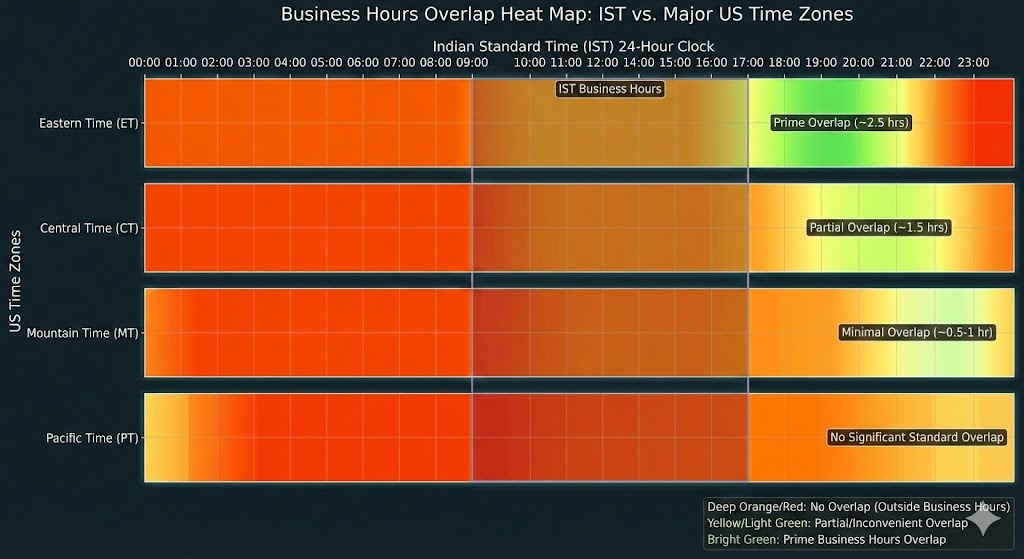
Overlap hours are often misunderstood as a need for maximum availability. In reality, two to four focused hours deliver far more value than forced presence across long stretches of the day. The goal is not to stay online longer. The goal is to make the overlap purposeful.
Overlap time should be harnessed for high-impact collaboration. It includes planning upcoming work to making decisions that can help with rapid execution and resolving risks long before they grow.
At times, routine updates and passive listening can waste the most valuable shared hours. When overlap is treated as a strategic window, teams stay focused, and execution stays fast.
Overlap Window Rules That Matter
For driving productivity across time zones, clear availability expectations are necessary. Every team member should know exactly when overlap starts and ends. The information can help avoid confusion and silent pressure to remain online beyond agreed hours.
Async communication should remain the default. Messages outside overlap should be avoided unless clearly defined as critical. The approach protects focus and prevents burnout.
Intentional leadership presence during overlap is important. Managers should unblock teams resisting pulling engineers into unnecessary discussions. Strong leadership overlap allows engineers to disconnect on time, overcoming the delivery risk.
Meeting Hygiene During Overlap
Overlap meetings must be short. Each meeting should have a clear agenda and an outcome structured for it. Besides, the standups should focus on blockers and actions to avoid delays, rather than work on detailed status updates.
Avoid meetings that exist only to share progress. Written updates work better for that. Decisions made during overlap should always be recorded and shared so async teams can move forward without follow-up calls.
Visual suggestion: Overlap heat map (IST vs US time zones).
Making Asynchronous Work “Bus Proof”
Why Async Is the Backbone of Time Zone Management
Asynchronous work is a system that keeps delivery moving when people working across distributed teams are unavailable.
When we talk about US-India time zones, there will always be hours when one side is unavailable. If work pauses during unavailability hours, velocity drops fast.
It is the poor async habits that create the hidden costs. Mostly, engineers have to redo tasks because context is missing, while reviews take longer because intent is unclear. In short, teams wait a full day for answers that should have been obvious. Over time, these issues turned time zone gaps into delivery delays.
Strong async makes work resilient; if one person is on leave or exits suddenly, progress is not lost. That is what makes the delivery bus proof.
Practical Async Protocols
-
Every task should be backed by context-rich tickets.
-
Explain the why, not just the what, by including references, constraints, and expected impact.
-
Acceptance criteria must be clear and testable, as ambiguity leads to rework across time zones.
-
For complex changes, short video walkthroughs can save hours of back and forth. Remember, a five-minute explanation can save days of clarification.
-
Documentation should live in one central system and act as the only source of truth. If it is not written there, it does not exist.
Enabling Reliable 24/7 Software Development
What Does 24/7 Development Actually Mean?
24/7 development does not mean engineers working through the night. It means offshore developers operate in their normal work hours while progress continues across the day. When the US team signs off, execution moves to India. When India wraps up, the results are ready for review. Velocity increases without asking anyone to stretch their day or sacrifice focus.
This model works because energy is preserved. Engineers work when they are sharp. Leaders review when decisions can be made calmly. Burnout drops because urgency is designed out of the system.
Where Does This Model Deliver the Most Value?
Product engineering benefits from continuous build and review cycles. Features move faster through development without waiting for the next day to start.
-
QA and testing gain overnight execution.
-
Test cycles run while product leaders are offline, which shortens the release timelines.
-
Platform maintenance improves through continuous monitoring and issue resolution.
-
Problems are identified and handled before they escalate.
AI and data workflows benefit from long-running jobs and iterative model work that progresses while other teams rest.
Why Is India Central to This Model?
India brings decades of offshore delivery maturity. Teams are trained to document clearly and execute independently. When structured well, they operate as true extensions of US product teams.
The Human Layer: Culture, Boundaries, and Trust
Time zones fail when culture is ignored.
When teams demand instant responses across continents, trust erodes fast. It is vital to understand that respecting off-hours is an operating requirement for sustainability.
Cultural differences also shape how people communicate. Some teams escalate quickly while others wait for clarity. Without shared norms, silence is misread as disengagement. All in all, the urgency turns into frustration amongst teams.
Over time, this creates hidden tension. Leaders feel they must stay online late. Offshore teams feel watched but not trusted. Productivity drops long before delivery metrics show it.
What Mature Teams Do Differently?
Strong teams set explicit response time expectations. It means not every message needs a same-day reply. Teams stick to protect their local working hours. In short, exceptions must be treated as real exceptions.
A mature offshore team deliberately invests in building rapport. They work on short onboarding visits with shared retrospectives. Besides, it is the context of business goals that helps teams see work. Trust grows when people feel ownership and respect, not constant supervision.
This is where offshore delivery becomes durable.
Escalation, On-Call, and Risk Management
Not every issue can wait for the next overlap window. Production incidents and customer-facing outages demand immediate action. When escalation is handled informally, the same people get pulled in repeatedly. Burnout follows, and response quality drops. Leaders often mistake availability for reliability. They are not the same.
Without a designed model, dedicated development teams either over escalate or hesitate. Both are expensive.
What Works in Practice?
Mature organizations define escalation paths before problems occur. Everyone knows who owns the first response and who gets involved next. On-call rotations are limited, planned, and compensated. This signals respect for time and accountability for outcomes.
Clear severity definitions remove emotion from decisions. Teams act based on impact, not urgency alone. This is what separates enterprise-ready offshore models from improvised global coverage.
Conclusion: The India–US Time Gap Is a Strategic Asset
Time zones do not slow teams. Poor operating models do. The India-US time difference only becomes a constraint when leadership treats offshore teams as support functions instead of delivery owners.
When designed with intent, this gap enables faster delivery through overnight progress. It improves focus by reducing constant interruptions. It also allows predictable scale without exhausting people. These benefits do not come from tools or longer workdays. They come from structure, clarity, and trust.
The real differentiator is not geography. It is ownership. Teams that own outcomes use time zones as leverage. Teams that execute tasks fight the clock every day.
Frequently Asked Questions

2 to 4 hours are usually sufficient, as the goal is not constant availability. It is all about high-quality interactions amongst the teams operating from different geographical points.
The overlap time window can be used for decisions and risk discussions. Besides, the execution can happen outside the overlap, as extensive overlap often leads to fatigue over improvement.
Not when designed correctly.
Burnout can happen when teams stretch workdays to stay aligned. A proper follow-the-sun model operates as per normal working hours. It means the work moves across teams and ownership is transferred through clear handoffs.
Yes. Effective 24/7 development relies on time zone sequencing and not round-the-clock staffing. Teams work standard hours in their regions. Progress continues as work passes across geographies.
All in all, night shifts should only happen for true on-call situations.
They optimize for availability instead of accountability. Hiring teams to be online longer does not improve delivery. It hides weak ownership and poor planning. Strong time zone management starts with clear responsibilities and not extended work hours.
Staff augmentation focuses on individual availability, whereas dedicated teams focus on outcome ownership.
Time zones become a constraint in the first model and an advantage in the second. To put it in words, dedicated teams plan work more precisely around handoffs and operate as a unit.
India combines a large engineering base with strong documentation and process discipline. Many US organizations are habituated to working with dedicated development teams from India. It makes structured handoffs, async execution, and ownership-driven delivery easier to sustain with India from the US.








 4.8 out of 5 by