Python dominated the AI and machine learning ecosystem for the longest time, becoming the default language for advanced AI research. However, that scenario is changing fast, and Node.js has taken the charge.
With its event-driven and non-blocking architecture, it enables developers to build high-performing, scalable AI applications. Whether it is handling data in real time or performing model inference, it can handle it all.
Businesses today are more concerned about how AI is deployed and integrated into apps that are used by millions of users. According to a report, around 40% of developers use Node.js, making it one of the most used web technologies. From chatbots to recommendation engines and intelligent automation, it acts as a backbone that connects AI modes with real-world applications.
The growing demand led to the rise of Node js libraries for AI and machine learning, while allowing developers to implement NLP, neural networks, and large language models workflows in JavaScript applications.
Here is a blog that covers the top 10 Node js libraries for AI integration that developers and businesses must be aware of. No matter if you are planning to build an AI product, scale the existing ecosystem, or hire nodejs developers, the guide will help you choose the right tools to grow and innovate.
Why Node.js Is Ideal for AI Integration?
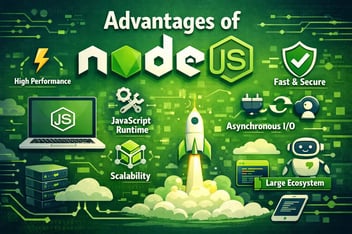
AI integration continues to rise, and businesses now prioritize speed and scalability over standalone model development. The shift led more businesses to adopt Node.js as an ideal platform for AI integration in the production environment. Here are some reasons why Node.js is a must for AI-driven applications.
1. Event-Driven, Non-Blocking Architecture
Built on an asynchronous, non-blocking I/O model, it can efficiently handle and process thousands of concurrent requests. It is important for AI-powered systems such as real-time chatbots, recommendation engines, fraud detection systems, and more.
AI interference involves API calls, database queries, and model responses. Node handles these operations without blocking data execution, resulting in lower latency and faster responses.
2. Ideal for Real-Time and API-First AI Apps
Most modern AI systems are consumed via REST APIs, GraphQL endpoints, or real-time sockets. Node.js excels in these areas, making it a natural fit for AI-powered SaaS platforms, conversational AI and virtual assistants, and streaming data and real-time predictions.
This is why many companies use Node.js as an AI orchestration layer, even when models are trained in Python or other languages.
3. Unified JavaScript Ecosystem
One of the benefits of Node.js is the ability to use JavaScript across the entire stack, frontend, backend, and AI integration. It offers plenty of benefits like a faster development cycle, seamless collaboration between teams, and reduced context switching.
With modern Node.js libraries and AI libraries, developers can integrate machine learning features without leaving the JavaScript ecosystem.
4. Strong AI & ML Library Ecosystem
The Node.js ecosystem has evolved, offering powerful tools for AI and machine learning integration, including deep learning and neural networks, computer vision, and large language model workflows.
Libraries like TensorFlow.js and LangChain.js enable node js machine learning use cases in production environments. It reduces the need for constant cross-language dependencies.
5. Integration with Python-Trained Models
Node.js complements Python. Most of the organizations train the models using Python-based ML libraries and deploy them using REST APIs, ONNX models, and Cloud-based AI services.
Node.js works as a deployment and integration layer, allowing businesses to serve AI models at scale.
This makes Node.js a preferred choice for companies building scalable AI products or planning to hire Node.js developers for long-term growth.
Top 10 Node.js Libraries for AI Integration
Here are the 10 most popular and widely used Node.js libraries for AI integration that developers rely on to build intelligent, production-ready applications.
1. TensorFlow.js
It allows developers to run and deploy machine learning models in JavaScript, and that is what makes it a primary tool for AI integration in apps. You can use your own data to fine-tune or retrain a pre-trained model as per your requirement.
TensorFlow is Python-based, but TensorFlow.js enables AI interference and training in a node js environment. The optimization techniques include reducing parameter counts and representational precision using quantization. It can be used for image and video recognition, predictive analytics APIs, and more.
2. Brain.js
It is an open-source machine learning library that helps build and train neural networks and only requires a minimal setup. The library allows the use of neural networks in any browser and is ideal for developers who want to add basic AI capabilities. There is no complexity of large frameworks, and therefore, developers find it easy to train neural networks for classification, regression, and prediction via API.
Some of the use cases involves stock market price prediction, facial recognition, facial features detection and machine translation. For startups and businesses planning to hire Indian programmers, Brain.js helps reduce development time while still delivering intelligent functionality.
3. ONNX Runtime for Node.js
It allows Node.js applications to run pre-trained AI models from frameworks like TensorFlow and PyTorch, without having to rewrite. As it supports open neural network exchange, the developers can deploy Python-trained models in the Node js for production. It is an ideal solution for bridging AI research and real-world applications.
The ONNX runtime is optimized for high-performance inference and integrates well with the backend frameworks, which allow teams to deliver scalable and low-latency AI features, while maintaining a unified Node js architecture.
4. Neuro.js
It is a lightweight neural network library that allows developers to build and train machine learning models within Node.js applications. Therefore, it is ideal for building AI assistants and chatbot applications. With a quick and easy implementation of neural networks for tasks such as classification, prediction, and pattern recognition, it can be used by both beginners and advanced developers.
The major focus of the library is on reinforcement learning and is suited for applications that need basic AI functionality. This makes it ideal for applications like text summarisation, question answering, and real-time bidding platforms.
5. Stdlib
Stdlib or Standard Lib is widey used for Javascript and Node.js and has a unique and rich collection of numerical, statistical and mathematical utilities. It supports both numerical and scientific ML apps that runs on the browser. Commonly used as a foundational layer that helps build ML algorithms, data processing pipelines and analytical models by offering optimized functions for linear algebra, random sampling and probability.
It can be used by the developers who want control over the machine learning logic. That is what makes it a top choice for custom AI implementation and performance-critical Node.js machine learning applications.
Recommended Read: Guide to Protect Your NodeJS Application
6. NeuralNets
NeuralNets is one of the practical Node.js libraries used for implementing neural networks and Node.js machine learning features within backend applications. It enables developers to build, train, and deploy neural network models in Node.js, making it useful for basic AI and ML workflows such as prediction, classification, and pattern recognition.
As part of the growing ecosystem of AI libraries and ML libraries, NeuralNets helps teams integrate intelligent logic into applications without switching away from JavaScript. For businesses planning to hire Node.js developers, experience with NeuralNets demonstrates hands-on knowledge of implementing machine learning using libraries in Node.js.
7. Synaptic.js
It is an advanced neural network library and has a popular architecture. It relies on a high-level API that allows building and training neural networks. As a lightweight AI library, developers can create custom neural network models for node js machine learning tasks, including classification and prediction, without using heavy frameworks.
It works well within the existing Node.js applications and can be used for experimentation and AI implementation. It allows you to train varied neural network architectures as the library algorithm is architecture-free and modular. Companies looking forward to hire AI developers, familiarity with synaptic.js reflects an understanding of implementing neural networks with the libraries in Node.js.
8. ML.js
It is a collection of powerful ML libraries that allows easy access to ML models. It supports a wide range of node js machine learning tasks, like classification, regression, and statistical analysis. It is a versatile libraries in the JavaScript ecosystem that allow developers to implement machine learning algorithms in Node.js applications, without external languages.
It has data-related tools for preprocessing and data visualization. ML.js integrates with the existing backends, which makes it a top choice for building data-driven and AI-powered features. For a quick integration and performance tuning, many teams hire dedicated JavaScript developers who are experienced with ML.js.
9. ConvNet.js
An exceptional library that facilitates deep learning and convolutional neural networks (CNNs) on a server or browser. The neural network modules are linked with layers and nonlinearities, which allows it to solve neural network problems using .js. It is suitable for performing tasks like image recognition, pattern detection, and feature extraction.
As one of the practical AI libraries in the JavaScript ecosystem, ConvNet.js helps teams integrate intelligent visual and analytical capabilities using familiar libraries in Node.js.
10. Keras.js
A JavaScript library that allows developers to run pre-trained models in Node.js and browser environments. It has deep learning capabilities and allows you to train and run deep learning models in the browser using TensorFlow.
Designed specially for model inference, it enables apps to leverage deep learning models created with Python-based Keras without rewriting in JavaScript. As one of the useful AI libraries for deployment, Keras.js is ideal for businesses that want to operationalize existing models while maintaining scalable architectures using libraries in Node.js.
Winding up
Relying on the right Nodejs libraries helps integrating AI and machine learning into the applications moe efficiently. Libraries like TensorFlow.js, ConvNet.js, Keras.js and other libraries allow developers to implement robust AI features within the Node.js environments, while reducing the development time.
For businesses who want expert guidance can partner with a trusted Node js development company in India ensures access to skilled professionals who can leverage these libraries and deliver high performance and intelligent applications.
Frequently Asked Questions

The most widely used node js libraries for AI include TensorFlow.js, Brain.js, ONNX Runtime, Neuro.js, ML.js, ConvNet.js, Synaptic.js, and Keras.js. These AI libraries and ML libraries enable developers to implement node js machine learning features like NLP, image recognition, prediction, and neural networks efficiently.
Yes, libraries like ONNX Runtime and Keras.js allow you to deploy Python-trained models in Node.js, making it easy to integrate AI features without rewriting models. This is a practical solution for businesses looking to hire Node.js developers or hire AI developers.
Node.js’s non-blocking, event-driven architecture combined with AI libraries such as TensorFlow.js or ConvNet.js allows developers to run node js machine learning models in real-time, enabling features like chatbots, recommendation engines, and predictive analytics APIs.
Partnering with a Node.js Development Company in India provides access to skilled developers experienced in libraries in Node.js, AI libraries, and ML libraries. They can deliver scalable, cost-effective AI solutions and help businesses implement node js machine learning workflows efficiently.






 4.8 out of 5 by