Worldwide IT spending is on track to reach $6.37 trillion in 2026, up 14.2% from last year, according to Gartner. Software alone accounts for nearly $1.47 trillion of that. Most companies can’t hire enough engineers locally to keep up with that kind of demand, so more and more of them rely on offshore development teams to build and maintain their products.
Bringing an offshore team on board has become fairly simple. Many companies run into trouble with the day-to-day work across time zones. Say a priority changes on a US afternoon call and nobody passes it on. Your offshore developers then spend their next morning building a version you no longer want. Over a few sprints, these small slips add up. They usually come down to gaps in offshore development communication and the lack of a clear owner for decisions.
Good offshore team management fixes this with habits your team can follow every week. Start with a fixed meeting cadence and a few hours of overlap each day. Give every offshore team member clear goals and KPIs. Base offshore team productivity reporting on things you can see, like sprint velocity and shipped features. Then add simple offshore delivery governance so everyone knows who approves each release and who makes the final call when priorities clash. Once this is in place, your offshore development services partner starts to feel like part of your own engineering team.
In this blog, we cover 13 practical tips for managing offshore development teams in 2026. You’ll also find the metrics worth tracking and the common mistakes that slow offshore engagements down.
13 Best Practices To Manage Offshore Team
To successfully manage an offshore team, businesses need more than just technical expertise; they need a structured approach to collaboration, communication, and performance.
In today's remote-first world, remote development team management requires aligning people, processes, and tools across time zones. When done right, managing distributed teams can significantly improve delivery speed, scalability, and overall efficiency.
Below are 13 proven offshore team management tips to help you streamline operations, improve communication, and maximize productivity.
1. Communicate your vision from top to bottom
The decision to offshore software development usually comes from leadership, but it affects everyone in the company. If only senior managers support it, your in-house team may see offshore developers as outsiders, and every handoff gets slower.
Before the first sprint, explain the move to the whole organization. Good offshore development communication at this stage should answer these questions:
-
Why are you working with an offshore development team?
-
Which business objectives should it help you reach?
-
How will roles change for current employees?
-
What outcomes do you expect, and how will you measure them?
Show your in-house engineers what they gain too. Offshore team members can take on maintenance and backlog tasks, which frees senior engineers for bigger product work.
Managing offshore development teams gets easier when everyone agrees on why the team exists. Good offshore team management starts with that agreement. Your offshore delivery governance and offshore team productivity reporting will build on it later.
2. Build Cultural Alignment & Trust Early
When managing distributed teams, cultural alignment is just as important as technical alignment. If not addressed in a timely manner, the differences in work styles, communication norms, and time zones can lead to misunderstandings. Therefore, it becomes necessary to work on cultural alignment and trust amongst the offshore and in-house teams from the very beginning.
One of the easiest ways to pursue this is by encouraging open conversations where both in-house and offshore members exchange their working methods. Organizations can create opportunities for informal interactions, such as virtual coffee sessions, to foster personal connections beyond project work.
Wondering What The Team-as-a-service Model Is?
Recommended Read: Why Should You Choose a Team as a Service Model for Your Business?
Additionally, establish shared values and ground rules that both teams follow. Whether it's response times, meeting etiquette, or decision-making practices, taking some intentional steps can help create a sense of unity.
3. Define Clear Scope & Objectives
Before starting a conversation with an offshore partner, it's essential to understand your objective and vision for your offshore team clearly. As a business, to effectively manage offshore teams, you must have clarity on:
-
What kind of engagement would you like to create?
-
Do you think this is a one-time arrangement, or do you intend to incorporate offshoring into your business model?
-
Have you created an outline and scope of the project?
-
What are your long-term goals with the team?
-
Have you been able to set up a clear development process to ensure organized collaboration and effective workflow management?
These are some of the questions you must have answers to before deciding to hire an offshore team.
4. Establishing clear expectations
One of the most important offshore team management tips is setting expectations early. Without clear direction, even skilled developers end up waiting for instructions, and you lose the expertise you hired them for. When offshore team members know exactly what’s expected, they can make decisions on their own and keep work moving across time zones.
Here are some tips on how to do so:
-
Communicate goals and objectives: Ensure you and your offshore team are aligned on the project's goals and objectives, with no communication barriers. They should understand the project's purpose and the desired outcome.
-
Define roles and responsibilities: Each team member should know their roles and responsibilities. This can include outlining the tasks each team member is responsible for and the deadlines they are expected to meet.
-
Set deadlines and milestones: Split the project into multiple mini milestones and establish deadlines to ensure the team stays on track and meets its goals on time.
5. Set Up Standard Communication Channels
Most problems in offshore engagements start with a missed message. A decision gets made on a call, nobody shares the notes, and the offshore team finds out a week later. Good offshore development communication prevents this by giving every type of conversation a fixed home.
-
Slack or Microsoft Teams for quick questions during overlapping work hours, with one channel per project.
-
Daily standups inside the overlap window to share progress and blockers.
-
Asynchronous updates at the end of each day, so teams in different time zones always start with full context.
-
Shared dashboards in Jira for offshore team productivity reporting, so sprint velocity and open tasks stay visible to everyone.
Agree on response times and on who approves what. These small rules are part of offshore delivery governance, and they make managing offshore development teams much smoother.
Want more ideas? Read our blog on 13 Tips to Streamline Communication With Offshore Team
6. SOPs & Documentation Process
Multiple people work on different aspects of a project. With team members being constantly switched and multiple reviewers sharing inputs, it's no surprise that the code gets swampy, increasing the “Technical Debt” of your project.
When managing distributed teams, poor documentation leads to confusion, delays, and increased technical debt. To ensure smooth offshore team management, establish clear SOPs and structured documentation that guide your team across processes, code standards, and workflows.
Why it matters:
-
Reduces rework and technical debt
-
Improves offshore productivity
-
Enables faster onboarding
-
Supports async collaboration in remote development team management
In 2026, strong documentation is essential for scaling and efficiently managing offshore teams.
7. Set Tools & Systems in Place
Your offshore team can only move as fast as its tools. When developers in different time zones work from the same stack, handoffs get quicker and fewer questions sit unanswered overnight. Shared tools are also the foundation of good offshore development communication.
Most offshore engagements need tools in these areas:
Pick tools based on team size and project complexity. A five-person team doesn’t need the same setup as a team of fifty.
Set up shared dashboards in Jira so offshore team productivity reporting happens on its own. Managers can check progress anytime without asking for status updates. Control access with role-based permissions and a VPN, so offshore developers can reach what they need and nothing more. Clear access rules are an easy first step toward offshore delivery governance.
For companies managing large, distributed teams, a build-operate-transfer model can also simplify infrastructure setup and team onboarding.
8. Hire The Right Leadership
Strong leadership on the offshore side makes every other tip easier to follow. A good tech lead or delivery manager becomes the main link between your in-house team and the offshore developers. They turn business objectives into daily tasks, and they flag risks before those risks turn into missed deadlines.
When hiring for this role, look for people who have:
-
Led engineering teams across different time zones before
-
Handled cultural differences and know how to provide constructive feedback without losing trust
-
Experience running sprint reviews and reporting on team performance
The right lead also owns offshore delivery governance on a daily basis. That means enforcing code review rules, managing release approvals, and making sure quality stays consistent as the team grows. Your managers get one clear point of contact, and the offshore team gets someone who can answer questions within their own work hours.
Managing offshore development teams without this layer usually ends with your in-house leads stretched thin across two time zones.
9. Continuous Training & Downloads
Good offshore team management doesn’t stop once onboarding ends. Your offshore developers need the same product knowledge as your in-house engineers, and that knowledge keeps changing as the product grows.
Start with a structured knowledge transfer in the first few weeks. Walk the team through your product vision, your users, and the codebase. Pair programming sessions with senior engineers work especially well here, because new offshore team members pick up coding habits and context much faster than they would from documents alone.
After that, keep training going in a few ways:
-
Run short monthly sessions on new tools, frameworks, or AI coding assistants your team is adopting
-
Share recorded demos whenever new features ship, so teams in different time zones stay up to date
-
Review skill gaps every six months and plan certifications or courses around them
-
Record handover sessions when people move between projects, so nothing gets lost
Training also improves offshore development communication. People who understand the business ask better questions and need fewer clarifications. Over time, this makes managing offshore development teams more predictable and keeps quality consistent across both teams.
10. Create Overlapping Work Windows
Time zone differences are one of the biggest hurdles in managing offshore teams. If your team in India finishes its day just as your US office logs in, a small question can hold up work for a full day.
You can’t expect an offshore team to be available around the clock. What works is a fixed overlap of 2 to 4 hours every day. For a US East Coast company working with India, that usually means early mornings in the US and evenings in India. Use that window for daily standups, quick decisions, and clearing blockers in real time.
Outside the overlap, rely on asynchronous updates. Share meeting agendas and deadlines a day ahead, and always mention which time zone they’re set in. Respect your team’s off hours too. Constant late-night pings hurt motivation and productivity faster than most managers expect.
A predictable overlap makes offshore development communication easier and keeps offshore team members aligned with your in-house team.
Learn the seven tips to handle time-zone differences when working with an offshore team.
11. Constant Communication & Regular Updates
Assigning a task and checking back two weeks later is a quick way to lose an offshore team. Without regular contact, developers start guessing at priorities, and small issues stay hidden until they turn into delays.
Set a fixed rhythm on top of your daily standups:
-
Weekly team check-ins to review progress, upcoming deadlines, and any changes in business objectives
-
Weekly or biweekly 1-on-1s with each offshore team member to talk about their work, blockers, and career goals
-
Monthly reviews with engineering leaders on both sides to look at team performance and plan improvements
Keep more contact in the first few months while the team learns your product. Once trust builds, you can ease off and lean more on written updates.
These conversations also bring accountability on both sides. Developers know their work is being seen, and you get honest feedback on what’s slowing them down. Over time, this habit makes offshore team management far more predictable and keeps everyone focused on the same outcomes.
12. Keep an Eye on it, But Don't micromanage
It is most important to understand that effective offshore team management requires balance.
When you hire an offshore software development team, you are onboarding experts with extensive experience and vast knowledge in their fields.
Micromanaging them will only create frustration and loss of trust among your offshore developers. This will result in a loss of enthusiasm and productivity. The team may feel that their ideas are not welcome and would refrain from sharing suggestions to improve your product.
Still, a better approach is to designate a senior developer as a tech lead or hire a project manager with proven team handling and management techniques to produce successful outcomes. These strategies help you effectively manage offshore teams by promoting communication and teamwork without the need for micromanagement.
13. Acknowledge Their Contributions
When you hire software developers in an offshore setting, showing appreciation for your offshore team is crucial to building relationships.
Appreciating their efforts shows that you value their contributions and hard work. It motivates them to put their best foot forward when working on your project.
It also enhances productivity and improves team retention while preserving good team camaraderie.
Ways to show appreciation to your offshore teams
-
Appreciate achievements publicly
-
Offer incentives and growth opportunities
-
Encourage learning and skill development
-
Promote high performers
Following the above tips, you can be sure to make your offshore software development project a success.
However, following best practices for managing offshore resources is the second step; the first is to find a reliable offshore development company like Your Team in India.
Key Metrics to Track Offshore Team Performance
Companies that excel at managing offshore development teams track performance through measurable indicators such as:
-
sprint velocity and delivery timelines
-
code quality and bug resolution rate
-
developer productivity metrics
-
feature release frequency
Tracking these metrics helps businesses improve offshore team management while ensuring that development goals and product timelines remain aligned.
What Is Offshore Team Management?
Offshore team management is the process of managing remote teams located in another country. It involves coordinating communication, aligning business goals, tracking performance, and ensuring seamless collaboration between onshore and offshore teams.
For businesses relying on offshore software development, effective management is critical to maintaining productivity, meeting deadlines, and ensuring code quality. With the right tools, structure, and leadership, offshore teams can become a strong competitive advantage.
Why Companies Build Offshore Teams?
Many companies build offshore teams to address talent shortages and accelerate software development. Offshore collaboration enables businesses to access highly skilled developers while maintaining operational flexibility.
Key advantages include:
-
Access to global talent pools: Businesses can hire experienced developers beyond local markets.
-
Faster product development: Distributed teams allow work to continue across time zones.
-
Cost optimization: Companies reduce infrastructure and hiring costs.
-
Scalability: Businesses can quickly expand development capacity when projects grow.
Why do Companies fear Offshore Software Development?
Miscommunication, mismanagement, and security concerns are among the primary reasons businesses avoid working with offshore development teams.
It's important to note the distinction between an offshore team and a distributed team: a distributed team includes employees working in various locations globally. In contrast, offshore teams are based in another country. Below are some of the businesses' most common apprehensions about managing offshore development teams.
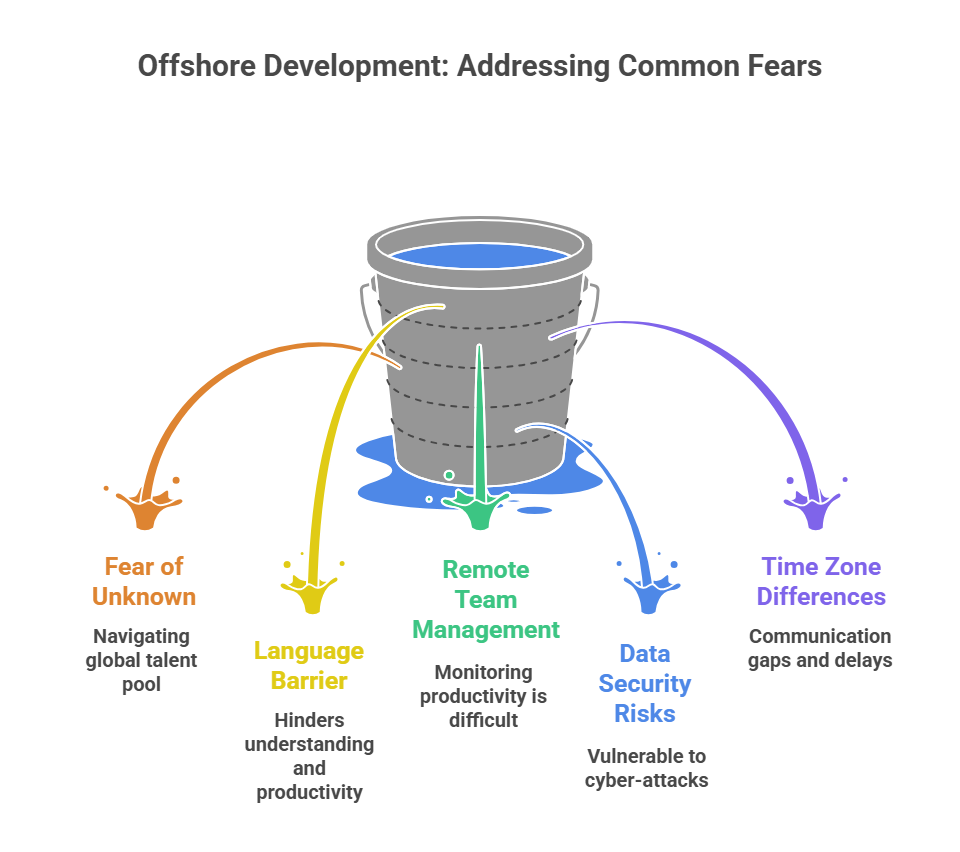
1. The Fear Of The Unknown: Lack of experience with global hiring creates uncertainty in building and managing offshore teams effectively.
2. Communication & Cultural Barriers: Language differences and cultural gaps can lead to misunderstandings, delays, and reduced productivity without proper offshore communication strategies.
3. Lack of Visibility: Businesses worry about tracking performance and productivity when teams work remotely.
4. Data Security Risks: Concerns around data protection and system access often make companies hesitant about offshore collaboration.
5. Time Zone Differences: Managing teams across time zones can lead to coordination challenges and slower decision-making.
But let me assure you that, though valid, you can easily tackle these challenges with the right offshore partner by following certain best practices to hire offshore teams.
Common Mistakes in Offshore Team Management
While many organizations successfully manage distributed development teams, certain mistakes can hinder productivity and collaboration.
Some common challenges when managing offshore teams include:
-
Unclear communication structures: Without defined channels, important updates may be missed.
-
Lack of proper documentation: Teams struggle to understand processes without clear SOPs.
-
Ignoring time-zone overlap: Limited interaction can slow decision-making.
-
Micromanaging developers: Excessive monitoring reduces productivity and trust.
-
Weak onboarding processes: New offshore developers need clear guidance and training.
Avoiding these mistakes significantly improves offshore team management and helps organizations build stronger distributed teams.
How to Build an Offshore Team in India?
Some businesses start by hiring a few remote developers. Others go straight to a dedicated development team or a full offshore development center to support continuous product development. The right choice depends on your long-term goals.
Companies looking to expand their development capabilities often choose India because of its strong technology ecosystem and experienced developer community.
Here are the key steps to set up an offshore team in India successfully:
-
Define project requirements: Identify the technical skills you need and how big the team should be.
-
Choose an engagement model: Pick a dedicated team, an offshore development center, or staff augmentation, depending on how much control you want.
-
Select the right offshore partner: A reliable partner handles recruitment and helps you manage developers once they join.
-
Set up communication and reporting: Agree on tools and meeting cadence for offshore development communication. Decide early how offshore team productivity reporting will work, so progress is visible from the first sprint.
-
Create onboarding and development workflows: Standard processes help offshore and in-house teams work together smoothly from day one.
How can we help in building a successful Offshore Team?
Your Team in India is one of the most trusted offshore development companies that can help you build your offshore team in India. We provide a dedicated team or an outsourced team tailored to your specific project requirements, ensuring effective collaboration and high-quality results.
One successful example of this offshore collaboration is ‘GoHire', an ATS (applicant tracking system). GoHire partnered with Your Team in India to scale their team quickly and economically. With our expertise, they built a team of 2 software developers, 1 HubSpot Migration Expert, and three digital media experts.
Companies worldwide trust us to offshore their software development projects. In the past decade, we have delivered over 1000 projects and have an over 90% clienGoHire 't retention rate.
If you, too, seek a guide to hiring offshore developers? Could you talk to our experts today?
Frequently Asked Questions (FAQs)

An offshore team is a team of remote developers hired from an offshore country to work on their development projects. These experts are hired from offshore partners who help businesses navigate the challenges and find the right resources to power their projects. Companies usually offshore their projects to leverage benefits like access to a large pool of talent at lower costs, no hiring and infrastructure costs, and flexibility to scale teams on demand.
Offshore teams are hired from offshore countries that offer large talent pools of skilled resources at a lower price. The main reason businesses offshore their projects is to reduce operational costs. Onshore teams are hired from within the same geography/continent where the business operates. It does not provide significant cost benefits to the company but offers resources in the same time zone, enabling easy operations coordination. Maintaining a local team is important for focusing on core business activities, such as sales and marketing, while offshore teams can handle non-core tasks.
Managing an offshore team is challenging because you work with developers from different countries. There are usually challenges in communication due to other languages and cultural practices, which can create misunderstandings and delays. Besides this, your offshore teams work in different time zones, making coordination of work difficult and resulting in missed deadlines.
It's important to note that an outsourced team may include offshore team members, but is typically contracted through a third-party organization for specific projects.
You can establish effective communication with an offshore team by:
Creating standard communication channels
Setting up required tools and technology to enable seamless collaboration
Ensuring that your offshore team understands the project goals, timeline, and deliverables.
Besides this, one must connect with the team through team building activities while regularly working on updates and feedback.
While offshore teams are based in another country, a distributed team may include members working from multiple global locations.
Businesses can overcome the time zone difference by managing an offshore team effectively. It may need adopting agile project development methodologies and establishing overlapping work windows across different time zones. Besides, engaging with a remote offshore team should aim at utilizing appropriate management tools, and holding regular project scrum calls to ensure the team stays on track with deadlines and deliveries.
Cultural differences can impact offshore team management in many ways. It can create communication barriers amongst team members due to differences in language and work ethics, leading to delays in decision-making and deliveries. Thus, developing soft skills is essential to improve collaboration with the global talent pool and understanding within culturally diverse teams.
To ensure quality work from offshore teams, companies must understand:
-
Project scope and delivery deadlines
-
Establish communication channels and project management tools
-
Define KPIs for each team member
-
Conduct regular meetings to ensure the development timelines are met.
Additionally, having a well-defined development process and hiring the right offshore development company is crucial for maintaining quality and ensuring that all team members follow organized procedures throughout the project.
For a successful offshore team setup, businesses must establish a comprehensive team onboarding and project download process amongst offshore and onshore teams.
Integrating offshore staff into business processes during onboarding is crucial for a smooth transition and successful offshore team collaboration. This will help facilitate a seamless transition and ensures successful execution.

By Mangesh Gothankar


By Ashwani Sharma
By Achin Verma








 4.8 out of 5 by