People mix up these two roles constantly, but they don't overlap nearly as much as it seems. A scrum master's whole job is scrum project management, keeping the team honest to agile principles day to day. A project manager's job is bigger. They run the project from kickoff to delivery no matter what framework the team happens to use. That's really the scrum master role in a sentence, and it's usually the part businesses get stuck on when they're deciding who to actually hire.
Around 71% of teams now use agile in some form, though only 13% follow it strictly. Most run a blended or hybrid model instead. Agile adoption has also cut project failure rates to about 9% for teams that use it well, compared to much higher failure rates under pure Waterfall. That shift is exactly why more companies are asking what scrum project management is and how it fits into their delivery process.
This blog breaks down what each role actually does, their responsibilities, skills, tools, and salaries, so you get a clear answer to the scrum master vs project manager which is better question for your project.
1. Key Differences: Scrum Masters vs. Project Managers
Here's how a project manager and a scrum master differ, and what each one brings to a team. Understanding this scrum master vs project manager split is the first step to figuring out which role your project actually needs.
|
Aspect |
Scrum Master |
Project Manager |
|
Core focus |
Keeping the team aligned to Scrum principles |
Delivering the project on time and within budget |
|
Leadership style |
Servant leader, supports rather than directs |
Directs planning, resourcing, and execution |
|
Scope |
Limited to the scrum framework |
Covers the entire project lifecycle |
|
Meetings owned |
Scrum events, standups, demos, reviews |
Kickoffs, status updates, client check-ins |
|
Risk handling |
Flags team-level blockers and burnout |
Tracks and manages project-wide risk |
|
Client interaction |
Minimal, mostly internal to the team |
Direct and ongoing |
|
Tools used |
Jira, Slack, Zoom |
Jira, Asana, Trello, Gantt charts |
Scrum Master
A scrum master's job is keeping the team running scrum properly. They support the team instead of directing it, coaching people through the scrum framework until they can run with it on their own. Teams with a good scrum master tend to collaborate better and ship more, which is really the whole point of the scrum master role.
What does a scrum master do?
-
Educates the team on the scrum framework
-
Removes barriers between the team and stakeholders
-
Leads scrum events, project meetings, calls, demos, and reviews
-
Guides the team on task creation, estimation, and time management
-
Resolves issues early and pushes continuous improvement
-
Keeps tasks and activities updated on project management tools
-
Shields the team from distractions and manages risk
-
Analyzes burnout charts to catch overload before it becomes a problem
-
Focuses, above all, on keeping the team aligned to scrum practices and principles
Project Manager
A project manager runs a team to get the work done on time. Their job includes closing out projects within budget and making sure every requirement gets met. Unlike the scrum master role, a project manager's scope isn't tied to one framework. It covers the whole project lifecycle regardless of methodology.
What does a project manager do?
-
Defines the project's scope and plans the workflow
-
Manages resources and keeps quality high even with limited ones
-
Assigns tasks based on skills and roles
-
Sets project deadlines
-
Delivers the project on time and within budget
-
Evaluates and manages risk throughout development
-
Resolves issues and conflicts within the team
-
Keeps communication with clients transparent
-
Makes sure deliverables meet client requirements and quality standards
-
Keeps the team motivated through the life of the project
2. Key Responsibilities of a Project Manager vs. Scrum Master
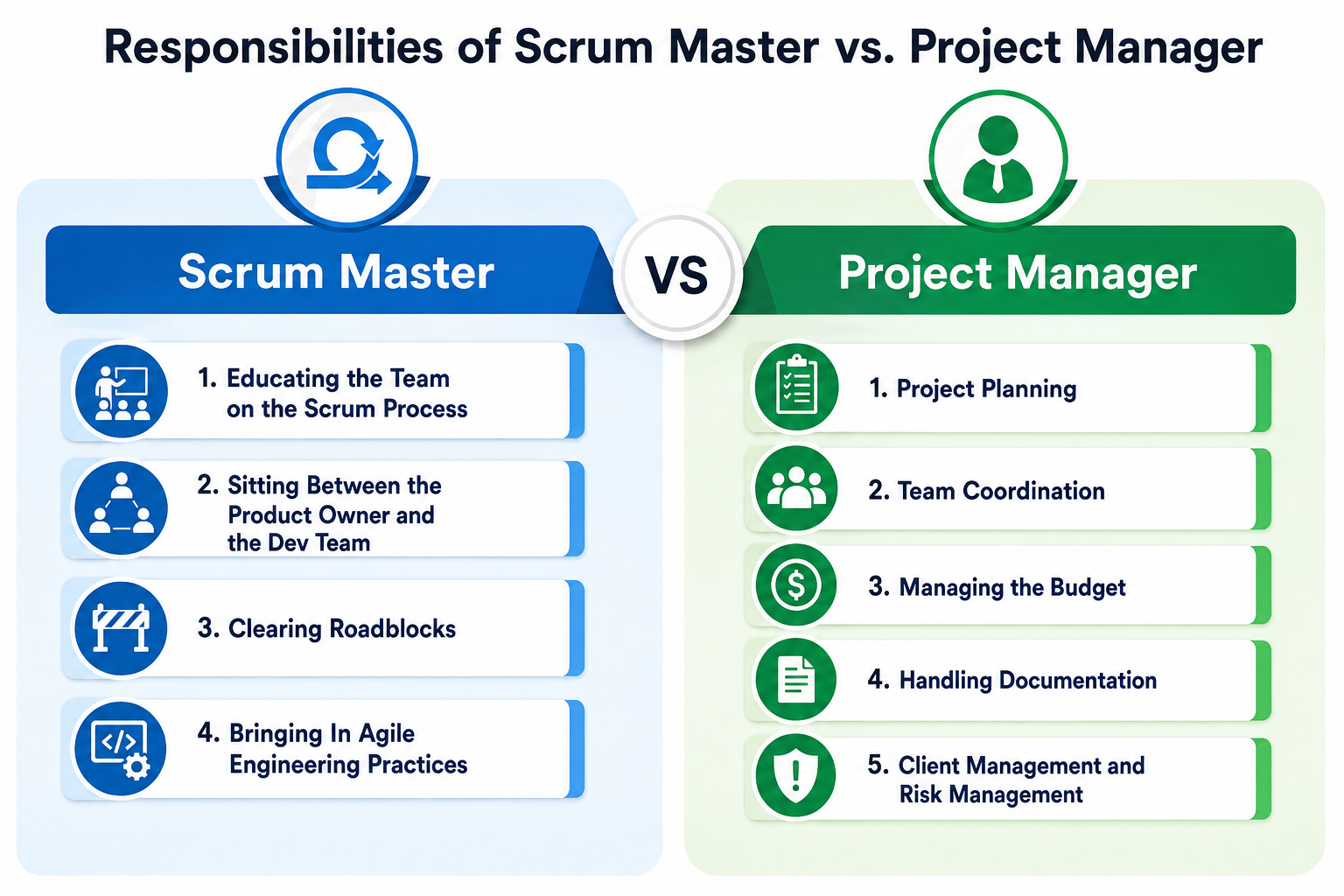
2.1 Responsibilities of a Scrum Master
1. Educating the Team on the Scrum Process
Most of a scrum master's day comes down to teaching, even if the job title doesn't say so. Sprint planning, running the regular scrum events, making sure nobody on the team is just nodding along without actually knowing what their role is. That last part matters more than it sounds. A lot of scrum failures trace back to someone quietly not understanding what they were supposed to be doing.
It's closer to coaching than managing. A scrum master's real job is giving the team an honest read on where things stand so they can course correct, and keeping the end goal in front of everyone often enough that it doesn't get lost in the day-to-day grind of tickets and standups.
2. Sitting Between the Product Owner and the Dev Team
The scrum master ends up as the go-between for the product owner and the developers, which sounds simple until you've actually done it. Daily standups are usually where this plays out. That's where blockers surface and where a scrum master either catches a problem early or doesn't.
Information has to flow both directions here. If the client wants something and the team doesn't know it, or the team hits a wall and the client never hears about it, that's on the scrum master. Trust is a big part of why this works. Teams and clients that trust their scrum master tend to flag problems earlier, which honestly makes everything else easier.
3. Clearing Roadblocks
Developers get pulled off sprint work constantly, whether it's a manager with an urgent ask or a client who forgot what the current priorities are. Someone has to push back on that, and it's usually the scrum master's job to do it.
Meetings work the same way. Not every meeting needs a developer sitting in it, and a scrum master who lets that slide is quietly costing the team hours it doesn't have.
4. Bringing In Agile Engineering Practices
Scrum masters also nudge the team toward better engineering habits like automation and continuous integration. Code gets merged into a shared repo often, tests run automatically, problems surface before they compound. It's not glamorous work, but this is a lot of why scrum project management tends to produce fewer bugs than teams stuck running a slower, less iterative process.
Related Reads: How Can You Collaborate With Developers for a New Product Launch?
2.2 Responsibilities of a Project Manager
Project Planning
A project manager starts by putting the plan together. What's the goal, what tasks get the team there, and by when? Requirements on real projects shift constantly, so the schedule can't be a one-and-done thing. A good project manager keeps adjusting it as things change while still hitting the deadline.
Part of this is just knowing what resources are actually available. Who's free, who's stretched thin, what each person on the team needs to know to do their piece. And through all of it, keeping the budget in view, because a plan that ignores cost isn't really a plan.
Team Coordination
Once the plan exists, someone has to make sure people are working on the right things. Project managers assign tasks and point the team toward the end goal, which sounds obvious until you're managing a project with a dozen moving parts and everyone pulling in slightly different directions.
The real skill in coordination is matching work to people, not just handing tasks to whoever's free that day. On bigger projects this gets messy fast, and the fix is usually splitting the team into smaller groups, each one owning a specific piece of the work.
Managing the Budget
Budgets get tracked constantly, not just at milestones. A project manager watches spending throughout the project, because delivering on time doesn't count for much if the project blew past its budget getting there. Clients tend to remember the number more than the timeline.
Handling Documentation
By the end of a project, someone needs a paper trail: what got done, how it was done, and whether it actually met what the client asked for. This isn't just busywork. Good documentation is what makes a project useful for reference later, whether that's for an audit, a similar project down the line, or just proving the work was done right.
Client Management and Risk Management
Project managers stay in close contact with clients the whole way through and pass along changes to the team as they come up. They also keep watching for risks early, so there's already a plan in place if something does go wrong. This is a big part of what separates traditional project management from something like scrum project management, where risk gets caught more organically through short sprints instead of upfront planning.
3. Tools, Skills, and Techniques Used by Scrum Master vs Project Manager
3.1 Techniques of Scrum Master vs. Project Manager
Scrum masters solely work within the Scrum methodologies. They promote agile principles within the Scrum team. They conduct the Scrum meetings and sprint planning according to the Scrum Guide. Their core competencies are coaching and monitoring.
Project managers have historically leaned on Waterfall, planning and managing a project from start to finish in a fairly linear sequence. That's changing though. A lot of project managers today run hybrid approaches that borrow from agile, since pure Waterfall doesn't hold up well on projects where requirements shift mid-stream.
3.2 Skills of Project Manager vs. Scrum Master
Project managers possess skills like critical thinking for faster decision-making. They have problem-solving skills to eliminate issues. They use their analytical skills to identify potential risks.
Scrum masters have the skills to teach scrum procedures. They promote a positive work culture. They use facilitation skills in scrum meetings. They possess the skill to identify when to use experiments for learning.
3.3 Scrum Master vs. Project Manager: Tools used
Project managers use various tools for traditional project management. These are Gantt charts, kanban boards, and network diagrams, as well as Asana, Jira, and Trello.
Scrum masters use Jira and Slack for efficient communication and collaboration; they also use Zoom for virtual meetings.
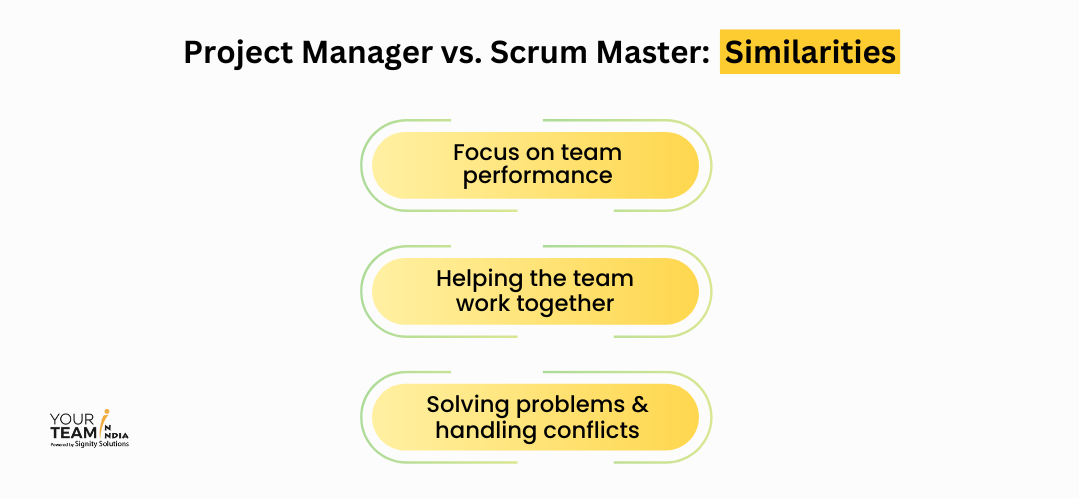
4. Similarities Between Project Manager vs. Scrum Master
-
Different titles, same goal really. Get the project delivered, with the client and team actually working together instead of around each other.
-
Communication matters for both roles too. Stakeholders need updates, and the team can't be the last to hear about a change that affects their work.
-
Leadership looks different between the two, but it's still leadership. A scrum master coaches and stays out of the way when the team's already moving well. A project manager sets the pace and makes the calls directly. Either way, the team has to trust whoever's running things.
-
Problem-solving might be the biggest overlap. Something always shifts mid-project. Both roles exist partly to catch it early and stop it from snowballing.
5. Who is better, a Project Manager or a Scrum Master?
By now you've seen how the two roles actually differ, so the choice really comes down to what your project needs. When it comes to scrum master vs project manager, which is better, there's no single right answer; it depends on your situation.
Scrum Master
When the project needs agile principles, scrum masters are the best choice. They are excellent at cooperating with different teams. They can also work well with cross-functional team requirements. Scrum Master is a great fit if the team member needs strong coaching about scrum principles.
Project Manager
Hire a project manager if there is a strict budget and tight deadlines. The project manager can handle complex requirements, team collaboration, documentation, and clients. They can provide a thorough development plan for the project and individual tasks to team members.
6. Who Gets Paid More: Scrum Master or Project Manager?
Here are the salaries for both roles, which are at different levels of expertise.
7. Certifications for Scrum Masters and Project Managers
A certification does not make someone good at the job, but it does prove they have put in the work to learn it properly, and that matters to a lot of hiring managers.
7.1 Project Manager Certifications
CAPM is usually the first stop. It is meant for people who are just getting into project management and need something to put on a resume before they have real experience to lean on.
PMP is the one that actually carries weight later on. Most companies look for it once a project manager is handling bigger, messier projects with more moving parts.
PgMP sits above both of these. It is built for people managing several connected projects at the same time, not just one.
7.2 Scrum Master Certifications
CSM is where almost everyone starts. It is the standard entry point into the scrum master role, and most job postings assume you have it or something equivalent.
PSM I and PSM II come from Scrum.org instead of Scrum Alliance. PSM I covers the basics, and PSM II is for people who already have some scrum experience and want to prove they can handle harder, more complicated team situations.
ICP ACC is a bit different from the other two. It is built for people who want to move past running a single scrum team and get into agile coaching more broadly.
Conclusion
Neither role replaces the other. A scrum master keeps the team running scrum the way it should be run, while a project manager owns the bigger picture from planning through delivery. Which one your business actually needs comes down to your methodology, team size, and how complex the project is.
If you are still weighing scrum master vs project manager which is better for your team, the honest answer is that it depends on what you are building and how your team already works.
At Your Team in India, we help businesses bring in experienced project managers who know how to keep communication clear and resources planned properly, even on complex or fast-moving projects. Hire dedicated project managers through YTII and get a free consultation to see what fits your team.
Frequently Asked Questions

It is a way of running projects in short cycles called sprints, where the team plans, builds, and reviews work in small chunks instead of all at once. A scrum master keeps this process running smoothly day to day.
It is a project manager who runs the project using agile techniques instead of a traditional linear plan. They break the work into sprints and adjust the plan as the project moves forward, rather than locking everything in upfront.
It happens, especially on smaller teams, but it is not ideal. The two roles pull in different directions, one focused on team process and the other on the full project scope, so combining them often means one side gets less attention.
Not directly. A scrum master supports the team's process, but a project manager is the one accountable for deadlines, budget, and the overall project lifecycle.

By Mangesh Gothankar


By Ashwani Sharma
By Achin Verma







 4.8 out of 5 by