There's a gap between an engineer who can build a model and one who can keep it running, and it usually surfaces around month four, when output quality starts slipping, and nobody set up the monitoring that would explain why.
Teams that screen for the first skill and assume the second comes bundled end up paying for the hire twice. In the US, that's a painful bill. A recent developer survey put the median AI and machine learning engineer salary at $189,500.
Remote hiring is how a lot of companies get around that number. It also strips out the informal signals you'd normally pick up in an office, like overhearing how somebody reasons through a pipeline failure at 2 am instead of reading a tidy summary of it later.
Below I've broken down which skills actually predict a good hire and what the budget looks like once you compare offshore developer rates by country rather than US salary bands alone. There's a section on testing too, since most AI interviews measure the wrong thing.
Remote AI Engineer vs ML Engineer vs Data Scientist
Job titles in this field are a mess. Two companies will use "AI engineer" to mean completely different jobs, and candidates know it, which is why the same person applies to roles with a $60,000 spread between them.
Sorting this out before you write the job description saves you a hiring round.
| Role | What they own | Hire when |
| Data Scientist | Analysis, experiments, finding signal in your data | You have data and don't yet know what's in it |
| ML Engineer | Training pipelines, model performance, feature engineering | You need a custom model built on your own data |
| AI Engineer (applied/LLM) | Building on top of existing models, RAG systems, prompt design, agentic workflows | You're shipping product features on GPT, Claude, or Llama |
| MLOps Engineer | Deployment, monitoring, versioning, infrastructure | Your models work but keep breaking after release |
Skills to Look for When You Hire Remote AI Engineers
Skill lists for this role tend to run long enough that they stop being useful. Here's what actually separates candidates, grouped by what the skill lets them do.
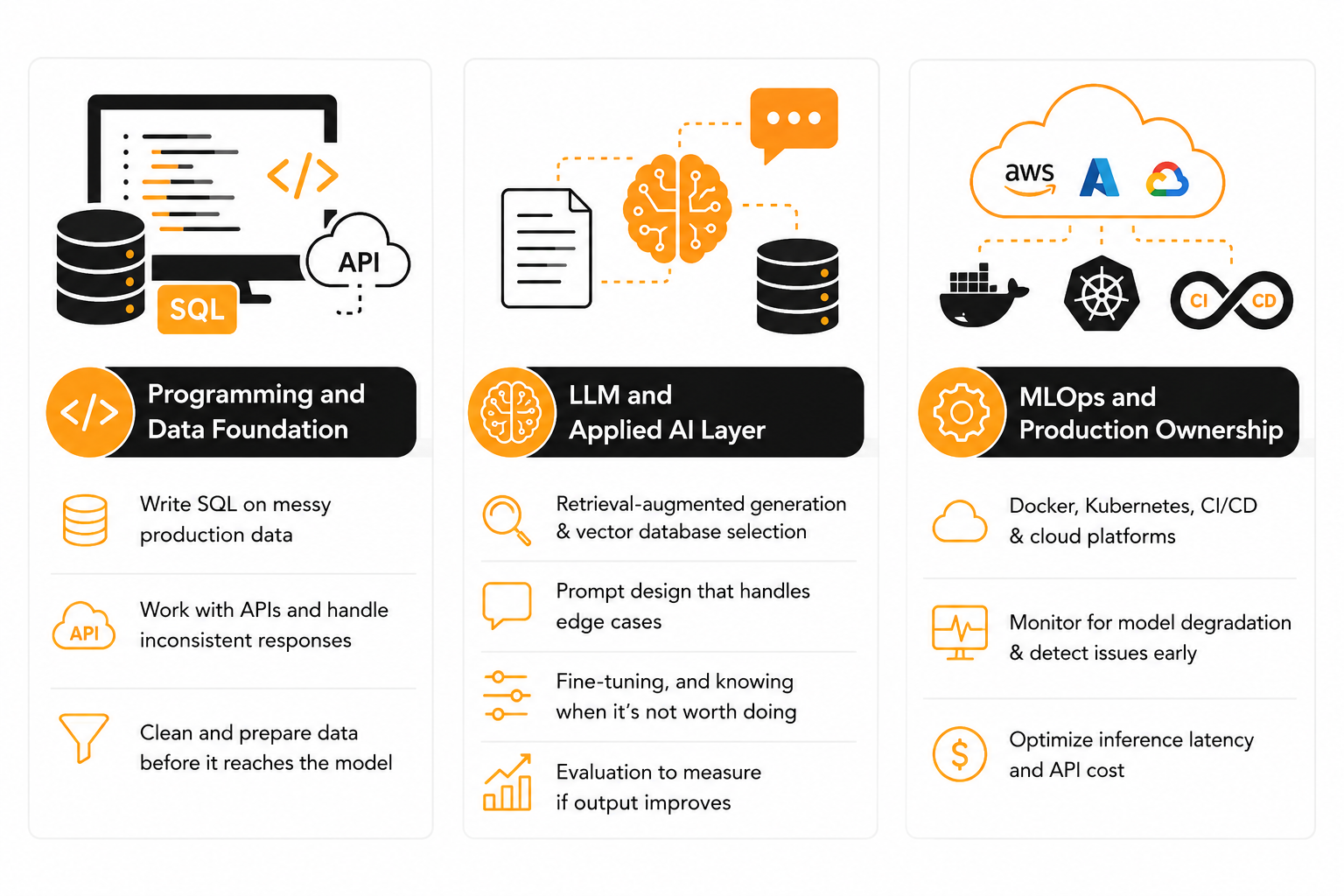
Programming and Data Foundation
Python is the baseline, and everyone has it on their CV, so it tells you almost nothing on its own. Look at how they handle data instead. Can they write SQL against a messy production database, work with an API that returns inconsistent responses, and clean up input before it reaches the model?
A lot of AI work is plumbing. Engineers who find that beneath them tend to build things that break.
LLM and applied AI Layer
This is where the money is right now. The specific skills worth screening for:
- Retrieval-augmented generation, including how they chunk documents and pick a vector database
- Prompt design that survives edge cases, not prompts that work in a demo
- Fine-tuning, and more importantly, knowing when it isn't worth doing
- Evaluation, meaning they have a way to measure whether output got better or worse after a change
That last one is the strongest signal in the whole list. Ask a candidate how they knew their last system improved. If the answer is that it felt better, keep looking.
MLOps and Production Ownership
Docker, Kubernetes, CI/CD, and at least one cloud platform among AWS, Azure, or GCP. Beyond the tooling, you want somebody who has dealt with a model degrading quietly in production and can talk through how they caught it.
Inference latency and API cost belong here too. An engineer who has never had to bring down a per-request cost will design something you can't afford to run at scale.
Engineers with LLM fine-tuning, MLOps, and production deployment experience command 25 to 40% more than generalist ML candidates, and that premium holds in offshore markets as well. Worth budgeting for, since this is the group that keeps systems alive after launch.
What Remote Work Exposes
Some weaknesses stay hidden in an office and surface immediately on a distributed team.
Written reasoning is the big one. When an engineer is nine hours ahead of you, their pull request description is the whole conversation. If they write two-line summaries of complex changes, you will spend your mornings chasing context.
Documentation habits matter for the same reason. So does knowing when to stop and ask. An engineer who quietly burns three days on the wrong approach costs more in a remote setup than a co-located one, because nobody saw it happening.
How Much Does It Cost to Hire a Remote AI Engineer?
An entry-level ML engineer in the US starts somewhere around $105,000. Seniors with six or more years behind them, outside the FAANG tier, are into the $190,000 to $260,000 range on base alone.
Generative AI specialists sit above that, and contract rates track the same curve. Contractors bill anywhere from $100 to $250 an hour depending on how much production experience they bring.
Europe is cheaper, though not by the margin most buyers have in mind. Senior packages in the UK and Germany land in the low six figures once converted, which narrows the gap considerably against a US hire.
Then there's the part that doesn't show up on the offer letter. Fully loaded employment cost for a US machine learning engineer reaches $190,000 to $230,000 a year once you add benefits, tooling, compute, and overhead. Compute is the line item people miss. GPU time and API spend during development can run into thousands a month before the product has a single user on it.
Time-to-fill is its own cost. Filling a machine learning engineer role takes 60 to 90 days on average, with cost-per-hire between $22,000 and $45,000 at the mid-to-senior level. Three months of an unshipped roadmap rarely gets counted in the budget, though it should be.
This is the arithmetic that sends teams offshore. Offshore ML engineers come in 40 to 70% below fully loaded US costs across every major region. The next section breaks down offshore developer rates by country so you can see where that saving actually comes from.
Offshore Developer Rates by Country for AI Talent
Rate guides usually quote generalist software developer numbers and leave you to guess what an AI specialist costs. The table below splits the two, since the gap between them is the whole point.
| Country | General dev hourly | AI/ML engineer hourly | US hours overlap | Strongest for |
| India | $20 to $45 | $30 to $65 | 2 to 3 hrs (early US morning) | Production ML at volume, LLMOps, deep MLOps bench |
| Poland | $40 to $70 | $55 to $90 | 3 to 4 hrs | Statistical rigor, computer vision, GDPR-native data work |
| Ukraine | $35 to $60 | $45 to $80 | 3 to 4 hrs | Research-grade engineering, custom model work |
| Vietnam | $20 to $50 | $30 to $60 | 1 to 2 hrs | Cost-sensitive applied AI, data pipeline work |
| Philippines | $15 to $45 | $25 to $55 | 1 to 2 hrs | Annotation-heavy workflows, English-first async teams |
| Colombia | $35 to $60 | $45 to $75 | 6 to 8 hrs | Real-time collaboration, embedded product teams |
| Brazil | $30 to $55 | $40 to $70 | 5 to 7 hrs | Large talent pool, LatAm nearshore delivery |
A few things stand out once it's laid out this way.
India's band is the widest on the table, and that comes down to size. The market is big enough to hold everything from small teams doing basic support work to engineering groups building products for Fortune 500 clients. A quoted India rate on its own tells you very little until you know which kind of team is behind it.
Colombia and Brazil charge what amounts to a timezone premium. You are paying for working hours that line up with yours. Whether that's worth 30% depends entirely on whether your AI work needs someone live during a production incident or just needs steady output.
Poland sits at the top because the market matured earlier. Senior ML engineers there run $55,000 to $78,000 all-in on annual packages, which is real money by offshore standards but still under half a comparable US hire.
Why offshore developer hourly rates vary so much inside one country
Seniority explains part of it. The rest comes down to four things buyers underweight.
The engagement model moves the number more than anything else. A freelancer on Upwork and a vendor-supplied dedicated engineer can be equally good and price 40% apart, because the second figure includes replacement guarantees, HR, infrastructure, and a bench.
The city matters too. Bangalore and Hyderabad price above smaller Indian cities for the same reason San Francisco prices above Denver.
Then there's how the vendor bills. Some quote a clean hourly figure and add compute, tooling, and project management separately. Others fold everything in. Comparing offshore software developer rates across vendors without checking what sits inside the number is how budgets slip.
Recommended Post: Guide on Offshore Software Development Rates By Country in 2026
Finally, contract length. Twelve-month commitments buy discounts that three-month pilots do not.
The AI premium on standard offshore software developer rates
This is the part missing from most developer rates by country comparisons. AI engineers do not bill at generalist rates, and the gap is measurable.
In India, engineers with hands-on LLM fine-tuning, RAG, or LLMOps experience command 20 to 40% more than generalist ML engineers. The same premium shows up in US market data at 25 to 40%. MLOps and production deployment specialists run 15 to 30% above base offshore rates in every market surveyed.
So if a vendor quotes you standard offshore software developer rates for an AI role, something is off. Either they're staffing a generalist and calling them an AI engineer, or they're pricing to win the deal and will swap the engineer after signing. Both happen often enough to ask about directly.
What the Hourly Rate Doesn't Include
An offshore quote of $40 an hour is not what the engineer costs you. It's what the invoice says. The real number sits higher, and the gap catches people out when they compare a vendor quote against a US salary. Here's where that extra goes.
Compute and API Spend
AI work burns money that regular development doesn't. GPU time for any training or fine-tuning, plus API calls to whichever model you're building on. During a build phase, this runs into thousands a month, and it goes up when the product launches, not down.
Time Spent Hiring
Screening AI candidates takes longer when you hire remote developers because you have to test production skills, not just coding. Your senior people spend hours on this, and those hours cost something even though nobody bills you for them.
Ramp-Up
A new engineer needs access to your data, your codebase, and your deployment setup before they produce anything useful. Budget four to eight weeks. On an AI project, it leans toward the longer end, since understanding your data is half the job.
Your Own Management Time
Someone on your side has to review work, answer questions, and unblock people. On a distributed team, that's real hours, especially in the first quarter.
Turnover Risk
AI engineers are in demand everywhere. If someone leaves at month seven, you pay the ramp-up cost twice.
None of this is an argument against hiring offshore. The savings are still large once you run the full comparison. It just means the honest version compares your loaded offshore cost against your loaded US cost, rather than putting an hourly rate next to a salary figure and calling it a match.
That's also a fair question to ask any vendor. Ask what their offshore developer hourly rates include and what gets billed on top. A clear answer tells you a lot about how the rest of the engagement will go.
Rate comparisons only get you so far, since the answer changes with team size, engagement model, and how long the project runs. Put your own numbers into our offshore team cost calculator and you'll get a fuller picture than any table can give you.
Engagement Models Compared
Once you know the budget, the next decision is how you actually bring the person on. Four common options, and they suit different situations.
| Model | You get | Best when | Watch out for |
| Freelance | One person, hourly or per project | Short pieces of work with a clear endpoint | Availability drops when a better offer turns up |
| Staff augmentation | Engineers who join your existing team and follow your process | You have technical leadership in-house and just need capacity | You still do all the managing |
| Dedicated team | A team that works only on your project, run by the vendor | Ongoing product work over a year or more | Needs real onboarding effort up front |
| Offshore development centre | A full unit with its own hiring, infrastructure, and admin | You're building AI capability you plan to keep | Only makes sense at scale |
For most AI projects, freelance is the wrong fit even though it looks cheapest. The work involves your data, your infrastructure, and decisions that carry on mattering long after the contract ends. Handing that to someone who leaves in twelve weeks means the knowledge leaves too.
Staff augmentation works well if you already have someone senior who can direct AI work. If you don't, you're asking a new remote engineer to set their own direction on a project you can't fully assess, which rarely ends well.
A dedicated team suits companies that are building something they'll keep improving. You get continuity, the team learns your data over time, and the vendor handles hiring and replacement if someone leaves. That last part matters more in AI than elsewhere, given how quickly good engineers get poached.
An offshore development centre is a bigger commitment and usually starts making sense somewhere past eight to ten people.
Best Practices for Hiring Remote AI Engineers
This is where most hiring processes go wrong. Not in sourcing, which is easier than it used to be, but in working out whether the person in front of you can actually do the job.
Write the Scope Before the Job Description
Answer three questions first. What is the system meant to do, what does good output look like, and who decides when it's good enough?
Teams that skip this write job descriptions listing every AI skill they've heard of. That attracts candidates who tick boxes rather than candidates who fit the work. If you can't describe the problem in a paragraph, you're not ready to hire AI engineers.
Test Judgment, Not Puzzles
Algorithm questions tell you nothing useful here. The job is making decisions under uncertainty with messy data, so test that.
Two briefs you can use directly:
Brief one, retrieval: Give the candidate 50 documents of your own, mixed formats, some of them poorly structured. Ask them to build something that answers questions from those documents and to explain their chunking approach and why they picked that vector database. Then ask how they'd know if it was working.
Brief two, debugging: Show them a system that used to work and now returns weaker answers. Give them the logs. Ask what they'd check first, second, third. You're listening for a method, not a right answer.
Pay for the time if it runs beyond two hours. Strong candidates have options and unpaid multi-day tasks filter them out rather than in.
Ask About Something that Broke
The single best interview question in this field: tell me about a model that failed in production and what you did about it.
Candidates who have shipped real systems answer this easily, usually with more detail than you asked for. Candidates who have only done tutorials and demos struggle, because nothing has ever broken on them.
Follow up on how they found out about the failure. If the answer is that a user reported it, they weren't monitoring. That's fixable, but you should know it going in.
Read the Repository, Not the CV
Open their GitHub and look at the README files. Can you understand what the project does and how to run it without asking anyone? That's the same skill they'll need every day on a remote team.
Commit messages tell a similar story. So do pull request descriptions, if any are public.
Run a Paid Trial before Committing
Two to four weeks on a small piece of real work. It costs you a fraction of a bad hire, and it surfaces the things interviews miss, mainly how someone communicates when they get stuck and whether they hit dates.
Give them something with a real deadline rather than a sandbox exercise. You want to see how they handle pressure, not how they perform when nothing is at stake.
Building Your Remote AI Team With Your Team in India
Hiring remote AI engineers comes down to knowing what you're building and testing for production judgment rather than credentials. Compare developer rates by country against loaded US costs, and the saving is clear enough to justify the extra work of getting the hiring right.
The hard part is vetting. Telling apart a candidate who has shipped a working AI system from one who has built demos is difficult across a forty-minute call.
Your Team in India handles that. We place AI engineers into dedicated teams, so screening, trial periods, and replacement risk sit with us. Our offshore developer hourly rates are quoted with everything included, no extras appearing later.
Tell us what you're building, and we'll come back with a team structure and a number. Talk to us about your AI project.

By Mangesh Gothankar


By Ashwani Sharma
By Achin Verma

Expect to pay more, and the gap is measurable. Engineers with hands-on LLM fine-tuning, RAG, or LLMOps experience earn 20 to 40% above generalist ML engineers in India, with similar premiums showing up in every other offshore market. If a vendor quotes you the same figure they'd charge for a backend developer, ask who exactly is being staffed on the project.
Depends on what the work needs. India suits production ML and MLOps at volume. Poland is stronger for computer vision and anything with GDPR requirements. Colombia and Brazil cost more but give you six to eight hours of overlap with US business hours, which matters if you need someone to live during an incident. There's no single best answer, which is why comparing developer rates by country in isolation leads people to the wrong choice.
One works if you already have technical leadership who can direct AI decisions. Without that, a single remote engineer ends up setting their own direction on a project you can't fully evaluate. Two people is usually the safer minimum, so somebody reviews the work.
Ask what sits inside the quoted rate and what gets billed separately. Compute and API spend often sit outside it. Then settle ownership of models, training data, and anything fine-tuned on your data, in writing. Comparing offshore software developer rates between vendors means nothing until you know what each number actually covers.








 4.8 out of 5 by