Companies hiring an AI automation engineer this year are competing for a shrinking pool of qualified candidates. Meanwhile, they are posting job descriptions built for a role that no longer exists.
Job postings for AI engineering roles rose 143.2 percent, according to Autodesk's AI Jobs Report with GlobalData. A job posting built for the wrong role does not just slow hiring down. It fills the pipeline with the wrong people entirely.
Demand for automation engineers is outpacing what local hiring pipelines alone can supply. And this is pushing more companies toward offshore hiring developer models that can move faster than a domestic search. Start with the workflow you want automated, not the tools you assume the hire needs to know. Screen for production deployment experience over familiarity with prompting. Then choose a hiring model based on budget and how much this work is likely to grow.
What an AI Automation Engineer Actually Does
An AI automation engineer connects a manual business process to the AI systems capable of replacing it. The role rarely involves building a model from scratch. It involves taking a process a team performs by hand and rebuilding it as a system that runs on its own, using APIs, large language models, and tools the business already owns.
Return request processing is a common example. A support agent may spend four to five minutes reviewing a single ticket against policy before approving or escalating it. Once automated correctly, the same review takes seconds for most cases, with only genuine exceptions reaching a person. Invoice reconciliation follows a similar pattern, as does resume screening and internal approval routing.
The work itself breaks down into a consistent set of tasks:
-
Mapping the current manual process, including every handoff between teams
-
Connecting the workflow to CRMs, ticketing systems, or databases through APIs and webhooks
-
Designing prompts that return structured output rather than free text a person must interpret
-
Building retry logic so a single failed API call does not take down the entire process
-
Monitoring the system after launch, since production traffic behaves differently from testing
Monitoring is the part most job postings leave out. It is also where the real engineering effort goes. A system that performs cleanly in testing and one that holds up after months of live traffic are not the same problem, and a strong candidate raises logging and fallback design before being asked. This shift is one of the clearer automation engineer hiring trends, stating that the role itself is stabilizing even as demand outpaces supply.
Top Skills to Look for Before You Hire an Automation Engineer
Hiring managers reviewing resumes for this role often weigh tool names more heavily than production history. Listing five automation platforms does not confirm a candidate has shipped anything that survived real traffic for more than a few weeks.
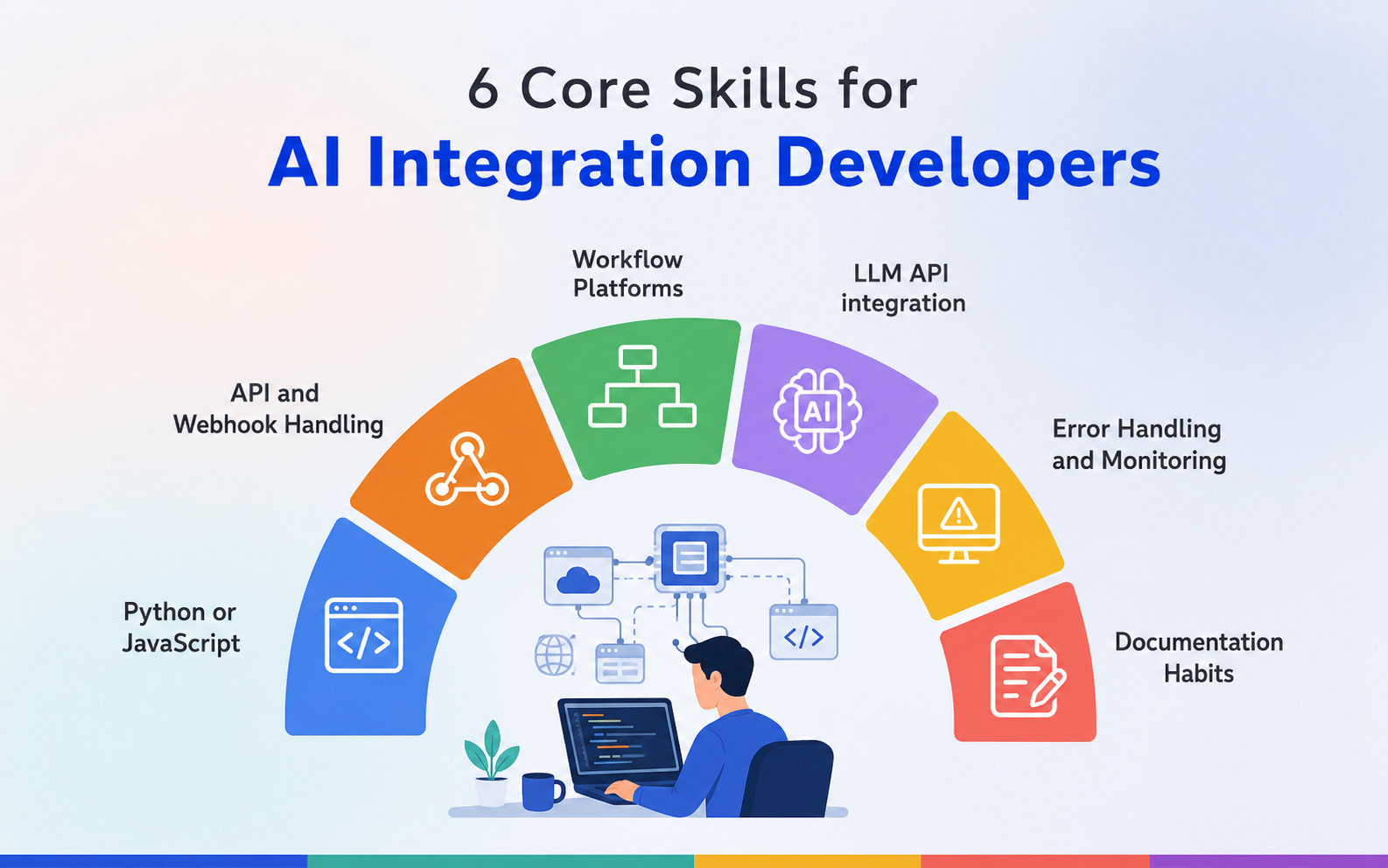
Python or JavaScript: Look for deployed, working code the candidate has shipped to production, not notebook exercises or portfolio pieces built only to demonstrate syntax knowledge.
-
A candidate should be able to describe a system they built end-to-end.
-
Ask specifically what broke and how they fixed it, not just what they built
API and Webhook Handling: Covers authentication, rate limits, and how the candidate has handled a third-party API failing in the middle of a live workflow rather than in a test environment.
-
Most production failures originate here
-
A reliable filter between candidates who have shipped real systems and those who have only demoed
Workflow Platforms: Familiarity with tools like n8n, Zapier, or Make matters less than judgment about when one of them is the wrong fit for the job.
-
Look for a reason behind the tool choice, not just tool familiarity
-
Strong candidates can explain a case where they moved away from a no-code tool
LLM API integration: Strong candidates design for structured output, such as JSON responses, instead of relying on free text that has to be parsed by hand later.
-
Free text that needs manual parsing later signals a weaker build
-
Ask how they validate the model's output before it reaches a downstream system
Error Handling and Monitoring: Retry logic, alerting, and clean logs separate a system a business can actually rely on from one nobody wants to touch once it starts misbehaving.
-
Separates a system a business can trust from one nobody wants to maintain
-
Ask what alerting looks like when a workflow silently starts failing
Documentation Habits: How a candidate explains a system to a colleague who has never seen the code, since that habit determines whether the system survives past its builder.
-
A workflow only its builder can debug becomes a liability the moment that person changes roles
-
Vague answers here predict maintenance problems down the line
Businesses running broader AI development work alongside automation projects often apply the same vetting standard across both. It is worth borrowing the same standard for a single direct hire, since the risk of a wrong pick does not shrink just because the engagement is smaller.
What an AI Automation Engineer Costs in 2026
Location decides more of the price tag here than seniority does. A full-time hire in the US, a contractor billed by the hour, and an offshore development partner are not variations on the same number. They are three different cost structures entirely, each carrying its own ramp-up time and its own risk once a workflow actually reaches production.
A senior full-time hire in a major US city usually commands a high salary because the role rarely comes with a supporting team. One person often owns integration, prompt design, and monitoring at once.
When it comes to the contractors, they are cheaper to start with, but the hourly rate rarely stays flat. Scope creeps fast in AI work, one working automation tends to surface three more Companies offering AI automation services at scale price this the same way, since a mismatched hire on a client engagement is expensive twice over.
Offshore development partners sit apart from all three. The monthly engagement model brings the cost of comparable production experience down substantially, and the business still gets a dedicated, accountable team rather than a rotating bench of freelancers.
|
Hiring Model |
Typical Cost Range |
Best Suited For |
|
Full-time, US-based |
$110,000 to $180,000 per year |
Long-term core product ownership |
|
Independent contractor |
$60 to $150 per hour |
Defined scope, short-term builds |
|
Specialist automation agency |
Project-based, moderate to high |
Done-for-you delivery, less internal control |
|
Offshore development partner |
$2,000 to $4,500 per month |
Ongoing work, budget efficiency, faster ramp |
Common Mistakes Companies Make When Hiring an Automation Engineer
Most guides on how to hire automation engineer talent focus on job boards and interview scripts. The real failures happen earlier than that, in how the role gets scoped. Deloitte's Global Human Capital Trends survey found that 66 percent of managers say their most recent hires were not fully prepared for the role. In the same, lack of experience is cited as the top reason. Automation hiring runs into this constantly, and a handful of mistakes account for most of it.
1. Writing the job description around tools instead of outcomes
A posting that lists Zapier, Make, and n8n without describing the actual workflow attracts people who know the tools but have never mapped a process end to end.
2. Skipping a real work sample
A candidate can speak fluently about retrieval pipelines and agent frameworks without having deployed either under real traffic. A short paid task, built around a scaled-down version of a live workflow, filters this out more reliably than a technical conversation ever will.
3. Judging the demo instead of the maintenance plan
A working prototype tests basic ability. It says almost nothing about how someone handles a failed API call at two in the morning or a data format that changes without warning. This gap tends to surface only after the system has already broken in front of users.
4. Confusing this role with an RPA developer or a general workflow builder
These are different skill sets solving different problems. A workflow that needs language understanding and decision logic will get weak results from someone whose background is limited to rule-based automation.
5. Treating the hire as a one-time need
Automation work rarely stops at one process. Businesses that budget for a single project, instead of a role built to scale, tend to restart the search within months once the first system proves its value.
Where to Find and Hire an AI Automation Engineer
Once you've figured out how to hire an automation engineer for the right scope, sourcing comes down to a handful of established paths. The right one depends on timeline, budget, and how much control the business wants over the build. The comparison below covers the six paths worth evaluating.
1. Your Team In India
A strong starting point for businesses that want dedicated, pre-vetted AI automation engineers without running the search internally. Sixteen years of offshore engineering delivery back this, along with a seven-day trial before any long-term commitment. Well suited to companies expecting automation work to grow past a single project.
2. Toptal
A premium freelance network for short, high-stakes work where screening quality matters more than budget. Good fit for a defined scope with a clear end date, though pricing sits well above most offshore alternatives.
3. Turing
Built around remote AI engineering talent at scale. More useful for companies growing broader technical capacity across several roles than for sourcing a single automation hire.
4. Upwork
Workable for narrowly scoped, one-off builds, provided the hiring team screens carefully and requests a paid work sample before committing to anything larger. Quality varies significantly across the platform.
5. Braintrust
Geared toward enterprise technical hiring across AI and engineering functions. A reasonable fit for larger organizations already running a structured internal recruiting process.
6. Arc.dev
Suited to companies that want a remote, developer-focused hire over a no-code generalist, particularly when the workflow needs custom backend logic alongside the automation itself.
Each path trades speed against control differently. A freelance marketplace gets a workflow live fastest, but maintenance becomes uncertain the moment the contractor moves on to the next project. A talent platform pre-vets for skill but adds a margin on top of the engineer's rate. An offshore development partner stays accountable for the system long after launch, which matters once a workflow becomes something the business depends on daily.
Why Growing Teams Hire AI Automation Engineers Through Your Team In India
Businesses weighing where to hire an automation engineer eventually face the same choice: build the capability internally, or work with a partner that has already solved the sourcing and delivery problem across similar engagements. We have spent over sixteen years building offshore engineering teams across more than fifty technologies, including AI, machine learning, and workflow automation.
That experience shows up directly in how we approach automation-adjacent work. US analytics company brought in an offshore team to build their AI platform, data engineering, model deployment, the works. Started scoped, SOC 2 data handling from day one, and kept refining after launch instead of walking away.
The same pattern applies whether you're building a full platform or automating one workflow. Start small, prove it, expand. Which is also why who you hire through matters as much as who you hire.
A freelancer or a one-off agency project can deliver a working system once. What most businesses actually need is a partner who stays accountable to it. A few things make that possible here:
-
Every engineer is evaluated against a production-focused skills matrix before placement, not judged on a portfolio alone
-
A seven-day risk-free trial lets a business review real output on a real workflow before any long-term contract begins
-
A single hire can grow into a full dedicated team as automation needs expand across departments, without restarting the search each time
-
Support continues after launch, covering monitoring and fixes rather than ending the moment the system ships
For companies still deciding between a full-time hire, a contractor, or a structured offshore partnership, the trial period removes most of what usually stalls that decision, since it replaces a resume-based bet with actual, verifiable output.
Frequently Asked Questions
 ML engineers train models. AI automation engineers take a model that already exists, GPT-4 or Claude, and connect it to a business workflow through APIs. For most businesses trying to hire an automation engineer, that second skill set is the one that actually matters.
$110,000 to $180,000 a year for a full-time US hire. $60 to $150 an hour for a contractor. Offshore development brings that same experience level down to $2,000 to $4,500 a month, which is why offshore hiring for AI automation services keeps growing.
ML engineers train models. AI automation engineers take a model that already exists, GPT-4 or Claude, and connect it to a business workflow through APIs. For most businesses trying to hire an automation engineer, that second skill set is the one that actually matters.
$110,000 to $180,000 a year for a full-time US hire. $60 to $150 an hour for a contractor. Offshore development brings that same experience level down to $2,000 to $4,500 a month, which is why offshore hiring for AI automation services keeps growing.
Skip the interview-only approach. Hand the candidate a small paid task on a real workflow and watch how they handle a failed webhook call or a rate limit. Anyone who can talk about prompting but stalls on error handling isn't ready for production work.
Six to ten weeks for a full US search, and that's before ramp-up starts. Offshore hire developer routes move faster, usually one to two weeks, including a trial period.
Agencies work for a single project with a clear end date. An individual hire, especially offshore, works better when the automation work keeps growing and someone needs to carry context from one project to the next.
Sometimes. If they already know the codebase, give them time and AI tooling access on one scoped project first. It's a reasonable starting point, not a long-term substitute for dedicated automation engineer hiring.

By Mangesh Gothankar


By Ashwani Sharma
By Achin Verma




.png?width=352&name=ai-agent-development-offshore--teams%20(1).png)


 4.8 out of 5 by