According to recent stats from the US Bureau of Labor Statistics, a software developer in the US earns around $135,980 per year. That number covers base pay only. Add benefits, payroll taxes, recruiting fees, and equipment, and one hire costs a lot more. Most growing companies need several.
That math keeps offshore IT services in the 2026 plans of US companies of every size.
Deciding to outsource is the easy part. Choosing which work to move is harder. Software development and QA are the easiest to move. The work already lives in Jira tickets and pull requests, so an offshore team can pick it up the next morning without a single call. Offshore healthcare IT services take more setup. If the project touches patient data, you need a signed BAA and locked-down access before anyone starts building.
Get the mix wrong and hidden costs show up as rework and slipped delivery timelines.
This guide covers the seven IT offshore services that give US businesses the best return this year. We ranked each one on four factors: the cost gap versus US hiring, the depth of the offshore talent pool, how cleanly the work hands off, and regulatory risk. You'll also see which delivery model suits each service and what to check before you sign with an offshore outsourcing company.
Why US Businesses Are Expanding Offshore IT Outsourcing in 2026
US companies have been offshoring for decades. What's different in 2026 is the kind of work they send and the reasons behind it.
1. The Outsourcing Market Is Still Climbing
Statista puts global IT outsourcing revenue at $618.36 billion for 2026. US companies spend $225.26 billion of that on their own, more than any other country. For US buyers, that growth means more offshore IT services options to choose from, and more reason to vet partners carefully before signing.
2. Companies Now Outsource for Talent First
Gartner's July 2026 forecast puts worldwide IT spending at $6.37 trillion this year, up 14.2% from 2025. Data center systems and IaaS are growing fastest as companies race to build out AI capacity.
That kind of growth creates demand for skills most US companies don't have in-house. Cloud architects, MLOps engineers, and data platform specialists are hard to hire locally, and price usually comes up only after a company has spent months failing to fill those roles.
3. Hiring in the US Is Slow and Expensive
BLS expects about 106,100 openings a year for software developers, QA analysts, and testers over the next decade. There aren't enough people in the US talent pool to fill them, especially for roles in AI, cloud, and data.
This slows down internal teams. Projects wait while hiring drags on for months. With offshore IT outsourcing services, companies have access to skilled professionals with specialized skills in emerging technologies. You can also grow or shrink the team based on your business needs.
4. India Has the Depth US Companies Need
India has one of the largest tech workforces in the world. Nasscom expects it to reach about 5.95 million people in FY26. For US companies, that means shorter hiring timelines and easier access to engineers with the exact stack they need, from .NET and Java to cloud and AI.
5. AI Is Now Part of the Delivery Itself
Deloitte found that 83% of executives already use AI inside their outsourced services, and 80% plan to keep or raise their outsourcing investment.
So it's fair to ask any vendor to point to where AI shows up in their workflow. Test generation and code review are the obvious places, and you should see shorter development cycles and lower development costs as a result. A team with real technical expertise can show you the numbers from past projects.
How We Ranked These Offshore IT Services
Not every IT function works well offshore. We looked at each service using four simple checks.
1. Cost gap: How much more the same role costs in the US. A bigger gap gives you more room to reduce development costs without hiring junior talent.
2. Talent availability: How quickly you can hire for the role offshore. If good engineers are hard to find there too, you lose the speed advantage.
3. Ease of handoff: Whether the work can be broken into clear tasks with acceptance criteria. Work that needs constant back-and-forth is harder to run across time zones.
4. Compliance risk: How much sensitive data the team will handle and which regulatory requirements apply. Higher risk doesn't rule a service out, but it does mean more setup before work begins.
The 7 Best Offshore IT Services for US Businesses
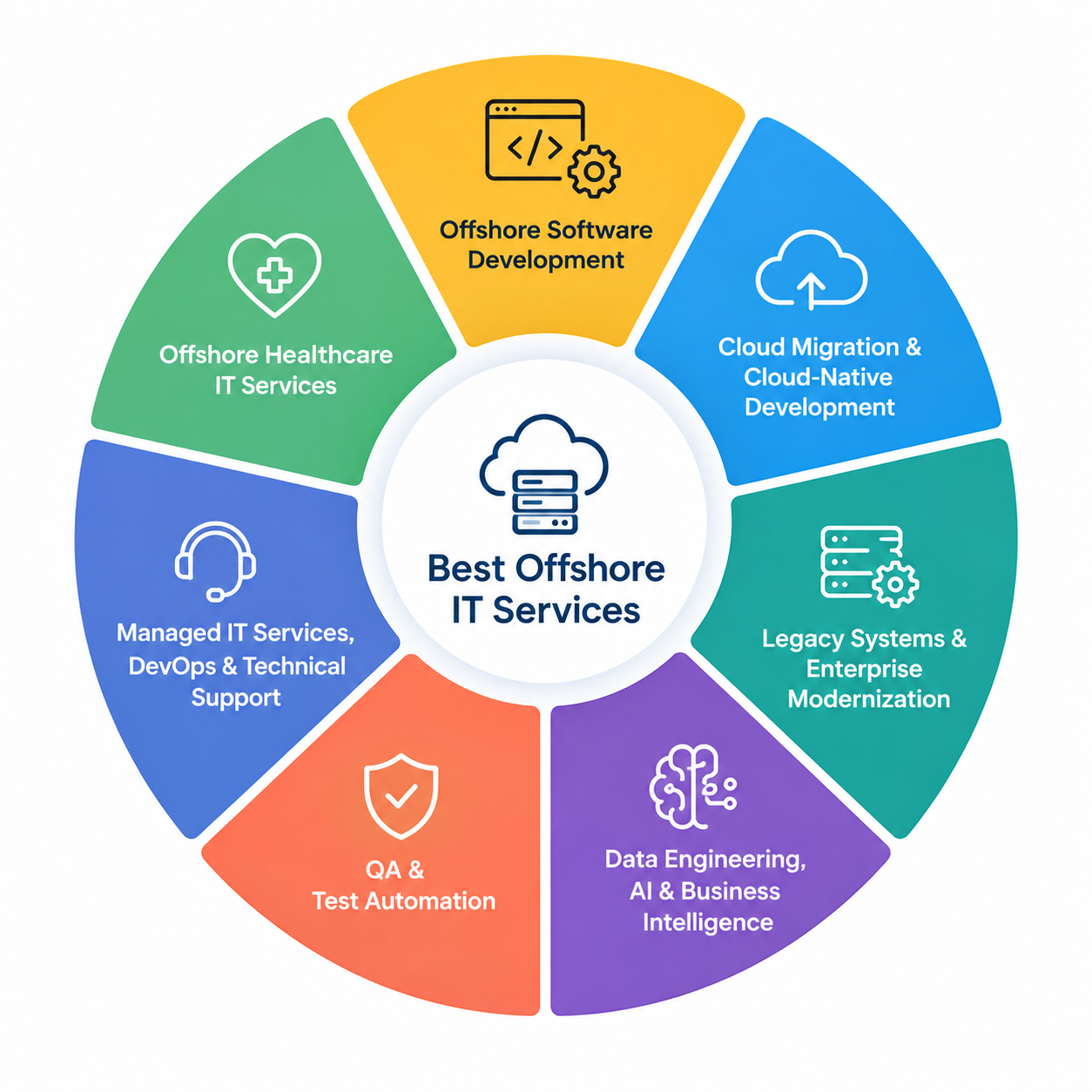
1. Offshore Software Development
This is the most common place US companies start, and for good reason. Offshore software development covers web and mobile apps, APIs, SaaS features, and ongoing product work. Most of this work already runs on Jira, GitHub, and daily standups, so it moves to an offshore team without much friction.
India's strength in software engineering makes hiring easier here than for almost any other service. Whether you need React, Node.js, .NET, Java, Python, or Flutter developers, you can usually find skilled talent with hands-on experience in your stack.
Time zones help too. Your US team reviews code and sets priorities during the day. The offshore team picks up the work overnight. Distributed teams set up this way can accelerate delivery without anyone working late.
2. Cloud Migration and Cloud-Native Development
Moving to the cloud takes a lot of hands. Someone has to plan the move, set up the environments, rewrite parts of the app, and test everything before the switch. Most US companies don't have enough people in-house to do this while also keeping current IT systems running.
An offshore cloud team can take on most of this work. That includes cloud migration from on-prem servers to AWS, Azure, or Google Cloud, setting up CI/CD pipelines, and writing infrastructure as code with tools like Terraform. For new products, the same team can handle cloud native development using containers, Kubernetes, and serverless functions.
The tricky part is usually the integration points. Your cloud apps still need to talk to older on-prem systems, payment gateways, and third-party tools. Map these out early so the offshore team knows what each connection needs.
Done right, the move improves operational efficiency and cuts the cost of maintaining your own servers.
3. Legacy Systems and Enterprise Modernization
A lot of US businesses still run on software built 15 or 20 years ago. Old .NET or Java apps, on-prem databases, sometimes COBOL. These systems work, but they're expensive to maintain and hard to connect with newer tools.
Enterprise modernization is slow, detailed work. That's exactly why it suits an offshore team. The project usually runs for months, the scope is clear, and most of the effort goes into rewriting code, moving data, and testing that nothing breaks.
Most teams don't replace the whole system at once. They build new services around the old one and move features over piece by piece. Both run side by side until the new version is stable. Your business keeps running the whole time.
The biggest risk is knowledge transfer. In many companies, only one or two people really understand how the old system works. Record walkthroughs early and pair them with the offshore engineers for the first few weeks. It saves a lot of guesswork later.
4. Data Engineering, AI and Business Intelligence
Most companies have plenty of data. The problem is getting it into a shape people can actually use. Sales data sits in one tool, product data in another, and finance runs its own spreadsheets.
An offshore data team fixes this from the ground up. They build pipelines that pull data from different sources into one warehouse like Snowflake or BigQuery. Then they set up business intelligence dashboards in Power BI, Tableau, or Looker so your teams can track what matters.
AI work fits here too. Many US companies want to add AI features to their products, like chatbots, search, or document processing, but can't find the specialized expertise locally. Offshore teams with LLM and machine learning experience can build and maintain these features for you.
Before any build starts, agree on the business goals and expected outcomes. A dashboard nobody uses or an AI feature nobody asked for, is wasted money.
5. QA and Test Automation
QA is one of the easiest services to move offshore and one of the fastest to show results. It's also a costly role to fill at home. The median US salary for software QA analysts and testers was $104,300 in May 2025.
The time difference works in your favor here. Your developers push code in the afternoon. The offshore QA team runs tests overnight using tools like Playwright, Cypress, or Selenium. By the next morning, your team has a bug report waiting. This keeps continuous progress going on your product without anyone working extra hours.
Automation adds long-term value. Once the offshore team builds a solid test suite, every new release gets checked the same way. That leads to consistent delivery and fewer bugs reaching your customers, ultimately boosting customer relationships.
One thing to get right from the start is test coverage. Share your most important user flows first, like login, checkout, or payments, so the team knows where to focus.
6. Managed IT Services, DevOps and Technical Support
Keeping systems running is a 24/7 job. Servers need monitoring, patches need to go out, and when something breaks at 2 a.m., someone has to fix it. Most US companies can't justify a full night shift for this.
An offshore team solves that problem because their working day covers your night. With managed services, the partner takes full ownership of this work and reports against clear targets like response time, fix time, and uptime. You pay for consistent outcomes instead of tracking hours.
This service usually covers:
-
Technical support for your employees or customers, from basic tickets to complex issues
-
DevOps and operational support, including monitoring, patching, backups and release management
-
Security monitoring to spot threats early and respond quickly
-
Back office operations tied to IT, like user access, license management and asset tracking
The key is a clear escalation plan. Decide upfront which issues the offshore team can resolve on its own and which ones need your approval.
7. Offshore Healthcare IT Services
Healthcare software carries more risk than most. Patient records are valuable to attackers, and mistakes are expensive. IBM's 2026 Cost of a Data Breach Report found healthcare breaches cost an average of $6.64 million, making it the costliest industry for the 13th year in a row.
That doesn't mean healthcare companies should avoid offshore work. It means they need the right setup before it starts. Offshore healthcare IT services cover EHR integrations using HL7 and FHIR, telehealth apps, patient portals, claims and billing software, and healthcare analytics.
HIPAA does not ban offshore work. It does require a signed Business Associate Agreement (BAA) with your partner and clear safeguards around patient data. Some state Medicaid contracts and federal programs add their own offshore rules, so check your contracts before you scope the project.
A safe offshore setup usually includes:
-
No real patient data in development or testing. Engineers work with fake or de-identified data.
-
Limited production access through secure virtual desktops, with every login logged.
-
Security certifications like ISO 27001 and SOC 2 Type II on the partner's side.
-
Clear breach notification timelines written into the BAA.
Share your business requirements and compliance needs in the first meeting. A partner experienced in healthcare technology services will ask about these before quoting a price.
Offshore vs Nearshore vs Onshore Outsourcing
US companies usually compare three options. Offshore services come from regions like India and the rest of Asia Pacific. Nearshore outsourcing uses teams in Latin America or, for some companies, Eastern Europe. Onshore outsourcing keeps the work with a vendor inside the US.
Also Read: Onshore vs Nearshore vs Offshore Outsourcing: Key Differences
India's time difference sounds like a drawback, but most offshore teams keep 2 to 4 hours of overlap with US mornings. The rest of their day goes into focused work while your team is offline. For most engineering work, that setup gives you better cost efficiency and lower operational costs than the other options.
Many companies also use hybrid models. A common one is an in-house product owner in the US working with an offshore engineering team in India. Some add a nearshore specialist for work that needs quick back-and-forth during US hours.
How to Choose the Right Offshore Outsourcing Company
Most mid-size US companies want something simpler: named engineers, direct communication, and a team that can grow with them. A dedicated team provider usually fits that better.
Pick the Right Delivery Model
-
Dedicated Team: engineers work only on your product and report to your leads. Best for ongoing work lasting six months or more.
-
Project-Based: fixed scope, fixed price. Works when requirements are clear and unlikely to change.
-
Managed Services: the partner owns a function, like support or monitoring, and reports against agreed targets.
Watch for Hidden Costs
The hourly rate is only part of the cost. Plan for a few weeks of slower output while the team learns your codebase. Account for delays in setting up access to tools and systems. Make sure the contract covers what happens if an engineer leaves, including who pays for the handover.
Questions to Ask Before You Sign
-
Can we interview and approve every engineer?
-
Who owns the code and IP?
-
Which security certifications do you hold?
-
How fast do you replace an engineer who leaves?
-
Can you share references from US clients in our industry?
-
Can we start with a short paid pilot?
A partner with proven processes will answer these clearly. Ask for examples of proven success with companies similar to yours. If the answers on IP ownership or replacements are vague, look elsewhere before you commit to any offshore outsourcing services.
Conclusion
Offshore IT services have become a practical way for US businesses to keep projects moving when local hiring can't keep up. Cost savings still matter, but most companies now go offshore to find the right skills faster.
Not every service carries the same risk. Software development, QA and cloud work are the easiest to start with because the work is well defined and hands off cleanly across time zones. Legacy modernization and data work need more upfront planning and good knowledge transfer. Healthcare IT can move offshore too, as long as the BAA, access controls and test data rules are in place before any work begins.
Whichever service you pick, results depend on the setup. Choose a delivery model that matches how long the work will run, define what "done" looks like before the first sprint, and budget for a slower first month. These steps protect the business case for offshore outsourcing and support longer-term digital transformation goals.
If you're still deciding which function to move first, an initial consultation with an experienced offshore engineering team can help you spot the hidden costs and pick the right starting point.
Frequently Asked Questions

Start with work that has clear tasks and low compliance risk. Software development and QA testing are the most common first steps. Once your team is comfortable working with an offshore partner, you can add cloud, data, or support work.
The biggest savings come from salaries. The median US software developer earns $135,980 a year before benefits, recruiting fees, and office costs. An offshore team with the same technical expertise brings more cost efficiency. You also avoid long hiring cycles, which saves money on delayed projects. Compare the full cost, including ramp-up time and management effort, before deciding.
Yes. HIPAA allows offshore work as long as your partner signs a Business Associate Agreement and follows proper safeguards. That means no real patient data in development, restricted production access, and security certifications like SOC 2 Type II. Check your state and federal contracts too, since some add extra offshore rules.
Most teams in India offer 2 to 4 hours of overlap with US morning hours. That's enough for daily standups, code reviews, and quick questions. The rest of their day goes into focused work, so progress continues while your team is offline.
With project-based outsourcing services, a vendor delivers a fixed scope and moves on. With a dedicated offshore development team, engineers work only on your product, follow your processes, and build knowledge over time. Look for a partner with an engineering-first culture and experience working with global clients, since that usually shows up in code quality and communication.

By Mangesh Gothankar


By Ashwani Sharma
By Achin Verma





 4.8 out of 5 by