For years, enterprises worldwide have viewed IT offshoring primarily as a cost-saving strategy. From relocating business processes to low-cost labor, cost efficiency remained a concern. However, modern IT offshoring reveals an extensive shift.
As per Deloitte, more than 67% of enterprises rely on offshore development teams to access specialized talent. The numbers underline how IT outsourcing is evolving from a cost-control mechanism to a business-first approach.
Organizations now leverage offshore outsourcing to accelerate software containing the power of AI. More importantly, most offshoring models are powered by global talent pools and technology that bring distributed teams together.
For CXOs, understanding the emerging IT offshoring trends is crucial for creating a dynamic IT infrastructure. Let’s begin.
Evolution of IT Offshoring: From Cost Saving to Innovation Partnerships
|
Phase |
Focus |
Key Drivers |
Typical Work |
|
2000–2009 |
Cost Reduction |
Lower labor costs, relocating business processes |
Helpdesk support, application maintenance, and back-office tasks |
|
2010–2018 |
Talent Access |
Global talent pools, agile collaboration |
Web & mobile development, QA testing, infrastructure support |
|
2019–2023 |
Digital Transformation |
Cloud adoption, data analytics, and DevOps practices |
Cloud migration, DevOps implementation, data engineering |
|
2024–2026 |
AI-first Innovation |
AI adoption, automation, and strategic collaboration |
AI/ML development, advanced analytics, product engineering |
Global Market Outlook: Why IT Offshoring Trends Are Accelerating?
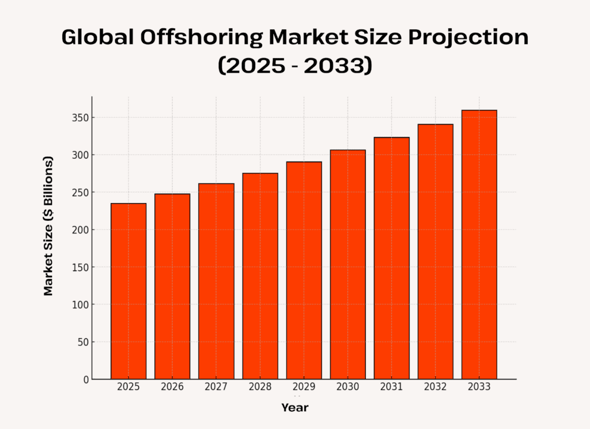
The global outsourcing market is expanding rapidly as organizations look for cost-effective development. It is the channel to gain specialized expertise with scalable engineering capacity.
Actually, it is the growing competition in the global market due to the rapid adoption of AI, cloud computing, and data analytics that has made it difficult to hire technical talent in markets like the US. It is the cost as well as availability that pushes organizations to East Asia and other regions.
Market Statistics
|
Metric |
Data |
|
Global IT outsourcing market size |
US $634.18bn (Statista) |
|
Expected market value |
USD 1,219.31 bn |
|
Companies outsourcing software development |
64% |
|
Enterprises using outsourcing teams |
68% |
Several factors are driving the inclination towards IT offshoring:
-
Shortage of specialized AI engineering talent
-
Increasing demand for automation solutions
-
Expansion of global digital infrastructure
-
Need for flexible development models.
Top IT Offshoring Trends in 2026
The IT offshoring in 2026 is all about transforming how organizations manage enterprise operations. Some of the IT offshoring trends are listed below:
1. AI and Automation Integration
Artificial intelligence has become a primary driver for outsourcing. Offshore engineering teams are increasingly being tasked with building AI-powered systems. Basically, it is done with the purpose of generating predictive insights and automating important tasks.
A typical AI-enabled offshore development pipeline includes a data engineering layer. Also, it needs teams to work on machine learning model development, with a check on API integrations and cloud deployments through continuous monitoring.
2. Global Talent Pools
One of the biggest factors that encourages working with offshore development teams is the talent shortage. Many companies struggle to find AI or ML developers in the local region due to the high costs involved.
Offshore development enables organizations to access highly skilled professionals at affordable prices. Most of the time, the hiring includes artificial intelligence solutions, cloud infrastructure management, and cybersecurity. By tapping into global pools, companies get a chance to scale development teams while keeping a check on affordability.
|
Security Measure |
Purpose |
|
Data Encryption |
Protect confidential information during storage or transfer |
|
Access Control |
Limit data access based on user roles |
|
Security Audits |
Identify vulnerabilities in development pipelines |
|
Compliance Monitoring |
Ensure adherence to regulatory standards |
3. Hybrid Offshore Delivery Models
Traditionally, offshoring was all about hiring remote developers. However, modern enterprises have switched to hybrid delivery models as they combine offshore development and onshore project management. The integrated approach accelerates delivery timelines with added resilience.
4. Cloud-Based Collaboration Tools
Cloud collaboration tools have simplified the whole idea of offshore development. For instance, integration of CI/CD pipelines within cloud-based development environments allows distributed teams to collaborate seamlessly. Besides, cloud communication tools ensure synchronized workflows in real-time for both in-house and offshore teams.
5. Global Capability Centers (GCCs)
Global Capability Centers (GCCs) are strengthening offshore innovation capabilities. The GCCs allow internal teams to easily pursue AI-first product engineering and predictive analytics initiatives.
Interestingly, India alone may host 2,400 GCCs by 2030. The numbers highlight the growing importance of offshore innovation hubs in global IT development strategies.
Emerging Technologies Driving the Future of IT Offshoring
The next phase of IT offshoring is being shaped by advanced engineering technologies that support distributed development.
Modern offshore teams now work across complex software ecosystems that include cloud infrastructures and dynamic data platforms. Here, emerging technologies redefine how offshore software development teams develop and maintain modern applications. They enable better scalability and data-driven decision-making within distributed development environments.
Some of the key technologies shaping the future of offshore outsourcing include:
Artificial intelligence and machine learning
AI and ML are used to build intelligent systems. It means systems capable of pattern recognition and automated decision support. Here, offshore teams bring expertise in developing models using advanced frameworks such as TensorFlow and PyTorch.
Predictive analytics platforms
Predictive analytics systems analyze historical datasets to forecast operational trends. These platforms rely on data pipelines and analytics engines built using tools like Apache Spark, Snowflake, etc.
Blockchain architectures
Blockchain platforms are extensively used to create immutable distributed ledgers that can provide transaction transparency. Offshore engineers typically bring proficiency in building blockchain applications using popular tools like Ethereum and Hyperledger.
Cloud-native software development
Cloud-native architectures rely on microservices, containerization, and orchestration frameworks such as Docker and Kubernetes. These architectures support scalable application deployment across cloud environments.
Intelligent automation systems
The automation platforms combine robotic process automation with workflow orchestration. Offshore teams use tools like UiPath and Automation Anywhere to help offshore teams simplify repetitive processes.
For global enterprises, these technologies enable offshore teams to build resilient infrastructure and advanced digital products while maintaining engineering efficiency.
Data Protection and Cybersecurity in Offshore Development
As organizations outsource the development of critical systems, data protection and cybersecurity have become top priorities. Therefore, businesses must ensure that outsourcing providers follow strict security protocols to protect sensitive information that safeguards the distributed digital infrastructure. This is why the modern outsourcing partnerships include security governance models and regular risk assessments.
Besides, to ensure secure offshore development operations, organizations must work with partners that are focused on:
-
Protect sensitive data across cloud environments
-
Mitigate risks associated with data breaches
-
Ensure compliance with GDPR guidelines
-
Safeguard distributed infrastructure and collaboration systems.
Security Best Practices
|
Security Measure |
Purpose |
|
Data Encryption |
Protect confidential information during storage or transfer |
|
Access Control |
Limit data access based on user roles |
|
Security Audits |
Identify vulnerabilities in development pipelines |
|
Compliance Monitoring |
Ensure adherence to regulatory standards |
Implementing these security measures helps organizations ensure safe collaboration between internal teams and offshore development partners.
Case Study: Scaling a HealthTech SaaS Platform with an Offshore Team
Problem
A HealthTech startup was building a preventive care platform, but struggled to scale its MVP. Actually, the system was incapable of supporting more than 1,000 concurrent users due to frequent crashes and slow API responses.
The team also faced strict compliance requirements for healthcare data. But most importantly, they had difficulty hiring experienced engineers locally.
Solution
The company partnered with Your Team in India to rebuild the platform using a scalable architecture. Our engineers implemented Node.js microservices and Docker containers.
Our developers worked on AWS cloud infrastructure, along with Redis caching for faster performance. The offshore team also introduced HIPAA-compliant security frameworks, including AES-256 encryption, role-based access control, and audit trails.
Outcomes
By leveraging IT offshoring, the company transformed its MVP into a scalable SaaS platform that provides secure healthcare services.
Read full case study: Scaling A European HealthTech SaaS With a 12-Member Team.
How CXOs Must Evaluate Outsourcing Partners?
The process to select the right outsourcing partner requires more than cost comparison.
For CXOs and technology leaders, the decision must focus on long-term strategic value. The goals must be to build a delivery capability that can support evolving digital transformation initiatives.
As IT offshoring trends shift toward innovation-driven partnerships, businesses need outsourcing providers with strong technical expertise and mature delivery frameworks. Evaluating partners across these dimensions helps organizations minimize risks and ensure sustainable collaboration.
When assessing potential outsourcing partners, CXOs should carefully evaluate:
-
Technical expertise
-
Strength of the global talent pipeline with ease to scale teams
-
Data security frameworks and compliance with data protection regulations
-
Flexibility in delivery models
-
Maturity of project management processes and collaboration tools
Remember, a structured evaluation framework can help organizations compare outsourcing providers more effectively.
Partner Evaluation Framework
Using such a framework, companies can identify outsourcing partners that not only deliver innovative software but also contribute to long-term business growth.
Using such a framework, companies can identify outsourcing partners that not only deliver innovative software but also contribute to long-term business growth.
|
Factor |
Why It Matters |
|
Technical Expertise |
Brings the capability to build innovative solutions |
|
Security Standards |
Protects sensitive data with compliance |
|
Talent Availability |
Enables rapid scaling |
|
Collaboration Tools |
Improves productivity |
Conclusion
The IT offshoring trends shaping 2026 reflect a major shift in how organizations approach outsourcing.
What was once primarily a cost-saving strategy has evolved into a powerful model for global collaboration. Today, businesses leverage offshore teams to access specialized talent and accelerate software development initiatives.
In other words, offshore outsourcing now plays a critical role in enabling AI adoption, cloud modernization, and data-driven decision-making. For CXOs and project leaders, success depends on selecting outsourcing partners that offer strong technical expertise backed by robust security frameworks.
Besides, organizations that adapt to the evolving outsourcing industry trends will be better positioned to remain competitive in the rapidly evolving global technology landscape.
Good Luck!
Frequently Asked Questions

The key IT offshoring trends in 2026 include the growing use of artificial intelligence in development. With companies extending access to global talent, many organizations are adopting hybrid delivery models and strong cybersecurity frameworks.
Most companies outsource software development offshore to reduce operational costs. Offshore teams provide access to specialized technical expertise. Such an approach helps organizations scale engineering teams faster and accelerate product development.
Several industries benefit from offshore IT outsourcing. Some of these include technology, fintech, healthcare, SaaS, and e-commerce companies. They rely on offshore developers to build digital platforms and support the growing demand for advanced software solutions.
Companies can ensure data security by implementing strong encryption practices. It is suggested that organizations should enforce strict access controls and conduct regular security audits. Besides, compliance monitoring can also help to protect sensitive data and reduce cyber risks.








 4.8 out of 5 by