Hiring a good software developer is not equivalent to hiring the right SaaS developers. Reason? SaaS engineering asks for more than clean code.
A developer building for a single client can go for shortcuts. And it could break the moment ten thousand users hit the same database. But SaaS products run on a multi-tenant architecture. They include subscription billing, API design, security review, and round-the-clock deployment pipelines. And these are not the parts of every developer resume.
Most companies that hire SaaS developers learn this only after a production incident forces the question. AI has changed how quickly this gap shows up. HackerRank's Developer Skills Report states that 97% of developers use at least one AI assistant, and AI writes an average of 29% of their code.
SaaS application development already moves faster than most software categories. On this, AI adoption is pushing that pace higher still. So the real question for any founder or CTO is straightforward. How do you tell which SaaS developers can build for what the product needs today, without leaving a mess for whoever inherits the codebase next year?
How Hiring a SaaS Developer Differs From Hiring a Software Developer
A developer who has only built single-client software can still ship a working product. The complications begin once that same application is handed a thousand tenants instead of one. Isolated data per account, billing logic that changes by plan, and a deployment process that does not take the entire platform offline for a single release all move from optional to mandatory.
The cost of missing this distinction shows up later, and it shows up large. Consider a reporting feature built around a single database query per page load. On a single-tenant application serving a hundred users, this design works without issue.
But a multi-tenant SaaS platform serving thousands of active accounts through the same endpoint, the same query could lock the database during the business hours. And correcting the design after launch, with live customer data already running through the system, will cost considerably more than building it correctly at the outset.
Skills and Technology Stack Your SaaS Developers Must Have
Screening for a SaaS role on language proficiency is not sufficient. Any developer may write clean Python or well-structured React components. But they still can struggle if asked to design for multi-tenancy, metered billing, or a release pipeline that pushes to production several times a week.
The areas below are worth testing directly, not assuming from a resume.
-
Cloud infrastructure: Ask what they have actually managed on AWS, Azure, or GCP. Have they set up an environment, handled scaling, or fixed a security issue? Or have they only deployed applications to infrastructure managed by someone else?
-
Multi-tenant databases: A SaaS solution keeps customer data separated through different schemas, row-level security, or separate databases. So, ask candidates which approach they have used and why. Their answer will depend on the product, security requirements, and expected scale.
-
APIs: REST and GraphQL are both common choices. Instead of asking which one they prefer, ask about an API they have built and maintained. How did they handle changes to the API? Did older integrations continue to work after a new version was released?
-
CI/CD and releases: SaaS products often need frequent updates. Find out how the candidate has handled regular releases in previous projects. Ask what was automated, how testing was handled, and what happened when a release failed.
-
Production monitoring: Ask what they use to find problems in a live application. Are they comfortable working with logs, monitoring tools, alerts, and application metrics? This is important when the application serves multiple customers at the same time.
-
AI coding tools: Many developers use platforms like GitHub Copilot and other AI coding assistants. It is important to know how they use them in their day-to-day work. And whether they check the code, test it, and understand what is going into production.
-
Real production experience: Ask about a problem they faced after an application went live. What happened? How did they find the cause? And what did they do to fix it? A real example explains you much more about a developer's experience than a list of certifications.
Remember, technical expertise will answer only half the question. When hiring SaaS developers, you need to look for someone who could explain a decision to a non-technical founder. Document their own work without being asked twice, and stay responsible for a feature after release, reducing the day-to-day load on the rest of the engineering team considerably.
A Step-by-Step Process to Hire the Best SaaS Developers
A holistic hiring process helps you spot the gaps before they become project problems. The major areas to focus on are relevant SaaS experience, technical ability, and how well the developer can work within the team.
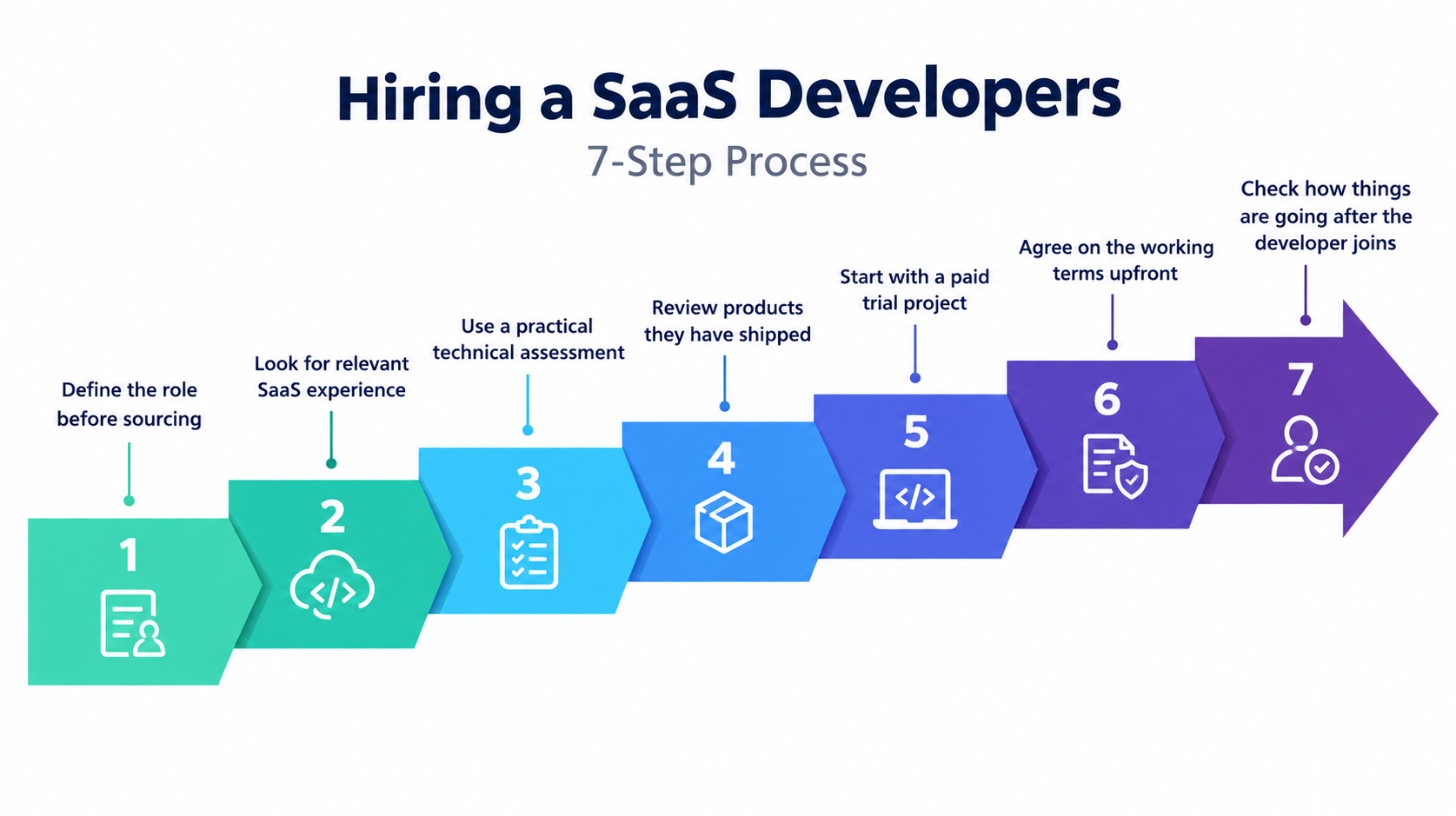
1. Define the role before sourcing
Start with the product requirements and list down the areas the developer will work on. It can include as billing, multi-tenancy, APIs, third-party integrations, cloud, or mobile. This will help you focus on candidates with relevant experience.
2. Look for relevant SaaS experience
Job portals give you a large candidate pool, but that also means more screening. Working with an offshore development company gives you access to a specialized talent network. It helps you find SaaS developers who have already worked with similar products and technologies.
3. Use a practical technical assessment
Give candidates a problem related to your product. It can be a task for designing a multi-tenant application or handling a billing scenario. Their approach will tell you more about their practical skills.
4. Review products they have shipped
Ask for the SaaS products they have taken into production. What did they work on? What issues came up after launch? And how they handled them. Having experience of a live product matters more than a collection of prototypes.
5. Start with a paid trial project
For a key role, consider a short paid engagement before making a long-term commitment. Use a real but contained task to assess code quality, communication, delivery, and ownership.
6. Agree on the working terms upfront
Get clarity on the practical details before the developer starts. Thing like who owns the code, how the source code and documentation will be handled, confidentiality, notice periods, and what happens when the engagement ends matters. Get these points into the agreement rather than sorting them out later.
7. Check how things are going after the developer joins
In the first few weeks you will understand whether the arrangement is working as expected. Look at the quality of the work, communication, delivery, and how well the developer fits into the existing team. If there is a problem, it is easier to deal with it early than after months of development.
Hiring SaaS Developers Is a Business Decision Before It Is a Technical One
Every engagement model to hire SaaS developers differs in terms of cost, timeline, and level of control. The choice you make will shape the product roadmap directly.
If you go for a freelancer mode, it solves a short-term capacity problem well. But a freelancer rarely carry context from one sprint into the next. And it becomes a real cost once the work turns into continuous development rather than a single feature.
Building an in-house SaaS development team can take four to six months. From job posting to a productive first release, it can be a long process. Hence, for the founders searching for SaaS developers for hire this could be a better way.
A dedicated SaaS developers team, or an offshore development centre. As this changes the calculation strategically. Recruitment does not restart with every new project, because the engineers already know the codebase and stay assigned across release cycles. Statista projects the global IT outsourcing market is growing at a 6.2% CAGR through 2030. The scale reflects how far this model has turned into a standard way of building and running software.
A comparable situation played out with a US-based SaaS platform serving enterprise clients across several product lines. Manual coding workflows and limited automation were slowing down every release.
When a dedicated AI development team took over full-cycle engineering support, it automated the repetitive parts of the workflow. While the release cycles sped up by 40%, their engineering productivity rose 30%.
What It Really Costs to Hire SaaS Developers in 2026
An hourly rate alone rarely tells the full cost story. Factors including region, engagement model, and seniority all move the number. Here is a real check:
-
United States: Senior SaaS engineering talent runs 80 to 150 dollars an hour.
-
Western Europe: Rates land between 60 and 110 dollars an hour, with skill depth close to the US and a smaller cost gap than most companies assume going in.
-
Eastern Europe: 40 to 70 dollars an hour, chosen mainly for the overlap in working hours with European teams.
-
India: The widest spread between cost and available depth, at 18 to 45 dollars an hour depending on seniority.
The number most rate cards leave out is the cost of replacing a developer. When someone leaves an in-house team, there is the hiring cost, the time needed for the new developer to understand the product, and often additional QA and rework on existing code. A lower hourly rate does not account for these costs.
With SaaS development company, you can keep sourcing, onboarding, documentation, and ongoing support under one engagement. Over a 12-month period, that can work out more cost-effectively than hiring through a marketplace and handling replacements, onboarding, and ramp-up separately.
What Mistakes Should You Avoid When Hiring SaaS Developers?
A lot of SaaS hiring decisions look fine on paper. The problems usually start once the developer joins the project. Here are a few things worth checking before you make that decision.
1. Hiring around a tech stack: “React developer” or “Node.js developer” tells you very little on its own. Look for the SaaS product they worked on and what they actually handled. Someone building just dashboards may not be the right person for a SaaS product with complex integrations or a large user base.
2. Starting with an unclear brief: Developers cannot deliver when they do not know what they are building. So, give them the product requirements, existing architecture, integrations, and their responsibilities before work starts.
3. Not paying attention to communication: This is easy to miss during technical screening. It becomes much more obvious when the developer is working with your product and engineering teams. See how they explain a problem, ask questions, and communicate when something is blocked.
4. Bringing someone into a messy codebase without context: If the product already exists, let the developer see it before they start. Old dependencies, missing documentation, and inconsistent code can change the amount of work involved. Finding that out after hiring is not ideal.
5. Having too many people make technical decisions: Someone needs to have the final say on architecture and major technical choices. Otherwise, developers can take different approaches to the same problem, and the team ends up spending time fixing those differences later.
6. Adding developers without adding coordination: A team of two developers and a team of ten do not work in the same way. As the team grows, someone needs to keep the work connected. Without that, adding more people can create more meetings and handoffs instead of faster delivery.
Your Team in India Gives You Vetted SaaS Developers Without the Hiring Risk
The cost of a wrong SaaS hire rarely shows up on day one. It shows up months later, in missed release dates, security gaps, and code that needs to be rebuilt before the product can scale further.
Your Team in India addresses this directly, giving companies access to pre-vetted SaaS developers across more than 50+ technologies, matched against the specific architecture, billing, and compliance needs of a live SaaS product.
Engagement options range from a single dedicated developer to a full offshore development center or a BOT team, so the structure fits the product roadmap instead of forcing the roadmap around a fixed hiring model. Every engineer works under complete code ownership terms, AI-ready development practices are part of delivery rather than added on afterward, and onboarding begins within days rather than months.
For businesses that need to hire SaaS development team capacity without running a six-month recruitment cycle, this model puts a team inside the codebase from week one. For those still weighing the decision, a technical review of the current codebase and hiring plan, done before any contract is signed, is usually the more useful place to start.
Frequently Asked Questions
 SaaS developers should have experience with the technologies your product uses, along with APIs, cloud platforms, databases, and production systems. Experience building and maintaining SaaS products is more useful than simply knowing a particular programming language.
Start by defining the product requirements and skills you need. Then look for SaaS developers with similar project experience. You can hire through job platforms, recruitment firms, or a SaaS development company.
Check the products they have worked on, the role they handled, and their experience with similar SaaS applications. Technical interviews and a small trial project can also help you judge their actual development skills.
Dedicated SaaS developers make sense when you need ongoing development support but do not want to build a full in-house team. They can work as an extension of your existing team and handle development work over time.
SaaS developers should have experience with the technologies your product uses, along with APIs, cloud platforms, databases, and production systems. Experience building and maintaining SaaS products is more useful than simply knowing a particular programming language.
Start by defining the product requirements and skills you need. Then look for SaaS developers with similar project experience. You can hire through job platforms, recruitment firms, or a SaaS development company.
Check the products they have worked on, the role they handled, and their experience with similar SaaS applications. Technical interviews and a small trial project can also help you judge their actual development skills.
Dedicated SaaS developers make sense when you need ongoing development support but do not want to build a full in-house team. They can work as an extension of your existing team and handle development work over time.

By Mangesh Gothankar


By Ashwani Sharma
By Achin Verma





 4.8 out of 5 by