Users now prefer applications that load instantly and feel as smooth as anything downloaded from the App Store. To solve this problem, Progressive Web App development was designed.
PWAs sit right between a website and a native app. Search engines pick them up like any webpage. Users can pin them to their home screen, no app store visit needed. And yes, they still send push notifications and feel native on both Android and iOS.
For companies building at scale, that combination can not be ignored.
But picking the right progressive web app frameworks is important. Not every PWA framework in 2026 is built for the same job. React PWA suits teams that want flexibility and a massive ecosystem. Next.js PWA is a stronger pick when server-side rendering matters. The framework you pick will directly affect load times and maintainability.
Here is the list of top frameworks in 2026 you must consider for efficient performance. If you're serious about Progressive Web App development, whether for a retail storefront or an enterprise dashboard, this is where to start.
What's Trending in PWAs?
PWAs have quietly become one of the smarter business decisions a company can make in 2026. The numbers back this up.
As per a report, Mobify reported 20% jump in the sales of mobiles when they switched to PWA. Another example is Lancome, which recovered around 8% of the abandoned carts by adding the feature of push notifications.
PWA development now is far different from what it used to be years ago. Today, businesses increasingly partner with expert mobile application developers to leverage Progressive Web Apps and deliver app-like experiences without requiring users to download native applications. Around the sectors like banking and healthcare, the adoption of PWA frameworks has grown significantly. And with Google continuing to reward Core Web Vitals in search rankings, Progressive Web App development has become as much an SEO strategy as a tech one.
Also read: 7 Best Technologies to Build Single Page Applications (SPAs)
What Makes a Good PWA Framework?
Not every framework that supports PWA features will actually serve your project well. Before jumping into the list, here are the factors worth checking:
1. Service Worker Integration
A good PWA framework should make service worker integration straightforward. Service workers are what power offline access, background sync, and push notifications. If a framework makes these painful to implement, cross it off the list.
2. Offline Functionality
Offline capabilities are not optional anymore. Users on slow or unstable connections expect the app to keep working. The right framework should handle offline caching without requiring you to build everything from scratch.
3. Performance on Mobile Devices
PWAs are mostly accessed on mobile devices. High-speed rendering, lean bundle sizes, and responsive layouts are non-negotiable. A framework that ships heavy JavaScript bundles will hurt your Core Web Vitals scores.
4. Single Codebase for Web and Mobile Applications
One of the biggest advantages of progressive web app development is maintaining a single codebase across platforms. The framework you choose should support this cleanly, not force workarounds.
5. Long-Term Scalability
What works for a small project often breaks under enterprise-grade solutions. If you are building for large organizations, pick a framework with a large community, frequent updates, and an extensive ecosystem of plugins and tooling.
With those factors in mind, here are the top PWA frameworks developers and enterprises are actually using in 2026.
Top PWA Tools and Best PWA Frameworks
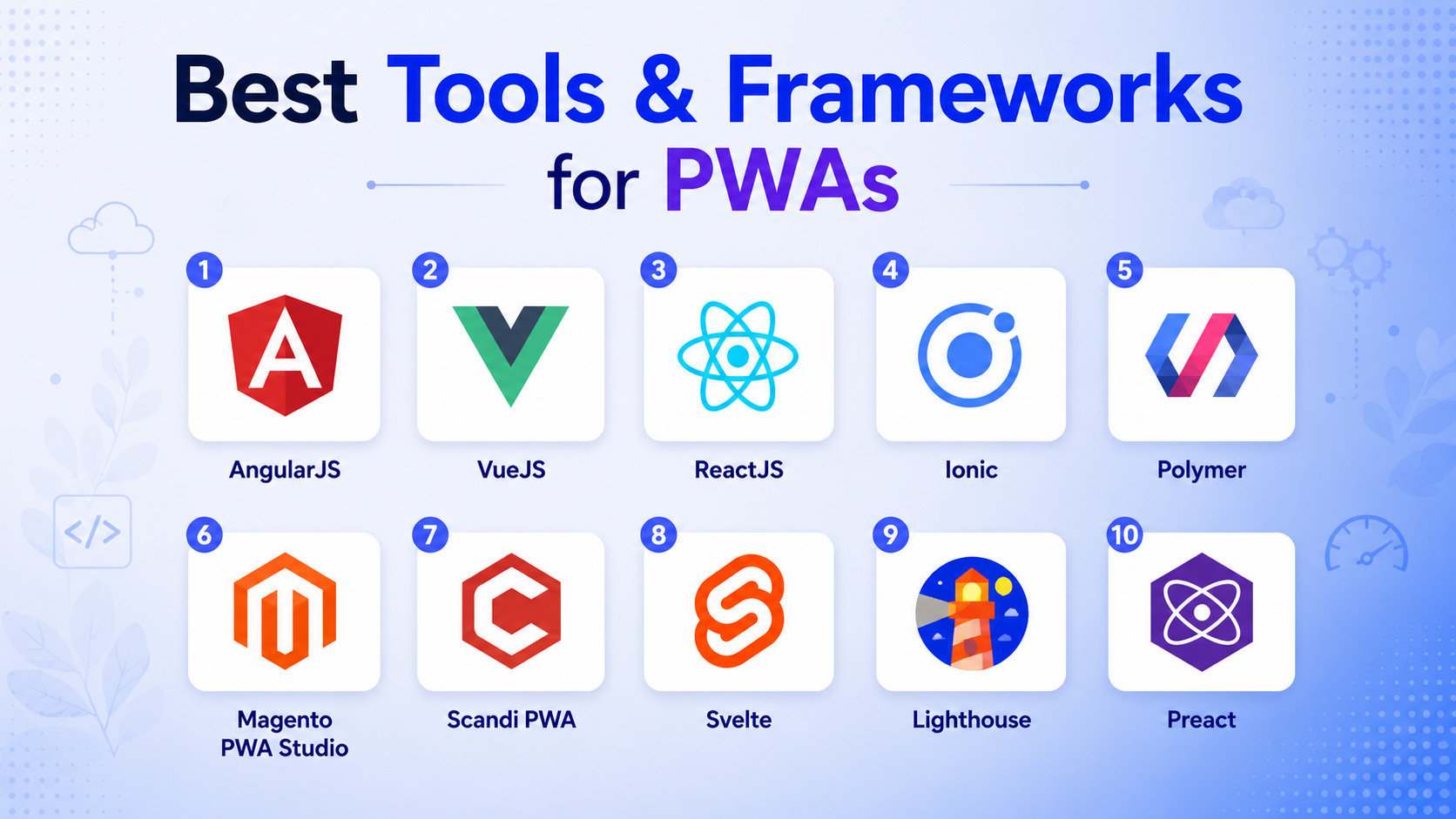
As progressive web apps (PWA) frameworks are simple and reliable, developers can employ different frameworks to develop PWAs. We have listed some of the popular frameworks here:
1. AngularJS

Angular has been a reliable choice for enterprise PWA framework development since Google released it in 2009. Built on the JavaScript ecosystem, it gives teams a structured, opinionated architecture for building robust web and mobile applications that scale. Teams working on large organizations and complex web and mobile applications appreciate having a defined way to do things, as it cuts down on debates and keeps codebases consistent across developers.
A few benefits that AngularJS comes attached with include the following
-
Strong TypeScript support out of the box
-
Built-in service worker integration for offline access
-
Opinionated architecture that scales well for enterprise-grade solutions
-
An extensive ecosystem of libraries and tooling
-
Large community with frequent updates
Best for: Large organizations and enterprise teams building complex, long-term, scalable web applications.
2. VueJS

Vue PWA has built a strong reputation among developers for one simple reason: it does not overcomplicate things. Vue 3's Composition API brings a cleaner way to build reactive, component-driven web applications, and the Virtual DOM keeps rendering fast even on budget mobile devices.
The benefits Vue.js offers make it the most suitable PWA framework to build a PWA, including the following:
-
High-speed rendering through Virtual DOM
-
Built-in support for offline functionality
-
Flexible setup with TypeScript and JSX support
-
Lightweight JavaScript framework with a small bundle size
-
Single codebase that scales well across web and mobile applications
-
Large community with an extensive ecosystem of plugins
3. ReactJS

React has been the backbone of countless web applications since Facebook open-sourced it in 2013. Still, it sits at the top of the JavaScript framework popularity graph, and the reasons are not hard to find.
Building a React PWA means your team gets Virtual DOM for fast rendering, a massive library of packages for every use case, and a component architecture that holds up as projects grow.
One thing worth noting, React on its own does not handle server-side rendering. Most teams pair it with Next.js PWA for that, which we cover separately below. It delivers a React PWA solution by employing JSX to render functions connecting HTML structures.
It has the following benefits:
-
PWAs built using React offer more flexibility and scalability with additional packages.
-
For native applications, developers may employ the same code.
-
The rendering process is fast due to the Virtual DOM.
-
The Progressive Web App framework makes the development of API interactions, server-side and static generated pages, and routing utilizing various JavaScript libraries simple and easy.
4. Ionic

Ionic started as an open-source SDK back in 2013. Today, it powers a huge number of hybrid web and mobile applications, and it remains a practical pick for teams who want PWA features without building separate native apps from scratch.
The framework sits on top of Angular PWA or React PWA. Ionic's comprehensive library of components for iOS and Android makes it a perfect choice for PWA development. This can be used to develop WebView-enabled web pages that run within the device browser.
The benefits it offers:
-
You don't need to purchase Ionic because it's open-source. Its software development costs are also fair, making it a suitable fit for small businesses.
-
Those who have sound knowledge of Angular and web technology can employ Ionic.
-
Ionic offers a vast library of plugins that enable you to access APIs without coding.
-
Debugging software and built-in browser tools make it easy to keep.
5. Polymer

One of the earliest JavaScript-based frameworks that has web components. It is built by Google and gives developers an idea of how to work with HTML, CSS, and JavaScript. There is no dependency on a development framework.
While Google has shifted focus toward Lit, Polymer still has a place in projects where web components and browser compatibility across older environments matter. Its wide variety of tools, components, and templates keep the development process straightforward.
Key benefits of Polymer:
-
Works across a wide variety of browsers without compatibility headaches
-
Independent framework, uses pure HTML, CSS, and JavaScript
-
Highly adaptable and easy to slot into existing web applications
-
Strong foundation for building web components based on PWAs
-
Lightweight approach keeps bundle sizes small on mobile devices
-
Simplified development process with ready-made tools and templates
6. Magento PWA Studio

Magento PWA Studio is Adobe's official set of tools for building PWAs on top of the Magento eCommerce platform.
The toolset covers everything from building user interfaces and managing data to testing your application before it goes live. For retail businesses with existing Magento infrastructure, it cuts both development time and cost significantly.
Why teams pick Magento PWA Studio in 2026:
-
Built specifically for Magento eCommerce, no complex integrations needed
-
Covers the full development process from UI to data tier management
-
Offline access and push notifications are built into the framework
-
Cost and time-efficient for businesses already on Magento
-
Easy to keep your web application updated as Magento evolves
7. Scandi PWA
ScandiPWA takes Magento PWA Studio a step further. Built on top of it as an open source PWA framework, it gives development teams far more flexibility in how they build and customise their storefront compared to Adobe's out-of-the-box offering.
Where Magento PWA Studio is the official toolset, ScandiPWA is the developer-friendly layer on top. Teams get the same Magento infrastructure underneath but with cleaner React-based components, better customisation options, and a more modern development process overall.
Why teams pick ScandiPWA in 2026:
-
Open source PWA framework with active community support
-
Built on React PWA architecture for a familiar component structure
-
More customisation flexibility than vanilla Magento PWA Studio
-
Reuses existing Magento infrastructure, cost and time-efficient
-
Complete set of PWA tools for UI, data management, and testing
-
Easier to maintain and keep your web application up to date
8. Svelte

Svelte is a JavaScript framework used to develop PWAs. It’s lightweight and seamless to use, and it builds small code bundles that load fast.
In addition, Svelte apps are already optimized for performance and have a high degree of interactivity.
The benefits of using Svelte include the following:
-
Ability to build lightweight applications that load quickly.
-
Small code bundles that are easy to download and install.
-
Simple and easy-to-learn syntax.
9. Lighthouse

Google introduced Lighthouse to enhance the quality of web apps. The PWA application development tool measures your website while considering every aspect and enlists the factors required to ensure you build a progressive web app.
The benefits of using Lighthouse include the following:
-
Being an automated tool, it can improve the quality of web pages
-
It has the ability to run against any web page, public or requiring authentication.
-
It has audits for accessibility, performance, SEO of progressive web apps, and more.
10. Preact

Preact, a JavaScript framework, is similar to React but smaller and faster. This easy-to-use framework is an excellent choice for beginners in the web development area, especially for developing PWAs.
The benefits of using Preact include the following:
-
Preacts are small in size, which is valuable when the loading performance budget is a constraint.
-
More time for interactivity.
-
The same UI can be created with less code
-
Easy to learn and use
Recommended Read: Flutter Vs PWA – Which is Better For Mobile App Development
Future of Progressive Web Applications (PWA)
Today, the rising demand of developers for building PWA apps proves that PWAs are the future. In the coming years, it will eventually replace most native apps.
However, before you make any decisions regarding PWA development, you need to get in-depth knowledge of PWA technology, your product tech stack, and your user base.
To achieve this, it is recommended to consult our dedicated PWA stack experts and know how and when you should go for the PWA technology.

By Mangesh Gothankar


By Ashwani Sharma
By Achin Verma
Frequently Asked Questions

PWA development is the process of building applications that are run as web apps on multiple platforms. PWAs are designed to deliver a user experience similar to native mobile apps but are also intended to be faster and more reliable.
PWAs offer several advantages over traditional web apps, including:
-
Improved performance
-
Increased reliability
-
Better user experience
-
Lower development costs.
PWA, a web application installed on a system, performs on an offline network state, utilizing the data cached at the time of users' last interaction with the application.
To know if a website performs as PWA, you must use Chrome's Lighthouse extension. This extension will let you know if the site is PWA and give you ways to convert it into one.
We provide IT Staff Augmentation and IT Resourcing Services, where we staff, manage and support offshore development teams according to our client’s requirements. Our services include:
-
Hiring Certified and Experienced Developers
-
Client’s Team Management
-
Offering State-of-Art-Infrastructure in terms of Hardware and Software








 4.8 out of 5 by