Airbnb, Netflix, Pinterest, and Snapchat got where they are with strong ideas and deliberate technology choices. Each one invested early in the technology behind its web and mobile applications, and the tech stack under those products still decides how fast they ship and how well they hold up under heavy traffic. If you are picking technologies for a new product, their choices are worth studying.
A tech stack for startups is the full set of tools used to build and run a product. It covers the programming languages, a web framework, a database system, a web server, cloud services, and the user interface people actually see. Get that mix right, and your team moves quickly. Get it wrong, and a good idea hits slow releases, rising hosting bills, and a rewrite nobody planned for. The pressure is higher in 2026 because most products now need some AI capability, and an AI tech stack adds its own layers on top of the usual front-end tech stack and back-end tech stack.
Strong startups tend to share two things: a talented team, whether in India, the US, or the UK, and an idea backed by the best technology stack for startup work they can afford. Even a sharp team slows down when the technology stack is complex, bulky, or outdated.
This guide explains what a tech stack is and breaks down the main tech stack components. It gives a clear example of a tech stack, covers a full-stack tech stack and the technology stack for SaaS applications, and shows how to choose the right tech stack for your own startup software development.
What is a Technology Stack?
A tech stack, also called a technology stack, is the set of tools a team uses to build and run an application. It brings together programming languages, a web framework, a database system, a web server, and cloud services, along with the user interface people actually see. The word “stack” describes the layering. Each layer depends on the one below it, so a choice made low in the stack affects everything above it.
Every tech stack has two structural parts:
-
Front end: the client side. It covers the user interface and everything a visitor sees and clicks in the browser or app.
-
Back end: the server side. It holds the application logic, the database, and the backend services that respond to user requests.
A stack that covers both sides is a full stack, and developers who work across both are full stack developers.
Beyond the front end and back end split, most stacks share the same core components. HTML, CSS, and JavaScript shape the interface. A programming language runs the logic inside a framework, a web server passes requests along, a database handles storing data, and a cloud provider hosts the lot. Real tools fill each slot: React builds the interface, PHP runs server-side logic, Swift powers native iOS apps, and GraphQL lets the front end ask the back end for exactly the data it needs. Hadoop is the odd one out. It crunches very large datasets, so it turns up in data-heavy products and seldom in an early-stage startup stack.
A modern tech stack in 2026 goes further. Containers, monitoring, analytics tools and business intelligence now sit beside the classic layers, and many teams add AI components on top. We get to those later in this guide.
Why is a Tech Stack Important for your Startup and ODC Team?
In the early days of a company, the tech stack rarely tops the list. Investor meetings and prototypes eat up the time, so teams reach for whatever they used last or whatever feels comfortable. That shortcut tends to cost money later, especially when part of the work runs through an offshore development center (ODC) team, because every change in technology touches people in more than one place.
Problems usually show up in three places:
-
Rewrites and data migration. A stack that fits today can become hard to maintain as the software project grows. Moving a whole codebase from Python to PHP is slow, and shifting data from MySQL to a NoSQL database means migrating live records without breaking anything.
-
Cloud lock-in. Changing your cloud provider is harder than it sounds. Our engineers at Your Team in India see that resources on AWS rarely map one-to-one onto Azure, so a move between the two often means redesigning parts of the cloud infrastructure.
-
Expensive stack changes. Switching stacks means retraining your in-house developers or hiring new ones with the right skills, and both routes eat time and budget.
The tech stack for startups that you choose now stays with you through the most critical stages of growth. Pick one that is robust, flexible, and a fit for the business before development begins.
Why Choose a Tech Stack for Your Startup?
A strong tech stack gives your web development work a solid base. It decides how competitive your application can be, because the tools behind it set the ceiling on speed, features, and reliability. The choice reaches into most parts of the product:
-
How the app works and ages. Clumsy or outdated tools get harder to maintain with every release.
-
Scalability. Web apps need a stack that can take more load through load balancing and extra servers, without a rebuild. This matters most for large-scale systems.
-
Data storage. The stack decides where application data lives, in the cloud or on local servers, and how fast it can be read.
-
Server capacity. How well your server systems handle traffic depends on the web server, the framework, and the technology infrastructure around them.
-
Fit with the project. The stack should match what your startup or project is meant to do.
-
IT outsourcing trends. Offshore development keeps changing, and a popular stack makes it easier to find and keep skilled developers.
Software development standards and outsourcing trends shift quickly, so watch what the market is adopting. Weigh the strengths and weaknesses of each option before you commit, and you can start building with confidence.
Top Factors to Consider When Choosing a Startup Tech Stack
No single stack suits every product. Seven factors usually decide which one fits yours.
1. Project type: Settle this first when you pick the best technology stack for a startup. A small marketing site can run on a CMS such as WordPress, extended with JavaScript or Python where needed. A large e-commerce platform needs a purpose-built web application stack with far more depth. Size up the complexity before you commit to programming languages or extra features. If your business has a solid base but limited technical knowledge, offshore software development through a dedicated team gives you that expertise without a long hiring cycle.
2. Your team’s skills: Developers deliver faster in tools they already know, and unfamiliar ones slow the first months of work. Pick a stack with a large community and solid documentation, since your team will lean on both when the code misbehaves. An experienced developer who knows the stack well is also the surest way to hit a deadline.
3. Time to market: The stack sets the pace of the build. A full stack developer who knows mature open-source libraries can get you to launch sooner, and third-party services can cover features you would rather not build yourself. Your goal matters here too. For a proof of concept, favor a stack that prototypes quickly. For an MVP you expect to grow, pick something sturdier, even if it takes a little longer to code.
4. Talent pool: A tool only helps if you can hire for it. Developers skilled in Python, Node.js and React Native stay in high demand, and competition from larger companies pushes salaries up. Outsourcing to India widens your options, since you can reach engineers experienced across many stacks, and a dedicated team keeps the same people on your product over time.
5. Scalability: Your web or mobile application should take on more users without a rebuild. Growth can be vertical, with bigger machines, or horizontal, with more servers behind load balancing. Check that your database system, your web framework, and your cloud platform all support the route you expect to take.
6. User experience: If your site is content-driven and depends on search traffic, choose a stack that supports server-side rendering, so pages load fast and search engines can read them.
7. Security and cost: Choose technologies with solid security practices. Niche tools usually mean pricier developers and heavier maintenance, so a popular stack often costs less over time.
Popular Tech Stack Options for Startups
These are the languages and stacks startups reach for most often in startup software development. Compare each against your project, your team, and your budget.
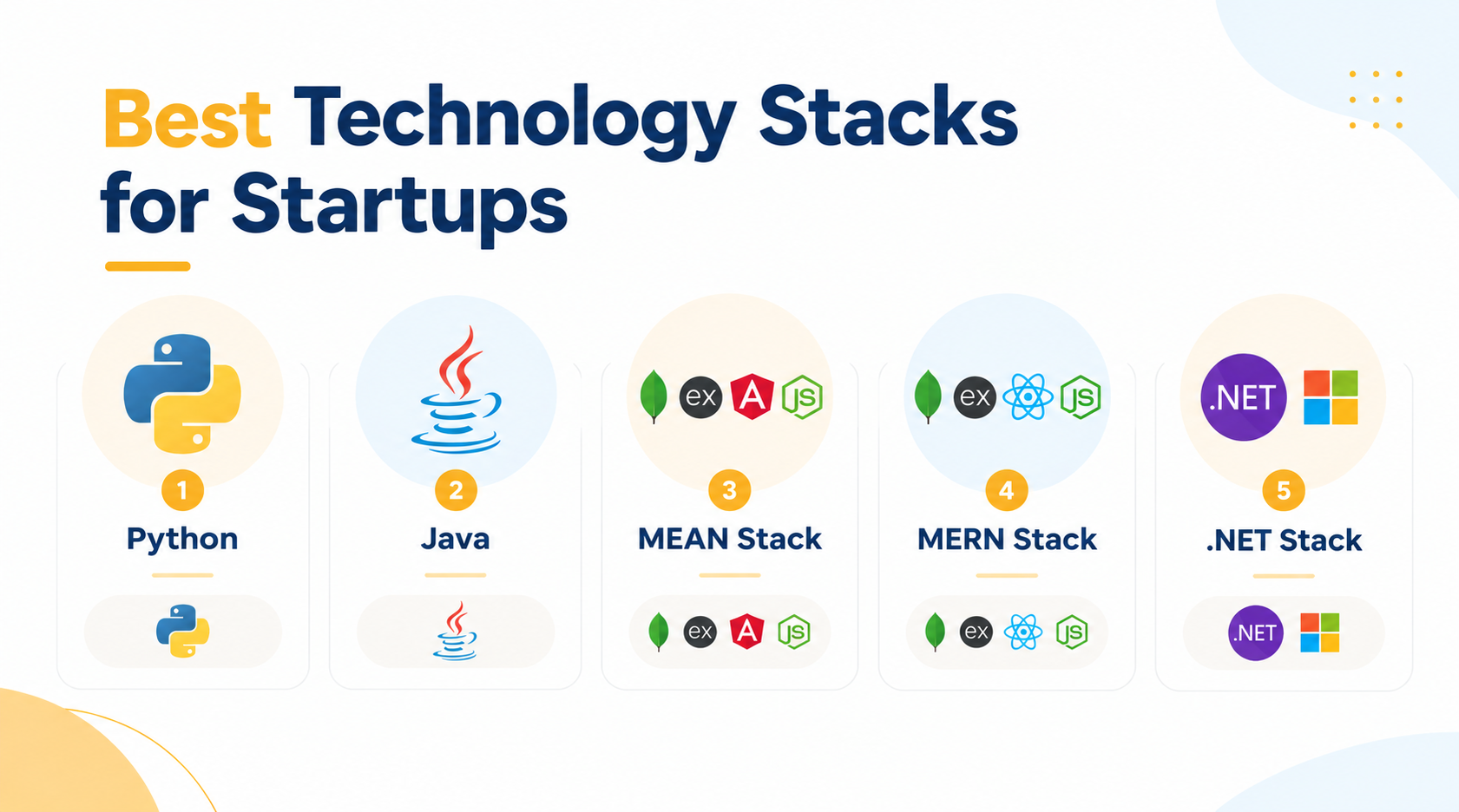
1. Python
Python is a high-level, interpreted programming language known for short, readable code. Its large library ecosystem lets a small team build fast, and web frameworks like Django and Flask cover the back end. Python also leads in machine learning and data analysis, which makes it the usual starting point when a startup adds AI tools to its product. When one part of the code needs more speed, developers can extend Python with modules written in C or C++.
Benefits of using Python
-
A huge ecosystem of third-party packages and support libraries
-
Simple built-in data structures that keep code short
-
Faster development, since readable code is quicker to write and review
-
A gentle learning curve for new team members
-
A strong fit for machine learning, data analysis, and automation
💡 Hiring tip: On a startup budget, you want a Python developer who has shipped real products. Look at the libraries and frameworks a candidate has used, how long they have used them and what they have delivered. Ask for examples close to your own product, such as a web back end or a machine learning pipeline.
2. Java
Java, maintained by Oracle, is an object-oriented programming language that runs on any system with the Java Runtime Environment (JRE). That is why people call it platform-independent. Its maturity, strong typing, and security features make Java a solid tech stack for startups that sell to large enterprises. Frameworks such as Spring cover most back-end needs, and built-in multithreading lets an application handle many tasks at once.
Benefits of using Java
-
Platform independence, so the same code runs across operating systems
-
Object-oriented design that keeps large codebases organized
-
Multithreading that makes good use of the CPU
-
Mature security features and a deep enterprise ecosystem
-
A long track record in large-scale systems
💡 Tips to Consider When Hiring a Java Developer
If you want to hire a Java Developer, you must recognize a quality candidate before hiring one. Java Developers are vital players in the software development industry.
Look for developers who have expertise in frameworks, tools, and programming languages. Don't forget to consider the experience before you opt to hire an app developer to build Java-based web & mobile applications.
3. MEAN Stack
Let's now talk about the MEAN (MongoDB, Express.Js, AngularJS, and Node.Js)!! It is one of the most popular technology stacks of 2021. This is an end-to-end stack; your team uses a single language throughout your stack.
Another benefit of using MEAN is that all the technologies are free and open-source with the support of a vigorous community. The applications of the MEAN stack are best for cloud hosting as it is scalable, extensible, and flexible. This tech stack can be deployed quite easily as it involves a web server. The database can be scaled on-demand to handle usage spikes temporarily.
Benefits of MEAN Technology
-
It is highly flexible.
-
MEAN Stack is cost-friendly for businesses.
-
It is Open-source and is widely available for use.
-
You can easily switch between server and client.
-
It saves your time.
💡 Tips to Consider When Hiring a MEAN Developer
If you are looking for full-fledged App development, it is best to hire a MEAN Stack Developer. A MEAN Stack Developer falls under the category of a Full-Stack Developer who is responsible for completing all the activities in terms of software development. It includes development, design, integration, and more.
Want to hire a MEAN Developer? Click here to contact us, and Our Team will help you to grow as a Startup.
4. MERN Stack
The MERN Stack is quite similar to MEAN, which replaces React with Angular. Yes, you got that right: MERN- MongoDB, Express.JS, React.Js, and Node.js. Since React.Js is known to use the Virtual DOM, you can easily implement changes whenever required.
Also, with React comes JSX, which is a modified version of JavaScript. JSX is further responsible for seamless components.
React is the most popular framework available in the software development industry and is used for developing high-end, single-page applications with interactive UIs.
Benefits of Using MERN:
-
It comes with a pre-built, comprehensive suite of technology tools.
-
As React JS can run on the server, the code can be used for both the browser and the server.
-
MERN Stack supports MVC architecture that makes the development quite an easy process.
-
All the technologies in MERN Stack are Open-Source technologies.
💡 Tips to Consider When Hiring a MERN Developer
When on a hunt to hire MERN Stack developers, make sure you look for someone well-trained and expert in creating the MERN STACK Platform to provide you with best-in-class results.
Your candidate must provide support to the project by efficiently planning and releasing a successful product. He/she must know all the technical activities & process enhancements to accelerate time-to-market.
Click here to hire MERN Stack Developers At Your Team In India.
5. .NET Stack
.Net technology allows you to develop a feature enriched and bug-free framework for dynamic web apps. It is also a subset of overflow stack that has a comprehensive tech stack with all essential aspects of the web-frontend.
Benefits of Using .NET Stack
-
Object-oriented development model
-
It is reliable and comes with the caching system
-
.NET works on Visual Studio IDE
-
It is a Cross-platform for design
💡 Tips to Consider When Hiring a.NET Developer
When you opt to hire a .NET developer, just make sure that your candidate is familiar with all the structures, frameworks, and more. This will help you understand the project-based requirements so that you can be on the same page with the developer.
Which Tech Stacks Are Used for Mobile Applications?
For mobile development, the platform decides your options. Android and iOS each have a main language, and cross-platform tools cover both.
1. For Android
Kotlin: Kotlin is a modern programming language built to work with Java, so teams can add it to an existing Android codebase file by file. Google fully supports Kotlin for Android development, says over 60% of professional Android developers use it, and reports that apps built with it are 20% less likely to crash. Its short syntax means less boilerplate code, which shortens the build time of a mobile application.
2. For iOS
Swift: Swift is Apple’s programming language and the default choice for new iOS apps. Developers tend to find it easy to read and learn, and Apple keeps it current, with Swift 6.4 released in September 2026.
Objective-C: Objective-C is the older iOS language. It still runs in many established apps and works alongside Swift in the same project, so you will meet it mostly when maintaining a legacy codebase.
Cross-platform: React Native, Flutter and Kotlin Multiplatform let one team build a mobile application for both platforms from a shared codebase, which stretches a small budget further.
How to Choose a Right Tech Stack
Picking the right tech stack for a startup takes careful thought, and no single option wins for every product. Work through these steps in order.
a) Decide where the product will run. Start with the platform: a web application, an Android app, an iOS app, or a mix. The platform narrows your choices early and shapes which developers you need to hire.
b) Define the product type. A content site or a SaaS dashboard asks for different tools than a native mobile application. If an app needs the best performance on one platform, native options such as Kotlin for Android or Swift for iOS fit well. If the product relies on AI or machine learning, Python is the usual back-end choice, with an AI tech stack layered on top.
c) Plan for your users. Estimate the audience you expect in the first months, then pick a stack that can grow past it without a rebuild. Heavy caching and complex infrastructure make little sense when you expect a handful of visitors on day one, whether you build on .NET or PHP. Keep the setup simple and scale it when real traffic arrives.
d) Match the stack to your goal. A proof of concept calls for a stack that prototypes quickly. An MVP headed for real traffic needs a sturdier, more scalable framework, even if it takes a little longer to code.
e) Check the talent. Confirm you can hire developers for the tools you choose, in-house or through a dedicated team.
f) Review security and cost. Prefer tools with strong security practices and a running cost you can sustain.
Need Help with Choosing the Right Startup Tech Stack?
Choosing the best startup technology stack for your project can feel heavy, especially while you are also chasing investors and a launch date. That is a good point to bring in outside help. Outsourcing software development to Your Team in India gives you engineers who have worked across many frameworks. They help you pick the right stack, take the product from build to launch with a dedicated team, and handle the complex parts of the project from day one.
Contact us for a free initial consultation today.
Frequently Asked Questions

A typical tech stack for SaaS pairs a frontend tech stack such as React or Vue with a backend tech stack built on Node.js, Django, or Ruby on Rails. These popular web frameworks and backend technologies help a small team ship fast. Relational databases like PostgreSQL anchor the data stack, covering data storage, managing data, and data access, while Google Cloud or AWS hosts the product. Start there and add pieces only when a real need appears.
LAMP is short for Linux, Apache, MySQL, and PHP. Linux is the operating system, Apache is the web server, MySQL is one of the relational databases, and PHP builds web pages on the server. The MERN stack runs JavaScript on both the client and the server and stores data in a document database. These different tech stacks both suit startups, so go with the one your team already knows.
The entire stack gains new layers. The key components are a model, a framework to run it, memory, and a way to reach other systems. The Model Context Protocol (MCP), an open protocol introduced by Anthropic in November 2024, gives AI tools one standard way to connect to databases, files, and other software systems. Machine learning workloads also bring heavy data processing, so budget for it early.
For many early products, yes. Google Cloud Functions, now called Cloud Run functions, run small pieces of application logic when an event or web request arrives. Google Cloud scales it automatically, and you pay only while the code runs. It suits webhooks and light web services, and you can test the same code in a local development environment first. Long-running jobs still fit a regular server better.

By Mangesh Gothankar


By Ashwani Sharma
By Achin Verma








 4.8 out of 5 by