AI hiring has become one of the hardest tasks for enterprises. Forrester's 2026 technology predictions project that time to fill open developer roles will double. Now more businesses compete for senior engineers who can pair system architecture skills with production AI tooling.
On the other hand, Deloitte's Global Business Services Survey found organizations with strong offshore governance structures are already capturing average cost savings above 20%. All that by building AI and digital capability through delivery centers in India. Partnering with an established AI development company gives startups, scale-ups, and enterprises a way to close that hiring gap immediately while keeping cost under control.
This guide breaks down what AI development outsourcing costs in 2026, the benefits it delivers, and the risks that need a mitigation plan before any contract is signed.
What Is AI Development Outsourcing
AI development outsourcing refers to partnering with an external team to design, build, and maintain AI solutions for your business. That too without the cost and complexity of building the capability in-house.
It majorly includes data engineering, model training and fine-tuning, MLOps, and integration of large language models into existing products. And is different from generic software outsourcing because the required skill set is narrower and harder to source. Building a computer vision pipeline or fine-tuning a domain-specific LLM requires engineers with direct production experience shipping similar systems for other clients.
Traditional IT outsourcing solves for coding capacity. But outsourcing AI development solves for a different combination entirely. It includes coding capacity, applied machine learning expertise, and data infrastructure knowledge. And that is why AI software development outsourcing engagements need a different vetting process than a standard staff augmentation contract.
A team can ship web applications well and still lack the experience needed to productionize a recommendation engine or a fraud detection model at scale. Adoption of this model looks different depending on company stage. Startups use it to reach a working AI prototype without spending the first six months of runway on hiring. Scale-ups use it to add specialized capacity, such as an offshore AI development pod, without expanding fixed headcount ahead of confirmed demand. Enterprises use it to add AI-specific skills to existing engineering organizations, skills that are expensive and slow to hire internally, while keeping core product teams intact.
For a broader comparison of engagement structures, our complete guide to software development outsourcing outlines how AI-specific engagements differ from traditional staff augmentation and project-based contracts.
The Real Benefits of AI Development Outsourcing in 2026
For companies evaluating a build-versus-outsource decision, the benefits of AI outsourcing are measurable rather than theoretical. Five outcomes consistently show up across engagements, regardless of company size or industry vertical.
1. Faster access to specialized AI talent
Companies bypass four to six month hiring cycles for niche roles such as LLM engineers, computer vision specialists, and MLOps engineers. Working with a partner that lets you hire AI engineers already vetted and deployed removes the recruiting bottleneck entirely.
2. Reduced time from prototype to production
A dedicated AI development team with repeatable delivery processes can move a proof of concept to a deployed system in weeks rather than months, because the workflow, tooling, and QA process are already established from prior engagements.
3. Lower total cost versus building in-house from zero
This is where the numbers get concrete. Plus Covr, a US-based insurtech company, had a 12-person tech team with no in-house machine learning capability and internal hiring timelines exceeding five months. A dedicated six-engineer AI outsourcing unit was deployed within the first week, building a claims routing engine, a document intelligence pipeline, and a risk scoring model on AWS. Within 10 days of onboarding, the client reported a 55% reduction in AI development costs and claims intake processing that ran three times faster than before, with document extraction accuracy rising from 61% to 94%.
4. Flexible scaling as the roadmap changes
Engagement size can flex up or down without the severance costs and notice periods tied to permanent hires, which matters most during the experimentation phase of an AI roadmap.
5. Stronger execution against the adoption gap
Teams that have already shipped production AI systems for other clients bring established processes for data validation, model monitoring, and deployment, the exact capability separating the small share of high performers from the broader 88% of companies that have adopted AI without seeing profit impact.
These benefits explain why the model has expanded well beyond startups into scale-ups and enterprise engineering organizations. The next question most engineering and finance leaders ask is what this actually costs, and what specifically drives that number up or down.
How Much Does AI Development Outsourcing Cost
AI outsourcing cost is rarely a single figure, since pricing depends on the complexity of the AI work, the seniority mix of the team, and the engagement model selected. A computer vision system with real-time inference requirements costs meaningfully more to build than a rules-based automation layer, because it requires more senior ML engineers and more testing cycles before production release.
Engagement model is the second major driver. Project-based contracts carry a fixed scope and price but less flexibility once requirements shift. Dedicated developer engagements and offshore development centers price on a monthly basis per engineer, which lowers the effective cost per unit of output as the engagement scales past three or four specialists.
The third driver is geography. And it produces the widest difference in AI outsourcing cost. Since senior AI engineering talent in North America and Western Europe commands a significant premium over equivalent talent in offshore hubs such as India.
A fourth factor that founders and finance teams frequently underestimate when calculating total AI outsourcing cost is onboarding overhead. Knowledge transfer sessions, tooling setup, access provisioning, and the first two to three weeks of ramp-up all carry a cost even before feature work begins. Vendors who document this cost upfront, rather than folding it into the first invoice, tend to produce more accurate budget forecasts across the life of the engagement.
The table below shows how these regions typically compare in relative cost terms for AI/ML engineering talent.
Beyond direct rate differences, engagement structure affects total savings. Deloitte's Global Business Services Survey found that organizations with strong offshore governance structures report average cost savings above 20%, and close to half of the organizations building next-generation digital and AI capability now operate delivery centers in India.
Our guide to IT outsourcing companies breaks down how to shortlist vendors once the target region and engagement model are set.
Risks of AI Development Outsourcing and How to Avoid Them
The risks of AI outsourcing are well documented, and five of them account for most of the problems companies report after signing a contract without the right safeguards in place. Each one can be addressed through contract terms, security certifications, and communication structure agreed before the engagement begins.
1. Data privacy and IP protection
AI engagements need some access to production data, customer records, or proprietary models. And that's exactly where things get messy if the contract doesn't spell out who owns what. This is one of the most common places outsourcing deals fall apart.
How to avoid it: Get the IP assignment clause and data processing agreement signed before a single file changes hands, and check that the vendor actually holds ISO 27001 or SOC 2, not just claims it on their site.
2. Inconsistent model quality
A model that looks great in testing can fall apart within weeks of hitting real production data. Nine times out of ten, that traces back to a team skipping a proper MLOps process.
How to avoid it: Ask the vendor to put their model validation and monitoring approach in writing, specifically how they catch data drift once the system is live.
3. Communication gaps across time zones
Delivery slows down when there is no defined overlap window or single point of contact managing the offshore AI development team.
How to avoid it: Confirm daily overlap hours and a named project lead as a signed term of the engagement before work begins.
4. Vendor lock-in and knowledge silos
Some engagements leave documentation and model logic concentrated with the vendor's team, creating dependency if the relationship ends.
How to avoid it: Require documentation, code repository ownership, and knowledge transfer sessions as standing contract terms rather than optional extras.
5. Regulatory exposure
AI systems handling customer or financial data must meet data residency and emerging AI governance requirements that vary by industry and region.
How to avoid it: Confirm the vendor's compliance track record against frameworks relevant to the industry, such as HIPAA for healthcare or GDPR for EU customer data, before onboarding.
Dedicated Developers, ODC or BOT, Which AI Outsourcing Model Fits You
Cost and risk factors are one part of the decision. The other is picking an engagement model that actually fits where the business is right now. Three models cover almost every AI development outsourcing deal, and each one lines up with a different team size, timeline, and plan for long-term ownership.
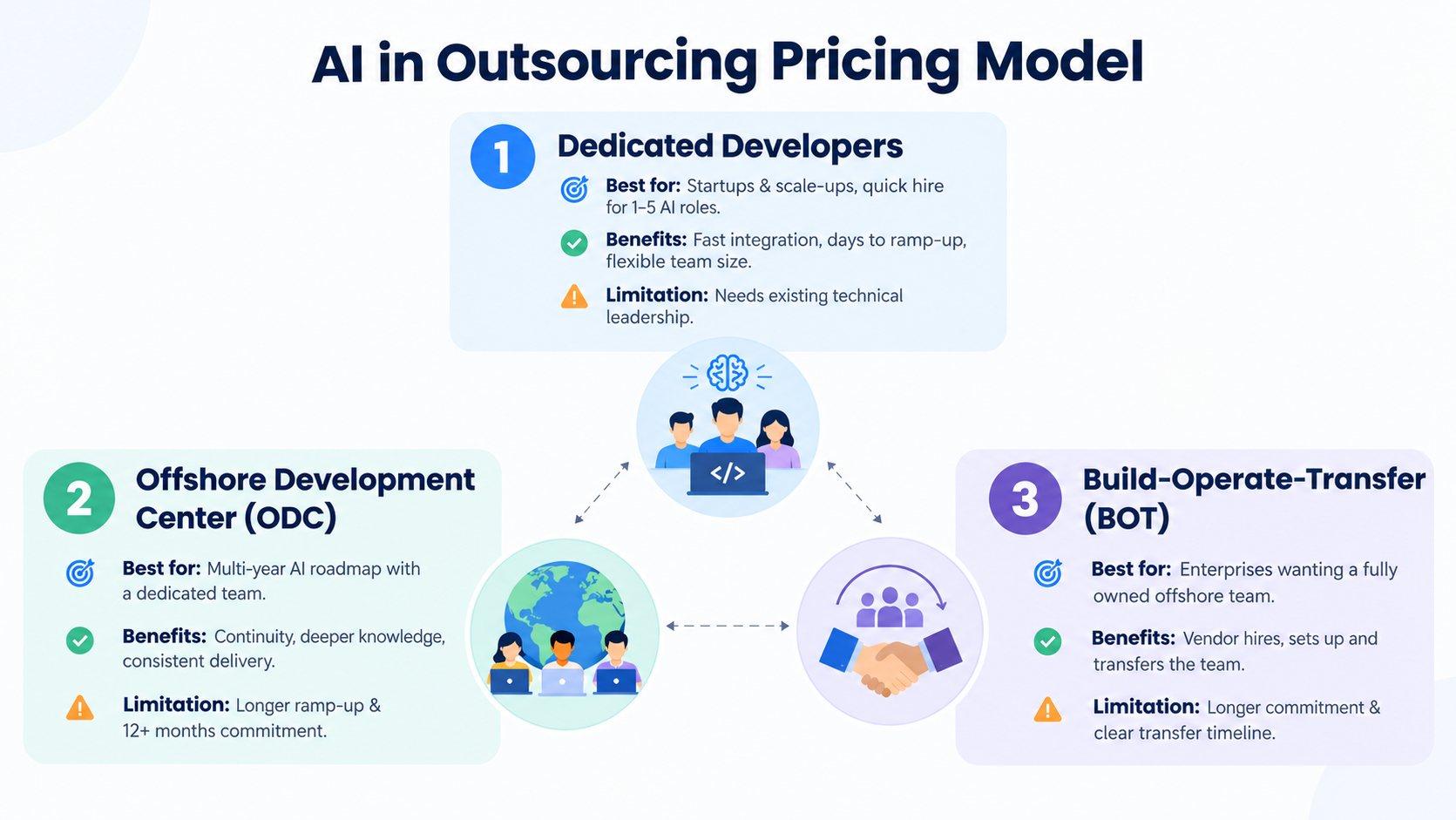
1. Dedicated developers
-
Best for: startups and scale-ups that want to hire AI engineers for one to five specialist roles inside an existing product team quickly.
-
Benefits: engineers integrate directly into internal sprints, ramp-up is measured in days, and the arrangement can be resized month to month.
-
Limitations: works best when internal technical leadership already exists to direct the work, since the model provides engineering capacity rather than end-to-end project ownership.
2. Offshore Development Center (ODC)
-
Best for: companies running a multi-year AI roadmap that needs a stable, dedicated unit rather than short-term capacity.
-
Benefits: a fixed team operates as an extension of the company, with continuity across projects and institutional knowledge that compounds over time.
-
Limitations: requires a longer ramp-up period than dedicated developers and performs best with a committed 12-month or longer engagement.
3. Build-Operate-Transfer (BOT)
-
Best for: enterprises that want an offshore AI development team fully transferred into their own legal entity after an initial operating period.
-
Benefits: the vendor recruits, sets up, and operates the team, then transfers ownership, delivering a fully built AI development team without running the initial hiring and setup process internally.
-
Limitations: requires a longer-term commitment and a transfer timeline agreed upfront to avoid ambiguity later in the relationship.
For a closer look at how staff augmentation compares with project-based contracts, see our breakdown of outstaffing versus outsourcing models.
Why Your Team In India Is Built for AI Development Outsourcing
Your Team In India works with startups, scale-ups, and enterprises that turn to AI development outsourcing to build AI capability without the delay and cost of hiring from scratch. The capabilities below are built specifically around the cost and risk factors outlined above.
-
Pre-vetted engineers across 50+ technologies, including AI/ML, cloud, QA, and custom software development, so an AI outsourcing team can be assembled quickly from specialized talent already screened for production experience.
-
All four engagement models available under one partner, including dedicated developers, ODC, BOT, and virtual captive centers, so the relationship can shift models as the roadmap changes without switching vendors.
-
Security and compliance built into delivery, including data processing agreements and documented IP assignment from day one, addressing the data protection risk covered earlier in this guide.
-
AI-ready development practices, including defined MLOps and model monitoring processes, addressing the model quality risk outlined above.
-
Rapid deployment timelines, with dedicated teams onboarded and operational within days of contract signing rather than months.
Companies that need an AI outsourcing team rarely have a six-month hiring runway available. Your Team In India is built to start immediately, with pre-vetted engineers ready to onboard against a defined scope.
Frequently Asked Questions
 The teams we build most often are LLM integrations, computer vision, and document processing pipelines. Most clients come to us with web and backend engineers already on staff who haven't taken a model into production before. That's the gap our engineers close, since a lot of them have already shipped two or three of these before joining a client's roadmap.
Yes, and it's how most of our engagements actually run. Our engineers typically own model training and the data pipeline, while your team keeps control of the product itself. We assign one technical lead on our side and ask for the same from you, plus a shared repo, and that's usually enough to keep both teams moving without extra process overhead.
We settle this in the contract before any work starts. Every repository, trained model, and piece of documentation transfers to you at close. Our engineers also walk your team through the architecture and flag anything still fragile in the system before we step back.
Both, when it's part of the original scope. We offer model monitoring, retraining as your data drifts, and bug fixes after launch as a separate phase, and we spell out that cost upfront in the proposal itself. If you're comparing us against another vendor, ask them the same question before you sign.
The teams we build most often are LLM integrations, computer vision, and document processing pipelines. Most clients come to us with web and backend engineers already on staff who haven't taken a model into production before. That's the gap our engineers close, since a lot of them have already shipped two or three of these before joining a client's roadmap.
Yes, and it's how most of our engagements actually run. Our engineers typically own model training and the data pipeline, while your team keeps control of the product itself. We assign one technical lead on our side and ask for the same from you, plus a shared repo, and that's usually enough to keep both teams moving without extra process overhead.
We settle this in the contract before any work starts. Every repository, trained model, and piece of documentation transfers to you at close. Our engineers also walk your team through the architecture and flag anything still fragile in the system before we step back.
Both, when it's part of the original scope. We offer model monitoring, retraining as your data drifts, and bug fixes after launch as a separate phase, and we spell out that cost upfront in the proposal itself. If you're comparing us against another vendor, ask them the same question before you sign.

By Mangesh Gothankar


By Ashwani Sharma
By Achin Verma







 4.8 out of 5 by