As the digital world continues to evolve, building the right software development team structure is no longer optional; it is a necessity. For startups and small-scale businesses, the transition from MVP development to a scaled product simply depends on how the development team structure aligns with business objectives and company vision.
As per a recent industry insight, around 74% of startups fail as they scale faster and have a poor product-market fit. This may be due to inefficient team structures and chaos in the development process. But organizations that follow agile methodology and structure their aligned teams are likely to achieve better results and adapt to the changing business needs.
MVP software development focuses strongly on the product's core features and gathers user feedback instantly to determine whether the product actually works in the market. What you will need is a clear understanding of goals, a collaborative software development team, and a focus on iteration. However, as the product gains popularity and begins to scale, the team structure becomes inefficient in handling the project demand and evolving business needs.
Therefore comes the need for a well-planned transition, and the focus shifts towards a scalable agile software development team structure. Leveraging hybrid teams becomes a necessity that directly impacts the project's success.
Here is a guide that helps you explore how to actually design a perfect software design structure, define its roles, and scale development teams strategically.
Understanding the Basics: Software Design Structure vs Software Architecture
Before you start building a software development team structure, you need a clear understanding of the differences between software design structure and software architecture. The terms can be used interchangeably, but they both actually serve a different purpose.
Software architecture is the blueprint of the system, which focuses on product components, integrations, and the ability to scale. Whereas software design structure is the actual implementation of these components, like the user interface, feature execution, and more.
Both are vital for the project to succeed, especially when you plan to build an MVP, where a robust foundation is essential for scaling a development lifecycle. Here is a comparison table that helps differentiate.
|
Aspect |
Software Architecture |
Software Design Structure |
|
Definition |
High-level blueprint of the system |
Detailed implementation of individual components |
|
Focus Area |
System structure, scalability, performance, and integrations |
Code structure, modules, user interface, feature implementation |
|
Scope |
Entire software application |
Specific components within the system |
|
Key Responsibility |
Defines how system parts interact |
Defines how each part is built and functions |
|
Roles Involved |
Software Architect, senior technical leaders |
Software Engineers, developers, UI/UX designers |
|
Decision Level |
Strategic (long-term) |
Tactical (day-to-day) |
|
Impact on Business |
Aligns with business goals and scalability |
Ensures efficient execution of business requirements |
|
Relevance in MVP |
Sets a scalable foundation |
Enables rapid prototyping and quick feature delivery |
|
Relation to Agile |
Guides the overall structure in agile projects and environments |
Supports iterative development and continuous improvement |
Why Does Team Structure Matter in MVP?
When you build a new product, you must understand the concept of Minimum Viable Product. MVP represents a simple and basic software application version that has the critical features and offers an immediate business value.
Importance of MVP Agile Development
-
Quick Time-to-Market: With a lean software development team structure for MVP, startups and businesses can easily scale and launch without having to pressurize and overcommit resources.
-
Offers a User-Centric Approach: The companies can ensure customer satisfaction in their development lifecycle, as it focuses on user stories and feedback.
-
Reduces the Risk: With an iterative approach, the risks are mitigated. With limited features and reduced technical work, the risk of costly rework is lower.
Aligning Business Objectives, Core Features, and User Feedback
There are three critical elements that a successful MVP has:
-
Business Objectives: Ensure that every feature you choose to integrate is capable of delivering measurable business goals.
-
Critical Features: Ensure to focus on the functionality that is able to solve the critical problem of the user, without overcomplicating the product.
-
User Feedback: Gather insights via beta testing, focus groups, and analytics to ensure the development is going right.
This alignment ensures that the software development process stays on track and that the team prioritizes work with the highest impact on project success.
How Early Team Size and Project Scope Influence Outcomes
When your MVP is at an early stage, the size of the team and structure become vital and play a significant role in efficiency.
-
Small and Cross-Functional Teams: Small teams of 5-6 members should have clearly defined roles and responsibilities (e.g., product owner, QA expert, UX/UI designer) to enable rapid iteration.
-
Scope of Project: Ensure you add a limited number of core features that ensure a fast release, reduce product complexity, and ultimately lead to a more effective continuous integration.
-
Team Collaboration: Businesses must ensure strong collaboration that enables instant prototyping, better alignment, and alignment with business objectives.
Starting with the right development team structure ensures that the MVP delivers value and sets the stage for efficient scaling.
Ideal Software Development Team Structure for MVP
When you plan to launch an MVP, it is vital to choose a lean, efficient software development team structure. Ensure they can maintain the quality of delivery at speed. The main focus is on a cross-functional team that can handle rapid prototyping and iterate continuously.
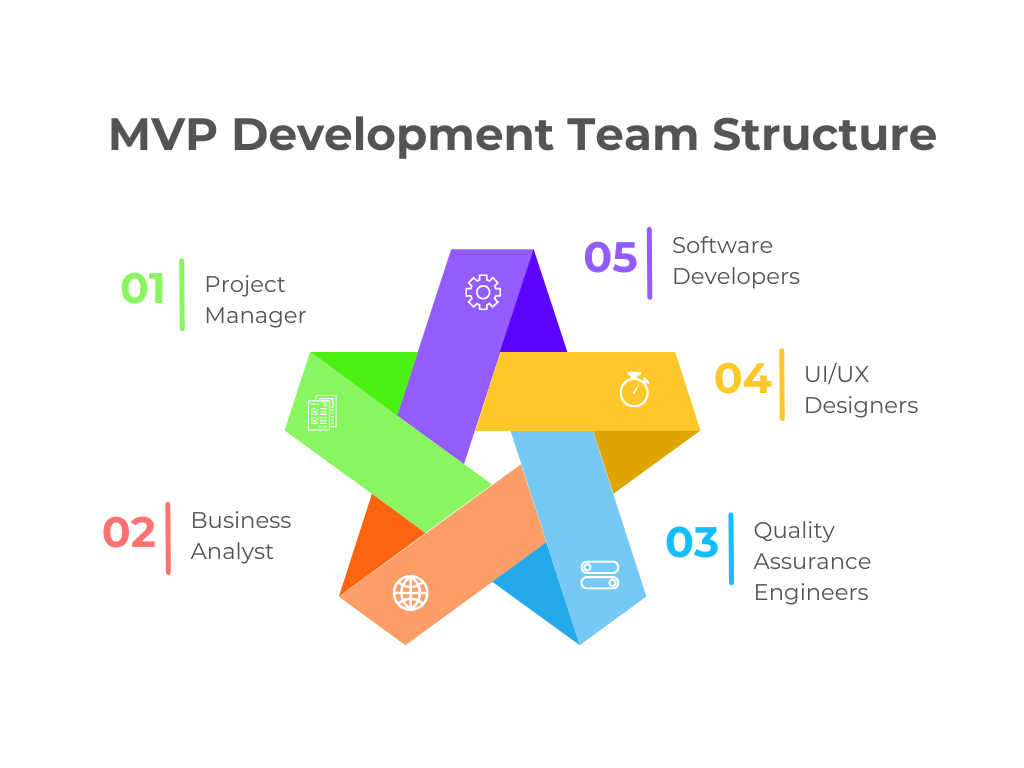
Product Owner / Product Manager
The product owner is responsible for defining the exact vision and goal of the product. They act as a bridge between the development team and stakeholders and help deliver the actual business needs like product features, ultimate goals, and more. This way, the business needs are turned into actionable user stories, which guide the process of software development.
Business Analyst
A business analyst works collaboratively with the product owner and works towards achieving the goals. They help translate the business goals into detailed requirements for the developer or team. It is their responsibility to ensure that every feature added can deliver a measurable business benefit and support the project's success from the outset.
Software Developers
The developers execute the requirements and implement these required features as per the software design structure and architecture. Frontend developers are more focused on user interface and interactions, backend engineers are more focused on managing data and system logic, while a full-stack developer needs to focus on both. They ensure rapid delivery and maintain code quality and continuous integration.
UI/UX Designers
UI/UX designers are responsible for creating an intuitive and smooth user experience. They also have a critical role in MVPs, as once the user visits a platform, the first thing that attracts them is the user interface. Incorporating the right feedback, designers can help the team refine the product, ultimately leading to customer satisfaction.
Quality Assurance Engineers
Quality assurance engineers test the features integrated by the developers and validate if the product actually meets the project requirements. They also have a major role that supports continuous integration and ensures the core features work seamlessly before moving towards release.
Recommended Post: The Power of MVP: Validating Software Early For Success
Agile Software Development Team Structure Explained
Adopting an agile software development structure is vital for both startups and established businesses that want to scale. A robust agile team can clearly define its roles and workflows and follow an iterative approach to deliver value while adapting to changing business needs.
What Makes a Strong Agile Software Development Team Structure
For an agile team to be successful, ensure it can balance the cross-development roles and define responsibilities accordingly. Some of the key principles include:
-
Robust Collaboration: Team members work collaboratively across different functions, like development, the design process, and business analysis.
-
Ownership: Every member of the team has to take responsibility and is accountable for their part in the development process.
-
Iterative Workflows: Agile teams focus on rapid prototyping, continuous integration, and shorter release cycles. It helps them get some time in every sprint so that they can focus on improving their product continuously.
Different Roles in an Agile Team Structure
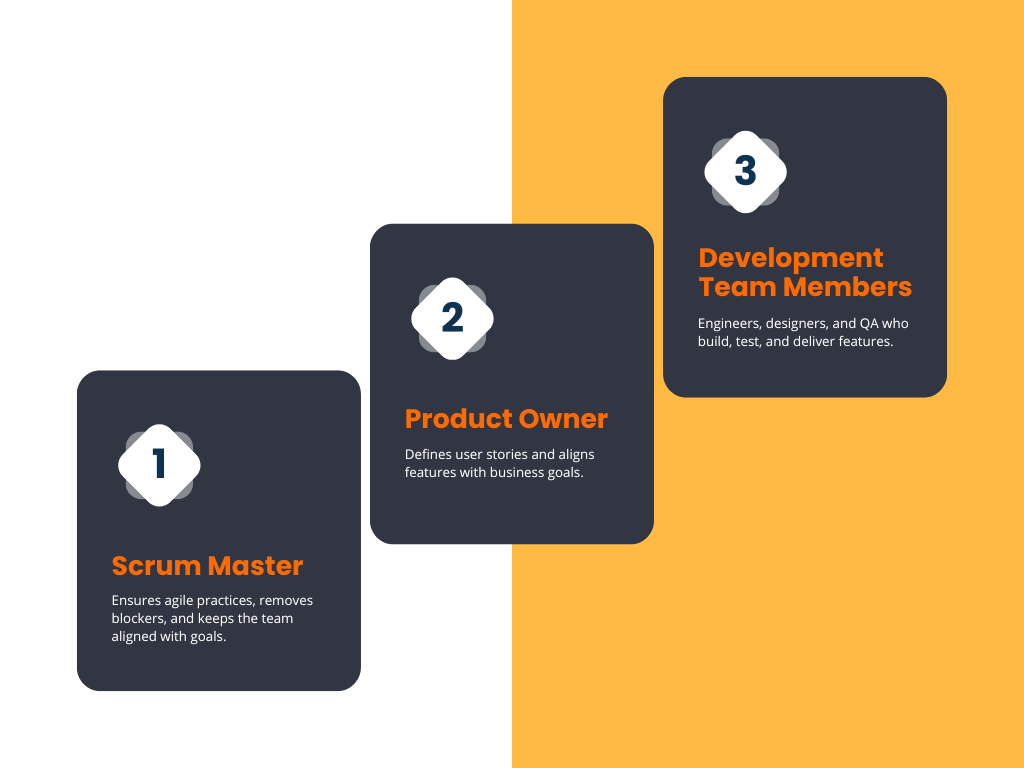
1. Scrum Master: The scrum master is responsible for facilitating the agile process, removing obstructions, and ensuring that the teams follow all the agile practices. Whether you want to coordinate the workflows or support continuous improvement, the scrum master ensures that the teams stay aligned with the goal of the project.
2. Product Owner: The product owner represents the business needs and serves as the critical point of contact for stakeholders. The major focus on user stories defines the project scope and ensures that all the features contribute to the business objectives.
3. Development Team Members: The development team helps build, test, and deliver features. This covers software engineers, UI/UX designers, and QA experts who work collaboratively in a cross-functional environment to ensure continuous delivery and better customer satisfaction.
Benefits of Agile Methodology
-
Continuous Delivery: Agile teams offer features iteratively while reducing the risk and improving time to market.
-
Continuous Improvement: Based on the user feedback, teams can adapt processes. It also helps them improve analytics and team retrospectives.
-
Faster Response to User Stories: Agile allows the team to pivot quickly, ensuring that development aligns with business goals and user needs.
By adopting a well-structured agile software development team, businesses can maintain efficiency, reduce project complexity, and ensure that their MVP or scaled product continuously evolves to meet user expectations.
Transitioning from MVP to a Scalable Team
Once you have validated the core features and begun with the first phase of development, the next phase is scaling the software development team structure. Scaling in the beginning or at any early stage can lead to financial loss as well as resources. Therefore, it is important to understand the right timing and approach for those who aim to grow efficiently. Here is when businesses should scale:
-
Increasing User Activity with Product
As the user base rises, the demand for the team size rises too. With a larger number of users participating, there will be more feedback and more potential bugs. A single MVP team at that time may not be sufficient to handle rising users and their demands. Scaling the team at that very stage ensures continuous integration and agile workflows keep pace with real-world usage.
-
Growing Software Application Complexity
Once your product is at the evolution stage, managing the architecture often becomes a challenging task. From new feature additions to handling different business requirements and more, the complexity rises continuously. The expansion of your software development team structure ensures that all your responsibilities are equally distributed among the team members, such as quality assurance engineers, DevOps teams, and developers.
-
Expanding Business Requirements and Features
With the evolving business requirements, the MVP may need to support user stories, modules, and sophisticated user interfaces. Scaling the teams allows you to bring specialized setup skills that can handle the most complex challenges without overloading the existing team members. It also maintains the project focus and customer satisfaction.
Strategies for MVP Growth in Tech Startups
-
Expanding Team Structure
Begin by identifying the gaps in the current teams and analyzing what needs to be taken care of. You may need to hire software developers, UI/UX developers, or QA experts. Hiring and expanding the cross-functional team ensures the delivery is fast and new features are added with the best quality.
-
Introducing DevOps Engineers
DevOps engineers help automate continuous integration and continuous delivery pipelines. It also reduces deployment inefficiencies, which improves operational efficiency. The involvement becomes important with the growth in complexity and thus requires multiple releases.
-
Boosting Project Management
Scaling teams need better-structured project management, and it is possible by introducing project managers who work on agile practices. This way, communication is streamlined, and the teams stay aligned with the business goals.
-
Handling Tasks without Team Overburden
As the features and products continue to rise, the team may be overburdened with the work. Hiring remote teams, or a hybrid model, can allow businesses to manage multiple projects simultaneously while maintaining the agile team structure.
Types of Development Team Structures
As the product moves beyond the MVP stage, choosing the right team structure is vital for scaling and maintaining business continuity. There are different models that can be adopted, and here are a few of the team structures:
-
Cross-Functional Teams
This is one of the most important and effective structures in the agile environment. The teams have all the critical members, like developers, designers, QA experts, project managers, and more, required to deliver an end-to-end feature.
With this structure, businesses can make better and faster decisions, streamline collaboration, and ensure continuous delivery. There are not many dependencies, so it can be used by startups and organizations that want to maintain speed while scaling their software development team.
-
Hybrid Teams
Hybrid teams combine in-house talent with remote and offshore teams while offering them flexibility and scalability. The model allows businesses to expand their software development team structure without overhauling the hiring process.
Hybrid processes are beneficial for handling different projects, assessing skill sets, and maintaining cost efficiency.
-
Traditional Hierarchical Structure
The model allows for managing the complex tasks and ensures accountability. It also supports structured project management when there are different teams involved.
-
Epilogue
Structuring the software development team in the right way allows businesses to move from MVP to scale, and it is important for the project to succeed and achieve long-term business goals. With a combination of perfect software design structure, a lean MVP agile development approach, and more teams, they can add on the key features, get user feedback, and continue to grow.
Want to accelerate your product development and scale your team efficiently? It is time to partner with Your Team in India, a perfect software development team that helps you grow and deliver value from MVP to full-scale applications.
Frequently Asked Questions

Prioritizing features requires balancing business objectives, user feedback, and the project scope. Focus on core features that deliver maximum value early, and use agile methodologies to iterate based on actual user interactions. This ensures your MVP agile development remains efficient and aligned with business goals.
Non-functional requirements, like performance, security, and scalability, impact architecture decisions early on. Planning for these in your software design structure ensures your MVP can evolve into a full-scale product without major rework or technical debt.
Small teams can manage multiple initiatives by adopting cross-functional or hybrid team structures, clearly defining roles and responsibilities, and leveraging DevOps practices for automation. This maintains project focus, continuous delivery, and ensures quality while scaling the development lifecycle.
Specialized MVP growth consultants can help define software development team structure, streamline development processes, and implement perfect agile team structures that scale efficiently. Look for consultants or agencies with experience in rapid prototyping, continuous integration, and scaling cross-functional teams for startups.








 4.8 out of 5 by