Flutter now handles production apps across iOS, Android, web, and desktop from a single codebase, and it's become a shortlist option for most teams doing cross-platform work in 2026. A lot of that comes down to the ecosystem around it. Flutter development libraries, tools, and plugins take care of the repetitive setup work, which leaves more room for developers to work on the logic that's actually specific to their app.
The framework's architecture has also matured. Where earlier Flutter projects leaned heavily on packages like Provider or ScopedModel for state management, most teams building serious applications in 2026 have shifted toward more structured, compile-safe options. The tooling around Flutter has changed too, with AI-assisted development tools now able to read a live widget tree and help debug or modify an app in real time.
This guide covers the Flutter packages for app development, libraries, and plugins that are worth knowing today, along with the tools that make the development process faster. Whether you're picking a state management approach for a new project or evaluating Flutter development services for an existing app, this should give you a practical starting point.
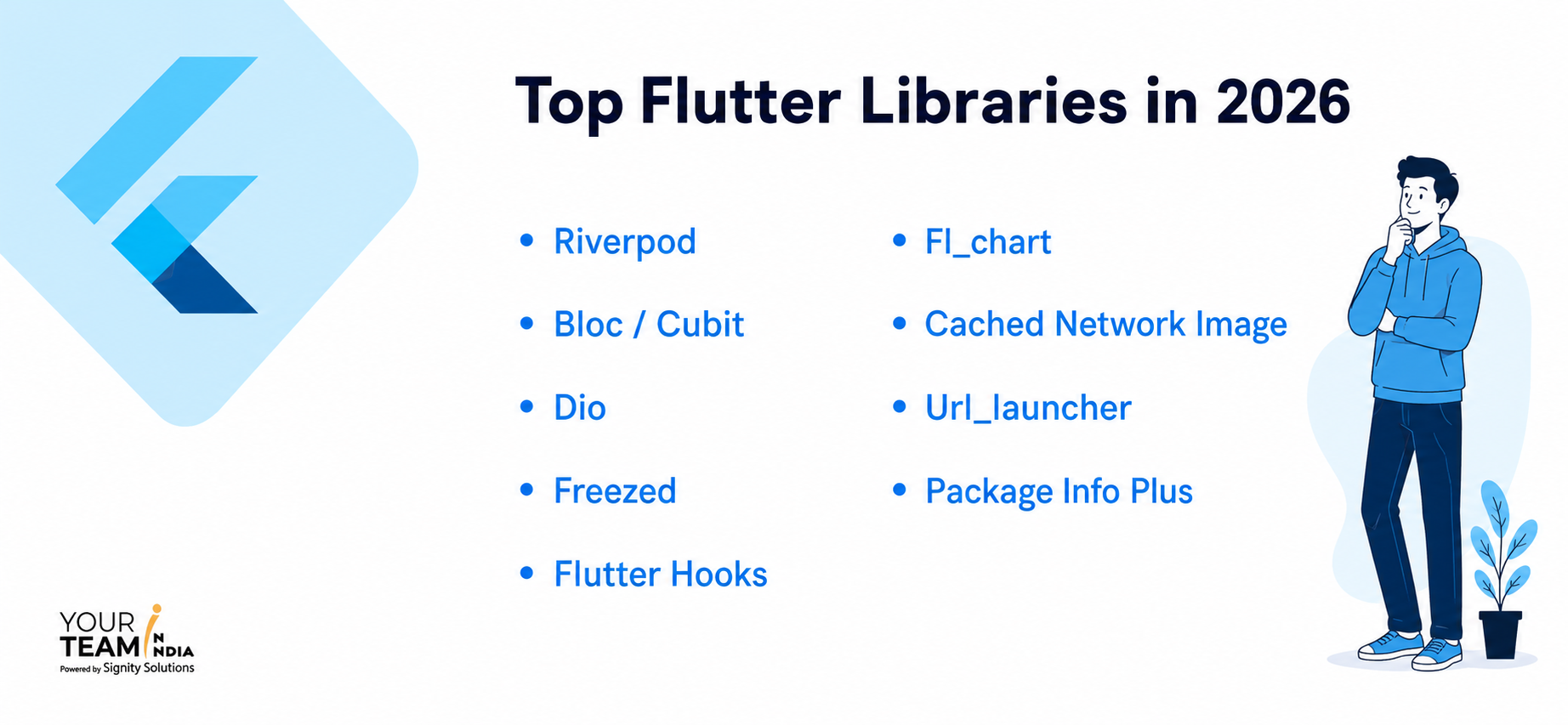
Top Flutter Libraries in 2026
1. Riverpod
Riverpod has taken over as the default pick among Flutter development libraries for state management. It doesn't rely on BuildContext, catches provider errors before the app even runs, and holds up well in large codebases where testing matters. Most teams starting new projects in 2026 reach for Riverpod before anything else.
2. Bloc / Cubit
Bloc holds up on projects that need strict, event-driven state changes with a traceable flow. Cubit is the lighter version, useful when a project doesn't need the full event layer that Bloc brings.
3. Dio
Dio remains the standard HTTP client for Flutter. FormData handling, file uploads, timeouts, and interceptors are all built in, which covers most of what a real-world app needs when talking to an API.
4. Freezed
Freezed writes the boilerplate for you, generating copyWith methods, equality checks, and JSON handling for data models. On any app with a decent number of models, this saves real time.
5. Flutter Hooks
Hooks cut down on the StatefulWidget boilerplate needed to manage a widget's lifecycle. Logic that used to live in a stateful class can now sit in a hook and get reused across widgets directly.
6. Fl_chart
Flutter still doesn't ship an official charting library, so fl_chart remains the go-to for pie charts, bar charts, and other visual data. This one hasn't changed much since 2023.
7. Cached Network Image
Fetches images from the web and caches them locally, with support for placeholder and error widgets while content loads. Still a reliable pick for apps that pull in remote media.
8. Url_launcher
Url_launcher opens URLs, emails, and SMS actions from inside a Flutter app on iOS and Android. It hasn't needed much updating since 2023 because the use case hasn't changed.
9. Package Info Plus
The original package_info library is discontinued. Package_info_plus replaced it and does the same job, pulling app version and build number at runtime:
import 'package:package_info_plus/package_info_plus.dart';
PackageInfo packageInfo = await PackageInfo.fromPlatform();
String appName = packageInfo.appName;
String packageName = packageInfo.packageName;
String version = packageInfo.version;
String buildNumber = packageInfo.buildNumber;
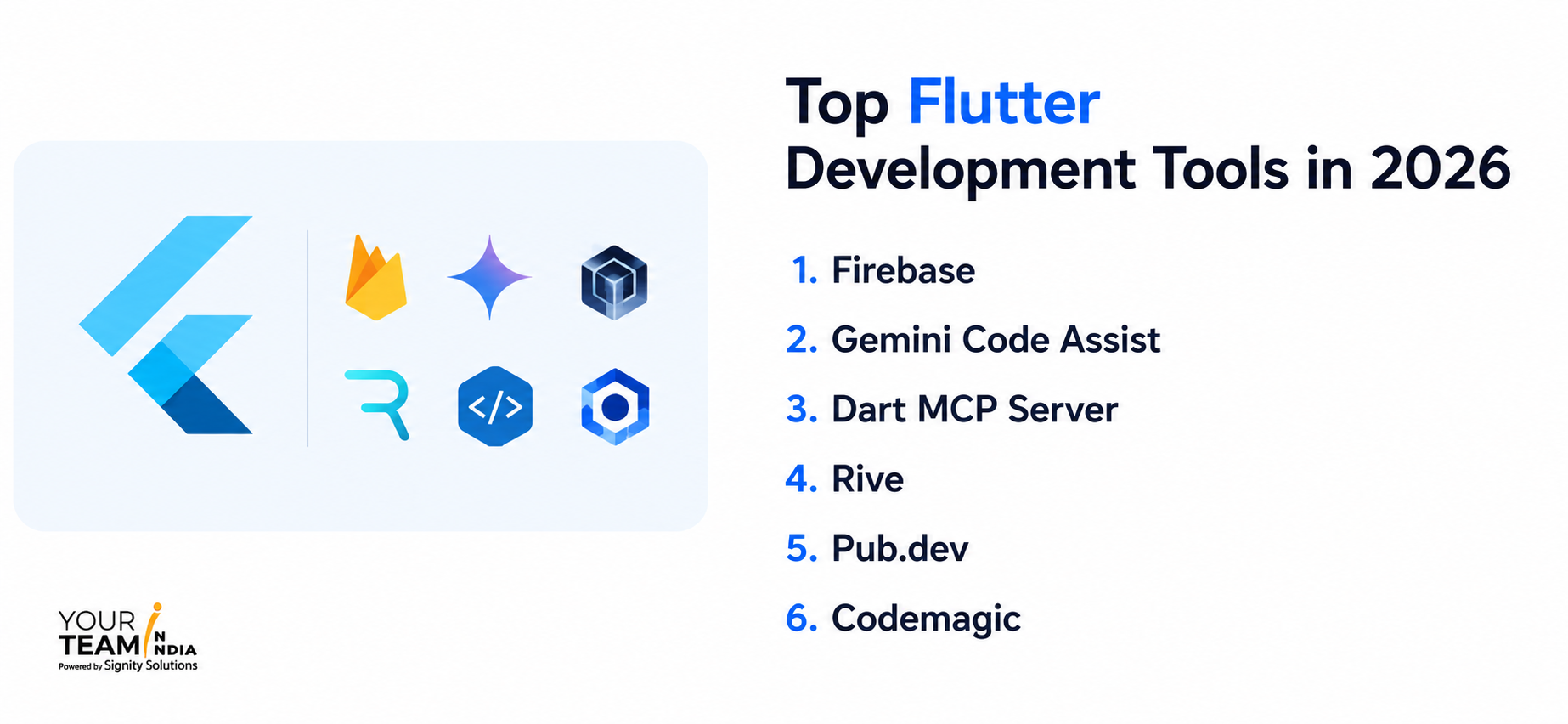
Top Flutter Development Tools in 2026
1. Firebase
Firebase handles most of the backend side of a Flutter app. Analytics, crash reporting, authentication, cloud storage- it's all there in one SDK, and you can usually get it running in a Flutter project within an afternoon.
2. Gemini Code Assist
Gemini Code Assist connects to a live widget tree through MCP servers, so it can see what's happening in your app rather than guessing from a code snippet. Developers use it inside Android Studio or VS Code to catch bugs, get fix suggestions, and push hot-reload changes without leaving the editor.
3. Dart MCP Server
The Dart team now ships its own MCP server, so AI coding agents can work directly inside a Flutter project instead of reading isolated code snippets out of context. Pair that with Genkit for building AI features into the app itself, and a good chunk of day-to-day Flutter work now runs through some kind of AI assistant.
4. Rive
Rive is used for interactive vector animation and UI, things like animated icons or character rigs that respond to touch or movement in real time. It moved to a native runtime this year, which improved performance over the older approach.
5. Pub.dev
Every package mentioned in this guide- Riverpod, Dio, Freezed- comes from here. Pub.dev is the official Dart and Flutter package repository, and it's where you'd check a package's popularity, maintenance status, and version history before adding it to a project.
6. Codemagic
Codemagic runs CI/CD built specifically around Flutter. Build, test, deploy across mobile, web, and desktop targets, without stitching together a custom pipeline by hand.
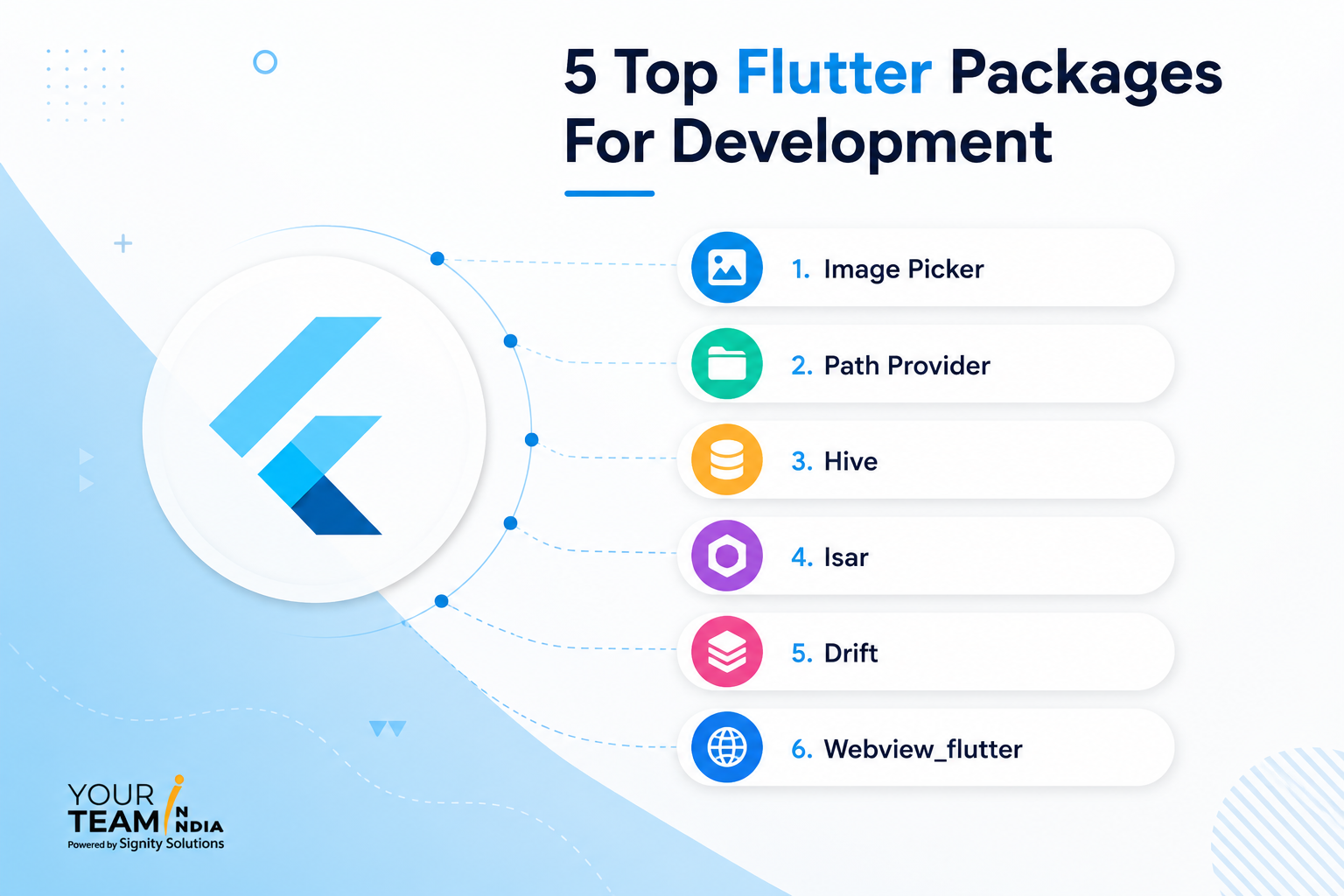
5 Top Flutter Packages For Development
1. Image Picker
Image Picker pulls photos from the camera or photo library on iOS and Android. It's one of those packages nearly every Flutter app ends up using at some point, and the API has barely changed in years.
2. Path Provider
Used to locate the correct file system paths for storing app data on iOS and Android. Any package that needs to read or write local files, including Hive and Isar below, depends on this one under the hood.
3. Hive
Hive is a key-value database written entirely in Dart. There's nothing native to set up, which makes it a fast option to reach for smaller projects that just need local caching without a full database.
4. Isar
A NoSQL database built for speed, with query performance that holds up even as local datasets grow. Isar has become a common choice for apps that need more structure than Hive but don't want to write raw SQL.
5. Drift
Drift wraps a real SQLite engine and adds Dart type safety on top, so a bad query gets caught at compile time instead of crashing the app later. SQLite still runs plenty of existing projects, but Drift is where most new ones start now.
6. Webview_flutter
Still the package to reach for when a Flutter app needs to embed native web content. The API has stayed fairly stable, and it remains actively maintained by the Flutter team itself.
Top Flutter Plugins for App Development in 2026
Here are the best flutter plugins in 2026 actually worth adding to a Flutter project this year.

1. Camera
Photo capture, video recording, live preview feeds, the official Camera plugin covers the basics most apps need. Since the Flutter team maintains it directly, it's worth trying before reaching for something third-party.
2. Geolocator
If an app needs GPS, this is where it usually starts. Current location, continuous tracking, geocoding both ways. Delivery apps and navigation tools are typically built right on top of it.
3. Google_maps_flutter
This plugin embeds an actual Google Maps view into a Flutter app, markers, overlays, route plotting included. On its own it just shows a map. Paired with Geolocator, it can track and display where a user actually is in real time.
4. Connectivity_plus
Online, offline, wifi or mobile data, Connectivity_plus reports which one applies right now. Useful for apps that need to pause an action, queue it, or just let the user know their connection dropped.
5. Local_auth
Face ID, fingerprint unlock, whatever biometric option a device already has built in, Local_auth taps into it directly. At this point, most apps handling payments or sensitive data treat this as a requirement rather than a nice-to-have.
6. Flutter_local_notifications
No backend push service required here. This plugin schedules and fires local notifications on its own, which is why reminder apps and anything with a time-based alert reach for it so often.
7. Permission_handler
Camera access, location, storage, normally each of these needs separate handling on iOS versus Android. Permission_handler wraps all of it into one API instead.
8. Share_plus
One line of code opens the native share sheet. After that, the user picks where the content goes, text, a link, a file, whatever app they already have installed.
9. Flutter_background_geolocation
Geolocator stops tracking the second an app moves to the background. This plugin doesn't. It's built to keep recording location in the background, which is why logistics and delivery apps rely on it specifically.
Conclusion
Flutter's ecosystem has moved a long way past where it was even a couple of years ago. State management mostly runs through Riverpod or Bloc now. AI-assisted tools like Gemini Code Assist and the Dart MCP server have found their way into daily workflows too, and local data handling looks different since Drift and Isar showed up. Picking the right combination of libraries, tools, packages, and plugins still comes down to what a specific project actually needs, but starting from an updated list beats working off assumptions from a few years back.
If you're building a Flutter app and want a team that already works with this stack day to day, YTII's Flutter developers can help you figure out the right setup for your project and take it from there.
Frequently Asked Questions

Say you're building a login screen and need to hit an API. You could write all the networking code yourself, handling errors, retries, timeouts, all of it. Or you could grab a library like Dio and skip straight to the part that's actually specific to your app. That's what Flutter libraries are, code someone else already wrote and tested, sitting on pub.dev, ready to plug in. Most people just call them packages.
Framework. There's a real difference. A library gives you a tool for one job. A framework gives you the whole structure, how the app renders, how it's organized, how it ships to iOS, Android, web, wherever. Flutter is the second one. Everything else in this guide, the libraries, the packages, the plugins, all of it plugs into Flutter. Flutter doesn't plug into anything.
Depends on whether the code needs to touch the actual device. The package is just Dart, so it runs the same everywhere, no surprises between iOS and Android. A plugin has to reach past Dart into native code, Kotlin on Android, Swift on iOS, because it's doing something Dart alone can't, like turning on a camera or reading GPS. Same install process for both, flutter pub add, but only one of them is talking to actual hardware underneath.
Technically no, most of these libraries and plugins are well documented enough for a solo developer to pick up. In practice, picking the right combination for a specific project, and avoiding the ones that'll cause problems down the line, is where experience matters. That's usually the gap Flutter development services end up filling for teams that want to move fast without re-learning the ecosystem from scratch.

By Mangesh Gothankar


By Ashwani Sharma
By Achin Verma






 4.8 out of 5 by