Statistics show that 92% of G2000 businesses outsource their IT operations, whereas 37% of small businesses outsource at least one business process. In many cases, an offshore company acts as an external provider of dedicated teams or services from another country.
And why not?
Offshore teams are not just a solution; they are a strategic advantage. They counter the challenges of the increasing tech talent shortage, market uncertainties, and shrinking economies. It's crucial to understand the distinction between an offshore team and an outsourced team.
An outsourced team is typically contracted through a third-party organization for specific projects and may include offshore team members as part of the outsourcing process. But an offshore team, when managed effectively, can provide a competitive advantage, such as faster delivery times and cost efficiency.
Although working with offshore development teams has many benefits, managing the offshore team brings its own set of challenges. Challenges like time-zone gaps, communication breakdowns, and cultural differences can impact productivity if not handled correctly. That’s why having the right offshore communication strategies and proven offshore team management tips is critical.
By following some simple tips for managing offshore development teams, you can transform offshore development services into exciting opportunities for collaboration and innovation.
In this blog, we’ll provide some practical tips that will help you manage your offshore development teams effectively. Let’s dive in.
But before we discuss the best practices for managing offshore resources, let us explore why businesses shy away from working with offshore teams.
13 Best Practices To Manage Offshore Team
To successfully manage an offshore team, businesses need more than just technical expertise; they need a structured approach to collaboration, communication, and performance.
In today’s remote-first world, remote development team management requires aligning people, processes, and tools across time zones. When done right, managing distributed teams can significantly improve delivery speed, scalability, and overall efficiency.
Below are 13 proven offshore team management tips to help you streamline operations, improve communication, and maximize productivity.
1. Communicate your vision from top to bottom
The decision to offshore software development, although made by top management, impacts everyone in your company. So it is essential to ensure that not just the leaders or seniors agree, but the lower hierarchy must also be fully dedicated to the task. When working with remote teams, it is especially important to establish a shared vision and maintain effective communication to ensure alignment on goals and successful collaboration.
To get everyone on board, please clearly communicate.
-
Why have you decided to offshore?
-
What impact in terms of growth and business opportunities will this bring to the company?
-
How will it not affect the jobs of the current employees?
-
What do you expect out of this offshoring decision to ensure everyone is on the same page?
Educating in-house resources on how offshore teams can enhance their work environment. From keeping the team motivated to reducing their workloads, seamless communication empowers them to perform better. Besides, it aids the development process, ensuring smooth operations in the future.
2. Build Cultural Alignment & Trust Early
When managing distributed teams, cultural alignment is just as important as technical alignment. If not addressed in a timely manner, the differences in work styles, communication norms, and time zones can lead to misunderstandings. Therefore, it becomes necessary to work on cultural alignment and trust amongst the offshore and in-house teams from the very beginning.
One of the easiest ways to pursue this is by encouraging open conversations where both in-house and offshore members exchange their working methods. Organizations can create opportunities for informal interactions, such as virtual coffee sessions, to foster personal connections beyond project work.
Wondering What The Team-as-a-service Model Is?
Recommended Read: Why Should You Choose a Team as a Service Model for Your Business?
Additionally, establish shared values and ground rules that both teams follow. Whether it’s response times, meeting etiquette, or decision-making practices, taking some intentional steps can help create a sense of unity.
3. Define Clear Scope & Objectives
Before starting a conversation with an offshore partner, it's essential to understand your objective and vision for your offshore team clearly. As a business, to effectively manage offshore teams, you must have clarity on:
-
What kind of engagement would you like to create?
-
Do you think this is a one-time arrangement, or do you intend to incorporate offshoring into your business model?
-
Have you created an outline and scope of the project?
-
What are your long-term goals with the team?
-
Have you been able to set up a clear development process to ensure organized collaboration and effective workflow management?
These are some of the questions you must have answers to before deciding to hire an offshore team.
4. Establishing clear expectations
One of the most important offshore team management tips is setting expectations early. Without clear direction, the team will operate mindlessly, merely following orders, which undermines the purpose of bringing experts on board. Having a dedicated team is essential to ensure effective collaboration and project success.
Here are some tips on how to do so:
-
Communicate goals and objectives: Ensure you and your offshore team are aligned on the project's goals and objectives, with no communication barriers. They should understand the project's purpose and the desired outcome.
-
Define roles and responsibilities: Each team member should know their roles and responsibilities. This can include outlining the tasks each team member is responsible for and the deadlines they are expected to meet.
-
Set deadlines and milestones: Split the project into multiple mini milestones and establish deadlines to ensure the team stays on track and meets its goals on time.
5. Set Up A Standard Communication Channel
Communication is the backbone of remote development team management. To avoid delays and confusion, set up structured communication systems using tools like Slack, Microsoft Teams, or Zoom.
Having clear communication channels have the following benefits:
-
Proper documentation of all of all discussions carried out between teams.
-
Ensures that no information falls through the gaps
-
Ensures both in-house and offshore teams are on the same page
-
Creates a backup for team members to refer to, which empowers teams to work more efficiently
-
Enhances team collaboration by facilitating regular meetings, open communication, and building trust among team members.
Besides defining the channels and modes of communication, it is also a good practice to train teams to communicate efficiently to optimize the time spent collaborating.
Do you have any tips on communicating with offshore teams? Please read our blog on 13 Tips to Streamline Communication With Offshore Team.
6. SOPs & Documentation Process
Multiple people work on different aspects of a project. With team members being constantly switched and multiple reviewers sharing inputs, it’s no surprise that the code gets swampy, increasing the “Technical Debt” of your project.
When managing distributed teams, poor documentation leads to confusion, delays, and increased technical debt.
To ensure smooth offshore team management, establish clear SOPs and structured documentation that guide your team across processes, code standards, and workflows.
Why it matters:
-
Reduces rework and technical debt
-
Improves offshore productivity
-
Enables faster onboarding
-
Supports async collaboration in remote development team management
In 2026, strong documentation isn’t optional, it’s essential for scaling and efficiently managing offshore teams.
7. Set Tools & Systems in Place
Equipping your offshore team with the right technology and collaboration tools is crucial to ensure seamless collaboration and help them significantly enhance their effectiveness and productivity.
Providing the right tools is essential to the success of an offshore software development team, as they enable it to overcome challenges and work efficiently across different locations.
For companies managing large, distributed teams, structured offshore models, such as build-operate-transfer engagements, can also help streamline infrastructure setup, team onboarding, and operational processes.
These tools can be broadly classified into two categories.
-
Communication Tools: Communication tools refer to the set of equipment, software, and technologies that enable your teams to communicate and collaborate seamlessly over digital platforms. Having these tools ensures team communication, promoting better coordination and faster problem-solving.
-
Project Management Tools: Project management tools are software applications that assist your project managers in planning, organizing, and managing the project assigned to the offshore team.
These tools help streamline workflows, reduce delays, and support remote development team management across time zones.
4 Effective Tools to Manage an Offshore Team
-
Slack: A cloud-based online messaging platform, Slack, enables team members to communicate with each other in real-time. It provides various features such as direct messaging, group chat, file sharing, and integration with other widely-used tools.
-
Zoom: Zoom is a platform for video conferencing where team members can have face-to-face conversations. It provides many features, including HD video, audio, and screen sharing.
-
Microsoft Teams: Microsoft Teams is a platform for collaboration that offers tools for chat, video conferencing, file sharing, and project management. It is a widely used solution adopted by businesses that utilize Microsoft Office 365 to keep connected over varying time zones.
-
Trello: Trello is a widely used project management tool with boards, lists, and cards to monitor tasks. It is an excellent option for businesses that need to track the progress of various projects.
|
Category |
Tools |
Purpose |
|
Communication |
Slack, Microsoft Teams |
Enables real-time messaging, file sharing, and collaboration across distributed teams |
|
Video Collaboration |
Zoom |
Helps offshore and onshore teams conduct face-to-face discussions and sprint meetings |
|
Project Management |
Trello, Jira |
Tracks tasks, development progress, and sprint deliverables |
|
Documentation |
Confluence, Notion |
Stores technical documentation and development guidelines |
Using these tools is essential for successful offshore team management, as they help coordinate tasks and communication across different time zones.
Remember, there is no right answer to which tool is best for project management. It completely depends on the team size and the complexity of the project.
So, you must evaluate all pros and cons before selecting one.
8. Hire The Right Leadership
Do you want to know how to manage offshore development teams with different cultural backgrounds? Hiring the right leaders is the answer you're looking for. Strong leadership is key to successful offshore team management.
Onboarding individuals with strong leadership qualities into your offshore team goes a long way in pursuing quality control. It enables the management of operational costs while fostering harmony among a diverse talent pool.
These leaders become the face of your organization among the offshore team. They help build a bridge between in-house and offshore teams, creating frictionless interactions to ensure enhanced productivity.
9. Continuous Training & Downloads
Want your offshore team and in-house team to work in perfect sync? -Train them!
Want to bridge the cultural gap between teams?- Train Them!
Want your offshore software development to be successful?- TRAIN THEM!
Investing in continuous training is essential for successful offshore software development and long-term offshore team management.
Training helps in the following ways.
-
It clearly explains a company's business, clients, operations, and other essential aspects.
-
It helps resources identify knowledge gaps and upskill accordingly.
-
It helps smooth the transition and handover of the work.
-
It supports professional development and career growth for offshore staff through remote training, certification programs, and regular evaluations.
10. Create Overlapping Work Windows
Time zone differences are a common challenge in remote development team management. Challenges of managing offshore teams involve tasks like coordinating across distances, requiring greater flexibility in communication, and allowing team members to collaborate. The time zone difference in offshore teams can create management issues if not tackled well.
Although it is impractical to expect your offshore team to be available 24/7, a smart approach is to create overlapping work windows occasionally for team scrums, discussions, and feedback.
Besides this, ensure you inform the team beforehand of meetings and deadlines set in your time zone. Be mindful of how and when you can reach out to them, both during and outside their work hours.
Learn the seven tips to handle time-zone differences when working with an offshore team.
11. Constant Communication & Regular Updates
When offshoring, could you make it a rule not to allocate a task and vanish for a long time before checking on it again?
Strong offshore communication strategies are key to project success. You should hold regular meetings daily in the initial phase to ensure the teams are on the same page as you. It may sound daunting and time-consuming initially, but who knows if things will skyrocket in the right direction.
Lack of regular interaction with offshore teams can lead to negligent behavior. Your team may gradually lose motivation and excitement because they believe that you are unconcerned with the team’s growth. Regular communication is especially important to keep remote team members engaged and accountable.
12. Keep An Eye on it, But Don’t micromanage
It is most important to understand that effective offshore team management requires balance.
When you hire an offshore software development team, you are onboarding experts with extensive experience and vast knowledge in their fields.
Micromanaging them will only create frustration and loss of trust among your offshore developers. This will result in a loss of enthusiasm and productivity. The team may feel that their ideas are not welcome and would refrain from sharing suggestions to improve your product.
Still, a better approach is to designate a senior developer as a tech lead or hire a project manager with proven team handling and management techniques to produce successful outcomes. These strategies help you effectively manage offshore teams by promoting communication and teamwork without the need for micromanagement.
13. Acknowledge Their Contributions
When you hire software developers in an offshore setting, showing appreciation for your offshore team is crucial to building relationships.
Appreciating their efforts shows that you value their contributions and hard work. It motivates them to put their best foot forward when working on your project.
It also enhances productivity and improves team retention while preserving good team camaraderie.
Ways to show appreciation to your offshore teams
-
Appreciate achievements publicly
-
Offer incentives and growth opportunities
-
Encourage learning and skill development
-
Promote high performers
Following the above tips, you can be sure to make your offshore software development project a success.
However, following best practices for managing offshore resources is the second step, the first being to find a reliable offshore development company like Your Team in India.
Key Metrics to Track Offshore Team Performance
Companies that excel at managing offshore development teams track performance through measurable indicators such as:
-
sprint velocity and delivery timelines
-
code quality and bug resolution rate
-
developer productivity metrics
-
feature release frequency
Tracking these metrics helps businesses improve offshore team management while ensuring that development goals and product timelines remain aligned.
What Is Offshore Team Management?
Offshore team management is the process of managing remote teams located in another country. It involves coordinating communication, aligning business goals, tracking performance, and ensuring seamless collaboration between onshore and offshore teams.
For businesses relying on offshore software development, effective management is critical to maintaining productivity, meeting deadlines, and ensuring code quality. With the right tools, structure, and leadership, offshore teams can become a strong competitive advantage.
Why Companies Build Offshore Teams?
Many companies build offshore teams to address talent shortages and accelerate software development. Offshore collaboration enables businesses to access highly skilled developers while maintaining operational flexibility.
Key advantages include:
-
Access to global talent pools: Businesses can hire experienced developers beyond local markets.
-
Faster product development: Distributed teams allow work to continue across time zones.
-
Cost optimization: Companies reduce infrastructure and hiring costs.
-
Scalability: Businesses can quickly expand development capacity when projects grow.
Why do Companies fear Offshore Software Development?
Miscommunication, mismanagement, and security concerns are among the primary reasons businesses avoid working with offshore development teams.
It's important to note the distinction between an offshore team and a distributed team: a distributed team includes employees working in various locations globally. In contrast, offshore teams are based in another country. Below are some of the businesses’ most common apprehensions about managing offshore development teams.
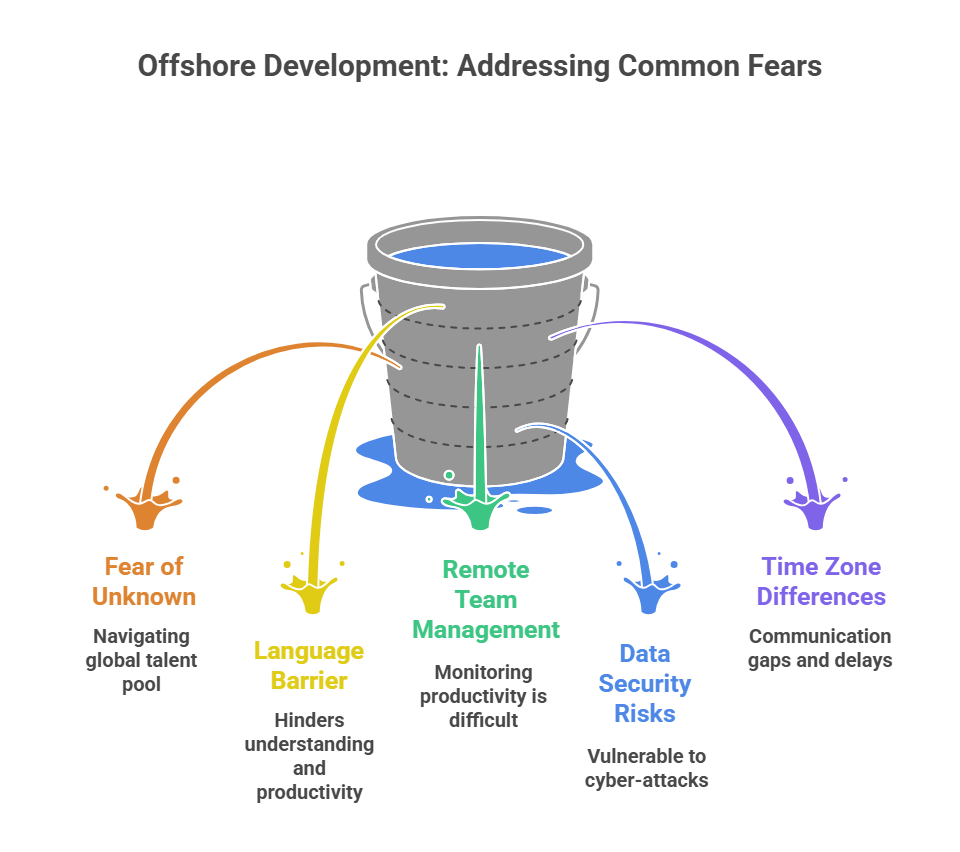
1. The Fear Of The Unknown
Lack of experience with global hiring creates uncertainty in building and managing offshore teams effectively.
2. Communication & Cultural Barriers
Language differences and cultural gaps can lead to misunderstandings, delays, and reduced productivity without proper offshore communication strategies.
3. Lack of Visibility
Businesses worry about tracking performance and productivity when teams work remotely.
4. Data Security Risks
Concerns around data protection and system access often make companies hesitant about offshore collaboration.
5. Time Zone Differences
Managing teams across time zones can lead to coordination challenges and slower decision-making.
But let me assure you that, though valid, you can easily tackle these challenges with the right offshore partner by following certain best practices to hire offshore teams.
Common Mistakes in Offshore Team Management
While many organizations successfully manage distributed development teams, certain mistakes can hinder productivity and collaboration.
Some common challenges when managing offshore teams include:
-
Unclear communication structures: Without defined channels, important updates may be missed.
-
Lack of proper documentation: Teams struggle to understand processes without clear SOPs.
-
Ignoring time-zone overlap: Limited interaction can slow decision-making.
-
Micromanaging developers: Excessive monitoring reduces productivity and trust.
-
Weak onboarding processes: New offshore developers need clear guidance and training.
Avoiding these mistakes significantly improves offshore team management and helps organizations build stronger distributed teams.
How to Build an Offshore Team in India?
Depending on long-term goals, businesses may choose to hire remote developers, establish a dedicated development team, or build a full offshore development center to support continuous product development.
Companies looking to expand their development capabilities often choose to build an offshore team in India because of the country’s strong technology ecosystem and experienced developer community.
Here are the key steps to set up an offshore team in India successfully:
-
Define project requirements: Identify technical skills, team size, and development goals.
-
Choose an engagement model: Businesses can work with dedicated teams, offshore development centers, or staff augmentation models.
-
Select the right offshore partner: A reliable partner helps you recruit, onboard, and manage developers effectively.
-
Establish communication processes: Define collaboration tools, reporting structure, and sprint planning frameworks.
-
Create onboarding and development workflows: Standardized processes ensure smooth integration between offshore and in-house teams.
By following these steps, businesses can efficiently build offshore teams that deliver high-quality software while maintaining operational efficiency.
How can we help in building a successful Offshore Team?
Your Team in India is one of the most trusted offshore development companies that can help you build your offshore team in India. We provide a dedicated team or an outsourced team tailored to your specific project requirements, ensuring effective collaboration and high-quality results.
One successful example of this offshore collaboration is ‘GoHire ’, an ATS(applicant tracking system). GoHire partnered with Your Team in India to scale their team quickly and economically. With our expertise, they built a team of 2 software developers, 1 HubSpot Migration Expert, and three digital media experts.
Companies worldwide trust us to offshore their software development projects. In the past decade, we have delivered over 1000 projects and have an over 90% client retention rate.
If you, too, seek a guide to hire offshore developers? Could you talk to our experts today?
Frequently Asked Questions (FAQs)

An offshore team is a team of remote developers hired from an offshore country to work on their development projects. These experts are hired from offshore partners who help businesses navigate the challenges and find the right resources to power their projects. Companies usually offshore their projects to leverage benefits like access to a large pool of talent at lower costs, no hiring and infrastructure costs, and flexibility to scale teams on demand.
Offshore teams are hired from offshore countries that offer large talent pools of skilled resources at a lower price. The main reason businesses offshore their projects is to reduce operational costs. Onshore teams are hired from within the same geography/continent where the business operates. It does not provide significant cost benefits to the company but offers resources in the same time zone, enabling easy operations coordination. Maintaining a local team is important for focusing on core business activities, such as sales and marketing, while offshore teams can handle non-core tasks.
Managing an offshore team is challenging because you work with developers from different countries. There are usually challenges in communication due to other languages and cultural practices, which can create misunderstandings and delays. Besides this, your offshore teams work in different time zones, making coordination of work difficult and resulting in missed deadlines.
It's important to note that an outsourced team may include offshore team members, but is typically contracted through a third-party organization for specific projects.
You can establish effective communication with an offshore team by:
Creating standard communication channels
Setting up required tools and technology to enable seamless collaboration
Ensuring that your offshore team understands the project goals, timeline, and deliverables.
Besides this, one must connect with the team through team building activities while regularly working on updates and feedback.
While offshore teams are based in another country, a distributed team may include members working from multiple global locations.
Businesses can overcome the time zone difference by managing an offshore team effectively. It may need adopting agile project development methodologies and establishing overlapping work windows across different time zones. Besides, engaging with a remote offshore team should aim at utilizing appropriate management tools, and holding regular project scrum calls to ensure the team stays on track with deadlines and deliveries.
Cultural differences can impact offshore team management in many ways. It can create communication barriers amongst team members due to differences in language and work ethics, leading to delays in decision-making and deliveries. Thus, developing soft skills is essential to improve collaboration with the global talent pool and understanding within culturally diverse teams.
To ensure quality work from offshore teams, companies must understand:
-
Project scope and delivery deadlines
-
Establish communication channels and project management tools
-
Define KPIs for each team member
-
Conduct regular meetings to ensure the development timelines are met.
Additionally, having a well-defined development process and hiring the right offshore development company is crucial for maintaining quality and ensuring that all team members follow organized procedures throughout the project.
For a successful offshore team setup, businesses must establish a comprehensive team onboarding and project download process amongst offshore and onshore teams.
Integrating offshore staff into business processes during onboarding is crucial for a smooth transition and successful offshore team collaboration. This will help facilitate a seamless transition and ensures successful execution.








 4.8 out of 5 by