As the business paradigm continues to shift towards more digitalization, businesses face dual challenges. One is the rising demand for skilled developers, and the other is the increasing development cost in-house.
And this is where offshore development centers (ODCs) steps it. It not only allows businesses to hire talent globally but also acts as a strategic growth driver for the development companies.
And some numbers tell these stories. The global offshore software development market was valued at around $178.32 billion in 2025 and is expected to reach $347.99 billion in 2030, at a CAGR of 14.2%. Also, it allows development companies to save on costs, along with fast hiring cycles.
Well, it is not only about the financial shift offshore is helping with, but there is also an operational shift.
More small-scale businesses and startups are now relying on the offshore setups to boost their development cycle, tap into the global pool of talent, and scale as per the need in the highly competitive market.
Which was once seen as a simple outsourcing model, has now evolved into a powerful offshore development center setup, where dedicated teams work as an extension of in-house teams.
Want to know more about offshore development, what exactly it is, how it works, and how it helps you successfully build and scale your business.
What is an Offshore Development Center (ODC)?
An offshore development center is a setup in a different country where a dedicated team of experts, like developers, engineers, IT professionals, quality assurance experts, DevOps engineers, and others, work exclusively on your project. They work as an extension of the in-house team and basically operate as a remote development unit.
It allows businesses to have full control over their teams, processes, and workflows, leveraging the benefits of global talent and cost efficiency.
Setting up an ODC has become one of the most strategic approaches to building high-performing tech teams.
1.1 Key Components of an Offshore Development Center
Setting up an offshore development center is far beyond hiring remote developers. There should be a well-defined structure, infrastructure, and more that align with the business goals. Let us discuss the key components of a high-performing ODC:
1. Infrastructure
There should be a robust infrastructure setup that ensures smooth operations. From ensuring the infrastructure has secure networks to cloud environments and deployment-ready systems, everything must be taken care of. Modern infrastructure now relies on cloud infrastructure that allows for real-time access and quick deployment cycles. With proper and secure infrastructure, productivity rises, and there is reduced downtime.
2. Talent & Team Structure
The success of an ODC depends on how well the team is structured, how experienced they are, and how well they can align with your business goals. If the team structure is defined appropriately, it ensures that everyone can understand their roles and responsibilities. This reduces the chaos and confusion and improves the overall project efficiency. Ensure the structure is flexible enough so that it can scale as per the project's needs.
3. Communication Framework
Effective communication is necessary to ensure the success of an offshore development center. Ensure integration of clear and effective communication channels, there are regular meetings, and transparency across the teams. When businesses establish a consistent communication practice, there are no misunderstandings, and time zone gaps are also bridged.
4. Security & Compliance
Security and compliance are two of the most critical roles that ensure offshore development centers can function effectively. It becomes even more important when dealing with sensitive business information and intellectual property. Robust frameworks include strict access control and data protection policies.
5. Tools & Technologies
Proper integration of tools and technologies leads to more efficiency. Whether it is project management platforms or version control, with the right technology stack, there is seamless collaboration, and the workflow is streamlined. With modern tools, productivity rises, and the teams remain aligned with the best practices in the industry.
1.2 Key Usage Examples of an Offshore Development Center
An ODC does not have a single use case. With more flexibility, businesses can use it across different stages depending on their use cases, goals, and technical needs. Some of the key usage examples where offshore development can deliver value include;
Startup Scaling Teams
Speed and cost-effectiveness are vital for startups. An ODC allows startups to build and scale their development teams. They don’t have to go through a lengthy process of hiring and onboarding. Rather, they have a limited budget and have a talent shortage as well. This allows for more innovation, quick go-to-market strategies, and ultimately helps gain a competitive edge in the early stages only.
Enterprise Digital Transformation
When businesses work on large projects, they often require a dedicated team to work on complex technicalities, cloud migration, AI integration, and more. An ODC offers the bandwidth and expertise businesses need to execute these initiatives, without overburdening the in-house teams. Leveraging ODC allows enterprises to modernize their operations and stay competitive in the evolving market.
Product Development
An ODC helps with end-to-end product development, and that means from scratch. From the ideation process to design, development, and deployment, all the stages are comprehensively worked on. Dedicated teams can be built based on the product roadmap. This also ensures more consistency and alignment with the business goals.
Legacy System Modernization
Most organizations are still using traditional systems. However, these can limit the scalability and innovation opportunities. An ODC plays a critical role in modernizing the systems. From technology upgrades to improved performance, transforming legacy systems for businesses can help improve the ongoing operations.
1.3 How an Offshore Development Center Works
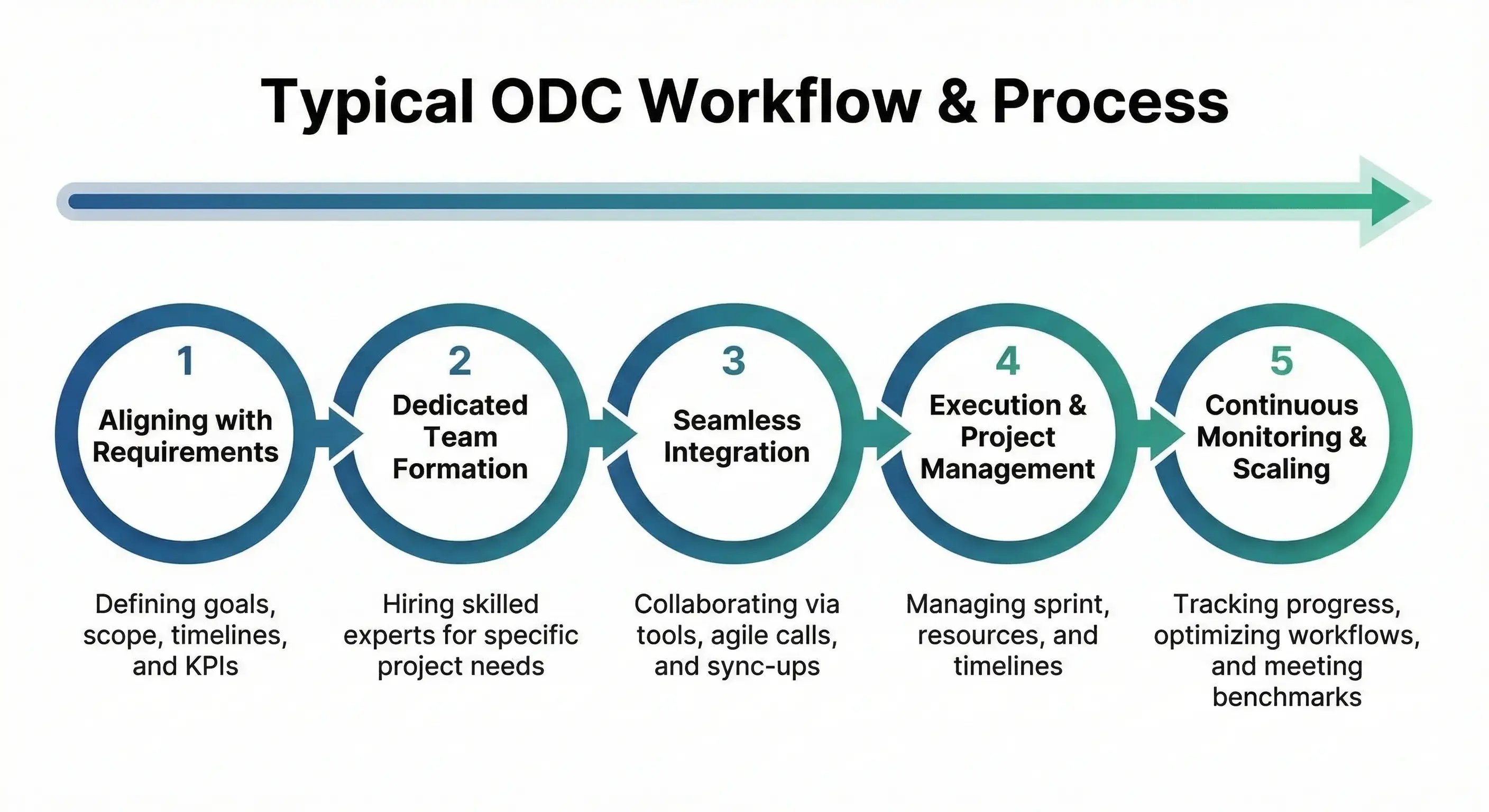
Five-step workflow flowchart showing how an offshore development center works from requirement alignment to continuous scaling.
The onshore and offshore teams work collaboratively as a unified team to manage tasks. The parent company handles the product vision, creates strategies, and ensures communication with stakeholders. At the same time, the offshore team focuses heavily on complex execution, development, and continuous improvement.
An ODC includes a full-time team consisting of software developers, QA engineers, designers, and others who contribute as an integral part of your software development lifecycle.
The ODC's success depends on how you integrate people, processes, and technology. Here is how the workflow actually operates:
1. Aligning with Requirements: The parent company defines the business goals, project scope, timelines, and key performance indicators. This ensures the offshore development team understands the parent company's expectations from day one.
2. Dedicated Team Formation: A dedicated development team is set up in a different geographical location based on the precise needs of the project. For example, if it is an AI-related project, developers with expertise in AI and ML are prioritized. The focus is on building a long-term, stable team rather than simply allocating temporary resources.
3. Seamless Integration with the Core Team: The offshore team integrates completely with your in-house team via collaboration tools, agile capabilities, and communication platforms. Daily scrum calls and regular sync-ups ensure alignment, transparency, and effective sprint planning.
4. Execution & Project Management: Project managers play a critical role in bridging the gap between onshore and offshore teams. They take care of the entire execution phase, including resource distribution, timeline management, and stakeholder communication, ensuring top-notch delivery.
5. Continuous Monitoring & Scaling: An ODC operates with a focus on continuous performance monitoring to raise productivity and meet quality benchmarks. Relying on key performance indicators and real-time dashboards allows businesses to track progress and optimize workflows continuously.
For companies leveraging an offshore development center in India, this approach ensures seamless coordination across different time zones.
1.4 Key Roles in an Offshore Development Center Team
An ODC acts as an extension of the in-house team that brings together experts from all over the world. Everyone in the setup has their own contribution that leads to faster delivery, seamless collaboration, and quality outcomes ultimately.
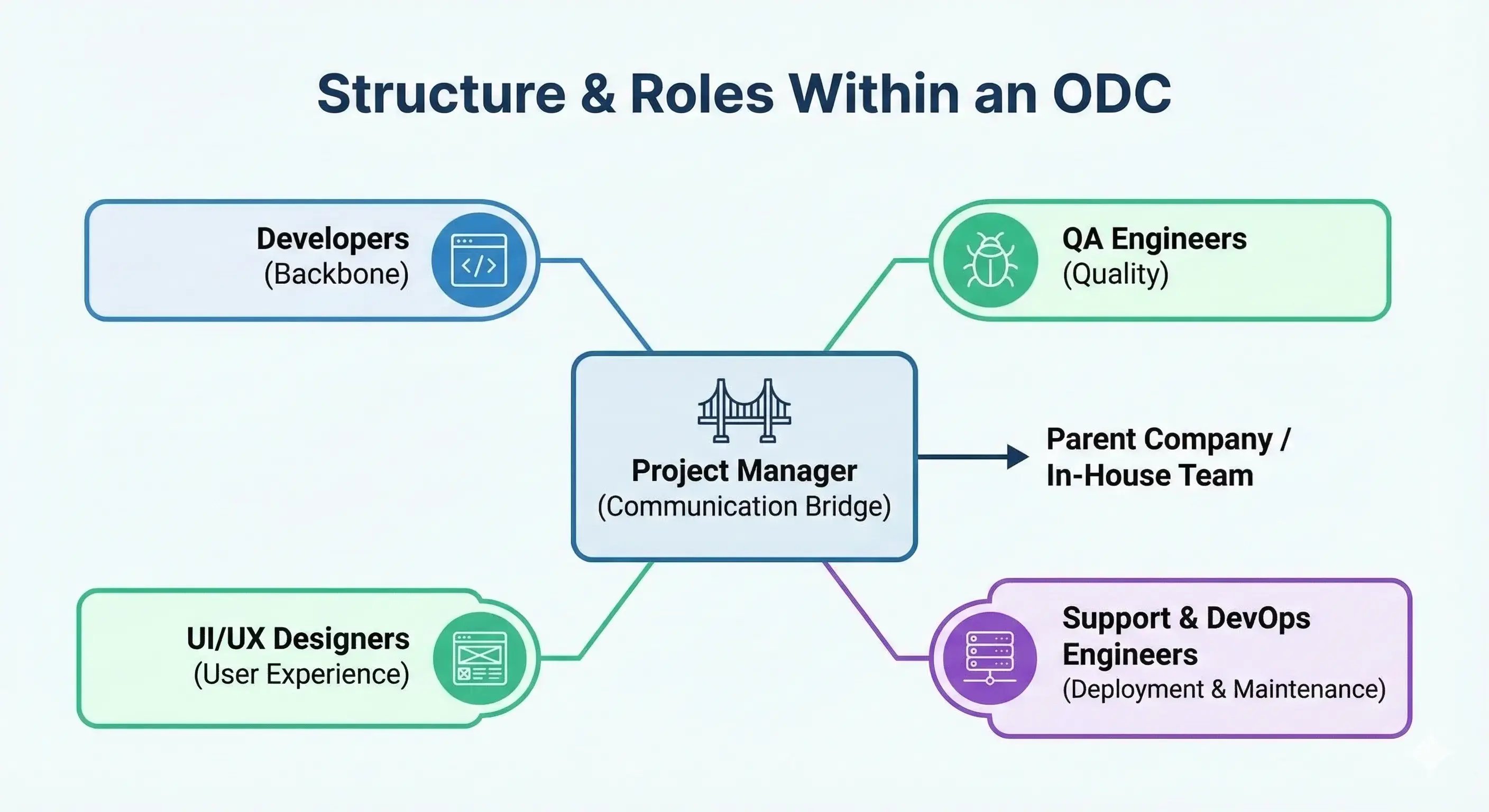
1. Developers
Developers are the backbone of the offshore development center and are responsible for developing and maintaining apps with modern tools and frameworks. They work closely as part of in-house teams and follow required coding practices to ensure the product aligns with business goals. They possess expertise in web development, mobile app development, cloud technologies, Artificial Intelligence, and more.
2. Project Managers
Project managers act as a communication bridge between the in-house teams and the offshore teams . From ensuring a smooth allocation of resources to proper task distribution and communication management, they help ensure the process remains transparent without chaos . They can also track the progress of the project, ensure the deliverables are met, and that quality standards are met.
3. QA Engineers
QA experts maintain product quality via continuous testing and validation. Structured testing strategies, like automation, help identify challenges at the early stages of the development cycle. They ensure that the final product is reliable, secure, and compatible across different platforms.
4. UI/UX Designers
UI/UX designers' main focus remains on creating an intuitive and visually appealing experience for the users, because first impressions matter . They can conduct research, design wireframes, and seamlessly collaborate with developers to work on the design part and satisfy the users.
5. Support & DevOps Engineers
DevOps and support teams ensure the deployment is smooth and provide ongoing maintenance for the app. They ensure smooth integration and continuous delivery via automation and monitoring tools. This investment keeps performance high and supports long-term scalability.
1.4 What ODC Means for Businesses
An ODC is not an operational model; it offers a strategic benefit for businesses that wish to scale their capabilities in the competitive ecosystem. The most critical benefit being it is not limited to local hiring, and allows companies to hire from anywhere in the world and set up their dedicated team.
At the core, ODC allows businesses to quickly move, operate, and innovate without any limitations.
Why Companies Are Shifting to ODC Models
The shift towards offshore development is driven by market competition and the ambition for growth. As the pressure due to competition continues to rise and technological advancements are happening, businesses need models that are agile and offer scalability.
Traditional hiring approaches could not meet the demand, as there is a limited availability of talent and resources. An ODC helps address all these challenges as it offers immediate access to skilled talent experts and a ready-to-deploy team structure.
The Benefits of Setting up an Offshore Development Center
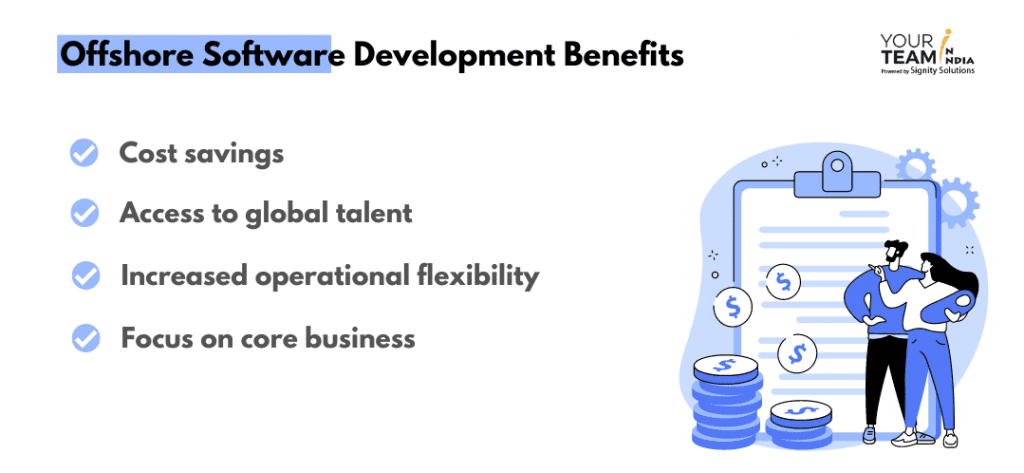
Setting up an ODC allows businesses to move from a traditional approach to a scalable and high-performing ecosystem. Whether it is reducing operational costs or enhancing technical assistance, it has plenty of benefits.
Here are the critical benefits of setting up an ODC you should know.
1. Cost Efficiency Without Compromising Quality
The Offshore Development Center has its equipment, infrastructure, and a team of highly qualified experts. As a result, your business will not have to worry about the costs of putting in place the necessary infrastructure. The ODC project may get started considerably sooner and at a lower price than if you started from scratch.
2. Access To A Large Pool Of IT Professionals
ODC gives you access to highly skilled IT teams with demonstrated IT expertise, abilities, and experience. It removes geographical limitations, allowing businesses to hire developers in India and other global talent markets to build strong and efficient teams. In addition, leading ODCs place a strong emphasis on developing their staff’s capabilities so that they can provide the greatest solutions to your target clients.
3. Greater Control and Transparency
As previously stated, the ODC carefully follows instructions given to them. You'll be able to assess and follow the present state of the project. You might wish to talk to the ODC company about contract conditions. If the outcomes do not meet your expectations, you have the option of requesting that the ODC rectify the project at an additional expense.
4. Continual Technical Assistance
Throughout the project's life cycle, ODC provides ongoing technical support. Offshore enterprises employ their skills to fulfill duties during the project. For your highly technical projects, there would be no scarcity of the right talent when you have the support of your ODC team.
5. Faster Project Delivery
ODC teams can deliver projects much faster because they work in ideal settings. The team adheres to the project timelines and guidelines established by the main office from start to finish. Additionally, they effectively collaborate with the in-house team, allowing the project to be completed in less time overall.
6. Efficient Resource Utilization and Scalability
The number of resources required varies depending on the project. An offshore development center functions as an extended arm that can handle the activities of in-house staff, allowing you to scale your IT department more effectively. Allocating resources without an ODC would be challenging.
Common Offshore Development Center Locations
The right location matters for the offshore development center to be a success and offer cost-efficiency. Different regions have their own set of pros and cons in terms of cost, talent, expertise, and more. Let us talk about some of the most preferred offshore development center locations that businesses usually prefer.
India
India is one of the most preferred destinations for setting up an ODC. Whether it is about a vast pool of talent, robust knowledge on technologies, or cost benefits, India is a hub that offers an ideal ecosystem for building scalable teams or setting up an ODC. The country’s infrastructure is mature, and it has experience working with clients globally.
Eastern Europe
Ukraine and Poland are strong ODC destinations that are especially ideal for companies in Europe. It offers high-quality experts and engineering capabilities, and has a strong alignment with the Western markets. Compared to India, the cost is higher, but still companies choose Eastern Europe as it offers proximity and time zone advantages.
Southeast Asia
Southeast Asian countries like Vietnam and the Philippines are quite popular and emerging destinations for setting up an ODC. These places offer a competitive advantage in pricing models and have a strong tech workforce. Though these are still developing regions, it offers a strong potential for businesses that want cost-effective growth.
India: The #1 Offshore Development Center Destination
With a combination of the right set of talent, cost-effectiveness, and scalability, India turns out to be a global leader for establishing an ODC. India boasts over 5 million software developers, which means businesses can access a large pool of talent in the country. Whether it is about finding expertise across the technologies or dominating in AI, cloud computing, and other advanced technologies, you can find the right talent in India.
In addition to talent, cost efficiency remains a major advantage. Companies can reduce development costs significantly compared to Western markets while maintaining high-quality standards. This allows businesses to reinvest in innovation and scale faster.
Steps to Establish an Offshore Development Center
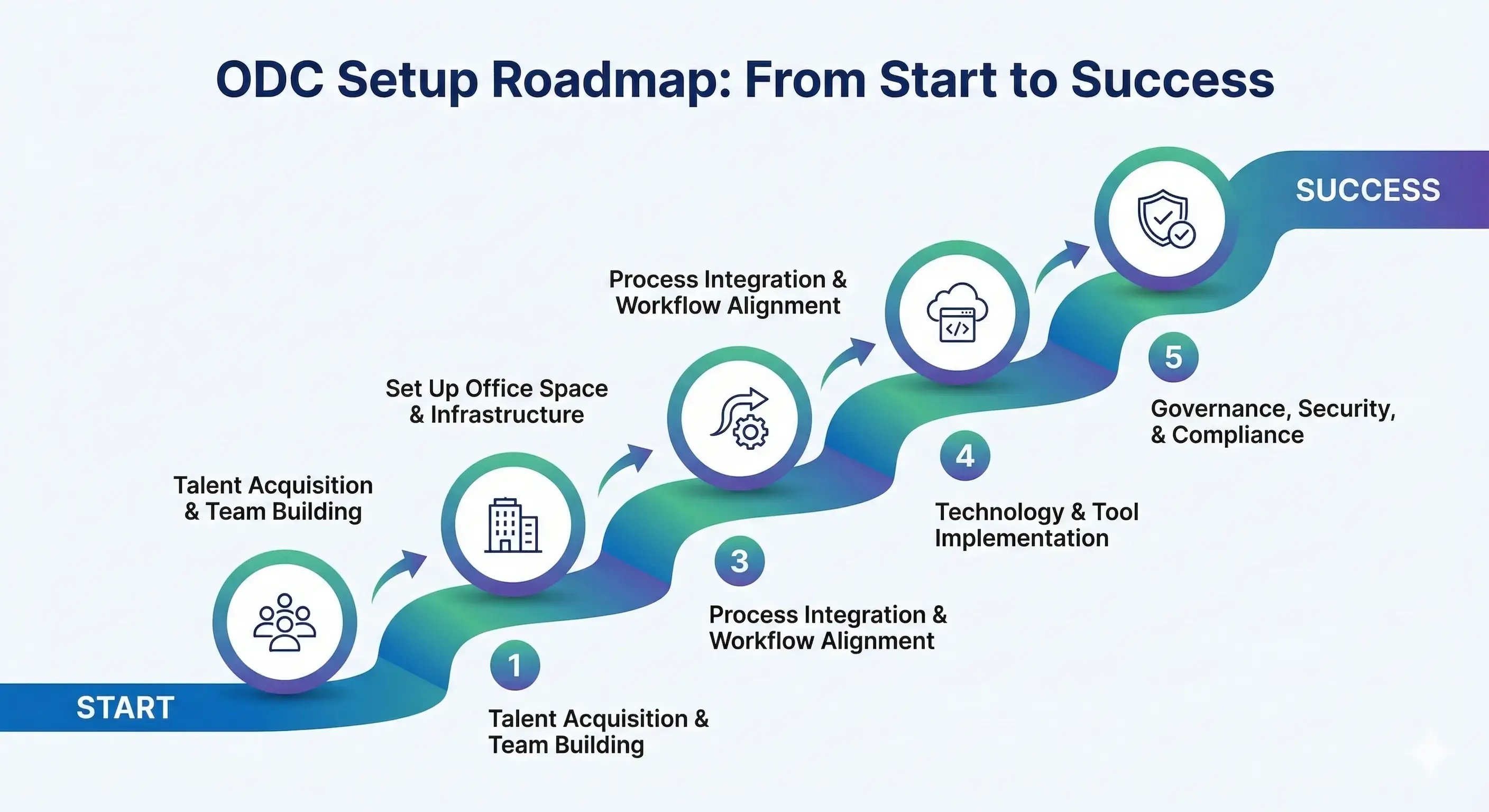
Businesses must follow a strategic approach to set up their ODC, and this approach goes far beyond outsouring or simply hiring freelancers. Whether it is defining the business goal or setting up a scalable infrastructure, each step must be carried out effectively for long-term success. Here is a step-by-step approach that helps businesses set up an ODC effectively
Step 1. Define Business Goals and Vision
Clearly define the purpose of setting up an offshore development center. Whether you want to build a product from scratch or scale the development capabilities, a clearly defined business goal and vision help align the offshore strategy with the business objectives. This step sets the foundation of a strong ODC.
Step 2. Outline the Scope of Work
The next step here is defining the project scope. This means clearly defining the features businesses want to add to their product and the technologies to be used. If the project scope is defined clearly, it can lead to better allocation of resources and a smooth project execution.
Step 3. Choose the Right Engagement Model
It is vital for businesses to have an understanding of how they want to collaborate with the ODC. There are different engagement models like dedicated teams, project-based, hourly, or ongoing technical support. Choosing the right model ensures more flexibility and alignment with the project scope.
Step 4. Identify Talent and Team Requirements
Defining the required skill sets and team composition is crucial for building an efficient Offshore Development Center. This includes selecting developers, testers, project managers, and other specialists based on the project’s needs. A well-structured team ensures productivity, quality, and faster delivery.
Step 5. Select the Right Location and Technology Approach
Choosing the right offshore location plays a key role in the success of your ODC. Factors such as talent availability, cost, infrastructure, and regulatory environment must be considered. At the same time, selecting an appropriate development methodology—such as Agile—ensures flexibility, faster iterations, and continuous improvement.
Step 6. Partner with a Reliable Offshore Development Provider
Selecting the right offshore development partner is one of the most critical decisions. A reliable partner helps you navigate local challenges, build the right team, and ensure smooth operations. Evaluating their experience, technical expertise, communication practices, and client success stories can help you make an informed choice.
Step 7. Set Up Infrastructure, Security, and Governance
The final step is to establish the operational backbone of your Offshore Development Center. This includes setting up infrastructure, defining security protocols, creating legal agreements, and implementing project management frameworks. A strong foundation ensures seamless collaboration, data protection, and long-term scalability.
Legal & Compliance Considerations for ODC Setup
Setting up an ODC that ensures legal frameworks and data protection is vital. Offshore operations mean collaboration around the world, and therefore, it becomes vital for businesses to address compliance and security so that risks are reduced and there is long-term stability.
1. Contracts and Legal Agreements
Ensure businesses are able to define the contracts very clearly, with all the information covered. From the scope of work to their roles and responsibilities, engagement terms, and dispute resolutions, the agreement should define everything. With a clear contract, there is more transparency and accountability, while creating a stable relationship.
2. Intellectual Property (IP) Protection
Protecting intellectual property is a top-notch priority for businesses when they plan to work with an offshore team. Businesses need to ensure that the entire product, including code, ideas, and other assets, is protected. There must be strict contractual clauses and safegualrds that IP ownership. It also prevents unauthorized use and ensures ownership over the assets.
3. Data Security Regulations and Compliance
An offshore setup can be anywhere around the world, and when different geographies are involved, adherence to regulations becomes even more important. These regulations depend on your target market and the niche you are working on. There are different protection frameworks like HIPAA, GDPR, and more across different countries. Ensuring compliance can help get rid of the legal risks and build more trust with the client.
4. Access Control and Security Governance
This is vital to prevent unauthorized data access. Implementing two-factor authentication and role-based access ensures that teams can only access the necessary information that is actually needed by them. When combined with audits and monitoring, the risk of data breach is reduced.
5. Non-Disclosure Agreements (NDAs)
NDAs are quite critical for data protection in an offshore development setup. NDAs have all the stakeholders, like offshore panthers, in-house team members, and others, so that the sensitive and confidential information is maintained. This is vital to ensure that the business data and intellectual assets are protected.
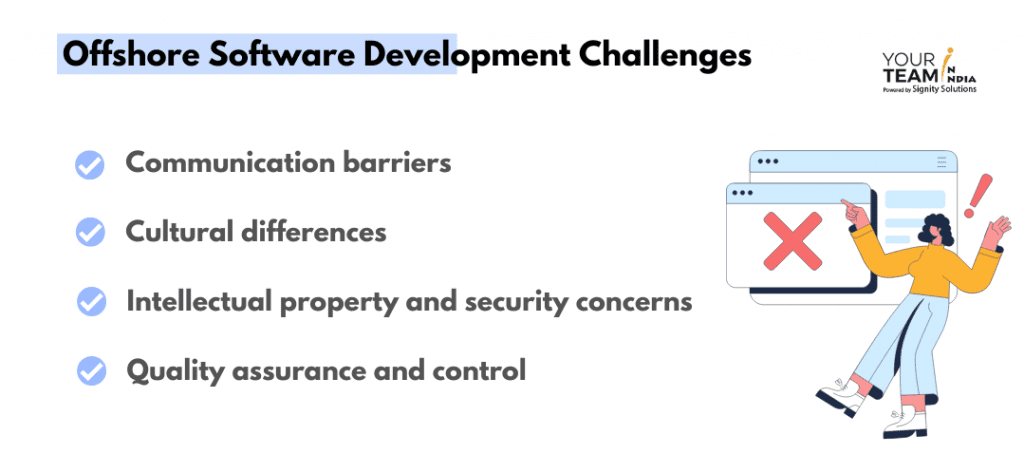
Common Challenges of an Offshore Development Center
While there are significant benefits of an ODC, there may be certain challenges businesses may face. So here are a few of the challenges and how businesses can overcome them.
|
How to Structure an Offshore Development Center Team
To maximize business efficiency and save on costs, businesses need to have the right team structure in place. The structure must align with the business goals and objectives. Here are the most commonly used team structures.
Dedicated Team Model
In this model, the team of developers exclusively works on your project. They work as an extension of your in-house team and are aligned with your processes, workflows, and more. The structure is ideal for businesses with ongoing development needs or long-term projects that need continuous support and monitoring.
Hybrid Model
They combine both internal and external teams while creating a balanced environment for the development ecosystem. Here, the core operations remain with the in-house team, but the development, testing, and other support tasks are given to offshore teams. This model allows businesses to have control over the vital operations while leveraging offshore capabilities.
Project-Based Model
In a project-based structure, the ODC works on a specific project with defined timelines, scope, and deliverables. This model is suitable for short-term requirements, such as building a specific feature, developing an MVP, or executing a one-time project.
How AI & Automation Are Shaping the Future of ODCs
AI and automation are helping evolve ODC centers in how they operate, perform functions, and more. What was earlier focused on cost optimization has now transformed into a high-performing and faster ecosystem. Here is how AI and automation help shape the ODC's future.
AI-Powered Development and Faster Delivery: AI is helping streamline the development process and lifecycle as it automates the repetitive and monotonous tasks. The complex work, like code generation, testing, and more, is automated with AI. This reduces the development time and also ensures more accuracy. Teams that leverage AI tools are able to deliver faster and error-free solutions.
Automation Driving Operational Efficiency: Manual work is eliminated in the development and operations. Whether it is carrying out testing, deployment, or workflow automation, AI in the ODCs can ensure a smooth execution and reduce turnaround time. This ensures that teams can een handle a higher volume of workload if needed.
Enhanced Decision-Making with Data and AI: AI-driven analytics allow businesses to make smarter decisions with real-time insights into performance, productivity of teams, and any risks that may arise. The ODC centers can leverage all these analytics to predict any challenge and boost operational efficiency.
Improved Collaboration and Communication: AI-powered tools are enhancing communication within distributed teams by enabling real-time collaboration, intelligent documentation, and automated updates. Features like smart assistants, automated meeting summaries, and language processing tools help bridge communication gaps and ensure better alignment between offshore and in-house teams.
Wrapping Up
Now that you are aware of all the details of how to set up an offshore center, its success ultimately depends on choosing the right offshore partner. And this is where Your Team in India comes in. With years of experience, a proven track record, and reliable delivery models, the team enables a seamless transition from planning to the entire process of execution.
Whether it is identifying the right talent or setting up an infrastructure, we support you at every stage of the development process. This ultimately allows you to focus on your core business objectives and grow.

By Mangesh Gothankar


By Ashwani Sharma
By Achin Verma
Frequently Asked Questions (FAQ's)
We have answered some common queries about offshore development centers. For more information, you can contact us.

An Offshore Development Center (ODC) offers a dedicated team that works exclusively for your business, while traditional outsourcing involves assigning specific tasks to external vendors with limited control and long-term alignment.
An offshore development center model allows seamless collaboration between your onshore and offshore teams. Core team members, including project managers and developers, work in sync with your internal staff using collaboration tools, ensuring smooth workflows and consistent output.
India offers a large pool of skilled developers, cost efficiency, strong IT infrastructure, and extensive experience in serving global clients, making it a leading ODC destination.
An in-house team operates within your organization with full control but higher costs, whereas an ODC provides similar control and collaboration benefits at a significantly lower cost with easier scalability.
A dedicated offshore development center implements robust security measures, including access controls, secure development environments, and strict intellectual property protection policies. This ensures sensitive business data is safe while maintaining quality standards and operational efficiency.
AI and automation enhance ODC efficiency by accelerating development, improving decision-making, and enabling smarter collaboration across distributed teams.








 4.8 out of 5 by