Nowadays, the gradual shift for businesses is towards intelligent automation; however, there remains confusion between RPA and AI. While both of these technologies are critical and help improve the efficiency of operations, they work in quite different ways.
Robotic process automation helps automate repetitive and rule-based tasks, whereas Artificial Intelligence continues to learn from the data, make predictions, and help with accurate decision-making. Collaboratively, they help reshape modern organizations, analyze how they operate, and ensure robust data management.
Adoption of AI and RPA solutions continues to rise across the globe, and there are numbers that depict the same. As per the industry research, over 60% of businesses actively increase the investment in RPA and AI-based systems, while making the operational flow much smoother.
RPA helps automate the operational backbone to perform structured operations, while AI helps enhance the capabilities by handling unstructured data and predictive analysis. This seamlessly makes the comparison of artificial intelligence vs RPA less about competition and more about collaboration.
Understanding the difference between AI vs automation is now vital for businesses that wish to scale without having to raise the manual workload. When collaboratively used, these technologies can help businesses streamline operations and boost productivity.
RPA Vs AI: Key Differences to Know
RPA vs AI are two critical and impactful technologies that drive automation in businesses. Both help boost the operational efficiency, productivity, and reduce the manual load on the employees. While RPA automates repetitive and monotonous tasks, AI allows systems to think, learn, and execute accordingly. Let us highlight the main differences:
|
Aspect |
Robotic Process Automation (RPA) |
Artificial Intelligence (AI) |
|
Core Function |
Automates repetitive, rule-based tasks |
Simulates human intelligence and decision-making |
|
Learning Ability |
Does not learn or adapt |
Learns from data and improves over time |
|
Type of Tasks |
Structured, repetitive processes |
Unstructured and complex tasks |
|
Decision Making |
Follows predefined rules only |
Makes data-driven predictions and decisions |
|
Data Handling |
Works best with structured data |
Can process structured and unstructured data |
|
Flexibility |
Low flexibility, rule-dependent |
High flexibility, adaptive, and dynamic |
|
Examples |
Data entry, invoice processing, report generation |
Chatbots, image recognition, predictive analytics |
|
Goal |
Task automation and efficiency |
Intelligent automation and decision support |
What is Robotic Process Automation?
Robotic Process Automation (RPA) uses software robots to automate repetitive, rule-based business tasks. These tasks traditionally were performed manually by the human operator and usually increase the workload and risk of errors.
Thanks to bots, which seamlessly interact with digital systems similar to a human being and execute a structured workflow, ensuring speed and accuracy. Whether it is clicking, data copying, moving files, or more, all the tasks are performed by these bots.
However, it follows predefined instructions and can not deviate from them. That means it is ideal for performing repetitive tasks, including data entry, system updates, and more, so that these monotonous tasks can be completed well on time. It does not learn and analyze from outside, and works on a fixed and predefined set of rules.
What is Artificial Intelligence?
Artificial Intelligence is the ability of machines and systems to simulate human intelligence. It analyzes the data, recognizes the behavior and patterns to make accurate predictions. It is different from traditional automation and possesses the ability to learn from data, adapt to inputs, and boost performance over time.
It can seamlessly process a large volume of data and apply contextual understanding for generating insights and actions. It continues to learn from data and, therefore, makes it a key driver of intelligent automation across the industries.
Today, AI is widely used in applications such as machine vision, chatbots, speech and image recognition, sentiment analysis, and natural language processing (NLP). These capabilities enable businesses to handle complex tasks that go beyond rule-based automation, making AI a critical component in modern AI and RPA ecosystems.
As UiPath Co-Founder Daniel Dines highlights, the integration of AI into automation platforms is helping organizations achieve higher productivity and expand the scope of what can be automated.
How RPA and AI are Best Deployed for any Business?
Let’s see how RPA and AI help your organizations and deploy to make your business better.
For building an effective automation strategy, it is vital for businesses to understand how these two technologies work collaboratively. While both RPA and AI help improve the efficiency of, the purposes remain different. RPA handles the repetitive tasks, whereas AI manages the complex business processes. Here is how RPA and AI work collaboratively and are deployed in business operations.
a) Robotic Process Automation is the backbone of the software robots, responsible for interacting with digital systems to replace the human workforce from mundane, non-value-added chores. RPA can smartly take all those tasks off your plate that you hate doing in your organization the most.
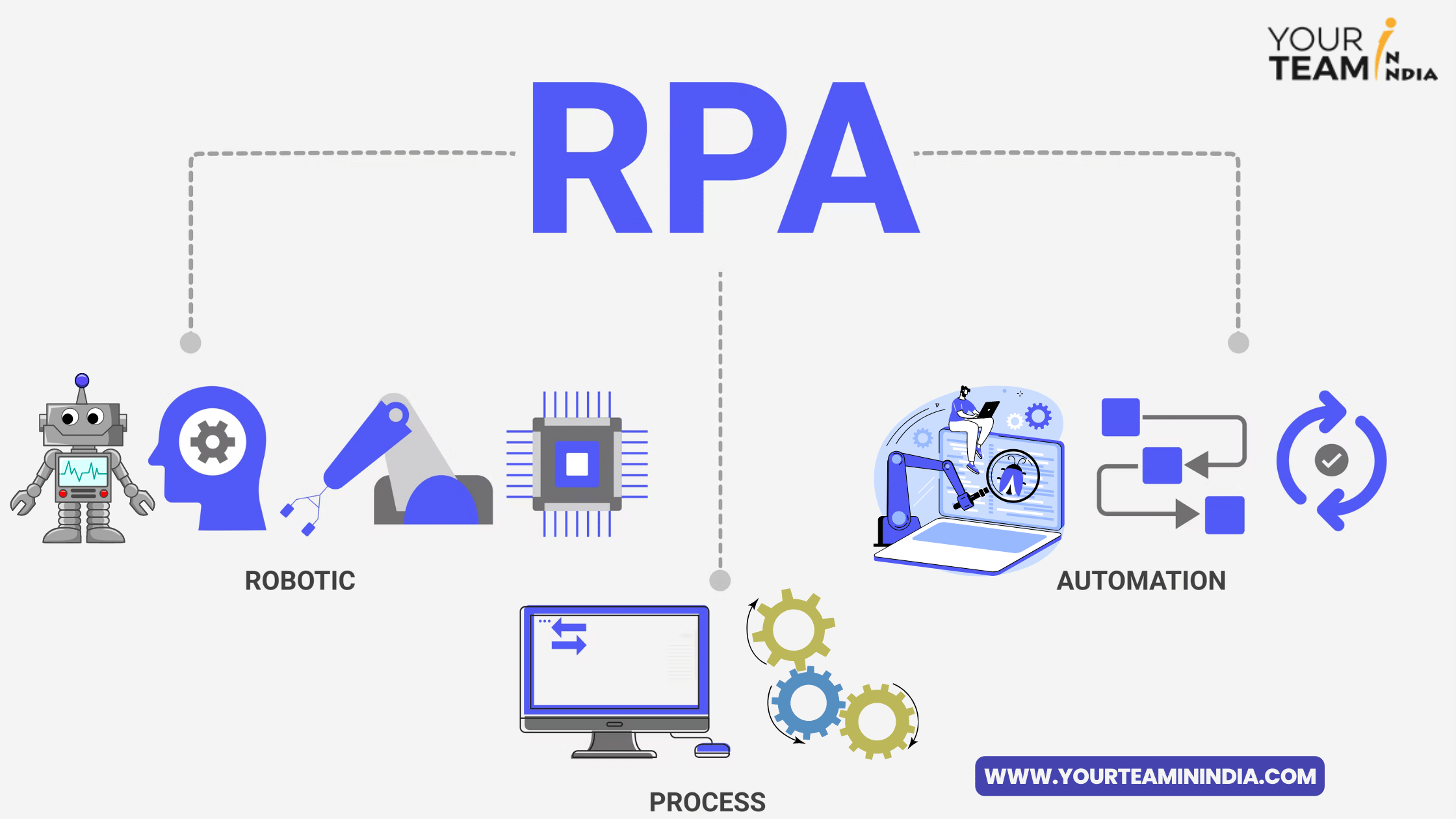
RPA supports your business in the following ways:
-
Copying and pasting data.
-
Logging in apps
-
Extracting structured content from documents
-
Structuring content from business documents
-
Connecting to APIs
-
Manage emails and attachments
b) Artificial Intelligence can be considered as the sibling of RPA, and when combined, forms intelligent automation. It handles more complex business processes as compared to robotic process automation. AI can make cognitive decisions using large sets of data to forecast potential outcomes. It can even go beyond execution to thinking.
AI supports your business in the following ways:
-
Analyzing and understanding documents
-
Understanding the conversations
-
Processing languages
-
Visualizing screens, like your virtual desktops
-
Finding processes and tasks to automate
-
Managing unstructured data
Robotic Process Automation vs. Artificial Intelligence
Now, let’s look at the difference between the two terms more deeply to decide which one is right for you. And, even if both are, how can you rightly implement them for the business chores?
So, how should one know when to roll out both AI and RPA? Well, keep the most complex tasks for AI and regular monotonous tasks for RPA. Remember, RPA will not automate your tasks end-to-end. However, AI has that power.
When to Use RPA
RPA is most effective when your processes are stable, repetitive, and follow a consistent set of rules. It serves as the foundation of automation by streamlining routine tasks across existing systems without requiring major infrastructure changes.
Use RPA for:
-
Data entry and data migration
-
Invoice processing and report generation
-
System logins and record updates
-
Email management and workflow routing
-
Repetitive back-office operations
When to Use AI
AI should be deployed when tasks require interpretation, prediction, or decision-making. It is particularly valuable for processes involving large volumes of data, unstructured inputs, or changing conditions.
AI is ideal for:
-
Workflows with unpredictable outcomes, such as loan default analysis or demand forecasting
-
Processing unstructured data from emails, images, videos, and documents
-
Language-based tasks such as translation, sentiment analysis, and speech recognition
-
Intelligent document processing and invoice extraction
-
Customer behavior analysis and personalized recommendations
Why Businesses Use AI and RPA Together
RPA automates execution, while AI adds intelligence. Together, AI and RPA enable end-to-end automation across both structured and unstructured workflows. RPA handles the repetitive steps, and AI manages the decision points, making the combination far more powerful than either technology alone.
RPA and AI Advantages for Small Businesses
Let’s talk about the prominent benefits of RPA and AI for every small business to know how your business will benefit from implementing these technologies for automation.
Benefits of RPA
1. Higher Productivity
RPA robots are entirely focused on certain business tasks. For example, robots can calculate and navigate through the screen in just a few seconds. Just imagine a robot doing the same task in 20 minutes, which takes four hours to complete. That’s just an example of how productivity can be enhanced in any business.
2. Improved Operational Efficiency
RPA software doesn’t need a break like humans. They can work 24x7 a day, which means you just need to pre-define tasks for the robots, and it will continue to work until you stop the process. Hence, an incessant boost in employee efficiency. Also, RPA needs less time to complete work in volumes.
3. Higher Accuracy
Humans are bound to make mistakes, but not robots. They will ensure timely task completion with minimum effort and without even stopping for a minute. Isn’t that what every business needs for outstanding performance?
4. Robust Security and Compliance
In RPA, the bot performs only single tasks, which means no stress about information leakage from one part to another, and compliance is maintained. Moreover, the data access is well managed, controlled, and documented. Hence, utmost safety can be maintained when using RPA.
5. Enhanced Analytics
RPA allows firms to collect data regarding task execution, which can further be used for analytical purposes. Perceptions attained from the analysis can help improve existing processes, which results in better decision-making for the business. In addition, when you can determine the gaps and further streamline them, it enhances efficiency.
Related Read: Best RPA [Robotic Process Automation] Tools
Benefits of Artificial Intelligence
1. Predictive Decision-Making
AI can analyze historical data to identify patterns, forecast trends, and support smarter business decisions. This helps companies anticipate customer needs, market shifts, and operational challenges.
2. Review Past Performance
AI gives you access to reviewing your past performance and data to predict the future of your business. You can predict the behavior of customers and prioritize your actions based on these predictions. Hence, a great deal for every company that is trying to boost sales.
3. Better Customer Management
Automated chats allow businesses to scale their customer engagement and free up employees who need to sit and chat with customers. In addition, it will enable greater customer satisfaction, which is one of the most important goals of any business. AI supports businesses to understand customer needs, their purchasing patterns, and suggest the most relevant services, offers, and rewards.
4. Stronger Cybersecurity
The cases of cyber exploits are increasing every year. For complete protection against such events, your business needs AI to protect the data, identify the security vulnerabilities, and take appropriate actions to keep everything safe from cyber attacks. When you use AI for business processes, you are automating tasks and making your system more secure.
5. Supports Salespeople
The sales team is an integral part of revenue generation. With AI technologies, you can coach the sales team to sell better. AI tools can record and transcribe the calls that salespeople make. Your sales team can use AI for analyzing the current strategy, predicting the future, understanding the gap, and creating better sales strategies for higher sales and profits.
6. AI Easily Embeds with CRM
CRM embedded with AI can take your customer relationship to the next level of success. With AI, you can quickly gather valuable insights to handle interaction with existing and potential customers. AI can do real-time analysis to provide apt and meaningful recommendations and predictions based on customer data and business processes.
Can AI, Machine Learning, and RPA Be Combined?
Yes, absolutely. AL, machine learning, and RPA can seamlessly integrate into the system to create intelligent automation solutions. All the technologies serve different purposes here. RPA handles the repetitive and rule-based tasks, while AI and ML manage the complex processes that include learning, predicting, and decision-making.
Say, for example, RPA helps automate the data entry processes and execute workflow, and on the other hand, AI and ML analyze the unstructured data and improve outcomes. Combining these technologies allows businesses to automate the end-to-end processes.
Concluding Thoughts
After analyzing the benefits of both RPA and AI, we suggest you implement the combination of both to manage all your structured and unstructured data. It will help you leverage the benefits of both technologies and balance and automate all tasks in your business processes. Also, make sure to hire only the trusted and best RPA and AI developers for your business to bring the results for your business.
At your Team in India, we have a team of RPA experts. If you want to hire Developers or have any questions about what services we offer for your team in India, click here to contact us.
Frequently Asked Questions

RPA vs AI is all about the capability. RPA automation helps streamline repetitive and rule-based tasks, whereas AI seamlessly analyze data to make accurate decisions. While RPA focues on execution, AI brings adaptability to the businesses.
Well, the best approach for the businesses is combining both AI and RPA. Here the RPA will handle the structured and repetitive tasks, while AI manaes the complex process of decision making. Together, they can create a intelligent automation that boosts productivity and accuracy.
For the small businesses, AI and RPA helps with task automation, reduce the operational cost, boost customer satisfaction and make decisions faster. Whether its automating invoices or answering customer queries, the AI-powered chatbots allow companies to scale efficiently and there is no increased overhead.
Your business is ready for RPA automation if you have repetitive, high-volume tasks that follow clear rules. AI is a better fit if your processes involve unstructured data, customer interactions, or predictive decision-making. A consultation with automation experts can help you identify the right mix of artificial intelligence vs RPA for your specific goals.








 4.8 out of 5 by