Artificial Intelligence has moved from an experiment to implementation in business operations. It used to be optional years ago, and now businesses can not work without it.
Traditionally, implementing AI means a bigger budget for businesses, dedicated teams, and custom development. However, now this barrier is gone because AI tools and no-code platforms allow businesses to build AI-powered experience solutions even with zero coding experience. This makes AI adoption even more valuable.
Businesses are leaning into this shift for clear reasons. Integrating AI into your business can help you reduce operational costs and minimise errors, gain a competitive advantage, boost customer experience and free up teams for a higher value.
The numbers back this up. According to McKinsey's 2025 State of AI survey, around 88% of businesses claim regular usage of AI in their business operations.
However, integration of AI into businesses in 2026 is not a click switch. It requires businesses to follow up a clear strategy, defined goals and challenges, and a way to measure if the process is moving in the right direction.
In the sections ahead, we'll walk through exactly how to integrate AI into your business, step by step, with the data behind why it matters now more than ever.
The Data Proves AI's Crucial Role in the Business
Here are the numbers you must actually know. The global AI market was around $390.9 billion in 2025 and is expected to reach $539.5 billion by 2026. And by 2033, Grand View Research puts it at $3,497.3 billion, growing at a 30.6% CAGR from 2026 onward.
That growth isn't coming from hype. It's coming from companies actually putting generative AI, AI agents, and natural language processing to work, inside operations, customer service, and up and down the value chain.
But market size only tells half the story. The real question is what AI does to the bottom line. PwC's sizzling prize research puts AI's contribution to global GDP at $15.7 trillion by 2030. Break that number down, and it gets more interesting: about $6.6 trillion comes from plain productivity gains, fewer errors and repetitive tasks.
AI adoption isn't a future bet anymore; it's already reshaping how money moves through the economy. The businesses building a real AI strategy today are the ones who'll hold the competitive advantage once everyone else catches up.
Why Incorporate AI in Your Business?
There are various reasons why businesses might consider integrating AI into their operations. These motivations can range from addressing existing challenges to improving business resilience or mitigating risks. Below, we'll explore some of the key reasons for integrating AI and what AI can do for business.
-
Reducing operational costs: AI can reduce operating costs by boosting efficiency and minimising the need for manual labour. AI chatbots and virtual assistants can handle unique inquiries 24/7 without human intervention.
-
Enhancing user experience with personalisation: Integrating AI into business can provide a more personalised user experience that is difficult to offer otherwise by analysing user preferences and behaviour. For instance, the most popular e-commerce sites like Amazon use AI algorithms to provide more customised experiences and suggest products based on user browsing and purchasing patterns.
-
Enhancing the decision-making process: Gut instinct only gets a business so far. AI systems can process far more data than any team could by hand, surfacing patterns and forecasts that support smarter decision-making; whether that's demand forecasting, scenario planning, or catching a shift in market trends before a competitor does.
-
Taking on complex challenges: AI can tackle complex business tasks that are difficult to handle with traditional methods. For example, image recognition, predictive analytics, natural language processing, and even generating images. These need machine learning and large language models, not spreadsheets and intuition.
-
Strengthening online security: Application of AI in business facilitates the reduction of cybersecurity threats by employing advanced algorithms to identify patterns, anomalies, and potential breaches in real time. This contributes to enhancing overall security and protects sensitive data.
-
Gaining a Competitive Advantage: Put all of this together, and the advantage compounds. Businesses using AI read market trends earlier, adapt their business model faster, and roll out innovative solutions while competitors are still running reports by hand. That's not a small edge. Over time, it's often the difference between leading a market and chasing one, and a real driver of sustainable growth.
Also Read: How Will AI Help You Accelerate Your Business Growth in 2026?
How to Integrate AI in Business?
Application of artificial intelligence in business can be overwhelming, particularly if you are not well-versed in the technology. However, it is crucial to recognise that integrating AI is a gradual process, and one must have an understanding of AI business integration. To help you with this, we have developed a comprehensive step-by-step guide.
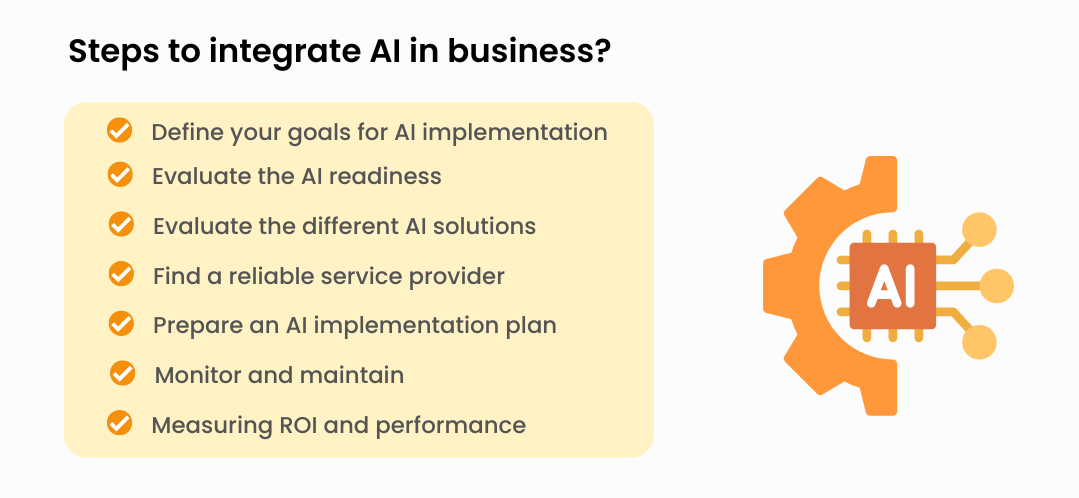
1. Define your goals for AI implementation
It is important to define the business goals before incorporating AI into the business. This involves pinpointing the issues that you are looking to resolve. To accomplish this, you need to review and evaluate the data and existing processes.
Additionally, you should assess the factors that affect the business processes. Well, for your ease, we have compiled a quick questions checklist to help you define your goals appropriately.
Try to answer these questions to make a decision.
-
What results do you want to achieve?
-
What are the primary hurdles you are facing to attain these outcomes?
-
How can AI help your business to fuel success?
-
What would be the KRAs, and how would you measure success?
-
What data do you already have, and what else would be required?
Getting answers to these questions can help you define the business requirements.
2. Evaluate the AI readiness
Here comes a crucial step where you must analyse the readiness to adopt AI in your existing system. At this step, businesses must analyse their capability of AI and how they can leverage the benefits of the technology. It’s time to familiarise yourself with the capabilities of AI.
For instance, the Generative AI field. It is not only fueling business growth but also increasing business efficiency with Generative AI. So, carefully understand what capabilities of AI can resolve the encountered business challenges and evaluate your readiness to adopt the AI solutions for your business.
3. Evaluate the different AI solutions
Once you have prepared yourself to implement AI into your business, it's essential to evaluate the different AI solutions that can be beneficial for your business. Start by exploring the possibilities of the tasks AI can perform for you, and consider various use cases where AI has been a huge contributing factor.
| "Do not implement the solution solely based on the current trends, as what is popular today may not be popular tomorrow.” |
Choose the best approach that suits you!
You can either
-
Build a new solution from scratch
-
Utilize your internal resources
-
Get a pre-built solution off the shelf
-
Collaborate with a partner to develop your AI project
-
Or outsource the entire AI development process.
However, it is always recommended to conduct thorough research on the existing solutions before proceeding with development, regardless of which approach you choose.
4. Find a reliable service provider
If you already have a team of proficient AI developers, they can take off the project and get things done for you! But what if you do not have a specific team that can implement AI solutions for you?
Well, that is where referring to a domain specialist will help you implement the chosen solution.
But remember, developing an AI solution is not the same as creating a typical software. It is beyond that which requires specific expertise.
Therefore, find a reliable artificial intelligence development company or hire an AI developer who can help you incorporate the AI solution into your business and leverage the benefits that come with it.
Not all the agencies have the specific knowledge they claim to have. So it is crucial to do proper research and consider the following before choosing one:
-
Check out the reviews of the service provider
-
Evaluate their domain expertise
-
Ask them the queries you have in your mind
-
Consider word of mouth and seek recommendations
-
Examine their prior work to confirm that AI has been successfully integrated into mobile apps.
5. Prepare an AI implementation plan
After identifying the business aspects that could benefit from AI incorporation, it is time to list the tools and resources required to execute the plan.
AI is powerful, and it only works when you have a clear understanding of what you are trying to achieve and convey the same to the AI solution.
Therefore, for the execution and implementation of the AI solution,
-
Provide the information as accurate as possible
-
Choose the datasets that are free from incoherent information
-
All the necessary attributes that are required for an algorithm to perform a task.
6. Monitor and maintain
In order for businesses to ensure that their strategies are working effectively, they need to have a monitoring system in place. Regular upgrades and maintenance are necessary to maintain and adjust the implemented plan to changing requirements. This will help businesses to continually improve their performance and achieve their goals.
7. Measuring ROI and performance
It's pointless to incorporate AI into your software application without having a means to measure its effectiveness. Measuring performance and understanding the ROI for your AI efforts is crucial. Analyze the key performance indicators to evaluate the impact of AI incorporation on your business.
Common Challenges AI Addresses for Businesses
AI is no longer just an optional tool; it has now become a necessity for businesses mining to thrive in this digital world. And certainly, it is crucial for companies to adopt this as it fuels business growth by addressing common challenges.
|
Challenge |
How AI Solves It |
Business Impact |
|
Efficiency |
Automation handles repetitive and time-consuming tasks |
Frees up resources to perform core other tasks |
|
Data-driven decision-making |
Real-time data analysis and predictive analytics spot patterns faster |
Smarter decision-making and lesser costly missteps |
|
Enhanced customer experiences |
AI chatbots and AI assistants personalize service using customer data |
Higher satisfaction and loyalty |
|
Innovation |
AI takes on mundane tasks, freeing resources for R&D |
Faster time-to-market for new business ideas and products |
|
Lack of skills and expertise |
No code platforms and AI assistants lower the technical bar to entry |
Smaller teams can adopt AI without hiring a full technical staff |
1. Efficiency
How pathetic it feels to perform repetitive tasks daily and waste manual efforts in achieving those. Well, AI surpasses those repetitive tasks by automating the repetitive and time-consuming tasks, enabling hired talents to focus on more strategic activities. This ultimately enhances productivity and efficiency.
2. Data-driven Decision Making
Decision-making is one of the crucial aspects of businesses, and when it is done based on data analysis, it empowers the entire decision-making process. That is where AI helps!
AI analyzes a tremendous amount of data in real-time and quickly, too, while offering data-based insights that are hard to acquire otherwise. This informed and data-driven decision-making can help businesses to create better outcomes and strategies.
3. Enhanced customer experiences
Delivering an exceptional customer experience is one of the crucial aspects of businesses offering their services online. However, it is complicated to attain that through manual efforts.
AI excellently delivers that exceptional customer experience by providing more personalized experiences while boosting satisfaction and loyalty.
Well, yes, and even a survey by Forbes Advisor suggests that many businesses incorporated AI to deliver excellence.
Don't believe words? Well, believe the numbers above and get your questions answered.
4. Innovation
Who doesn't want to fuel their businesses with innovation? Well, everybody wants it!
And that is what AI brings to the businesses.
AI accelerates innovation by performing mundane tasks and frees up the resources for development and research tasks.
5. Lack of skills and expertise
Finding out the right skills is one of the most complicated tasks these days. And without the necessary expertise, businesses may struggle to get the desired results. However, sufficient knowledge of the field and the incorporation of AI can help companies attain the heights they are aiming at.
Top AI Integration Strategies
Integrating AI into your digital presence can make the space more efficient and intelligent. But how do we add this intelligence to the digital space? Here are three top AI integration strategies.
a) Recommendations
Popular OTT streaming service, such as Amazon Prime and Netflix, demonstrate the power of AI integration, a key factor behind their strong customer engagement and high user retention.
Well, what made these platforms among the top choices?
It's the incorporation of AI into their applications that examine the user's decision based on gender, location, preferences and age.
Depending on the choices made by each user, the technology recommends the most popular alternatives in their watch playlist. This sharing of users' insights into what they can opt for next has turned out to be one of the secret mantras for the success of the most popular brands. This has been possible due to the integration of AI recommendations.
b) Reasoning
AI harnesses the power of reasoning to solve complex problems. Popular applications like Google Maps utilize AI to provide users with the most optimal routes, surpassing human capabilities.
This enables Maps to optimize routes and get users to their destinations quickly. With the ability to make real-time decisions and reasoning power, AI helps provide top-notch customer service.
c) Behavioural
Artificial Intelligence (AI) has revolutionized the digital world by studying user's behaviour while they use a specific platform or application. Companies must incorporate AI into their systems to set new standards and create a safer online environment.
The way it works is that if there is any suspicious activity, such as an attempt to steal data or impersonate an online transaction, AI tracks this behaviour and cancels the transaction to prevent any harm.
The three AI integration strategies mentioned above are gaining a lot of attention for their ability to offer a great user experience consistently. However, if you think that's all you need to know about AI integrations, there is actually a lot more to consider.
Let's explore some factors you should take into account when selecting AI tools and other important information about AI integrations.
Factors to consider when selecting AI tools
AI is consistently helping businesses thrive, but does that mean every AI tool suits your business requirements and addresses the challenges faced by the industry? Well, not really!
While considering AI solutions for your business requirements, there are a few factors that must be taken into account. Let us check out some of them:
-
Effectiveness: Does the chosen AI tool have the capability to provide the desired features required for your business requirements?
-
Scalability: Can the AI tool address the growing business requirements, offering desired scalability?
-
Compatibility: Can the chosen AI tool be used with the existing system and technologies without any issues?
-
Data Confidentiality and Security: Does the selected tool adhere to industry-specific data privacy and security laws?
How much does it Cost to Integrate AI into Business
The cost of integrating AI into businesses can vary significantly depending on the platform, its complexity, the required resources, development time, and the features to be included. However, it is possible to hire an AI development expert for as little as $22 per hour. To get an accurate quote for your specific project requirements, it is always recommended to connect with an AI development expert.
Bottom Line
Incorporating AI into businesses can open up a whole new world of opportunities. It can transform the way businesses operate, work with customers, and even make decisions.
However, assessing your business requirements, understanding the impact AI incorporation can create, finding the right AI solutions and effectively implementing those solutions to your business can help you harness the power of AI and improve your bottom line. But all it requires is a professional AI expertise that can help you attain it all.
Your Team In India has a solution for your artificial intelligence development services requirements.
Whether you are looking for AI development experts to develop an innovative solution for your business or planning to incorporate AI into your existing business digital space, YTII has got you covered.
Frequently Asked Questions

You can just start. A chatbot here, an automated workflow there. But without a plan tying those tools to a real goal, most of them end up underused within a few months.
Automation follows fixed rules: if X, then Y. Agents go further. They can work through multi step problems and adjust on their own, without someone approving every step.
Most teams see early wins, like fewer support tickets, within 60 to 90 days. Bigger gains, like real cost savings, usually take two or three quarters.
Both, depending on the role. Repetitive, rules based work is most exposed. For most other jobs, AI just shifts what people spend time on.

By Mangesh Gothankar


By Ashwani Sharma
By Achin Verma



%20(1)%20(1).webp?width=352&name=Programming%20Outsourcing%20(2240%20x%201260%20px)%20(1)%20(1).webp)




 4.8 out of 5 by