MCP adoption moved fast this year. Anthropic's July 2026 spec update put monthly SDK downloads past 400 million, four times what they stood at the start of the year. Getting an agent connected isn't the hard part anymore. Getting it into production is hard. McKinsey's State of AI 2025 survey found 62% of organizations are experimenting with AI agents, but only 23% have scaled one into even a single business function.
The MCP server is usually where that stall happens. Bringing in an offshore team can close the gap, but this isn't a normal handoff. The server touches production data directly, so the usual staff-aug approach falls short. This guide covers MCP server development with offshore teams: how to structure the work so it holds up in production, and what to check for when you hire offshore developers to build it.
What Is an MCP Server and How Does It Work?
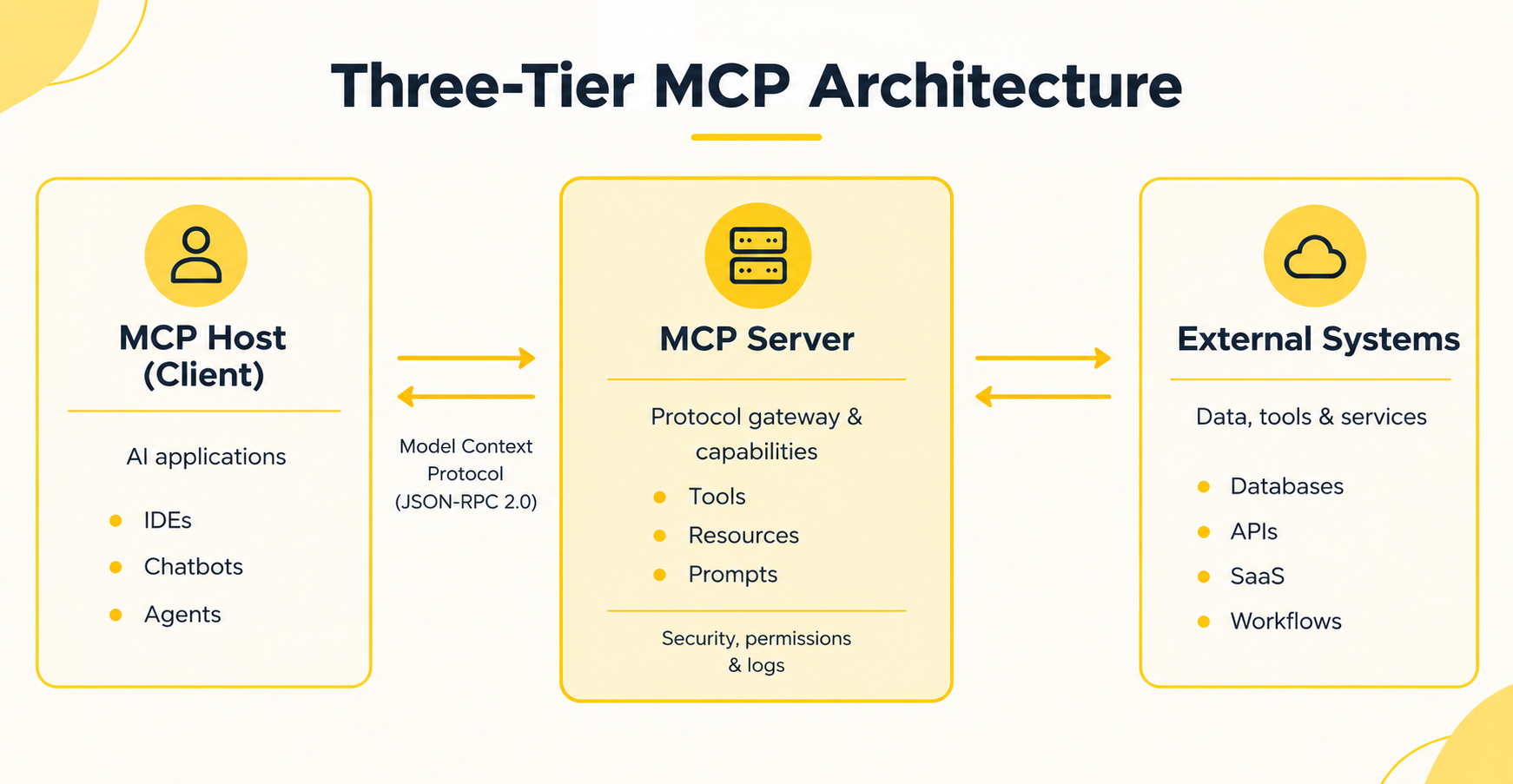
LLMs are frozen at training time. A model can't query your database or check today's inventory count unless something else connects it to that system.
An MCP server is that connection. It's a lightweight adapter that takes a request from an AI application and turns it into a specific backend operation, a database query, an API call, or a file read. Build the server once, and any MCP-compatible client can call it, instead of writing custom integration code for every AI model your company happens to use.
Under the hood, MCP servers communicate using JSON-RPC 2.0 over a standard transport layer, either stdio or Streamable HTTP/SSE. The server doesn't check which model sent the request. It only checks whether the request matches its schema.
Anthropic no longer governs MCP alone. In December 2025, it handed stewardship of the protocol to the Agentic AI Foundation under the Linux Foundation. OpenAI and Google DeepMind backed the move. MCP went from an Anthropic-specific tool to a vendor-neutral standard around that point, which is why building an MCP server is now ordinary backend work, not something specific to Claude.
Why MCP Servers Aren't a Standard Offshore Project
An MCP server exposes three things to a model: tools it can call, resources it can read, and prompts it can reuse. That's the entire surface area. Writing one means defining exactly what an LLM can do and see, not building generic backend logic.
One Server, One Domain: Each MCP server should map to a single domain, a ticketing system, an internal database, or deployment logs. Combining domains into one server increases the damage if something goes wrong.
Higher Stakes Than a Typical API: A normal API bug returns a wrong value. A bad tool schema on an MCP server can make an LLM call the wrong function with the wrong data, against a system that trusts it.
How to Build an MCP Server With Offshore Development Team
Getting these three things right (specs, access control, and a standardized build process) is what separates an MCP server that survives contact with production from one that turns into a support burden. Here's how you can build an MCP server with an offshore development team.
1. Set the Specs Before Writing Any Code
Most MCP failures trace back to specs that got skipped, not code that got rushed. Nailing down the server boundaries, schemas, and transport before anyone starts coding saves you from rewrites once the offshore team is three weeks deep.
Split by domain: Build one MCP server per system: one for your ticketing tool, one for the internal database, one for deployment logs. A single server that reaches across all three becomes the one place a mistake does the most damage. Keeping domains separate also makes it easier to hand different servers to different offshore engineers without them stepping on each other's work.
Write the schema first: Define exact input and output schemas in Zod for TypeScript or Pydantic for Python before your offshore team opens an editor. The schema is what the model reads to decide how to call a tool, so a loose or ambiguous field definition doesn't just risk a bug; it risks the model passing the wrong value into a live system. Review and sign off on the schema as its own deliverable, separate from the code.
Pick the transport upfront: Use stdio for servers that run locally, inside an IDE or a desktop AI assistant. Use Streamable HTTP or SSE for servers that need to run remotely and serve cloud-based agents. This isn't a detail to leave to the developer's judgment. It determines how the server gets deployed, how it authenticates, and how it scales, so it needs to be in the spec on day one.
2. Lock Down Data and Credentials
MCP servers sit close to real systems, so the access rules matter as much as the code itself. These three habits keep a testing shortcut from turning into a production incident.
No production access for testing: Offshore engineers should test every tool against a sandboxed environment with representative but non-real data. Granting even read-only production access "just for testing" is the most common shortcut that turns into a permanent hole.
Build auth in from day one: OAuth 2.1 or bearer token validation belongs in the server template before a single tool is implemented. If authentication gets added at the end, it usually gets added around code that wasn't written with access boundaries in mind, and retrofitting security is where gaps get missed.
Keep secrets out of the codebase: Route API keys and credentials through environment variables and a secrets manager such as AWS Secrets Manager or HashiCorp Vault, never hardcoded or committed to a repo the offshore team can access. Extend the same rule to logs. A credential printed to a debug log is as exposed as one committed to Git.
3. Standardize How the Team Builds and Tests
MCP servers sit close to real systems, so the access rules matter as much as the code itself. These three habits keep a testing shortcut from turning into a production incident.
Automate the testing: Offshore teams should deliver automated smoke tests alongside every server and validate tool outputs with the official MCP Inspector before the code ever reaches your review queue. This shifts verification earlier, so issues surface during the offshore team's own working hours instead of after a handoff, when a fix means waiting a full day for the time zone to align again.
Pick one stack, one container setup: Standardize on a single SDK, Node.js, Python, or Go, across every MCP server in your fleet, rather than letting each developer pick their own. Run everything through Docker so a reviewer on your side can pull the exact build the offshore team tested and run it without a live call to debug environment differences.
What the Engagement Model Should Actually Look Like
MCP servers aren't a one-time build; they keep changing as your internal systems do. The team structure you pick determines whether that ongoing work stays manageable or turns into a rebuild every few months.
Dedicated Team Over Freelance or One-Off Staff-Augmentation
MCP server work doesn't end at launch. New internal tools get added, schemas change as your systems evolve, and existing servers need patching as the spec itself keeps moving. A dedicated offshore team that stays with the codebase catches this drift early. A freelancer or a rotating staff-aug pool has to relearn your bounded contexts and schema decisions every time someone new picks up the work, which is exactly where the shortcuts from the sections above start creeping back in.
What to Put in the Contract
Specify the deliverables that actually matter for this kind of work, not generic milestones:
-
Named bounded contexts for each server, agreed before work starts
-
Schema sign-off as its own deliverable, separate from code
-
Sandboxed environments for all testing, with no path to production data
-
Containerized handoff for every server, so builds are reproducible on your side
Treat this list as a floor for any offshore proposal you're evaluating, not just a nice-to-have.
A Realistic Build Timeline
A first MCP server moves through the same rough sequence every time: spec, schema review, sandboxed build, containerized handoff, smoke tests. The length of each stage depends on how many tools the server exposes and how complex the underlying system is. If an offshore partner quotes you a fixed timeline before they've seen your spec, that's a number they made up, not one they calculated.
Cost Optimization and Project Timeline Management
Three phases decide where the budget actually goes on an MCP server build, and misallocating effort across them is where teams overspend.
Architecture and spec design carries the most risk per decision and the least room for offshore cost savings. Keep senior architects, onshore or offshore, on this phase. The transport layer choice and the schema design made here constrain everything built afterward, so this isn't the phase to cut corners on seniority to save cost.
Core implementation is where offshore cost advantages actually show up. Once the schema is signed off, writing handler code against it is repeatable work that doesn't require someone to hold the full system in their head. This is the highest-leverage phase for offshore effort.
Ongoing maintenance works well offshore too, but only if the team that built the server stays on it. A new team inheriting an MCP server without context on why the bounded contexts were split the way they were ends up relearning decisions instead of maintaining them.
The most expensive timeline mistake is deferring CI setup until after core development starts. Running MCP Inspector validation on every pull request from day one catches schema and protocol issues while they're cheap to fix, instead of during a compressed QA window at the end.
Common Mistakes When Offshoring MCP Development
These mistakes share a pattern: they save time in week one and cost more in week eight, usually after the code has already shipped and someone else is stuck untangling it. Here's where that trade-off shows up most often.
1. Vague Interface Contracts
A schema with loosely typed fields or missing validation rules looks fine in review and breaks during integration. By then, the offshore team has already built against the wrong assumptions, and the fix touches both the server and whatever called it.
2. Broad Access That Was Supposed to Be Temporary
A developer asks for wider database access to debug one issue faster, gets it, and nobody revokes it once the issue is fixed. This is how sandboxed testing quietly turns into standing production access with no one deciding it should.
3. One Server Covering Too Many Systems
Combining the ticketing integration and the internal database into a single MCP server saves a bit of setup time upfront. It also means a bug or a compromised credential in one integration now has a path into the other.
Conclusion
MCP server development isn't harder than typical offshore work because of the protocol itself. It's harder because the server sits directly between an LLM and systems that were never built with a model in mind. Get the specs, access boundaries, and build process right, and an offshore team can run this work as reliably as any other part of your stack. Skip any of them, and the shortcuts show up later, usually in production, usually at the worst time.
If you're weighing whether to build this in-house or bring in outside engineering capacity, it's worth evaluating any partner against the specifics in this piece: named bounded contexts, schema sign-off as its own step, sandboxed access, and containerized handoffs. That checklist tells you more about whether a team is ready for this work than a portfolio does.
Your Team in India runs MCP server development on exactly this model: dedicated engineers, schema sign-off before a line of code ships, and sandboxed access by default. Talk to us about your MCP build.
Frequently Asked Questions

REST APIs communicate over HTTP status codes. MCP servers communicate using JSON-RPC 2.0, so errors come back as structured, typed objects instead of an HTTP 500. An offshore team used to REST-only work needs to unlearn that default, or tool failures surface as generic errors instead of ones the calling model can actually interpret.
Split work by tool or resource boundary, not by file. Each pull request should touch one tool's schema and handler together, so a reviewer working async, often the next day given the time difference, can review it without needing the full server in front of them.
Keep a short document mapping each server to the protocol version it was built against. The July 2026 spec update moved MCP's core architecture from stateful to stateless, which is exactly the kind of change that breaks a server silently if nobody's tracking which version it targets.
Returning a generic error instead of a structured JSON-RPC error object. Running MCP Inspector on every pull request, not just before release, catches malformed responses while they're a one-line fix instead of a production incident.

By Mangesh Gothankar


By Ashwani Sharma
By Achin Verma




.png?width=352&name=ai-agent-development-offshore--teams%20(1).png)


 4.8 out of 5 by