The global AI in retail market was valued at USD 12.40 billion in 2025 and is projected to reach USD 105.88 billion by 2034, growing at a CAGR of 26%. Most retail businesses cannot build this internally. AI in retail spans data engineering, machine learning, natural language processing, and computer vision, and few retail organizations have all four skill sets on staff.
So the practical question is not whether to adopt retail AI solutions. Yes, it is important to hire an AI development team for retail automation who understand retail operations. They must be able to build something that works with real POS data, real supply chain data, and real customer behavior, not a generic model trained on someone else's industry.
This guide covers what you actually need to hire an AI development team for retail automation: the roles a retail AI project requires, what those roles cost, and which engagement model fits your project.
Why Retail Businesses Hire AI Development Team for Retail Automation
The retail industry generates more data than most industries know what to do with, and hiring a dedicated team is how retail companies turn that data into something that actually works day to day.
The data problem basic automation cannot solve: A typical retail business logs transaction data, loyalty program data, customer feedback, purchase history, store traffic, and supply chain data every day. Most of it sits in a system nobody looks at until the monthly report gets pulled. A basic automation tool can move that data from one system to another. Predicting which SKU is about to stock out or which customer is close to churning needs a machine learning model trained on your own operational data.
Why retail companies choose external teams over in-house hiring: A generic recommendation model does not know your seasonality, your regional demand patterns, or your loyalty tiers. Getting a model that does usually means bringing in people who have tuned one for retail before. Hiring full-time machine learning engineers and AI/LLM engineers directly takes months, and most retail projects do not need them on payroll forever, just for the scope of the build. Retail brands already running AI-powered solutions for demand forecasting, dynamic pricing, and customer insights are the ones setting the pace right now, and most of them tie the project to a specific business goal, like faster inventory turns or fewer stockouts, rather than adopting AI for its own sake.
A retail chain running twenty physical stores and an online storefront does not usually have a machine learning engineer sitting idle waiting for a pricing project. That is the gap an external retail AI development team fills.
What Does a Retail AI Development Team Actually Build?
AI solutions for retail cover more ground than most people expect going in. Before you hire AI developers for retail, it helps to know what you're actually asking them to build, since that shapes which roles you need and what the project costs.
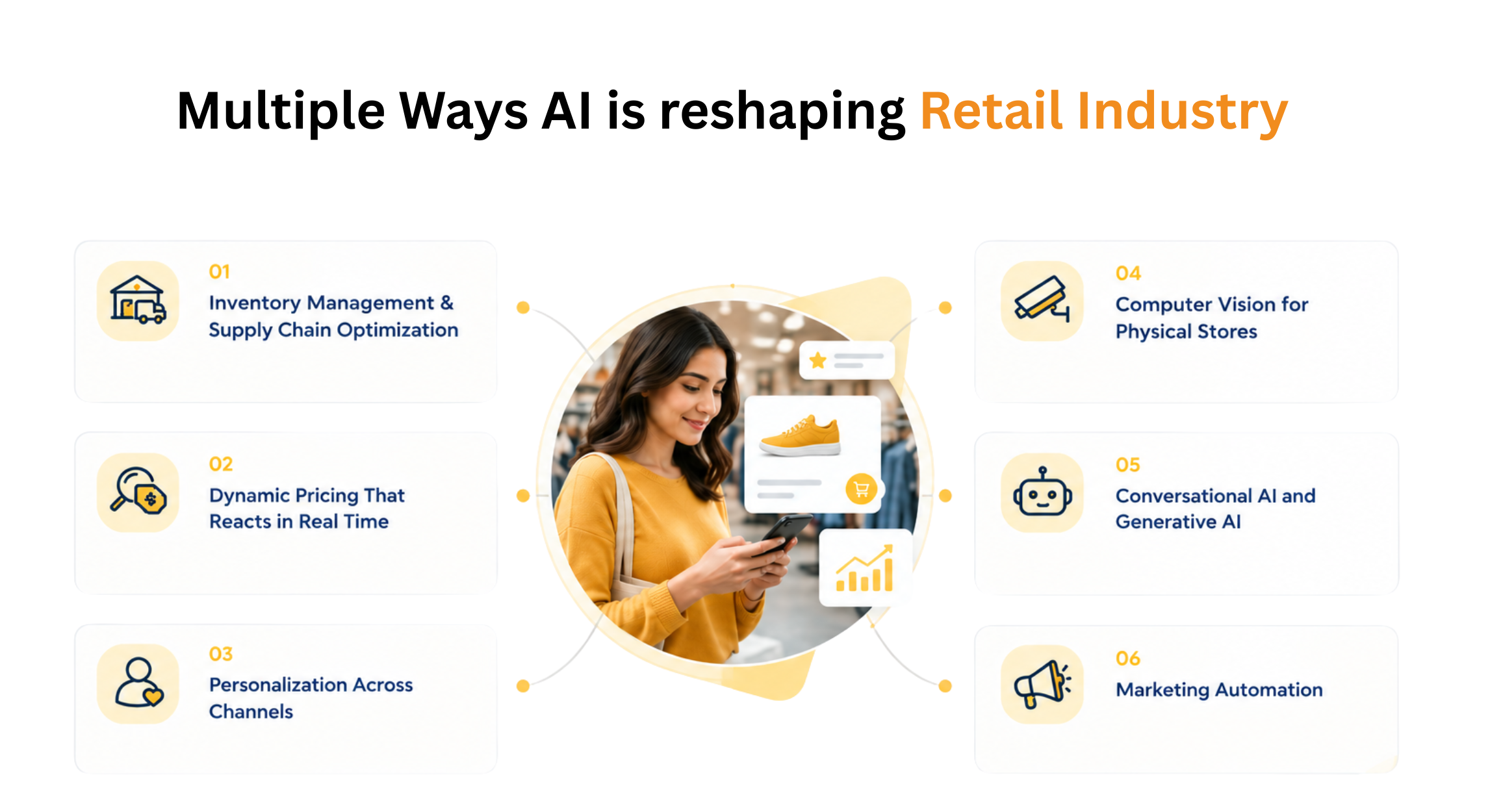
1. Inventory management and supply chain optimization
Most inventory tools can tell you what sold last week. Few can tell you what's about to sell out at a specific store next week. That gap is what a machine learning model closes once it's trained on supply chain data, sales trends, and enough historical demand to spot the pattern. Retail executives tend to start here, largely because the POS and inventory data is already sitting in existing systems and doesn't need to be built from scratch. It ultimately helps improve supply chain management and boost operational efficiency. Retailers overcome most of their inventory problems this way, by improving inventory management at the forecasting stage instead of reacting after a shelf is already empty.
One multi-channel retailer took this route with a dedicated AI team and cut stock-related delays by 15% while onboarding new SKUs 40% faster; the full ShopEase case study breaks down what the build involved.
2. Dynamic pricing that reacts in real time
A lot of retail pricing still happens in a spreadsheet, updated by hand once a week if someone remembers. A dynamic pricing engine removes that lag. It tracks customer demand, competitor pricing, and current inventory levels, and adjusts prices the moment those numbers shift, not on whatever day the next review happens to fall. Real-time data is what separates a genuine dynamic pricing setup from a scheduled batch job that just runs more often.
3. Personalization that follows the customer across channels
Recommendation engines, automated support that handles customer queries, and personalization built on purchase history and customer data add up to more relevant shopping experiences across every sales channel a customer touches, not just the one they happened to convert on. The same logic applies to technical support: a system that already knows a customer's order and delivery status resolves routine questions faster than a generic script.
4. Computer Vision for Physical Stores
Shelf monitoring, store layout analysis, and foot traffic tracking extend AI off the website and mobile apps and onto the sales floor. Retail systems use this for loss prevention and for understanding how store layouts actually affect buying behavior, which POS data alone cannot show.
5. Conversational AI and Generative AI
Natural language processing and generative AI power shopping assistants and product Q&A, handling routine customer conversations so support staff can focus on the cases that actually need a person.
6. Marketing Automation
AI-driven marketing campaigns built on customer insights and consumer behavior data, targeting offers with more precision than a manually built segment ever could.
Most retail AI development companies can deliver across all six areas. Few retail businesses need all of them on day one. The roles below are what it takes to build any one of them properly.
Essential Roles You Need on a Retail Artificial Intelligence Team
A retail AI project usually breaks down for a boring reason: someone forgot a role, not because the model itself was wrong. Here is who actually needs to be involved, and what happens when one of them is missing.
a) Data Engineer
Retail data comes from a dozen different places: POS exports, inventory systems, loyalty program data, e-commerce platforms, and almost none of it uses the same format. The data engineer's job is cleaning and structuring that mess before anyone touches a model. Skip this role and every project downstream slows down, because the team ends up fixing data quality problems mid-build instead of before it starts.
b) Machine Learning Engineer
This is the person who actually builds and trains the models: demand forecasting, dynamic pricing, whatever the use case is. A good retail ML engineer has seen enough retail data to know that a spike around a holiday weekend is not the same thing as a spike from a viral product, and builds the model to tell the difference.
c) AI/LLM Engineer
Covers anything conversational: shopping assistants, product recommendation logic, retrieval systems that let an AI agent actually answer a question about your specific catalog instead of guessing. This role overlaps with the ML engineer at some shops, but for a serious generative AI build, you want someone who specializes in it.
d) MLOps Specialist
A model that works in testing and a model that works in production are two different problems. The MLOps specialist is the one who deploys it, watches it, and keeps it running as your sales channels, seasons, and data sources shift under it. This is the role smaller vendors skip most often, and it is usually why a retail AI pilot never makes it past its first year.
e) Project Manager
Someone has to connect what the engineers are building to what the business actually needs: inventory turnover, customer satisfaction, margin. A project manager who has worked in retail before, not just in software delivery, is worth asking for by name.
Depending on the project, you might also need a UI/UX designer for anything customer-facing, or a QA engineer to test model accuracy and catch bias before launch. Worth raising in the first conversation with any retail AI development company you're evaluating.
What Does It Cost to Hire AI Developers for Retail?
Cost comes down to three things: experience level, where the developer is based, and how the engagement is structured. Here is what the market looks like right now.
Hourly rates by experience level
Offshore hubs like India offer the same skill level at roughly 50 to 70 per cent less than hiring the equivalent role in the US or Western Europe. Retail software development services built through an offshore or dedicated team model have picked up a lot of mid-sized retailers for exactly that reason.
Project-level costs
Hourly rate only tells you part of the story. What you actually pay depends more on scope and how clean your data already is.
A small pilot, say a demand forecasting model for one product category, usually runs $40,000 to $80,000. A mid-scale project that combines two or three use cases, pricing plus inventory plus a recommendation engine, lands somewhere between $80,000 and $150,000. A full retail AI platform spanning multiple sales channels and integrations can run $150,000 and up, sometimes well past $250,000 for a large retail organization.
Data readiness moves these numbers more than anything else. If your sales data and customer data are already centralized and reasonably clean, you land toward the lower end of any range. If a data engineer has to spend the first several weeks reconciling inconsistent POS and inventory systems before any model work starts, budget for that time separately.
Engagement Models: Which One Fits Your Retail AI Project?
How you structure the engagement changes the outcome almost as much as who you hire. Four engagement models cover most retail AI projects.
1. Dedicated Team
A full-time external team- data engineer, ML engineer, AI/LLM engineer, MLOps specialist, project manager- works only on your retail platform. Functionally, they operate as an extension of your own staff. Pick this when AI is turning into core infrastructure for the business rather than a single project, since you keep the same people who built the first model around to improve it later. Best for retail brands treating AI as something ongoing, not a one-time deliverable.
2. Staff Augmentation
Instead of a full team, you bring in one or two specialists and slot them into a technical department you already have, maybe an ML engineer, maybe someone who handles MLOps. If your in-house developers are strong but nobody on staff has actually shipped a production model before, this is usually the cheaper fix compared to hiring a whole new team.
Retail companies with a working tech team lean toward this option most often. They don't need five new hires. They need the one or two skills nobody in the building has yet.
Recommended Read: Choose The Right Model To Hire Remote Developers
3. Project-Based Engagement
Here the vendor agrees to build one specific thing, say a restocking agent or a pricing module, for a fixed price and a fixed timeline. You know the cost going in. You know roughly when it ships.
This suits a retailer testing the waters for the first time. Scope stays tight, so there's less room for the budget to creep, and less risk if the whole idea turns out not to work the way you hoped.
4. Time and Materials
You pay an hourly rate as the work continues, and the scope is allowed to shift. This tends to suit generative AI and AI agent projects specifically, since testing with real customer conversations often changes what needs to be built partway through.
Best for exploratory projects, or for retailers who expect requirements to change once they see what the AI platform can actually do.
How to Choose the Right Retail AI Development Company
A few questions separate a retail AI development company that delivers from one that just talks a good game. Ask for retail case studies, not a general AI portfolio. A vendor who has only worked in healthcare or fintech will burn your first few weeks relearning things a retail team already knows.
Watch whether they ask about your data sources before pitching a model, and whether they can speak to your POS or inventory management setup specifically. Also ask what happens after launch, since retail models drift as seasons and buying patterns change, and retraining sometimes gets billed separately.
Conclusion
Getting this right comes down to matching the roles, the budget, and the engagement model to what your business actually needs, not what a vendor wants to sell you. That's the whole point of this guide.
If you're ready to move on, Your Team In India can help you hire an AI development team for retail automation who already understand retail: POS integrations, optimize inventory, demand forecasting, the parts that generic AI shops tend to get wrong. We work across all four engagement models: dedicated team, staff augmentation, project-based, or time and materials, so the structure fits your project instead of the other way around.
Whether you need to hire an AI development team for retail automation from the ground up, or bring in one or two AI developers for retail to fill a specific gap, our team can scope it with you. Talk to Your Team In India about your retail AI project and get a straight answer on cost, timeline, and the right engagement model for where you are right now.
Frequently Asked Questions

Budget $40,000 and up for a single-use-case pilot, like a demand forecasting model. Combine two or three features, say dynamic pricing plus inventory management plus personalization, and you're looking at $80,000 to $150,000. Full platforms spanning multiple sales channels can run past $250,000, and the gap between those numbers usually comes down to how much cleanup your data needs first.
Five roles cover most retail AI builds: data engineer, machine learning engineer, AI/LLM engineer, MLOps specialist, project manager. For a smaller pilot, say one demand forecasting model, a data engineer and a single ML engineer can usually get it done without the full roster.
Staff augmentation means dropping one or two specialists, an ML engineer or an MLOps person, into a technical team you already have. A dedicated team is a separate group that works only on your retail AI platform. Companies planning to keep building on AI for years tend to go dedicated; companies filling one gap tend to augment.
Usually, yes, through APIs rather than a rip-and-replace. Still ask this directly during scoping. Integration complexity is one of the biggest swing factors in both cost and timeline, and it's easy for a vendor to gloss over until you're already under contract.
6 to 12 weeks for a single-use-case pilot, like demand forecasting or dynamic pricing. 4 to 8 months for a multi-feature build covering inventory, pricing, and customer experience together. Data quality is what usually pushes a project toward the longer end.
No. Online, it runs through your website and app, reading purchase history and browsing behavior to personalize what a shopper sees. In-store, it leans on computer vision and foot traffic data for things like loss prevention and layout analysis. Feed both into one system and you get a unified customer experience, even though the tech underneath each channel is doing something different.

By Mangesh Gothankar


By Ashwani Sharma
By Achin Verma






 4.8 out of 5 by