Digital transformation leaders are under pressure to turn generative AI into measurable business value, not just working demos. That pressure is justified.
Gartner predicted that at least 30% of generative AI projects would be abandoned after proof of concept by the end of 2025, largely because of weak data readiness, poor governance, rising costs, or unclear business outcomes.
McKinsey reported in November 2025 that nearly two-thirds of organizations had not yet begun scaling AI across the enterprise, and only 39% reported EBIT impact. That is the real enterprise challenge now.
Companies need AI systems that retrieve the right information, respond within acceptable latency, align with governance requirements, and justify ongoing investment. A strong offshore RAG pipeline optimization team helps enterprises close that gap by focusing on retrieval quality.
Let us dig into the blog to understand how the retrieval pipeline optimization can aid with system performance, architectural discipline, and operational accountability from day one.
What Enterprise-Grade RAG Actually Means?
Enterprise-grade RAG is a retrieval-augmented generation production system that delivers accurate, auditable answers under real security, latency, and cost constraints.
A working prototype can impress a room. An enterprise-grade system has to perform under pressure. It has to retrieve approved information from fragmented repositories, respect role-based access, surface citations, and maintain response quality even as content changes.
That is why enterprise RAG should be understood as infrastructure rather than interface. The interface is what users see. The retrieval pipeline is what determines whether the answer deserves trust.
This distinction matters even more as business usage grows. OpenAI reported in December 2025 that it now serves more than 1 million business customers, with ChatGPT message volume growing 8x and API reasoning token consumption per organization increasing 320x year over year. Growth at that scale increases pressure on architecture choices, cost discipline, and system observability.
For CEOs, CIOs, and transformation leaders, enterprise-grade RAG is no longer about proving a use case. It is about proving repeatability, governance, and return on investment.
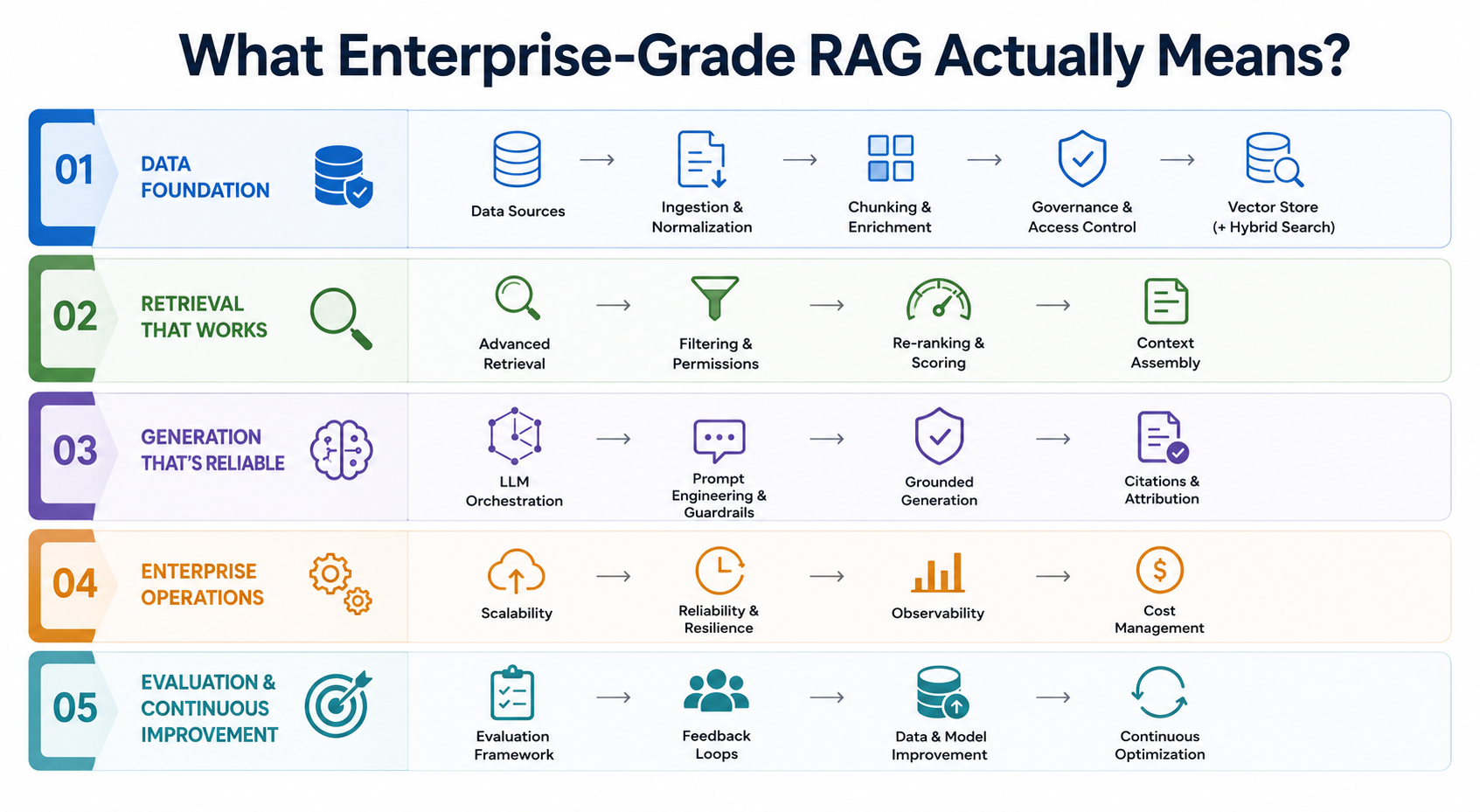
RAG Demo vs Enterprise-Grade Production: What Changes?
A RAG demo proves the concept can answer. Production proves the system can answer reliably, securely, and cost-effectively across real workflows. In a demo, teams often use a clean document set, a narrow prompt, and a forgiving audience.
In production, the environment changes completely. Content is inconsistent, permissions matter, response latency affects adoption, and answer quality must hold across thousands of queries. The architecture also becomes broader.
What was once a prompt-and-model exercise becomes a pipeline involving ingestion, chunking, embeddings, hybrid retrieval, reranking, observability, and governance. That shift is where many companies stall. Enterprise value begins when retrieval quality becomes measurable and operational discipline replaces prototype optimism.
Related Read: Hiring for RAG vs. Fine-Tuning
Why Retrieval Breaks First In Production?
The retrieval pipeline is the system that turns raw enterprise content into usable context for the model.
Most production issues begin long before the model generates an answer. They begin when source documents are poorly parsed, metadata is incomplete, document freshness is unmanaged, or access control rules do not carry forward into search results. In other words, the AI output becomes unreliable because the information pipeline beneath it is unreliable.
Ingestion Quality Determines Trust
In enterprise environments, source material is inherently messy. Teams work across PDFs, emails, knowledge bases, policy documents, CRM notes, support tickets, spreadsheets, and internal wikis. If ingestion does not preserve structure, ownership, document versioning, and sensitivity labels, retrieval quality degrades immediately. The system may still return fluent answers, but the business will not trust them.
Chunking Determines Relevance
Chunking is one of the most underestimated parts of enterprise RAG performance tuning. If chunks are too large, the retriever pulls a broad but diluted context. If they are too small, the critical meaning gets fragmented across multiple records. The strongest systems preserve section boundaries, tables, headings, and domain-specific identifiers so the retriever can work with meaningful context instead of arbitrary text slices.
Search Strategy Determines Precision
Many teams still assume vector search alone is enough. In enterprise settings, it rarely is. Policy IDs, product codes, legal clauses, and exact business terminology often require sparse retrieval or keyword precision alongside semantic search. That is why hybrid retrieval is increasingly viewed as the practical standard. TechTarget noted in April 2026 that hybrid search frameworks are reshaping retrieval for AI because organizations need both semantic and exact-match performance.
Reranking Determines Final Context Quality
Even when retrieval returns relevant passages, context quality still depends on which passages are prioritized. Reranking helps the system surface the most useful evidence before generation begins. In practice, this reduces noisy context, improves citation quality, and increases answer confidence for business users.
|
Pipeline Stage |
What Goes Wrong |
Business Impact |
Metric |
|
Ingestion |
Broken parsing or stale content |
Low trust |
Freshness rate |
|
Chunking |
Loss of structure or context |
Weak relevance |
Recall@k |
|
Retrieval |
Vector-only or poor filters |
Missed evidence |
Precision@k |
|
Reranking |
Irrelevant ordering |
Noisy answers |
NDCG / MRR |
|
Generation |
Weak grounding |
Hallucination risk |
Grounded answer rate |
The Retrieval Pipeline Optimization Guide
RAG pipeline optimization improves retrieval quality, latency, governance, and cost across the full answer lifecycle.
The fastest way to improve retrieval augmented generation production is not to change the LLM first. It is to strengthen the retrieval system that feeds it.
Start With Corpus Design
A mature RAG program begins by deciding what knowledge belongs in the system and how that knowledge should be governed. High-value source systems require document ownership, metadata standards, access rules, update frequency, and relevance criteria to be defined up front. When enterprises skip this step, they usually end up over-indexing irrelevant material and under-serving the workflows that matter most.
Use Hybrid Retrieval As The Default Enterprise Pattern
Hybrid search combines dense retrieval with sparse or keyword retrieval, so the system can understand semantic meaning while still catching exact-match business language. This is especially important in regulated industries, technical documentation environments, and support operations where a single code, version number, or clause can change the right answer entirely.
A recent enterprise retrieval paper in Discover Computing describes the growing need for customizable hybrid retrieval and privacy-preserving reranking in enterprise document search systems. That direction aligns with what enterprise teams are already implementing in production: retrieval logic has to reflect both relevance and control.
Tune Latency Where It Actually Matters
Latency in RAG systems is cumulative. It comes from embedding calls, retrieval fan-out, metadata filtering, reranking, orchestration, and generation. The mistake many teams make is focusing only on model inference time. In practice, enterprise RAG performance tuning requires query-path analysis across every stage. Top-k settings, ANN index tuning, caching, prompt assembly, and model routing all influence user experience and infrastructure cost.
Treat Vector Database Optimization As A System Decision
Vector database optimization is often discussed too early and too narrowly. The database matters, but it should follow use-case constraints rather than vendor popularity. Some organizations can move quickly with pgvector or Elasticsearch-based hybrid search.
Others need platforms like Pinecone, Weaviate, Qdrant, or Milvus due to scaling needs, metadata filtering requirements, multitenancy, or low-latency targets. Grand View Research estimated the vector database market at $2.05 billion in 2024 and projects it to reach $7.34 billion by 2030, reflecting strong demand but not a one-size-fits-all architecture.
Build Evaluation Before You Scale Traffic
An enterprise system should never be released on intuition alone. It needs benchmark queries, failure categories, regression tracking, groundedness checks, citation accuracy tests, and business-specific acceptance thresholds. If a delivery partner cannot explain how retrieval quality is measured before and after changes, the organization is not looking at a production-ready process.
7 Enterprise RAG Mistakes That Destroy Production ROI
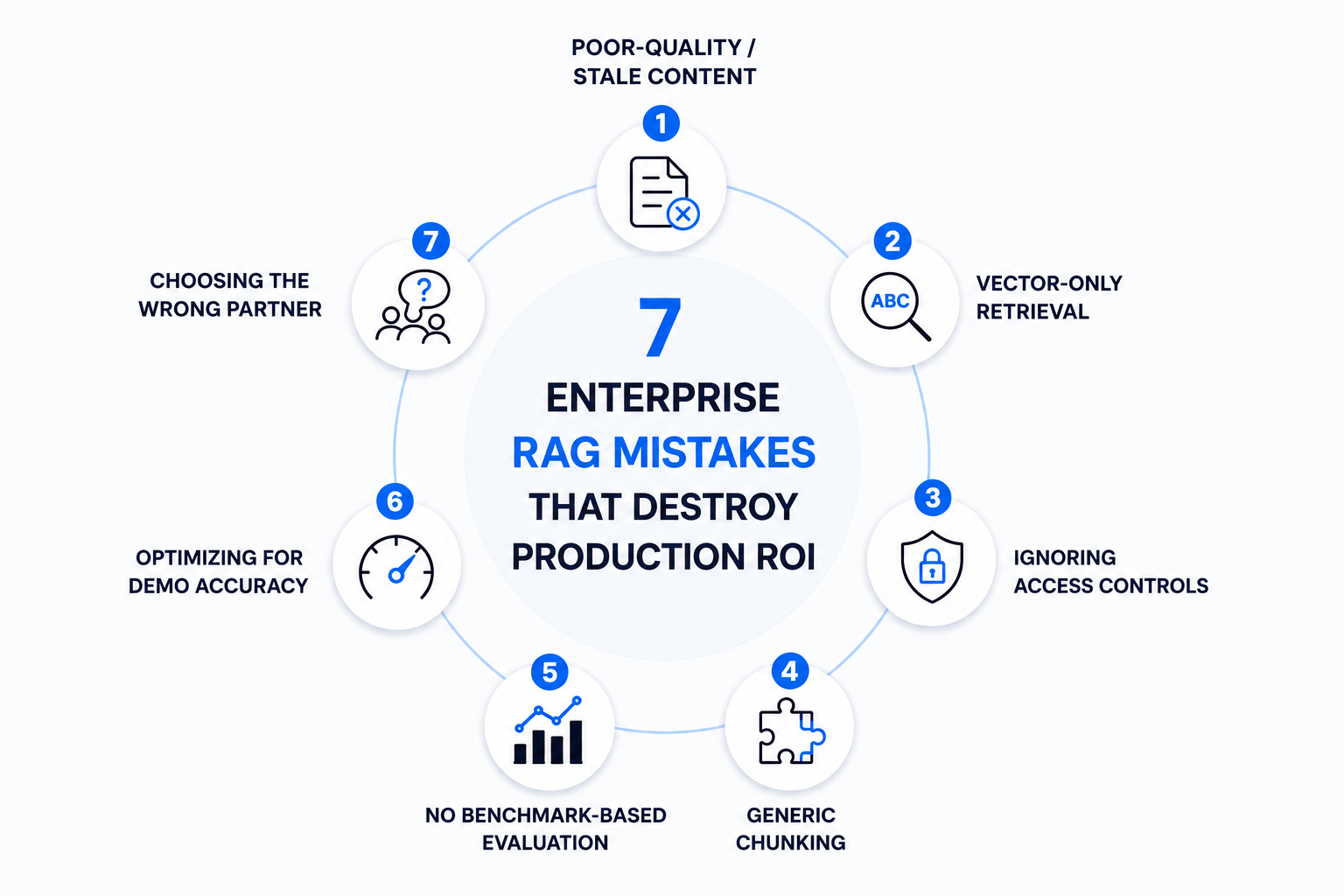
The biggest RAG failures usually come from operating shortcuts, not model limitations.
-
The first mistake is indexing poor-quality or stale content and expecting the model to correct it.
-
The second is relying on vector-only retrieval when exact-match business language matters.
-
The third is ignoring access controls inside the retrieval layer.
-
The fourth is treating chunking as a generic preprocessing step.
-
The fifth is launching without a benchmark-based evaluation.
-
The sixth is optimizing for demo accuracy instead of production latency and cost.
-
The seventh is choosing an implementation partner that cannot explain retrieval metrics, failure modes, and rollback plans.
Each of these mistakes reduces trust, slows adoption, and turns an AI initiative into an expensive experiment.
What CEOs And Digital Transformation Leaders Should Evaluate?
Enterprise RAG ROI comes from aligning architecture choices with business goals, risk tolerance, and long-term operating models.
The CEO-level conversation has shifted. The important question is no longer whether generative AI can answer questions. The important question is whether the system can reduce support costs, improve employee productivity, shorten decision cycles, and do so without introducing governance risk or spiraling infrastructure spend.
Technology Stack Should Follow Workflow Value
A good enterprise RAG stack includes ingestion services, embedding models, search infrastructure, reranking, access control enforcement, evaluation pipelines, observability, and application integration. But stack decisions should always follow workflow design. If the use case is internal policy search, the architecture may differ significantly from a customer support copilot or a field-service assistant.
Governance Should Be Built Into Retrieval
Governance is not a post-launch layer. It has to be part of the retrieval logic from the beginning. That includes source-level permissions, data classification, prompt and response logging, auditability, fallback policies, and human review for high-risk actions. This is especially important in sectors where retrieval quality affects legal, financial, or compliance outcomes.
Cost Control Should Be Visible Early
Many companies underestimate the true cost of retrieval augmented generation production because they focus on model pricing alone. Real costs also sit in document processing, storage, indexing, reranking, monitoring, and integration maintenance. Strong architecture decisions reduce those costs by routing requests intelligently, caching effectively, and limiting expensive operations to high-value cases.
Partner Selection Should Be Metric-Driven
If a company is choosing an offshore or implementation partner, it should evaluate more than delivery capacity. The right partner should be able to define measurable retrieval targets, explain architecture trade-offs clearly, and show how performance tuning connects to business outcomes. In 2026, that is the difference between an AI vendor and an enterprise transformation partner.
Enterprise RAG Cost Drivers Leaders Must Evaluate
Enterprise RAG cost is shaped by far more than model tokens. Leaders should evaluate document parsing volume, embedding generation, vector storage, query traffic, reranking depth, observability tooling, and the effort required to maintain source freshness.
Costs also rise when teams over-index low-value content, use oversized context windows, or route every query to the most expensive model.
The stronger operating model is to align infrastructure with business-critical workflows first, then tune latency, caching, and retrieval paths around real usage data. This is where architecture maturity drives ROI. When leaders understand where the system spends money, they can make better decisions on stack design, partner choice, and rollout scope.
How Offshore Teams In India Accelerate Enterprise RAG?
An offshore team adds value when it combines engineering depth, delivery discipline, and measurable optimization across the retrieval lifecycle.
India-based teams are well-positioned for this work because enterprise RAG is inherently cross-functional. It requires data engineering, search expertise, MLOps awareness, software integration, and QA discipline operating against the same benchmark framework. The value is not simply lower cost. The value is sustained execution across ingestion, retrieval, reranking, evaluation, and production hardening.
Offshore Delivery Works Best With Clear Architecture Ownership
The strongest operating model typically includes a solution architect, data engineer, ML engineer, application engineer, and QA support working from a shared retrieval roadmap. That model prevents the common failure mode where one team optimizes embeddings, another team changes prompts, and nobody owns measurable answer quality.
Follow-The-Sun Execution Reduces Delivery Lag
When internal product or transformation leaders define business priorities during their local day, a distributed offshore team can continue retrieval tuning, indexing work, evaluation runs, and integration support in parallel. That shortens iteration cycles and helps enterprise programs move faster without creating architecture chaos.
Documentation And Observability Reduce Rework
Production RAG programs need more than code. They need decision logs, benchmark history, retrieval dashboards, query failure classification, and change-management discipline. This is where mature offshore teams create disproportionate value. They turn optimization into an operating capability rather than a series of ad hoc fixes.
The execution gap remains large across the market. McKinsey found that nearly two-thirds of organizations had not yet begun scaling AI enterprise-wide, while OpenAI reported that 75% of workers using AI said it improved speed or quality and that users saved 40 to 60 minutes per day. That contrast is exactly why companies need disciplined implementation.
Conclusion
Enterprise RAG succeeds when retrieval is treated as a strategic system, not a chatbot feature. The organizations that scale successfully do not begin with prompt experimentation alone. They begin with corpus quality, chunking logic, hybrid retrieval, vector database fit, evaluation rigor, and governance by design.
That is what transforms a promising demo into an enterprise asset for us at Your Team in India. For leaders navigating digital transformation, it is necessary to remember that the real advantage comes from choosing an architecture and delivery model that reduces risk, accelerates implementation, and turns AI into measurable operational value.

By Mangesh Gothankar


By Ashwani Sharma
By Achin Verma
Frequently Asked Questions

They fail because retrieval quality, data freshness, governance, and performance are weak.
Yes, when supported by documented governance, secure development workflows, role-based access, and measurable delivery standards.
It includes ingestion optimization, chunking design, hybrid retrieval, metadata filtering, reranking, latency control, caching, evaluation, and observability.
They should start with retrieval needs, filtering complexity, scale, multitenancy, and governance requirements, then choose the simplest architecture that meets those constraints reliably.
A company should use one when it needs to accelerate implementation with specialized retrieval, data, and AI engineering support without building the full capability internally first.
They should ask for benchmark metrics, governance design, cost-per-answer estimates, integration readiness, rollback plans, and proof that the system improves a business workflow rather than only a demo scenario.







 4.8 out of 5 by