RPA is a type of business process automation that allows anyone to define instructions for a robot or "bot" to perform. To be precise, no physical robots are involved in robotic process automation.
Instead, the "robot" in RPA is a software bot capable of understanding what's on a screen, navigating systems, identifying and extracting data, and performing a wide range of defined actions, all error-free, at high speed and volume, without interruption.
RPA automates everyday, mundane, and repetitive workplace processes, such as copy-paste tasks or moving files from one location to another. That's how RPA drives measurable efficiency gains for organizations in 2026.
As companies continue racing to stay competitive, the demand for expert RPA consulting services has surged. Businesses are actively seeking ways to streamline operations, cut costs, and redirect focus toward value-added activities, and RPA addresses all three. It's no surprise that mid-to-large organizations are increasingly looking to hire RPA developers and work with a qualified RPA consultant to implement automation at scale.
RPA Is Powerful, But Only When Done Right
RPA gets a lot of buzz, and for good reason. But the hype can sometimes create unrealistic expectations. Automation is not a shortcut. Drop it into a broken or poorly understood process, and it will just make things worse, faster.
The businesses that actually see results from RPA are the ones that treat it as a serious implementation project, not a plug-and-play fix.
Before jumping into tools and timelines, the groundwork matters most. That means having a clear plan that ties your automation goals directly to your broader business objectives. Without that alignment, even the best RPA setup will underdeliver.
Recommended Post: Best RPA [Robotic Process Automation] Tools
With that foundation in place, here are 7 factors that consistently determine whether an RPA implementation succeeds or stalls, drawn from real-world experience in RPA consulting services across industries.
Success Factors for RPA Implementation
Getting RPA right doesn't happen by accident. These seven factors have proven time and again to be the difference between an automation program that delivers real value and one that quietly fails.
First and foremost - “The People.”
Common to any transformation, people hold the key, as people are the driving force behind accepting the change throughout the organization. This varies from leadership having to change leaders to managers and professionals on the floor having to be open to new ways of working.
And once the RPA strategy and the implementation team have been identified, six subsequent factors become unskippable for successful RPA implementation:
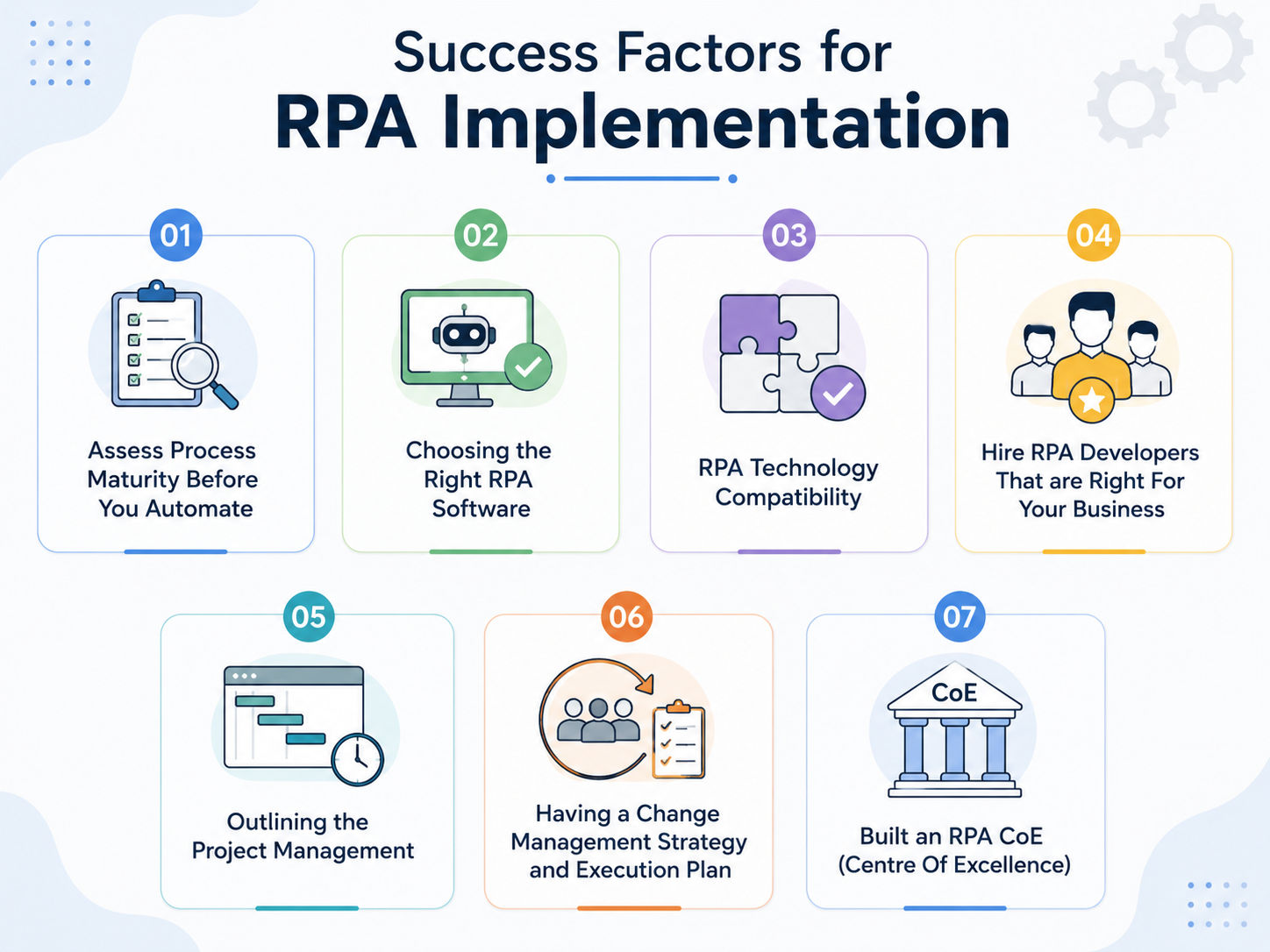
1. Assess Process Maturity Before You Automate
Not all processes are suitable for RPA automation. RPA produces the best ROI when implemented on processes that are labor-intensive, repetitive, rule-based, and have a limited number of process exceptions.
RPA is a considerable choice for defined, mature, repetitive, and data-heavy processes.
So, to assess if the process is a potential choice for RPA, process maturity and RPA readiness assessments need to be done before robotic process automation execution. To achieve this, ensure the RPA business case and target ROIs are already lined up before performing the process maturity and RPA readiness assessment.
The process maturity and RPA readiness assessment outcome will provide a vetted list of RPA processes. Moreover, the assessment can also identify a second tier of potential RPA processes, where small process redesign or standardization is needed before being automated.
This lets organizations eliminate several redundancies before implementing RPA while ensuring greater efficiency of implemented robots, along with a different number of exceptions and potential errors.
So, if an extensive RPA program is being implemented, it’s advisable to start by automating the most accessible processes. The knowledge and experience acquired from implementing the easy process first can then be used to automate the more complex processes.
2. Choosing the Right RPA Software
There's no shortage of RPA software in the market today, but not all of them are built equal.
So, picking the right Robotic Process Automation software is crucial as it serves as your business automation platform where you create your processes. Besides, consider the solution's scalability, product features roadmap, and AI potential.
Don’t Fall Prey To - The software products with definite capabilities and roadmap mostly work like a macro, though marketing themselves as an RPA solution.
An RPA software with good product features and scalability would allow you to create more efficient processes with minimal human interaction and stability for rolling out RPA enterprise-wide.
Besides, when RPA software is combined with a strong product roadmap focusing on AI technology, you can scale up to cognitive RPA and other AI aspects. Choosing poorly here doesn't just slow you down. It can mean scrapping everything and starting from scratch.
3. RPA Technology Compatibility
Choosing an RPA platform isn't just about features; it also has to actually work within your existing environment.
On the usability side, most modern RPA software is designed to be intuitive. But don't just take the vendor's word for it; have non-IT team members actually sit with the process design and configuration interface. If your operations manager can't figure out how to monitor a bot without calling in a developer every time, that's a problem.
The better RPA platforms come with a control room, a central dashboard where you can schedule robot tasks, track performance, and get alerted the moment something goes wrong. It flags which bots failed and exactly where the breakdown happened, so your team isn't left guessing.
Beyond monitoring, look for user access controls and detailed audit logs for every robot.
4. Hire RPA Developers That are Right For Your Business
Most companies don’t have a dedicated team of RPA developers to help businesses successfully establish a Robotic Process Automation process, and that is why businesses and companies look for experienced RPA developers.
Therefore, the key to choosing the right RPA resources is to analyze whether it jells with the organization or not. Below are the parameters you should consider:
-
The RPA experts should understand your industry and process areas being considered for RPA. It sounds simple, but most implementation partners will say they have experience in a spectrum of industries and processes, which might not necessarily be the case.
-
Organizations should check for social proof and ask potential RPA consultants for RPA-specific client references similar to your business vertical. Ideally, the implementation partner has already worked with the organization and understands the business, processes, and information systems.
-
Considering the size of the RPA implementation program, it’s equally crucial for clients to choose a partner who builds, tests, and deploys RPA solutions within the timeframe. Businesses and organizations should ensure that potential RPA implementation partners can address the deliverable challenge within the timeline.
Keep the expectations and final deliverables clear before choosing an RPA developer.
5. Outlining the Project Management
Whether RPA implementation is a small-scale project or a large-scale program, project governance and management practices are imperatives for successful implementation.
So, the primary step is to build a project management team and define the governance structure for RPA. Also, ensure the team includes the key personnel from the relevant business units, IT and project management professionals.
Next, secure executive and process owner buy-in. This will determine the goals of the RPA program, like minimizing person-hours and costs or improving the efficiency or quality of work performed. After all, defining the main objective of the RPA program will help determine the RPA business case and ROI (Return On Investment). Besides, establish the rating process that is to be used in the maturity process and RPA readiness assessment.
Once the project management team and RPA program goals are established, it's easy to develop an RPA implementation plan.
6. Having a Change Management Strategy and Execution Plan
“Change management” is a critical element defining the success of any significant transformation. This approach helps in ensuring that organizations are capable of adapting to change.
Especially for RPA, the change is big, and it hits the core of an organization, leading people to fear that RPA will start to take over the workplace. This eventually causes resistance to change.
So, a good change management strategy and execution plan aligned to your corporate culture will help employees better understand change and their roles and responsibilities after the difference in the long run. Also, it will help ease this tension and simultaneously create a smooth adoption of RPA and future AI in the organization.
This is also where working with a trusted RPA consultant pays off. Someone who has been through multiple RPA transformations can bring real-world success stories to the table, address employee concerns with credibility, and act as a steady partner through the transition.
7. Built an RPA CoE(Centre Of Excellence)
COE is a central group that manages RPA deployment across the enterprise.
Simply put, CoE ensures you leverage the most out of your human-and-bot workforce.
The COE group consists of IT professionals, process managers, citizen developers, functional experts, and representatives from different verticals of the organization. Depending on the governance model, there might be strict authority over all RPA initiatives or even shared governance responsibilities with respective business units. In either case, the CoE integrates standards and best practices, providing leadership and technical expertise to ensure the enterprise gets the most out of its RPA investment.
Usually, in organizations, RPA starts as a Proof of Concept (POC), but when a CoE comes into the picture, it can shoulder a lot of responsibilities, like:
-
Aligning the requirements and objectives of all stakeholders
-
Providing RPA services and support
-
Integrating RPA standards, processes, and best practices
-
Building an enterprise-wide RPA strategy
-
Offering centralized RPA governance
-
Managing RPA change management from business as well as technical perspectives
-
Educating and training employees on RPA skills
Finally… RPA is growing exponentially!
RPA is no longer an emerging technology that organizations are cautiously experimenting with. Rather, it's a proven, mainstream business tool that is growing faster than ever in 2026.
Companies across every industry are finding new ways to deploy automation across business units and processes, pushing for greater precision, efficiency, and speed. The question is no longer "should we adopt RPA?
And that's exactly the point. If executed properly, RPA helps seamlessly transform how businesses operate, and if not done right, it's simply a waste of time.
Therefore, businesses must take time to evaluate the technology and hire RPA developers with genuine and hands-on experience. Choosing the right professional RPA consulting services from the beginning helps you easily figure out things as you go.

By Mangesh Gothankar


By Ashwani Sharma
By Achin Verma
Frequently Asked Questions

They help figure out which processes make sense to automate, which platform fits your setup, and how to actually get it running without chaos. A lot of businesses don't realize how much happens after the bots go live, monitoring, fixing edge cases, and scaling up. That's where solid RPA consulting services really prove their worth.
Most companies pick the software first and regret it later. An RPA consultant helps you step back and look at the bigger picture, what's worth automating, what isn't, and what the realistic outcomes look like. That kind of clarity at the start saves a lot of backtracking down the road.
Short answer: anywhere from a few weeks to a full year. One simple process with clean data behind it? You could have something running in three to four weeks. In most cases, the technology isn't what slows things down. It's internal readiness, getting the right people aligned and processes documented properly.
No, RPA handles tasks that follow a clear, repeatable pattern, with the same steps every time. AI comes in when there's judgment involved, like reading an unstructured document or flagging something unusual in a dataset.








 4.8 out of 5 by