The digital software landscape has entered a new phase of evolution, and what began as an accelerated transformation during COVID is now the long-term growth strategy. As we live in 2026, businesses are no longer experimenting with digital solutions; rather, they are integrating them into day-to-day processes to engineer future-ready systems. The long term strategy focuses on scalability, resilience, and, of course, automation.
The global custom software development market is projected to grow from around $50.9 billion in 2025 to over $61 billion in 2026, and is expected to expand to approximately $375 billion by 2035, at a CAGR of 22%.
Cloud native architectures, API based development, backend systems, and more are now being adopted and are clearly transforming how modern applications are built. The traditional tools and processes often fall behind when it comes to flexibility, performance, and data control; the need for custom software solutions becomes a strategic need, rather than a luxury.
In this blog, we explore how custom software is helping businesses build future-ready systems, stay competitive, and scale efficiently in an increasingly digital-first world.
What are Custom Software Solutions?

Custom software solutions are applications that are built for unique business purposes. Yes, unlike the generic applications, they are off-the-shelf software solutions, customized to the unique needs of business and align precisely with their business objectives, workflow, customer expectations, and the ultimate goals.
Businesses are adopting custom software solutions that can support remote operations, ensure data-driven decision-making, and ensure security is taken care of. As system security and privacy are major concerns, organizations are choosing software that can seamlessly integrate with their existing system and offer them complete control over the information.
By investing in tailored solutions, companies gain greater flexibility, improved performance, and the ability to scale without technology limitations.
Companies are increasingly opting for custom software development over off-the-shelf solutions. Obtaining a competitive edge is really difficult in the new normal. But these tailored solutions are making work easier and helping take a step ahead.
Custom Software v/s Off-the-Shelf-Software
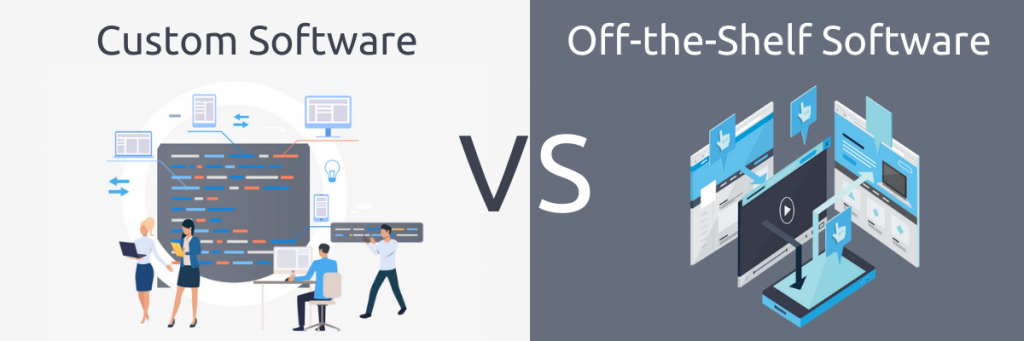
Custom software solutions are built to satisfy market demands. While off-the-shelf software allows a company to adapt to its expertise. You would realize what the best decision for your organization should be by learning the pros and cons of the app.
Today, the word "off-the-shelf" is a legacy from the times we had to go to the store to purchase software that was neatly packed in a box that we would select, carry to the counter, pay for, and then bring home to our machine to update. Here are the key differences you must know:
| Feature | Custom Software | Off-the-Shelf Software |
| Purpose | Built specifically for your business needs | Designed for mass-market use |
| Customization | Fully customizable and scalable | Limited or no customization |
| Time to Deploy | Longer initial development time | Quick to implement |
| Cost Structure | Higher upfront cost, lower long-term ROI risk | Lower upfront cost, ongoing license fees |
| Scalability | Scales seamlessly with business growth | Scaling often requires upgrades or add-ons |
| Integration | Easily integrates with existing systems | Integration may be limited or complex |
| Security | Higher security with controlled access | More vulnerable due to widespread use |
| Ownership | Full ownership and IP rights | Vendor-owned with usage restrictions |
| Maintenance & Updates | Managed as per business priorities | Controlled by the software vendor |
Types of Custom Software Development
- Fully Custom Software Development: The ones you build from scratch, according to the company’s needs or requirements.
- Modern Interface Applications: Pre-developed libraries or development codes, which are utilized by offshore software developers decrease repeat code and hence, focus on developing code that caters to specific business needs.
The Pros
Custom software is designed to address your business's unique needs, not the general needs of a broad user base. This means it can be easily modified, expanded, and maintained as your organization grows, giving you true operational flexibility.
Because it’s built for your exact processes, custom software can integrate seamlessly with your existing systems and teams. This fosters better collaboration across departments and reduces friction in data and workflow sharing, often leading to measurable improvements in productivity and decision-making.
Security remains a top priority for businesses in 2026. While no system is completely immune to threats, custom applications are less likely to be targeted by widespread attacks because they are unique and not used by many organizations. In contrast, generic off-the-shelf solutions, used by many companies, tend to attract attackers who exploit known vulnerabilities.
By combining tailored functionality with strong, business‑specific security practices, such as secure authentication, role‑based access control, and regular vulnerability assessments, custom software can help protect sensitive data and maintain the trust of your users and stakeholders.
The Cons
From being highly tailored to meet the requirements, it incurs a huge amount of time and money investment for the same. Off-the-shelf-software creators offer their products at a low price as their cost is distributed amongst many users.
But custom made applications are created for one user i.e. your company.
During the process, it is very common for offshore development centers to discover new needs and added costs, which earlier you assume to have been knowing them all.
Frequent changes can result in loss of project scope and a product that’s insufficient or different from what you originally intended.
Steps in Developing Custom Software
Follow the steps below to improve software quality and ensure your project stays on time, within budget, and aligned with business goals.
1. Analysing
To build anything, including software, it's critical to define your current process, your expectations and your measurement of success.
2. Understanding
Developing custom software solutions can be a challenging task. You can build one by taking the help of your internal IT team or by hiring a team of dedicated offshore developers on a contractual basis for the same or software development vendors and companies.
3. Outsourcing or In-house
Getting the work done in-house can be challenging to meet the ongoing and added new demands. Thus, hiring developers or companies who have successfully designed and implemented other software, are more advantageous.
4. Being Realistic & Timeline
It’s very important to be realistic while road mapping the project. To keep a track of the progress, the timeline is utmost. All this should be in-line with the fixed budget.
In case you need to launch your product (web or mobile app) early in the market, then having a team of extra hands can be helpful. So, adding new resources as the extension of your existing team can be the right approach.
You just have to look out for a reliable outsourcing partner, hire indian developers on-demand, and contract basis.
5. Testing
Before you implement the new software across your entire business, test it. Set up a team that will perform the testing of your software on multiple parameters; cross-browser compatibility, mobile usability, etc.
6. Documentation
Documentation is important for all stages of development and implementation.
Custom software solutions should appeal primarily to specific business needs. In order to get long-term benefits, it is the right option for all kinds of companies. But you can only get full benefits from using this service from a trusted organization.
Thus, it is very important to choose the right offshore software development center to get a high ROI.
Why do Startup, Established, Small and Large Companies Need Custom Development services?
- To improve your company’s visibility
- Better customer experience
- Escalating communication management in and outside the company
- Innovative advertising methods
- Increase sales
- Increase efficiency with less manpower
- Improved security and privacy
Let's Discuss in More Detail
The trend is clearly shifting from commercial to custom software solutions. Pandemic has amplified the need for the same. It has a necessity for companies to survive in today’s market with high risk and vulnerability.
The need to stand out from other companies or brands is now, more than ever. Also, what increases the demand for boutique software is the high risk of data on off-the-shelf-software and increasing fraud.
To maintain privacy, accountability, record, and security, there is no better option than this. It's because the custom software is made for in-house use only, thus lowering the risk.
New Era of Smart Custom Software
Smart software today goes beyond basic automation; it anticipates needs, adapts to user behavior, and integrates seamlessly across business operations.
To prepare for such uncertainty, companies are increasingly spending more on virtual comforts and accessibility, to remove hindrances from work in the present or the future.
The wise decision to take is to opt for custom software solutions since it can be customized to suit your business-focused requirements.
Yes, during the initial development process, you need to invest heavily. But it will certainly give you a great return on investment by introducing custom apps. To get the software solution, all you need to do is select a trusted and reputed company.
To choose the best custom software development company that understands your requirements preserves accountability in the market and offers expert after-sales support, you must have the basic technical expertise and do proper research.
So, if you want to boost your business growth without any stress with advanced tech solutions, then custom software solutions are your go-to thing.
Need some consultation for your project? Connect with us now to get a free quote.
Frequently Asked Questions

Custom software is designed specifically for your business processes, allowing companies to quickly pivot, scale, or integrate new features in response to market changes, without being constrained by off-the-shelf limitations.
Yes. While the upfront cost may be higher, custom software provides long-term ROI by automating workflows, reducing inefficiencies, and enabling faster growth, often paying for itself within the first few years.
Since it is built specifically for your organization, custom software has fewer vulnerabilities than generic products. Developers can implement tailored security protocols, encryption, and access controls, reducing the risk of cyberattacks.
Absolutely. Custom software can be built to seamlessly integrate with existing ERP, CRM, and other enterprise systems, ensuring smooth data flow and minimizing disruptions to ongoing business operations.







 4.8 out of 5 by