Most Angular job descriptions still screen for RxJS depth and NgModule experience. That made sense in 2022, but it filters the wrong candidates today.
Angular itself hasn't slipped. Stack Overflow's Developer Survey found 18.2% of developers working with it, second only to React. What moved is the framework. New Angular projects no longer ship zone.js, and since v22 the default change detection strategy is OnPush. The Angular team also publishes its own Agent Skills now, so agentic coding tools stop writing *ngIf into codebases that switched to @if two versions back.
Which means a candidate can list six years of Angular and still produce code your team ends up rewriting. So, to build interactive SPAs, PWAs, or Native Mobile Apps, you need the right AngularJS developers for your project. If you are wondering which skill sets you should look for while hiring your offshore AngularJS development team, this blog is for you.
Responsibilities of an Angular Developer
An Angular developer builds and maintains the front end of a web application using Angular. Their role is basically handling the process between design handoff and backend contract. This simply means most of the job is judgment about the structure, rather than writing markup.
Day to day, the work covers:
-
Breaking designs into reusable components that other developers can extend later without rewriting them
-
Consuming backend APIs, including the HTTP requests, error states, and loading behaviour that designers rarely specify in their design documents
-
Making state management calls, which increasingly means signals and signal-based stores instead of reaching for NgRx by default
-
Writing unit tests that survive CI, now against Vitest on any project started after v21
-
Reviewing pull requests and holding coding standards steady across the codebase
-
Diagnosing performance problems, from bundle size to change detection firing far more often than it needs to
-
Keeping the application on a supported Angular version
-
Building accessibility in rather than retrofitting it two weeks before launch
From the above-mentioned plan, it is easy to say that hiring a skilled Angular developer is critical to the success of your project. This brings us to our next section: how to hire highly skilled remote Angular developers to ramp up your project quickly.
12 Angular Developer Skills to Screen For in 2026
Screening criteria for Angular moved further in the last two release cycles than in the five years before them. The list below separates what any Angular developer should bring on day one from what tends to appear only with real project time behind it.
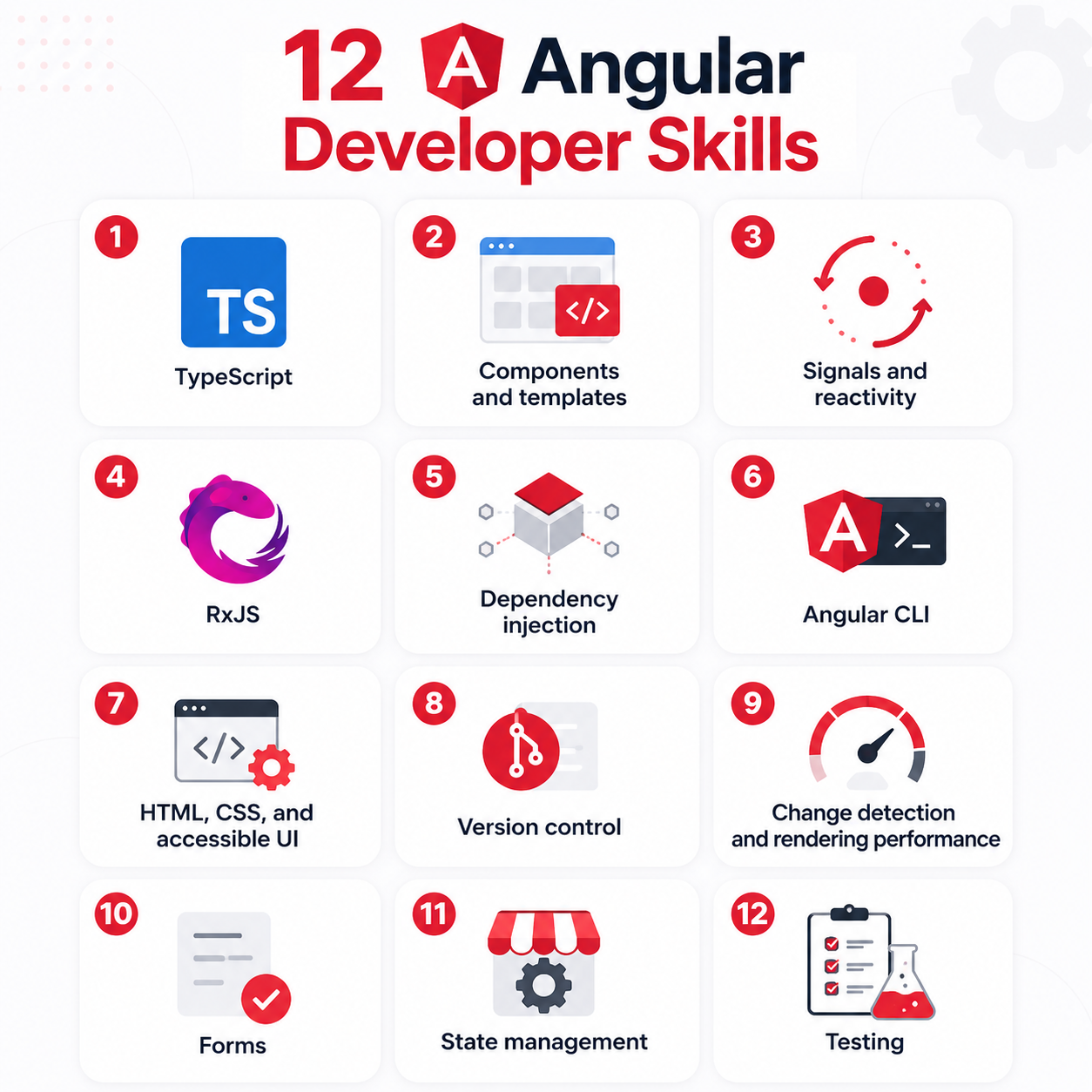
1. TypeScript
Angular is a TypeScript framework, and JavaScript sits underneath as assumed knowledge rather than the working programming language. Look for static typing habits: generics, strict null checks, typed API responses. A developer who annotates everything as any writes code that compiles cleanly and fails at runtime. Angular v22 requires TypeScript 6.
2. Components and templates
Standalone components are the default and NgModules are legacy. Built-in control flow (@if, @for, @switch) replaced the structural directives. Someone writing *ngIf in a code test is showing you which version of Angular they learned. Signal-based input(), output(), and model() should be familiar, along with sensible project structure for creating components other people can extend.
3. Signals and reactivity
The one that matters most. computed(), effect(), linkedSignal(), and the resource() API are the vocabulary of a modern Angular application. Useful screening question: how would they derive one piece of state from two others without an effect?
4. RxJS
Still needed for genuine data streams, debouncing, and coordinating async work, but no longer the default answer for component state. Reactive programming knowledge is a plus, and a candidate who reaches for BehaviorSubject to hold a boolean is signalling their last serious Angular project was several versions ago.
5. Dependency injection
inject() over constructor injection, plus providers, injection tokens, and hierarchical injectors. A solid understanding here separates developers who can structure an app from those who can only fill in components. Angular v22 added the @Service decorator and injectAsync for deferred loading.
6. Angular CLI
Beyond scaffolding, CLI tooling is how Angular projects stay current. ng update runs automated migrations between versions, and a developer who has never used it is a developer whose last team fell behind. Familiarity with the command line interface, schematics, and build configuration is baseline.
7. HTML, CSS, and accessible UI
Rendering still happens in HTML and CSS regardless of what the framework does above it. Angular Material covers most component needs, and Angular Aria reached stable in v22 for teams building their own design system. Accessibility should be part of how they build web apps, not a pre-launch audit.
8. Version control
Git fluency, including rebasing, resolving conflicts on a shared branch, and writing a pull request someone else can review. On collaborative projects, this affects delivery speed more than raw coding ability does.
9. Change detection and rendering performance
Zoneless is the default for new apps since v21, and OnPush is the default strategy since v22. A senior developer can explain why a component re-renders and fix it. This extends to server-side rendering and hydration on public-facing Angular applications where crawlability and Core Web Vitals matter.
10. Forms
Reactive forms remain everywhere in existing codebases. Signal Forms went stable in v22 and will show up in new work. Someone building dynamic forms with cross-field validation has done real product work rather than tutorials.
11. State management
Knowing when not to add a library is the skill. Signal-based stores handle a lot of what teams used to reach for NgRx to do. Ask what state management solutions they have used and, more revealingly, which one they later removed.
12. Testing
Vitest replaced Karma as the default runner in v21. Look for unit testing habits that survive CI rather than tests written to satisfy a coverage number, plus some component testing experience.
Skill Requirements for Angular Developer (Junior to Senior)
Job descriptions tend to list every skill under one heading, which is how teams end up paying senior rates for component work. Splitting expectations by band makes the tradeoff visible before you write the offer.
|
Junior (0–2 years) |
Mid-level (2–5 years) |
Senior (5+ years) |
|
TypeScript fundamentals, HTML, CSS |
Signal-based architecture, computed() and effect() used deliberately |
Application architecture across multiple Angular apps, often in an Nx monorepo |
|
Standalone components and built-in control flow |
RxJS operators for genuine async coordination |
Zoneless migration on existing codebases |
|
Reading and using signals in existing code |
inject(), injection tokens, hierarchical providers |
Server-side rendering, hydration, Core Web Vitals budgets |
|
Angular CLI scaffolding |
Reactive forms and Signal Forms, including cross-field validation |
Design system ownership using Angular Material or Angular Aria |
|
HttpClient basics and API consumption |
Routing with guards, resolvers, and lazy loading |
Build pipeline and continuous integration configuration |
|
Git branching and pull requests |
Change detection debugging under OnPush |
Upgrade strategy across major releases, including breaking changes |
|
Unit tests for their own components |
Judgement on state management, including when to skip a library |
Effectively setting AI tooling standards, such as which Angular agent skills the team installs |
|
Following existing project structure |
Accessibility as part of the build |
Mentoring, code review at scale, hiring input |
Soft Skills To Look For In Angular Developers
1. Communication
Communication doesn't just mean one's ability to speak in English, but also refers to their ability to understand technical briefs. Your Angular team should be able to break down the brief into smaller subsections and create a delivery timeline to meet the final goals. A lack of communication skills can lead to confusion, creating delays and quality issues in the project.
2. Empathy
Empathy is a crucial attribute for an Angular developer. An empathetic developer would consider your project as their own and would not hesitate to go beyond their work scope to deliver a quality product. Their empathy would also reflect in the way they code, as they would create cleaner code and proper documentation to ensure smooth maintenance of applications.
3. Team Player
Any development project, big or small, requires multiple resources like UI/UX designers, back-end developers, and QA to complete, so teamwork is a vital skill to look for in an Angular developer.
Now that you know the key skills to look for while hiring Angular developers, you are all set to build your Angular team for the next project.
4. Learning velocity
Angular ships a major release roughly every six months. A strong command of the current version decays into legacy knowledge within about two years unless someone keeps up deliberately. Ask what changed in the last release and what they think of it. Vague answers tell you they are coasting on what they learned once.
5. Judgement with AI tooling
New for 2026 and worth screening directly. Agentic coding tools now generate a meaningful share of Angular code, and the difference between developers is no longer whether they use them. It is whether they review the output. Someone with a deep understanding of the framework catches a hallucinated API immediately. Someone without one ships it. Ask how they set up their own environment and whether they have configured skills or instruction files for Angular development.
Experience the difference with our AngularJS development company. Harness the power of next-level web solutions to exceed your goals and surpass expectations!

Frequently Asked Questions (FAQs)

TypeScript, standalone components with built-in control flow, and signals for reactivity form the base. Beyond that, look for dependency injection using inject(), HttpClient work, reactive forms, and Vitest testing. RxJS still matters for genuine async coordination but no longer covers component state. Angular v22 requires TypeScript 6, so older TypeScript experience needs checking.
Yes. Stack Overflow's 2025 Developer Survey found 18.2% of developers working with Angular, up from 17.1% the previous year and second only to React. Demand concentrates in enterprise software development, where applications run for a decade or more and framework churn carries real cost.
They are separate frameworks. AngularJS reached end of life in January 2022 and receives no updates. Angular is the rewritten TypeScript version, currently at v22. A job description asking for AngularJS experience when it means Angular will filter out strong candidates and attract the wrong ones.
Give a small code test rather than quizzing on definitions. Useful signals: whether they reach for @if or *ngIf, how they derive state from two other values, and whether they can explain why a component re-rendered. Ask what changed in the last release, since a vague answer suggests they stopped tracking the framework.

By Mangesh Gothankar


By Ashwani Sharma
By Achin Verma






 4.8 out of 5 by